2002 Ford Think Neighborhood Electric Car Review Pros and Cons
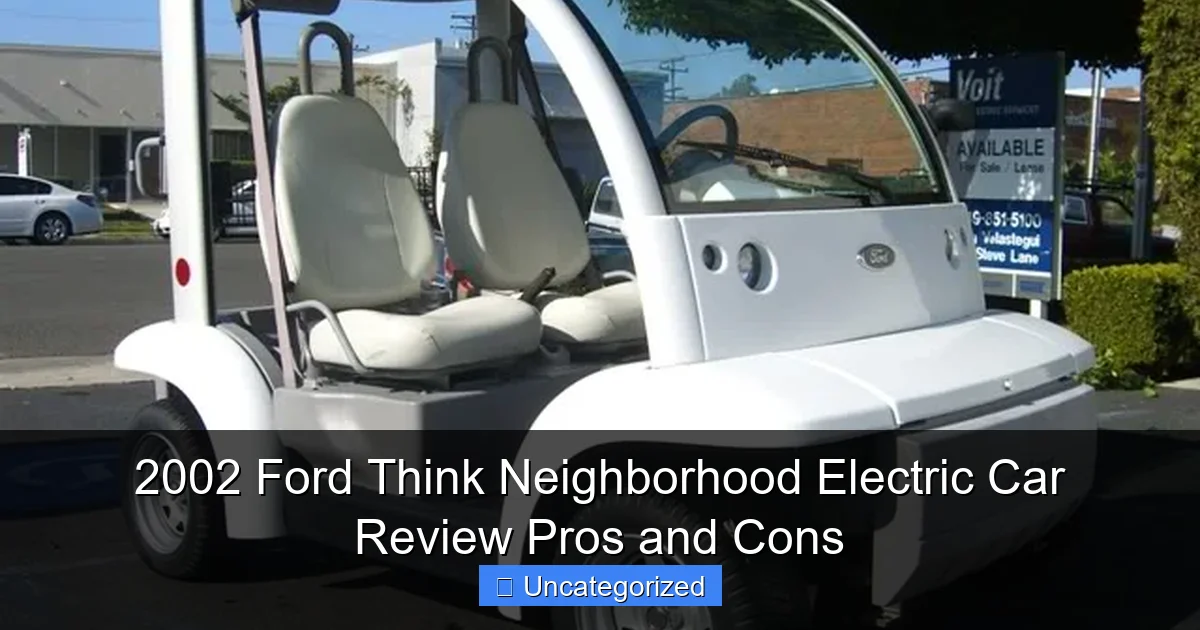
Featured image for 2002 ford think neighborhood electric car
Image source: imagehost.vendio.com
The 2002 Ford TH!NK Neighborhood Electric Car is a compact, eco-friendly commuter vehicle designed for short urban trips, offering zero-emission driving and low operating costs. With a top speed of 25 mph and a range of just 30–50 miles, it excels in efficiency but falls short for longer commutes or highway use. Ideal for eco-conscious city dwellers, its limited power and battery life highlight a trade-off between green innovation and practical versatility.
Key Takeaways
- Eco-friendly choice: Zero emissions make it ideal for short, urban commutes.
- Limited range: Only 30–50 miles per charge; plan trips carefully.
- Low speed: Top speed of 25 mph restricts use to neighborhoods.
- Affordable maintenance: Fewer moving parts reduce long-term repair costs.
- Battery lifespan: Replace every 3–5 years; factor in added expense.
- Compact design: Perfect for tight parking but lacks cargo space.
📑 Table of Contents
- The 2002 Ford Think: A Bold Step Into the Electric Future (That Never Fully Arrived)
- Origins and Development: From Norwegian Roots to American Ambitions
- Design and Features: A Quirky, Functional Package
- Performance and Practicality: The Trade-Offs of an Urban EV
- Market Reception and Legacy: Why the Think Failed (and What It Taught Us)
- Comparing the 2002 Think to Modern EVs: How Far We’ve Come
- Final Verdict: The 2002 Ford Think’s Pros and Cons
The 2002 Ford Think: A Bold Step Into the Electric Future (That Never Fully Arrived)
In the early 2000s, as the automotive world grappled with rising fuel prices and growing environmental concerns, Ford made a daring move: the launch of the 2002 Ford Think Neighborhood Electric Vehicle (NEV). This compact, all-electric car wasn’t designed for cross-country road trips or highway dominance. Instead, it targeted a niche yet forward-thinking market—urban commuters, campus shuttles, and eco-conscious drivers seeking a zero-emissions solution for short-range travel. With its quirky design, modest range, and bold promise of sustainability, the Think stood out as one of the first mass-produced electric vehicles from a major automaker in the modern era. But was it ahead of its time, or a misstep that foreshadowed the industry’s electric struggles?
The Think’s story is a fascinating case study in innovation, market timing, and the challenges of transitioning to electric mobility. While it didn’t achieve mainstream success, its legacy lives on in the EVs of today. From its unique Scandinavian origins to its abrupt discontinuation, the 2002 Think offers valuable lessons for anyone interested in the evolution of electric vehicles. In this review, we’ll dive deep into its performance, design, practicality, and the pros and cons that defined its short-lived career. Whether you’re a vintage car enthusiast, an EV pioneer, or just curious about automotive history, this is the definitive guide to Ford’s electric gamble.
Origins and Development: From Norwegian Roots to American Ambitions
The Scandinavian Genesis of the Think
The Ford Think didn’t start as a Ford project. Its story begins in Norway with Think Global, a company founded in 1991 with the mission of creating affordable, sustainable electric cars. The first prototype, the Think City, emerged in the mid-1990s, featuring a lightweight design and lead-acid batteries. By the late 1990s, the Think had gained traction in Europe, particularly in Scandinavia, where environmental policies favored zero-emission vehicles. Ford took notice and acquired a majority stake in Think Global in 1999, seeing it as a strategic foothold in the emerging EV market.
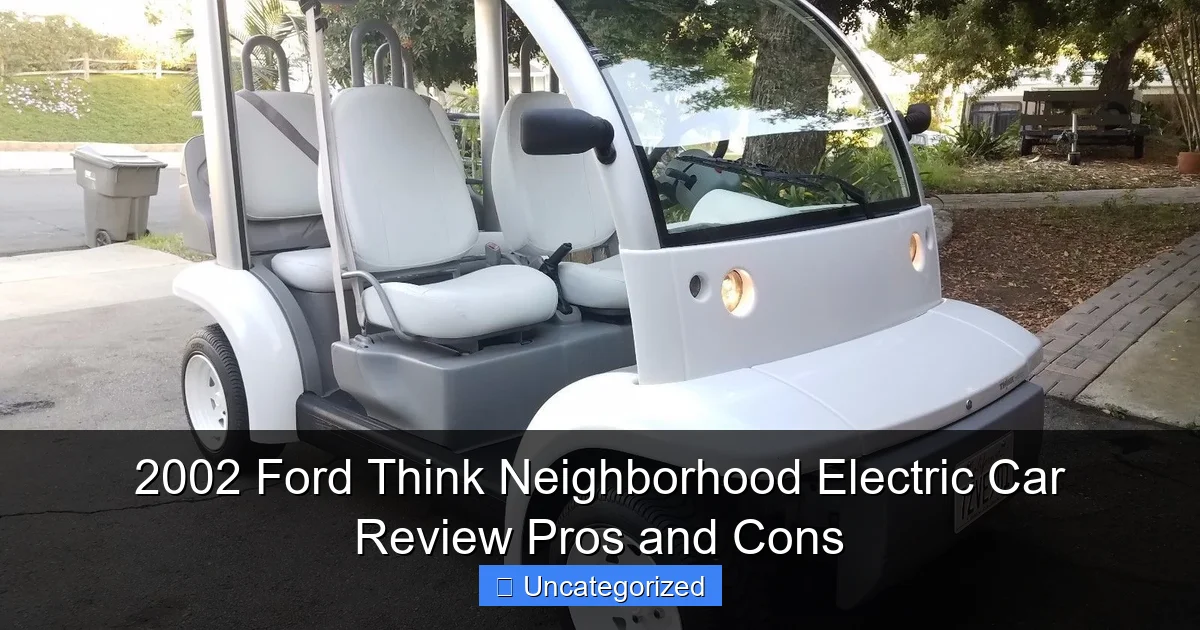
Visual guide about 2002 ford think neighborhood electric car
Image source: i.pinimg.com
Ford’s investment wasn’t just about technology—it was about timing. The 1990s saw a brief EV surge, with GM’s EV1 and Toyota’s RAV4 EV hitting the market. Ford wanted to avoid being left behind. The 2002 Think, based on the Think City platform, was Ford’s answer: a refined, Americanized version of the Norwegian original. It featured improved battery technology, a sturdier chassis, and a design tweaked for U.S. safety standards. But the core idea remained unchanged: a small, efficient EV for urban use.
Why the U.S. Market Was a Double-Edged Sword
Ford’s decision to launch the Think in the U.S. was both bold and risky. On one hand, the U.S. had the largest automotive market in the world, with growing interest in eco-friendly alternatives. On the other hand, American drivers were (and still are) deeply attached to long-range, high-performance vehicles. The Think’s limited 50-mile range and 25 mph speed cap (to comply with NEV regulations) were major hurdles.
For example, in California—a key EV market—the Think qualified for zero-emission vehicle (ZEV) credits, which incentivized automakers to produce EVs. This gave Ford a financial boost, but it also created a perception that the Think was more of a compliance car than a genuine innovation. Meanwhile, in cities like Portland or Seattle, where short commutes and green policies were common, the Think found a niche. But for most Americans, it was simply too limited for daily use.
Design and Features: A Quirky, Functional Package
Exterior: Compact, Lightweight, and Unmistakable
The 2002 Think’s design was undeniably unique. With its boxy silhouette, rounded edges, and large greenhouse windows, it looked like a cross between a city car and a futuristic pod. Measuring just 12.5 feet long and weighing around 1,800 pounds (with lead-acid batteries), it was designed for agility and efficiency. The lightweight plastic body panels reduced weight and corrosion, while the large windows provided excellent visibility—a boon for urban driving.
One standout feature was the rear-hinged “suicide” doors, which opened wide for easy access to the rear seats. This design, borrowed from the original Think City, was both practical and eye-catching. However, it also drew criticism for safety concerns, particularly in crowded parking lots. The Think’s compact size made it perfect for tight city spaces, but its lack of a trunk (storage was limited to a small rear hatch) was a drawback for practicality.
Interior: Minimalist and Functional
Inside, the Think embraced a minimalist approach. The dashboard was simple, with analog gauges for speed, battery charge, and energy use. The seats were basic but comfortable, with cloth upholstery and limited adjustability. The rear bench could fit two adults, though legroom was tight. Storage options were sparse: a glove compartment, door pockets, and the rear hatch.
The real star of the interior was its visibility and ease of use. The high seating position and large windows made it easy to see traffic and pedestrians, while the simple controls required little learning curve. However, the lack of amenities—no air conditioning (in early models), no power windows, and no infotainment—felt dated even in 2002. For drivers accustomed to modern conveniences, the Think was a step back.
Technology and Safety: Ahead of Its Time (But Not Enough)
The Think’s technology was a mix of innovation and compromise. Its electric motor (rated at 32 kW) and lead-acid batteries provided a smooth, quiet ride, but the range was limited to 50 miles on a full charge. Later models introduced nickel-cadmium (Ni-Cd) batteries, which improved range slightly (up to 60 miles) and durability. Charging took 6–8 hours via a standard 110V outlet—a process that was simple but time-consuming.
Safety features were minimal by modern standards but included dual airbags, ABS brakes, and a steel frame. The Think also had regenerative braking, which helped recharge the batteries during deceleration. However, its lightweight design raised concerns about crash safety, especially in collisions with larger vehicles. The 25 mph speed cap (due to NEV regulations) limited its use to city streets, but it also made it less appealing to drivers who needed higher speeds.
Performance and Practicality: The Trade-Offs of an Urban EV
Range and Charging: The Biggest Limitations
The 2002 Think’s 50-mile range was its Achilles’ heel. While sufficient for short commutes (the average American drive is 25 miles daily), it fell short for anything beyond city limits. For example, a driver in Los Angeles could use the Think for daily errands but couldn’t rely on it for a trip to Santa Monica (30 miles round-trip) without careful planning. The lack of public charging infrastructure in 2002 made range anxiety a real issue.
Charging was another hurdle. The Think’s onboard charger worked with standard outlets, but a full charge took 6–8 hours. This meant overnight charging was essential, which wasn’t practical for drivers with irregular schedules. Later models with Ni-Cd batteries charged slightly faster, but the process was still slow by today’s standards. Tip: Early owners often used timers to start charging during off-peak electricity hours, saving money on utility bills.
Driving Experience: Smooth but Slow
The Think’s electric motor delivered instant torque, making it surprisingly zippy in city traffic. Acceleration from 0 to 25 mph was brisk, and the car handled well in stop-and-go conditions. However, its 25 mph speed cap meant it couldn’t keep up on highways or even many suburban roads. The suspension was tuned for comfort, absorbing bumps better than most small cars of the era, but the lightweight design made it feel unstable at higher speeds.
The driving experience was quiet—almost eerily so. Without engine noise, the Think’s cabin was peaceful, but it also made pedestrians less aware of its presence. Ford addressed this with a warning chime at low speeds, a feature now standard in modern EVs. The steering was light and responsive, making parking a breeze, but the lack of power assist (in some models) could be tiring in heavy traffic.
Real-World Use Cases: Where the Think Shined (and Struggled)
The Think excelled in specific scenarios:
- Urban Commuting: For short trips (under 25 miles), the Think was perfect. Its small size, zero emissions, and low operating costs made it ideal for city dwellers.
- Campus and Facility Use: Universities, corporate campuses, and industrial parks used the Think as shuttle vehicles. Its quiet operation and compact size were well-suited for these environments.
- Eco-Conscious Drivers: Early adopters who prioritized sustainability over convenience embraced the Think as a statement of their values.
However, it struggled in others:
- Suburban Families: The lack of a trunk and limited range made it impractical for errands or school runs.
- Highway Drivers: The 25 mph speed cap ruled out most highway use, limiting its appeal to rural or suburban drivers.
- Long-Term Ownership: Battery degradation (common in lead-acid and Ni-Cd systems) reduced range over time, making older models less reliable.
Market Reception and Legacy: Why the Think Failed (and What It Taught Us)
Sales and Ownership Challenges
The 2002 Think’s sales were modest at best. Ford initially planned to sell 2,000 units in the U.S. but fell far short, with estimates suggesting only 500–1,000 were delivered. High upfront costs (around $20,000, compared to $15,000 for a comparable gasoline car) and limited incentives (outside California) deterred buyers. Maintenance was another issue: lead-acid batteries needed frequent replacement (every 2–3 years), and specialized repair shops were scarce.
Ownership stories reveal a mixed bag. Some drivers loved the Think’s simplicity and eco-friendliness, while others found it impractical. One owner in Seattle praised its “perfect fit for city life,” but a family in Texas called it “a novelty that didn’t last.” The lack of a strong dealer network for repairs also hurt its reputation.
The End of the Road: Ford’s Abandonment and the Think’s Afterlife
By 2003, Ford had lost interest in the Think. The company faced financial struggles and shifted focus to hybrid technology (leading to the Escape Hybrid in 2004). Think Global filed for bankruptcy, and Ford sold its stake. The remaining Thinks were either scrapped or sold to niche buyers. A second attempt to revive the Think in the mid-2000s (with lithium-ion batteries) also failed.
Despite its commercial failure, the Think’s legacy endured. It proved that:
- EVs could be practical for short-range use.
- Consumer education was critical—many buyers didn’t understand NEVs’ limitations.
- Infrastructure (charging, repairs) was as important as the cars themselves.
Today, the Think is a cult classic among EV enthusiasts. Its lessons paved the way for modern EVs like the Nissan Leaf and Tesla Model 3, which addressed its shortcomings with longer range, faster charging, and better amenities.
Comparing the 2002 Think to Modern EVs: How Far We’ve Come
To appreciate the Think’s place in history, let’s compare it to a modern EV like the 2023 Nissan Leaf S. The table below highlights the key differences:
| Feature | 2002 Ford Think | 2023 Nissan Leaf S |
|---|---|---|
| Range | 50 miles (lead-acid) | 149 miles (40 kWh battery) |
| Top Speed | 25 mph (NEV-limited) | 89 mph |
| Charging Time | 6–8 hours (110V) | 7.5 hours (240V) or 30 min (DC fast charge) |
| Battery Type | Lead-acid or Ni-Cd | Lithium-ion |
| Price (New) | $20,000 (est.) | $27,400 |
| Features | No AC, no power windows | AC, infotainment, advanced safety |
The progress is staggering. Modern EVs offer 3x the range, faster charging, and a host of amenities the Think lacked. But the core idea—a compact, efficient EV for urban use—remains unchanged. The Think was a pioneer, but today’s EVs are the refined heirs of its vision.
Final Verdict: The 2002 Ford Think’s Pros and Cons
The 2002 Ford Think was a bold experiment that fell short of mainstream success. Yet, its strengths and weaknesses offer valuable insights for today’s EV market.
Pros:
- Zero Emissions: A true eco-friendly option for short-range driving.
- Low Operating Costs: Electricity was cheaper than gas, and maintenance was minimal (no oil changes, exhaust systems, etc.).
- Compact and Agile: Perfect for city driving and tight parking spots.
- Quiet Operation: A peaceful ride with no engine noise.
Cons:
- Limited Range: 50 miles was insufficient for most drivers.
- Slow Charging: No fast-charging options in 2002.
- High Upfront Cost: Priced higher than comparable gasoline cars.
- Lack of Features: No AC, power windows, or modern amenities.
- Speed Cap: 25 mph restricted its use to city streets.
The Takeaway: The 2002 Think was a visionary car trapped in the wrong era. Its limitations were less about engineering and more about market readiness. For collectors and enthusiasts, it’s a fascinating piece of automotive history. For the rest of us, it’s a reminder of how far EVs have come—and how much further they can go. The Think didn’t change the world, but it planted the seed for the electric revolution that’s now in full swing.
Frequently Asked Questions
What is the 2002 Ford Think Neighborhood Electric Car?
The 2002 Ford Think Neighborhood Electric Car (NEV) is a compact, battery-powered vehicle designed for short-distance urban travel, with a top speed of 25 mph and a range of up to 30 miles per charge. It was Ford’s attempt to enter the low-speed electric vehicle market, targeting eco-conscious drivers in gated communities or city centers.
What are the key pros and cons of the 2002 Ford Think NEV?
Pros include zero emissions, low operating costs, and easy maneuverability in tight spaces. Cons are its limited range, slow charging time (8–12 hours), and lack of safety features compared to full-sized vehicles.
How long does the battery last on a 2002 Ford Think electric car?
The original lead-acid batteries typically last 2–3 years or 15,000–20,000 miles, depending on usage and maintenance. Replacement batteries can be costly, but newer lithium-ion upgrades are available for improved performance.
Can the 2002 Ford Think be driven on public roads?
Yes, but only on roads with speed limits of 35 mph or lower, as it’s classified as a low-speed vehicle (LSV) under federal regulations. Always check local laws, as some states require additional safety equipment like seat belts or turn signals.
What is the top speed of the 2002 Ford Think Neighborhood Electric Car?
The 2002 Ford Think NEV has a top speed of 25 mph, making it ideal for neighborhood commutes but unsuitable for highways or high-speed roads. Its speed is electronically limited to comply with LSV regulations.
Is the 2002 Ford Think electric car reliable?
While simple in design, the 2002 Ford Think can be reliable if well-maintained, but aging components like batteries and wiring harnesses may require frequent repairs. Enthusiasts often recommend thorough inspections before purchasing a used model.