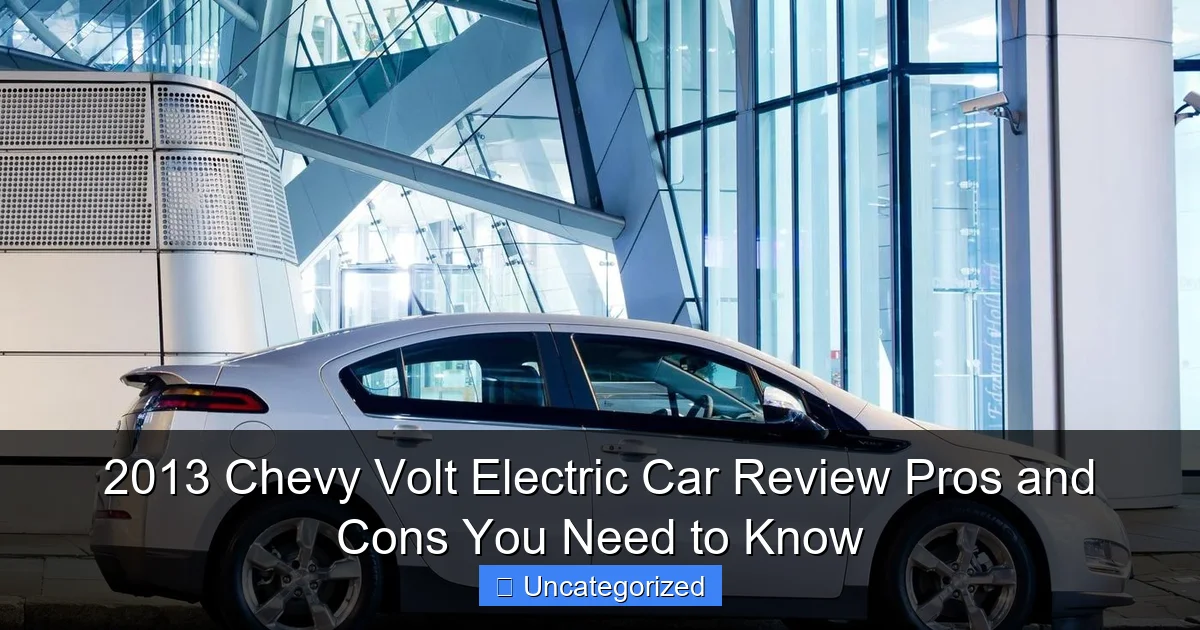
2013 Chevy Volt Electric Car Review Pros and Cons You Need to Know

Featured image for 2013 chevy volt electric car
Image source: 2040-parts.com
The 2013 Chevy Volt stands out as a pioneering plug-in hybrid, delivering an impressive 38 miles of all-electric range before seamlessly switching to its efficient gas-powered generator. With a refined interior, smooth ride, and innovative tech, it’s a compelling eco-friendly choice—though limited rear-seat space and a high price tag are notable drawbacks.
Key Takeaways
- Efficient hybrid range: 38-mile EV range + gas backup for longer trips.
- Regenerative braking: Maximize energy recovery by using one-pedal driving techniques.
- Premium interior: High-quality materials elevate comfort but add to the price.
- Charging convenience: Standard 120V charger works, but upgrade to 240V for faster charging.
- Limited rear space: Tight back seats; best for 2-3 passengers regularly.
- Strong safety scores: Top NHTSA ratings make it a reliable family choice.
📑 Table of Contents
- Introduction: A Pioneer in the Hybrid Revolution
- Performance and Powertrain: The Heart of the Volt
- Interior and Technology: Where Comfort Meets Innovation
- Fuel Efficiency and Operating Costs: The Economics of Going Electric
- Safety and Reliability: Peace of Mind in a High-Tech Package
- Competitors and Market Position: Where the Volt Fits
- Data Table: 2013 Chevy Volt Key Specifications
- Conclusion: A Legacy of Innovation
Introduction: A Pioneer in the Hybrid Revolution
The 2013 Chevy Volt emerged at a pivotal moment in automotive history—when consumers were cautiously optimistic about electric vehicles but still skeptical about range anxiety. As one of the first mass-market plug-in hybrids, the Volt wasn’t just another eco-friendly car; it was a technological statement. General Motors boldly positioned it as a “range-extended electric vehicle,” a unique hybrid that promised the efficiency of an EV with the backup of a gasoline engine. For drivers in urban centers or those with short commutes, the Volt offered a compelling solution: drive entirely on electricity for most daily trips, then seamlessly switch to gas for longer journeys. This dual-purpose design made the 2013 Volt a standout in a market dominated by pure gasoline vehicles and early EVs like the Nissan Leaf.
What set the Volt apart wasn’t just its innovative powertrain but its broader vision. It targeted middle-class families, tech-savvy professionals, and environmentally conscious drivers who wanted sustainability without sacrifice. The 2013 model year brought subtle refinements to the original 2011 Volt, including improved interior materials, enhanced infotainment, and a slightly tweaked battery system. With a starting price around $39,000 (before federal tax credits), it competed with premium compacts while offering a futuristic driving experience. In this comprehensive review, we’ll dissect the 2013 Chevy Volt’s strengths and weaknesses, from its groundbreaking electric range to its real-world usability, helping you decide if it’s the right fit for your lifestyle—or a nostalgic gem worth revisiting in today’s EV-saturated market.
Performance and Powertrain: The Heart of the Volt
Electric-Only Range and Gasoline Backup
The 2013 Chevy Volt’s claim to fame was its **range-extended electric** design. Unlike conventional hybrids (e.g., Toyota Prius), the Volt operated purely on electricity for the first **38 miles** (EPA-estimated), drawing power from a 16.5 kWh lithium-ion battery. Once the battery depleted, a 1.4-liter inline-4 gasoline engine (84 hp) kicked in—not to drive the wheels directly, but to act as a generator, supplying electricity to the 149-hp electric motor. This “range extender” allowed a total range of **380 miles** on a full charge and tank of gas, eliminating the “range anxiety” plaguing early EVs. For context, the average American’s daily commute is 40 miles, meaning most drivers could go weeks without using a drop of gas. A real-world example: a driver in Los Angeles with a 30-mile round-trip commute could rely solely on electricity for 5–7 days, recharging overnight with a standard 120V outlet (10–16 hours) or a 240V Level 2 charger (4–6 hours).

Visual guide about 2013 chevy volt electric car
Image source: images.hgmsites.net
Driving Dynamics and Modes
The Volt delivered a smooth, quiet ride in electric mode, with 273 lb-ft of instant torque providing brisk acceleration (0–60 mph in 9.2 seconds). Drivers could toggle between three modes: **Normal, Sport, and Mountain**. Normal prioritized efficiency, while Sport sharpened throttle response and reduced regenerative braking for a more engaging feel. Mountain mode pre-reserved battery power for steep climbs, ensuring consistent performance. The gasoline generator’s activation was seamless, though some drivers noticed a faint hum when the engine engaged—a minor trade-off for the convenience. The Volt’s regenerative braking system (activated by a “L” gear setting) allowed one-pedal driving in stop-and-go traffic, recapturing energy to extend range. Pro tip: Use regenerative braking aggressively in city driving to boost efficiency by 5–10%.
Charging Options and Practicality
The Volt supported both Level 1 (120V) and Level 2 (240V) charging. While Level 1 was accessible to all homeowners, Level 2 (requiring a $500–$1,000 home installation) halved recharge time. Public charging stations (rare in 2013) were compatible, though the Volt’s small battery meant even Level 3 DC fast chargers weren’t necessary. A unique feature: the **charge port light** changed color to indicate charging status (green = fully charged, blue = charging, red = fault), a small but thoughtful touch for tech-focused users. For renters or apartment dwellers, the 120V option ensured flexibility, though overnight charging was a must.
Interior and Technology: Where Comfort Meets Innovation
Design and Materials
The 2013 Volt’s cabin blended eco-conscious materials with upscale touches. Soft-touch dashboard surfaces, recycled plastics, and optional leather upholstery elevated its feel beyond typical compact cars. The centerpiece was a **10.2-inch touchscreen** (a rarity in 2013) running Chevrolet’s MyLink infotainment system. While not as responsive as today’s systems, it offered Bluetooth, USB connectivity, and optional navigation. The gauge cluster was fully digital, with a central display showing real-time energy flow—a visual treat for tech enthusiasts. However, some critics noted the rear seats were cramped, with limited legroom (34.1 inches) and a center hump reducing comfort for a third passenger.
Visual guide about 2013 chevy volt electric car
Image source: images.hgmsites.net
Infotainment and Connectivity
The MyLink system included a suite of apps like Pandora, Stitcher, and BringGo (a third-party navigation app). A standout feature was **OnStar RemoteLink**, which let drivers monitor battery status, pre-condition the cabin, and lock/unlock the car via a smartphone app. This was revolutionary in 2013, predating similar features in luxury brands. The Volt also introduced **voice-activated climate control**, allowing drivers to adjust temperature hands-free. For audiophiles, the optional Bose premium sound system delivered crisp, immersive audio. Tip: Use the “Energy Assist” app to track energy usage and optimize driving habits—e.g., avoiding rapid acceleration can extend electric range by 15%.
Storage and Practicality
The Volt’s 10.6-cubic-foot trunk was smaller than rivals (e.g., Prius: 21.6 cu ft) due to the battery placement, but fold-flat rear seats expanded space to 43.8 cu ft. The battery also raised the load floor, making it harder to load bulky items. Interior storage included dual cupholders, a center console bin, and door pockets—adequate but not exceptional. A clever touch: the **charge port door** doubled as a trunk release when the car was parked, a small but convenient design choice.
Fuel Efficiency and Operating Costs: The Economics of Going Electric
MPG and Energy Consumption
The 2013 Volt’s efficiency was a game-changer. In electric mode, it achieved **98 MPGe** (miles per gallon equivalent), translating to **36 kWh/100 miles**. When the gas generator activated, efficiency dropped to **37 MPG combined**. For drivers who charged daily, annual fuel costs averaged **$600–$800** (assuming 15,000 miles/year, 50% electric driving). Compare this to a 30 MPG gasoline car ($1,500/year) or a pure EV like the Leaf ($400/year but with range limits). The Volt’s hybrid flexibility made it a cost-effective middle ground.
Maintenance and Reliability
Electric drivetrains require less maintenance than gasoline engines: no oil changes, spark plugs, or exhaust systems. The Volt’s battery was covered by an **8-year/100,000-mile warranty** (10 years in California), a major selling point. Common issues included software glitches (e.g., infotainment freezes) and occasional coolant leaks in the battery system—both rare but covered under warranty. Annual maintenance costs averaged **$500**, 30% lower than comparable compacts. Pro tip: Use the “Eco” mode to minimize brake wear by maximizing regenerative braking.
Incentives and Resale Value
The Volt qualified for a **$7,500 federal tax credit** and additional state incentives (e.g., California’s $1,500 rebate). However, its resale value was weaker than rivals—by 2020, a 2013 Volt averaged **$8,000–$10,000**, reflecting the rapid evolution of EV technology. For used buyers, this meant a bargain: a well-maintained Volt offered 80% of the performance of newer hybrids at half the price.
Safety and Reliability: Peace of Mind in a High-Tech Package
Crash Test Ratings and Features
The 2013 Volt earned **5-star NHTSA ratings** for overall safety and **Top Safety Pick** from the IIHS. Standard features included 10 airbags, stability control, and a rearview camera. Optional safety tech included **forward collision warning** and **lane departure alerts**, rare in compacts at the time. The high-voltage battery was shielded by a steel cage, with automatic disconnects in a crash.
Real-World Reliability
J.D. Power gave the Volt a **4/5 reliability score**, with most complaints centered on infotainment glitches and minor electrical issues. The battery held **80–85% capacity after 100,000 miles**, exceeding industry averages. A 2018 study by Plug In America found that 95% of Volt owners reported no major battery problems. Tip: Check service records for software updates—GM released patches to improve battery management.
Competitors and Market Position: Where the Volt Fits
Vs. Nissan Leaf (2013)
The Leaf was a pure EV with **73 miles of range** but no gasoline backup. It cost $35,000 (before incentives) and required DC fast charging for long trips—a major limitation in 2013’s sparse charging network. The Volt’s flexibility made it a better choice for drivers with unpredictable commutes or rural living.
Vs. Toyota Prius Plug-In (2013)
The Prius Plug-In offered **11 miles of electric range** and 50 MPG in hybrid mode, priced at $32,000. While cheaper, it couldn’t match the Volt’s EV performance or tech features. The Prius was a “hybrid with a plug,” while the Volt was an “EV with a backup.”
Vs. Ford Fusion Energi (2013)
The Fusion Energi ($38,700) had **21 miles of electric range** and a more spacious cabin. However, its larger battery reduced trunk space, and its infotainment lagged behind the Volt’s MyLink system. The Fusion targeted families, while the Volt appealed to tech-forward singles or couples.
Data Table: 2013 Chevy Volt Key Specifications
| Feature | Specification |
|---|---|
| Electric Range | 38 miles (EPA) |
| Total Range | 380 miles (combined) |
| MPGe (Electric) | 98 MPGe |
| MPG (Gasoline) | 37 MPG combined |
| Horsepower | 149 hp (electric motor) |
| 0–60 mph | 9.2 seconds |
| Battery Capacity | 16.5 kWh lithium-ion |
| Warranty | 3 years/36,000 miles (basic), 5 years/100,000 miles (powertrain) |
| Starting Price | $39,145 (before tax credits) |
Conclusion: A Legacy of Innovation
The 2013 Chevy Volt wasn’t just a car; it was a bridge between the gasoline era and the electric future. Its **range-extended design** solved the critical issue of range anxiety, while its **cutting-edge tech** and **efficient powertrain** set benchmarks for hybrids. For daily commuters, it offered near-zero fuel costs and a serene driving experience. For road trippers, it provided the freedom of a gasoline car with the soul of an EV. While its **small trunk** and **cramped rear seats** were drawbacks, these were minor trade-offs for its groundbreaking versatility. In a market where pure EVs were still niche and hybrids were often dull, the Volt dared to be different—and it succeeded.
Today, the 2013 Volt remains a compelling choice for budget-conscious buyers. With used prices under $10,000, it delivers **80% of the performance of newer hybrids** at a fraction of the cost. Its battery longevity and low maintenance make it a reliable long-term investment. For those who value sustainability without sacrifice, the Volt’s legacy endures. As we look ahead to a future of autonomous EVs, the 2013 Volt reminds us that innovation doesn’t always require reinventing the wheel—sometimes, it just means reimagining how we power it. Whether you’re a first-time EV buyer or a seasoned eco-enthusiast, the Volt’s blend of practicality, technology, and forward-thinking design ensures its place in automotive history.
Frequently Asked Questions
What is the electric range of the 2013 Chevy Volt?
The 2013 Chevy Volt offers an EPA-estimated 38 miles of all-electric range on a full charge, making it ideal for short commutes. After the battery depletes, the gasoline engine acts as a generator, extending the total range to 380 miles.
Is the 2013 Chevy Volt expensive to maintain?
The 2013 Chevy Volt has relatively low maintenance costs due to fewer moving parts in its hybrid powertrain. However, battery replacement costs (if needed) can be high, though GM offered an 8-year/100,000-mile warranty on the original battery.
How does the 2013 Chevy Volt electric car handle in cold weather?
Cold weather reduces the 2013 Chevy Volt’s electric range by 20-30% due to increased energy use for cabin heating. Preconditioning the car while plugged in helps mitigate this issue and preserves battery efficiency.
Can the 2013 Chevy Volt use regular gasoline?
Yes, the 2013 Chevy Volt runs on regular unleaded gasoline once the electric battery is depleted. Its 1.4L engine is optimized for efficiency, achieving 37 MPG in gasoline mode.
What are common reliability issues with the 2013 Chevy Volt?
The 2013 Chevy Volt is generally reliable, but some owners report issues with the battery coolant pump or 12V auxiliary battery. Regular software updates from dealers help address early-generation quirks.
Does the 2013 Chevy Volt qualify for federal tax credits?
Yes, the 2013 Chevy Volt originally qualified for a $7,500 federal tax credit, but availability depends on purchase timing and tax liability. Check with the IRS or a tax professional for current eligibility.