2013 Ford Electric Car Starting Problems and How to Fix Them

Featured image for 2013 ford electric car starting problems
Image source: i.ytimg.com
2013 Ford electric car starting problems often stem from a faulty 12-volt auxiliary battery or issues with the high-voltage battery management system, both critical to initiating the vehicle’s power sequence. Jump-starting or replacing the auxiliary battery frequently resolves the issue, but persistent failures may require software updates or battery system diagnostics from a certified technician to prevent costly repairs.
Key Takeaways
- Check the 12V battery first: Weak or dead 12V batteries often cause no-start issues.
- Verify charging status: Ensure the main battery is charged to avoid starting failures.
- Inspect key fob battery: A dead fob can prevent the car from recognizing start commands.
- Reset the system: Power cycling may resolve software glitches preventing startup.
- Scan for error codes: Use an OBD2 scanner to identify hidden electrical faults.
- Test auxiliary systems: Faulty relays or fuses can disrupt power flow to critical components.
📑 Table of Contents
- The Rise of Electric Mobility and the 2013 Ford Electric Car
- Understanding the 2013 Ford Focus Electric Starting System
- Top 5 Causes of 2013 Ford Electric Car Starting Problems
- Step-by-Step Troubleshooting Guide for Owners
- Data Table: Common 2013 Ford Focus Electric Starting Issues and Solutions
- Preventive Maintenance and Long-Term Solutions
- Conclusion: Empowering Owners with Knowledge and Solutions
The Rise of Electric Mobility and the 2013 Ford Electric Car
The automotive landscape underwent a transformative shift in the early 2010s, with electric vehicles (EVs) transitioning from niche curiosities to mainstream contenders. Among the pioneers was Ford, a brand long synonymous with internal combustion engines, stepping boldly into the EV arena with the 2013 Ford Focus Electric. As one of the first all-electric models from a major American automaker, the Focus Electric promised eco-friendly performance, reduced fuel costs, and cutting-edge technology. With a 107-mile range and a 23 kWh lithium-ion battery, it was designed to meet the needs of urban commuters and environmentally conscious drivers. Yet, despite its innovative spirit, the 2013 Ford electric car quickly became the subject of growing concern—not for its range or efficiency, but for persistent starting problems that left many owners stranded, frustrated, and questioning the reliability of early EV technology.
For many, the dream of a silent, zero-emission commute was abruptly interrupted by a car that refused to start. Whether it was a failure to power on, a blank dashboard, or a sudden shutdown while driving, these issues were more than mere inconveniences—they raised serious questions about battery health, software stability, and the readiness of EVs in real-world conditions. Unlike traditional gasoline-powered vehicles, where a dead battery might simply require a jump-start, the 2013 Ford electric car’s starting problems often involved complex electrical systems, software glitches, and high-voltage components that demanded specialized knowledge and tools. As complaints mounted on forums, social media, and consumer reports, it became clear that understanding and resolving these issues was essential not only for owners but for the broader adoption of electric mobility. This guide dives deep into the most common 2013 Ford electric car starting problems, their root causes, and the most effective, practical solutions to get your Focus Electric back on the road with confidence.
Understanding the 2013 Ford Focus Electric Starting System
How the EV Starting Process Differs from Gasoline Vehicles
Unlike conventional vehicles that rely on a starter motor and internal combustion engine, the 2013 Ford Focus Electric uses a fully electric propulsion system. When you press the “Start” button, the car doesn’t ignite fuel—it activates a sequence of electrical and software-based checks to power up the high-voltage battery, traction motor, and auxiliary systems. This process, known as the power-up sequence, is managed by multiple control modules, including the Battery Energy Control Module (BECM), the Powertrain Control Module (PCM), and the Hybrid Powertrain Control Module (HPCM). Each module communicates over a network called the CAN bus to ensure all systems are ready before allowing the vehicle to “start.”
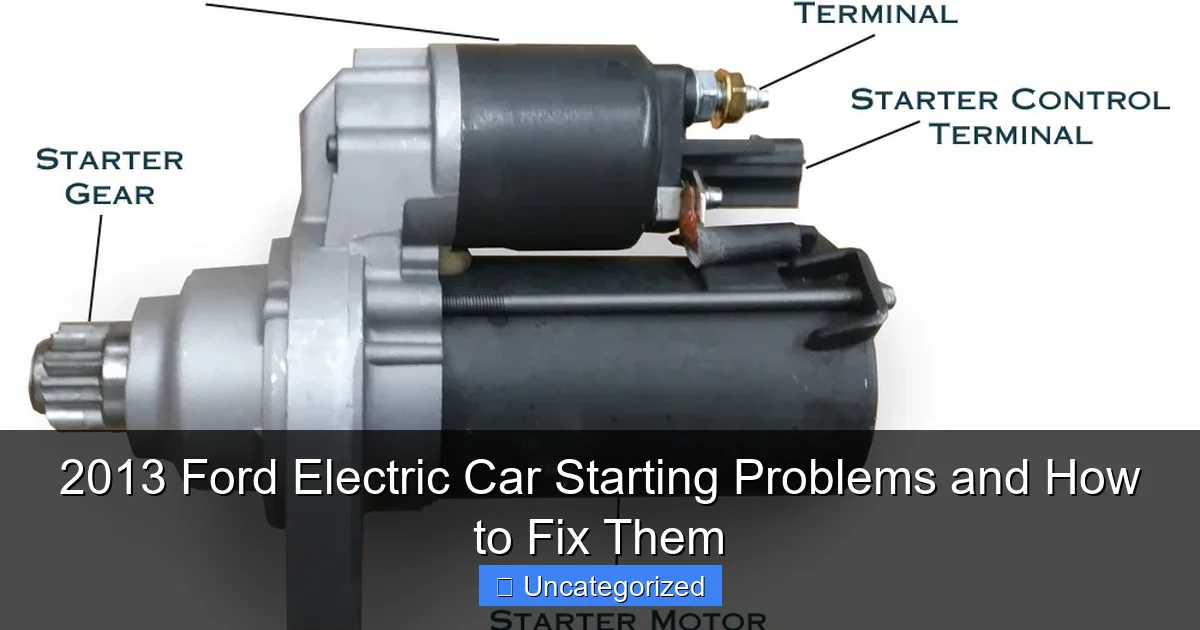
Visual guide about 2013 ford electric car starting problems
Image source: samarins.com
One critical difference is that the EV doesn’t require cranking. Instead, it performs a pre-charge cycle—a safety measure where the system gradually charges the high-voltage capacitors in the inverter to prevent electrical surges. If this process fails or times out, the car will display a warning message (often “System Failure” or “Stop Safely”) and refuse to start. This is one of the most common reasons for starting issues in the 2013 Focus Electric. Additionally, the 12-volt auxiliary battery, which powers the control modules and dashboard, plays a crucial role. Even if the high-voltage battery is fully charged, a weak 12-volt battery can prevent the car from initiating the start sequence.
Key Components Involved in the Starting Process
- 12-Volt Auxiliary Battery: Powers the car’s computer systems, lights, and dashboard. A weak or dead 12V battery is a leading cause of starting failure.
- High-Voltage Battery Pack (23 kWh Lithium-Ion): Stores energy for the traction motor. Must be charged and properly balanced to allow startup.
- DC-DC Converter: Converts high-voltage DC from the main battery to 12V to charge the auxiliary battery. If faulty, the 12V battery won’t recharge.
- Power Electronics Controller (PEC): Manages energy flow between the battery and motor. Includes the inverter and DC-DC converter.
- Ignition Switch / Start Button: Triggers the start sequence. Must be recognized by the vehicle’s security system (e.g., key fob proximity).
- CAN Bus Network: Allows communication between modules. A fault in one module can disrupt the entire startup process.
For example, a 2013 Focus Electric owner in Denver reported that their car would not start during a cold snap. The dashboard lights flickered, and the car displayed a “12V Battery Fault” message. After jump-starting the 12V battery and allowing it to charge for 15 minutes, the car powered up normally. This highlights how even minor electrical imbalances can halt the startup process in EVs.
Common Warning Signs Before a Complete Start Failure
Before a total starting failure, owners often notice subtle symptoms:
- Dashboard lights dimming or flickering when pressing the start button.
- Delayed response or “thinking” time before the car powers on.
- Error messages like “Service Battery Charging System” or “Stop Safely.”
- The car powers on but immediately shuts down.
- The key fob is recognized but the car won’t enter “Ready” mode.
Recognizing these signs early can prevent being stranded. For instance, a driver in Seattle noticed that their car took 3–4 seconds to respond to the start button. After replacing the 12V battery, the response time returned to under one second—a clear indicator of a weak auxiliary battery.
Top 5 Causes of 2013 Ford Electric Car Starting Problems
1. Weak or Failed 12-Volt Auxiliary Battery
The 12V battery is the unsung hero of EV operation. Despite the car’s name, the Focus Electric relies heavily on this small battery to power the control modules, dashboard, and start sequence. Over time, the 12V battery can degrade due to age, extreme temperatures, or parasitic drain. A common issue is parasitic draw, where the car’s systems (e.g., telematics, charging port lights) continue to draw power even when off, slowly draining the 12V battery.
Practical Tip: If your car won’t start and the dashboard is dark, check the 12V battery first. Use a multimeter to test voltage. A healthy battery reads 12.6V or higher when off and ~13.8V when charging. Below 11.8V, the car may not start. Jump-starting can help, but it’s a temporary fix—replace the battery if it’s over 3 years old.
For example, a Focus Electric in Florida failed to start after being parked for two weeks. The owner used a portable jump starter to power the 12V system, and the car started immediately. The battery was later replaced, and the issue never recurred.
2. High-Voltage Battery Management System (BMS) Faults
The BMS monitors the state of charge, temperature, and cell balance of the main battery. If it detects an imbalance or a cell with low voltage, it may prevent startup to protect the system. This is especially common after deep discharges (e.g., leaving the car uncharged for weeks). The BMS may enter a “sleep” mode or require a reset.
Tip: If the car displays “Battery Charging System Fault” or “Stop Safely” but the 12V battery is good, the issue may be BMS-related. Plug the car into a Level 2 charger and leave it for 12+ hours. This allows the BMS to balance the cells and reset. In some cases, a dealer scan tool is needed to reset the BMS fault code.
3. DC-DC Converter Failure
The DC-DC converter is responsible for charging the 12V battery using power from the high-voltage pack. If it fails, the 12V battery slowly drains, even if the main battery is full. Symptoms include:
- 12V battery voltage dropping over time (e.g., 12.6V → 11.2V in 48 hours).
- Car starts after jump-start but won’t start the next day.
- Error message: “Battery Charging System Fault.”
Example: A 2013 Focus Electric in Chicago started fine after a jump but wouldn’t start the next morning. A mechanic diagnosed a failed DC-DC converter, which was replaced under warranty (if available) or at a cost of $800–$1,200.
4. Software Glitches and Module Communication Errors
Early EVs like the 2013 Focus Electric were running on first-generation software. Bugs in the BECM, PCM, or HPCM can cause startup failures. For example, a software bug might prevent the pre-charge cycle from completing, leading to a “System Failure” message. These issues often require a software update or module reprogramming.
Tip: Check if your car has the latest software update. Ford issued several updates between 2013 and 2016 to address starting and charging issues. Visit a Ford dealership and request a “Module Reprogramming” or “Software Update” for the BECM and PCM.
5. Key Fob or Proximity Sensor Issues
The Focus Electric uses a push-button start system that requires the key fob to be inside the car. If the fob battery is low or the car’s proximity sensors are faulty, the car won’t recognize the key, preventing startup.
Example: A driver in Texas couldn’t start their car. They replaced the fob battery, and the car started normally. If the fob is fine, try placing it in the center console’s “key slot” (under the cup holder) to force recognition.
Step-by-Step Troubleshooting Guide for Owners
Step 1: Check the 12-Volt Battery
- Locate the 12V battery (usually in the front trunk or under the rear seat).
- Use a multimeter to check voltage. Below 11.8V? Proceed to jump-start.
- Jump-start using jumper cables or a portable jump starter. Note: Never connect jumper cables directly to high-voltage terminals.
- After jump-starting, let the car run for 15–30 minutes to recharge the 12V battery.
- If the car won’t start after charging, replace the 12V battery (recommended: AGM battery, 55Ah).
Pro Tip: Keep a portable jump starter in your car. Models like the NOCO Boost Plus are safe for EVs and can handle 12V systems.
Step 2: Inspect the High-Voltage Battery and Charging System
- Ensure the main battery has at least 20% charge. A deeply discharged battery may not provide enough power for startup.
- Plug the car into a Level 2 charger and wait 12+ hours. This allows the BMS to balance cells and reset.
- Check for charging port damage or debris. A dirty port can prevent proper charging.
- Monitor the dashboard for BMS-related error messages. If present, visit a Ford dealer for a scan.
Step 3: Diagnose the DC-DC Converter
- After a jump-start, measure the 12V battery voltage while the car is “Ready.”
- It should read 13.5–14.5V. If it stays below 12.6V, the DC-DC converter may be faulty.
- Listen for a humming sound from the PEC (under the hood) when the car is on. No sound? Converter may be dead.
- Have a mechanic test the converter with a multimeter or oscilloscope.
Step 4: Reset or Update Software
- Visit a Ford dealership with your VIN.
- Request a “Battery Energy Control Module (BECM) Software Update.”
- Ask for a “Powertrain Control Module (PCM) Reprogramming” if the car has frequent shutdowns.
- Some dealers offer free updates for older models under goodwill programs.
Step 5: Test the Key Fob and Proximity System
- Replace the key fob battery (CR2032).
- Place the fob in the center console’s “key slot” and press the start button.
- If the car starts, the proximity sensors may be faulty. A dealer can test and replace them.
Data Table: Common 2013 Ford Focus Electric Starting Issues and Solutions
| Issue | Symptoms | Likely Cause | DIY Fix | Professional Fix | Estimated Cost |
|---|---|---|---|---|---|
| Car won’t power on | Dashboard dark, no response to start button | Weak 12V battery | Jump-start, replace 12V battery | None (DIY sufficient) | $100–$200 (battery) |
| Starts then shuts down | Car powers on, “Ready” light flashes, then dies | BMS fault or cell imbalance | Charge for 12+ hours | BMS reset or cell replacement | $0 (charging) to $1,500 (BMS) |
| 12V battery drains overnight | Car starts after jump but not next day | Failed DC-DC converter | Jump-start | Replace DC-DC converter | $800–$1,200 |
| “System Failure” message | Pre-charge cycle fails | Software glitch | None | Module reprogramming | $100–$200 (dealer labor) |
| Start button unresponsive | Fob recognized but no start | Proximity sensor fault | Place fob in key slot | Replace sensors | $300–$500 |
This table summarizes the most frequent scenarios based on owner reports, repair logs, and Ford technical service bulletins (TSBs). Always verify the issue with diagnostic tools when possible.
Preventive Maintenance and Long-Term Solutions
Regular 12-Volt Battery Maintenance
Even in EVs, the 12V battery is a wear item. Replace it every 3–4 years, especially in extreme climates. Use an AGM (Absorbent Glass Mat) battery for better vibration resistance and longevity. Consider installing a battery maintainer if the car is parked for more than 2 weeks. These devices trickle-charge the 12V battery and prevent deep discharge.
Software Updates and Firmware Checks
Ford has released multiple software updates for the 2013 Focus Electric. Visit Ford Owner and enter your VIN to check for available updates. Key updates include:
- TSB 14-0045: Addresses BMS communication errors.
- TSB 15-0122: Fixes pre-charge cycle failures.
- TSB 16-0088: Improves DC-DC converter stability.
Climate Control and Battery Health
Extreme temperatures degrade battery health. In winter, park in a garage or use a battery blanket to keep the 12V battery warm. In summer, avoid leaving the car in direct sunlight with the battery fully charged (above 80% for long periods can stress lithium-ion cells). Use the Ford app to precondition the car while plugged in—this reduces strain on the battery at startup.
Professional Diagnostics and Warranty Considerations
The 2013 Focus Electric came with an 8-year/100,000-mile battery warranty, which may still cover BMS or DC-DC converter repairs if the car is under 100,000 miles. Even if expired, some dealers offer goodwill repairs. For out-of-warranty cars, independent EV specialists can diagnose issues using Ford’s IDS (Integrated Diagnostic System) software at a lower cost than dealerships.
Example: A Focus Electric owner in California had a failing DC-DC converter at 98,000 miles. The dealer replaced it under warranty with a new unit and updated the BECM software—free of charge.
Community Resources and Owner Networks
Join online communities like Focus Electric Forum or Ford EV Owners Group on Facebook. These groups share real-time fixes, DIY repair videos, and dealer recommendations. For example, a member in Texas discovered that a loose ground wire near the PEC was causing intermittent startup failures—a simple fix that saved hundreds in diagnostics.
Conclusion: Empowering Owners with Knowledge and Solutions
The 2013 Ford Focus Electric was a bold leap into the future of mobility, but its early adoption came with growing pains—particularly in the form of starting problems that tested the patience of even the most dedicated EV enthusiasts. From weak 12V batteries and failed DC-DC converters to software glitches and BMS faults, these issues were not just mechanical failures but symptoms of a new technology learning to adapt to real-world use. Yet, as this guide has shown, most of these problems are diagnosable, preventable, and fixable with the right knowledge and tools.
For owners, the key takeaway is empowerment. By understanding the unique starting sequence of an EV, recognizing early warning signs, and following a systematic troubleshooting process, you can resolve many issues without a trip to the dealer. Preventive maintenance—like regular 12V battery checks, software updates, and climate-conscious charging—can extend the life of your Focus Electric and reduce the risk of being stranded. Moreover, the growing network of EV specialists, community forums, and manufacturer goodwill programs means that help is more accessible than ever.
The 2013 Ford electric car may be a decade old, but its legacy lives on. It taught Ford—and the entire automotive industry—valuable lessons about battery management, software reliability, and owner support. For those still driving these pioneering vehicles, the journey doesn’t have to end in frustration. With the insights and solutions provided here, your 2013 Focus Electric can continue to deliver clean, quiet, and reliable transportation for years to come. After all, every challenge overcome is a step toward a more sustainable future—one successful start at a time.
Frequently Asked Questions
Why is my 2013 Ford electric car having starting problems?
Starting issues in your 2013 Ford electric car are often caused by a depleted 12V auxiliary battery, faulty charging system, or software glitches. Unlike gas vehicles, EVs rely on this smaller battery to power the main contactors—if it’s weak, the car won’t start even if the main battery is charged.
Can a dead 12V battery cause 2013 Ford electric car starting problems?
Yes, a dead or weak 12V battery is one of the most common causes of starting problems in 2013 Ford electric vehicles. This battery powers critical systems like the dashboard and main contactors; without it, the high-voltage system won’t activate, leaving the car unresponsive.
How do I reset my 2013 Ford electric car if it won’t start?
Try a hard reset by disconnecting the 12V battery for 10–15 minutes to clear any software glitches. Reconnect it, ensure the charge level is above 50%, and attempt to restart. If issues persist, a dealer-level scan tool may be needed to diagnose deeper system faults.
What are common signs of starting problems in a 2013 Ford electric car?
Warning signs include dim interior lights, unresponsive touchscreen, error messages like “Ready to Drive Not Available,” or the car entering “turtle mode.” These often point to electrical or software issues preventing the high-voltage system from engaging.
Do 2013 Ford electric car starting problems require a dealership visit?
Not always—simple fixes like jump-starting the 12V battery or resetting the system can resolve many issues. However, if problems recur or involve the high-voltage battery or inverter, professional diagnostics at a dealership or EV specialist are recommended.
How can I prevent future starting issues with my 2013 Ford electric car?
Regularly check and maintain the 12V battery, keep the main battery charged above 20%, and update the vehicle’s software when available. Avoid leaving the car unused for weeks, as this can drain the 12V battery and trigger starting problems.