2015 Ford Focus Electric Car Review Performance and Range Insights

Featured image for 2015 ford focus electric car
Image source: automobilesreview.com
The 2015 Ford Focus Electric delivers a smooth, quiet ride with instant torque, making it a standout in urban commuting. Limited range (76 miles per charge) and sluggish acceleration at highway speeds highlight its compromises, but its low running costs and nimble handling keep it competitive in the compact EV segment.
Key Takeaways
- 76-mile range: Ideal for short commutes but lags behind rivals.
- 143-hp motor: Delivers quick acceleration in city driving.
- Regen braking: Boosts efficiency and reduces brake wear.
- Limited fast charging: Lacks DC fast-charging capability.
- Spacious cabin: More rear legroom than most EVs.
- Slow highway charging: 240V charge takes 3–4 hours.
📑 Table of Contents
- Introduction: The Electric Revolution Hits the Compact Segment
- Performance and Powertrain: Efficiency Meets Everyday Driving
- Range and Charging: Real-World Efficiency and Practicality
- Interior, Technology, and Comfort: A Modern Cabin with Smart Features
- Safety, Reliability, and Ownership Experience
- Competitors and Verdict: Where Does the Focus Electric Stand?
- Conclusion: A Smart, Practical Step into the Electric Future
Introduction: The Electric Revolution Hits the Compact Segment
The automotive world in 2015 was undergoing a quiet but profound transformation. While Tesla was making headlines with its luxury Model S and Nissan’s Leaf had established itself as the affordable EV pioneer, Ford was quietly carving out its own niche in the electric vehicle (EV) market with the 2015 Ford Focus Electric. Positioned as a practical, no-nonsense electric car for the masses, the Focus Electric aimed to prove that eco-friendly driving didn’t require sacrificing everyday usability or comfort. With a sleek, familiar exterior design and a cabin packed with technology, Ford’s electric compact sedan was more than just a compliance car — it was a statement that mainstream automakers could deliver a compelling EV experience without breaking the bank or alienating traditional drivers.
Unlike many early EVs that felt like experiments, the 2015 Focus Electric stood out by leveraging the well-established Focus platform, giving it a level of refinement and driving dynamics that set it apart from its competitors. For urban commuters, environmentally conscious families, and tech-savvy drivers looking to dip their toes into electric mobility, the Focus Electric offered a compelling package: zero tailpipe emissions, low running costs, and the peace of mind of a trusted brand. But how did it perform in the real world? Was its range sufficient for daily driving? And how did it compare to rivals like the Nissan Leaf and Chevrolet Spark EV? In this comprehensive review, we’ll dive deep into the 2015 Ford Focus Electric‘s performance, range, charging capabilities, interior features, driving experience, and overall value — providing you with the insights needed to understand whether this electric compact was a hidden gem or a missed opportunity in Ford’s EV journey.
Performance and Powertrain: Efficiency Meets Everyday Driving
Electric Motor and Power Output
At the heart of the 2015 Ford Focus Electric is a 107-kilowatt (143 horsepower) permanent magnet AC electric motor, paired with a 23-kWh liquid-cooled lithium-ion battery pack. This setup delivers 184 lb-ft of torque — a figure that may not sound staggering on paper, but in practice, it translates to brisk, linear acceleration thanks to the instant torque characteristic of electric motors. Unlike internal combustion engines that need to rev to reach peak torque, the Focus Electric delivers full twist the moment you press the accelerator, resulting in a surprisingly responsive drive, especially in city traffic.
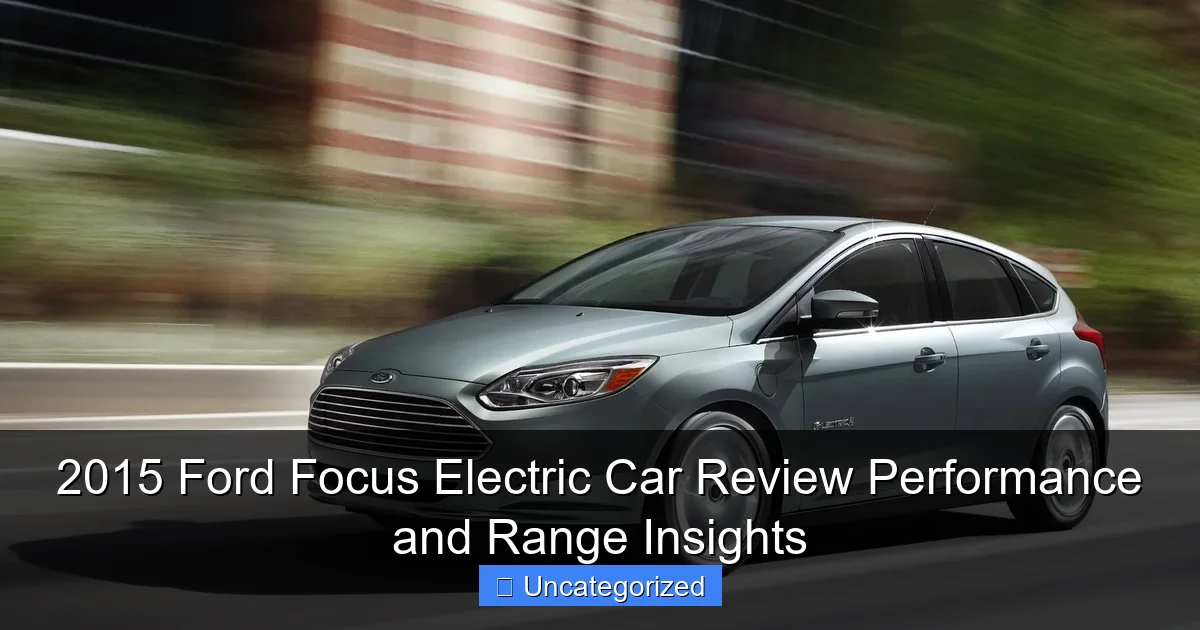
Visual guide about 2015 ford focus electric car
Image source: s1.cdn.autoevolution.com
For example, during a typical morning commute through stop-and-go urban traffic, the Focus Electric can accelerate from 0 to 30 mph in just over 3 seconds — faster than many gasoline-powered compacts. This makes merging onto highways or darting through traffic gaps effortless and safe. While top speed is electronically limited to 84 mph, it’s more than adequate for U.S. highways, where most driving occurs between 60–75 mph.
Transmission and Drive Modes
The Focus Electric uses a single-speed direct-drive transmission, which eliminates gear shifts and contributes to a smooth, seamless driving experience. There are no jerky transitions or RPM drops — just consistent power delivery. To enhance efficiency and driving dynamics, Ford introduced a Regenerative Braking System with three selectable modes: Low, Medium, and High.
- Low mode: Minimal regenerative braking, ideal for highway cruising or drivers transitioning from gasoline vehicles.
- Medium mode: Balanced regen, offering a natural feel with moderate energy recovery.
- High mode: Strong regen, allowing for “one-pedal driving” in city conditions — lift off the accelerator, and the car slows significantly, recapturing energy while reducing brake wear.
Tip: For maximum range and efficiency, especially in urban environments, set the regen to High and practice one-pedal driving. Many owners report up to a 10% improvement in real-world range using this technique.
Handling and Ride Quality
Thanks to the Focus platform, the electric version benefits from a well-tuned suspension system, independent rear suspension, and a lower center of gravity due to the floor-mounted battery. This results in composed handling, minimal body roll during cornering, and a stable ride at highway speeds. While not a sports sedan, the Focus Electric handles more like a well-balanced compact car than a sluggish EV.
The steering is light and precise, making parking and maneuvering in tight city streets a breeze. However, some drivers may find the steering feedback a bit numb compared to the gasoline Focus ST, but for daily driving, it’s more than adequate. The added weight of the battery (approximately 450 lbs more than the standard Focus) is well-managed, and the chassis feels planted without being overly stiff.
Range and Charging: Real-World Efficiency and Practicality
Official Range and EPA Estimates
The 2015 Ford Focus Electric is rated by the EPA at 76 miles of combined city/highway range on a full charge. This places it behind the 2015 Nissan Leaf (84 miles) and significantly below later models, but at the time, it was competitive within its price and segment. The EPA also reports an energy consumption rate of 32 kWh/100 miles, which translates to an efficiency rating of 105 MPGe (miles per gallon equivalent) in the city and 99 MPGe on the highway.
While 76 miles may seem modest by today’s standards, it was sufficient for the average U.S. daily commute (35 miles round-trip) with a buffer for errands and detours. For example, a driver in Portland, Oregon, who works downtown and lives 12 miles away could easily commute five days a week and still have 16 miles of range left — plenty for grocery shopping or a dinner out.
Real-World Range Variability
Real-world range can vary significantly based on driving habits, terrain, weather, and climate control use. In mild conditions (60–75°F), drivers consistently report achieving 70–75 miles, closely matching the EPA estimate. However, extreme temperatures take a toll:
- Cold weather (below 32°F): Battery efficiency drops, and cabin heating (especially with seat heaters and defrosters) can reduce range by 20–30%. Some owners report as low as 50 miles in winter.
- Hot weather (above 90°F): Air conditioning use can cut range by 10–15%, though less severely than heating.
- Highway driving at 70+ mph: Aerodynamic drag and sustained high motor output reduce efficiency, often resulting in 60–65 miles of range.
Tip: Pre-condition the cabin while the car is still plugged in. Using the MyFord Mobile app (discussed later), you can set the climate system to heat or cool the car before departure, preserving battery range for driving.
Charging Options and Times
The Focus Electric supports both Level 1 (120V) and Level 2 (240V) charging. Here’s a breakdown:
- Level 1 (Standard Household Outlet): Adds about 4 miles of range per hour. A full charge takes 20–24 hours. Best for overnight charging or as a backup.
- Level 2 (240V, 30A EVSE): Adds about 22 miles of range per hour. A full charge takes 3–4 hours. Ford includes a portable 240V charging cord (with a NEMA 14-50 plug), but a wall-mounted unit (like the ChargePoint Home) is recommended for convenience and safety.
Unfortunately, the Focus Electric does not support DC fast charging (CHAdeMO or CCS), a notable limitation compared to the Leaf and Spark EV. This means no 30-minute top-ups at public fast-charging stations — a drawback for road trips or long-distance errands. However, for most daily use cases, Level 2 charging is sufficient.
Interior, Technology, and Comfort: A Modern Cabin with Smart Features
Design and Materials
The interior of the 2015 Focus Electric closely mirrors the gasoline-powered Focus, with a few EV-specific touches. The cabin features soft-touch materials on the dashboard, piano black accents, and a clean, minimalist layout. The centerpiece is the 8-inch SYNC 2 touchscreen infotainment system, which includes navigation, climate controls, and energy flow monitoring.
One standout feature is the SmartGauge with EcoGuide, a customizable digital instrument cluster that displays real-time energy usage, regenerative braking feedback, and efficiency tips. For instance, a green “leaf” icon lights up when you’re driving efficiently, while a “battery” gauge shows how much energy is being used or recovered. This gamification encourages eco-friendly driving habits.
Infotainment and Connectivity
The SYNC 2 system supports Bluetooth, USB, and voice commands for calls, music, and navigation. It also includes the MyFord Mobile app, which allows remote control of several functions via smartphone or smartwatch:
- Check battery status and remaining range
- Start or stop charging
- Pre-condition the cabin (heat or cool)
- Locate the vehicle
- Schedule charging during off-peak hours (saving money on electricity)
Example: A driver in Chicago could set the app to preheat the car at 6:30 AM on a cold winter morning, ensuring a warm cabin by 7:00 AM without draining the battery during the commute.
Comfort and Space
The Focus Electric seats five, with comfortable front seats offering good lateral support. Rear legroom is adequate for adults under 6 feet, though taller passengers may find the sloping roofline limits headroom. The trunk offers 10.2 cubic feet of cargo space — less than the gasoline Focus (13.2 cu ft) due to the battery placement and charging hardware. However, it’s sufficient for groceries, a stroller, or a weekend trip’s worth of luggage.
Notable interior features include:
- Heated front seats and steering wheel (great for cold climates)
- Dual-zone automatic climate control
- Keyless entry and push-button start
- Rearview camera with dynamic guidelines
One minor gripe: the absence of Apple CarPlay and Android Auto (introduced in later models) means smartphone integration is limited to Bluetooth audio and voice commands.
Safety, Reliability, and Ownership Experience
Safety Ratings and Features
The 2015 Focus Electric earned a 5-star overall safety rating from the National Highway Traffic Safety Administration (NHTSA), with top scores in frontal and side crash tests. It also received a “Top Safety Pick” designation from the Insurance Institute for Highway Safety (IIHS) when equipped with the optional forward collision warning system.
Standard safety features include:
- Six airbags (dual front, side, and curtain)
- Anti-lock brakes (ABS)
- Electronic stability control
- Rearview camera
- Tire pressure monitoring system
Optional features (on higher trims) include:
- Blind-spot monitoring
- Rear cross-traffic alert
- Forward collision warning with automatic braking
Tip: Always test the automatic braking system during a test drive — it can be a lifesaver in sudden traffic stops.
Reliability and Maintenance
Electric vehicles have fewer moving parts than gasoline cars, which generally leads to lower maintenance costs. The Focus Electric has proven reliable over time, with few major mechanical issues reported. The battery pack is covered by an 8-year/100,000-mile warranty (or 10-year/150,000-mile in CARB states), providing peace of mind against degradation.
Common maintenance items include:
- Regular tire rotations and alignment
- Brake fluid changes (every 3 years)
- Cabin air filter replacement
- 12V auxiliary battery (which powers lights and electronics — replace every 3–5 years)
One unique consideration: the regenerative braking system reduces wear on brake pads, often extending their life to 70,000 miles or more — a significant cost saver.
Ownership Costs and Incentives
The 2015 Focus Electric had a starting MSRP of $29,170, but with federal tax credits (up to $7,500) and state incentives (e.g., $2,500 in California), the effective price could drop to under $20,000. Additionally, electricity costs average $0.13/kWh, meaning a full charge costs about $3.00 — equivalent to driving 76 miles for less than the price of a gallon of gas.
Owners also benefit from:
- Lower insurance rates (in some states)
- HOV lane access (where applicable)
- Free public charging at some workplaces and shopping centers
Competitors and Verdict: Where Does the Focus Electric Stand?
Comparison with Key Rivals
To understand the 2015 Focus Electric’s place in the market, let’s compare it to two main competitors: the Nissan Leaf and Chevrolet Spark EV.
| Feature | 2015 Ford Focus Electric | 2015 Nissan Leaf (SV) | 2015 Chevrolet Spark EV |
|---|---|---|---|
| Range (EPA) | 76 miles | 84 miles | 82 miles |
| Charging (0–100%) | 3–4 hrs (Level 2) | 4 hrs (Level 2) | 7 hrs (Level 2) |
| DC Fast Charging | No | Yes (CHAdeMO) | Yes (CHAdeMO) |
| MPGe (City/Highway) | 105/99 | 126/101 | 128/109 |
| Starting MSRP | $29,170 | $29,010 | $26,685 |
| Cargo Space | 10.2 cu ft | 14.5 cu ft | 11.4 cu ft |
| Infotainment | SYNC 2 (8-inch) | NissanConnect (5.8-inch) | MyLink (7-inch) |
As the table shows, the Focus Electric trades blows with its rivals. While it has slightly less range and lacks DC fast charging, it offers a more refined ride, better interior materials, and superior tech features like the SmartGauge and MyFord Mobile app. The Spark EV is more efficient and faster to charge, but feels less polished. The Leaf leads in range and fast charging but has a less engaging driving experience.
Who Should Consider the 2015 Focus Electric?
The 2015 Ford Focus Electric is ideal for:
- Urban and suburban commuters with short to moderate daily drives
- Tech-savvy drivers who appreciate connected features and efficiency feedback
- First-time EV owners seeking a familiar, comfortable car with low running costs
- Families needing a reliable, safe, and practical second vehicle
It’s less suited for:
- Long-distance travelers who need fast charging and extended range
- Drivers in extreme climates without access to home charging
- Performance enthusiasts seeking sporty dynamics
Conclusion: A Smart, Practical Step into the Electric Future
The 2015 Ford Focus Electric may not have been the longest-range or fastest-charging EV of its era, but it carved out a niche as a practical, well-rounded, and technologically advanced electric car for everyday drivers. Its blend of familiar styling, responsive performance, smart features like regenerative braking and remote climate control, and strong safety credentials made it a compelling choice for those transitioning from gasoline to electric — without sacrificing comfort or convenience.
While the lack of DC fast charging and slightly lower range compared to rivals are drawbacks, they are balanced by the Focus Electric’s superior cabin quality, intuitive infotainment, and lower maintenance costs. For city dwellers, suburban commuters, and eco-conscious families, it offered a realistic path to zero-emission driving at a competitive price point — especially with incentives.
Today, as used EVs become increasingly popular, the 2015 Focus Electric remains a smart used car buy for budget-conscious buyers. With battery health typically holding up well (many still retain 90%+ capacity after 8+ years), and a growing network of Level 2 chargers, it continues to deliver value. In the broader story of Ford’s electric journey — which now includes the Mustang Mach-E and F-150 Lightning — the 2015 Focus Electric was a quiet pioneer, proving that mainstream automakers could deliver a credible, user-friendly EV experience. It may not have set the world on fire, but it lit the fuse for what was to come.
Frequently Asked Questions
What is the driving range of the 2015 Ford Focus Electric car?
The 2015 Ford Focus Electric offers an EPA-estimated range of 76 miles on a full charge, making it suitable for daily commutes and urban driving. While modest compared to newer EVs, it was competitive for its time in the compact electric car segment.
How fast does the 2015 Ford Focus Electric car charge?
Using a 240-volt Level 2 charger, the 2015 Focus Electric can fully recharge in about 3.5 to 4 hours. With a standard 120-volt household outlet, charging takes approximately 20 hours, so a dedicated home charging station is recommended.
Is the 2015 Ford Focus Electric car reliable for long-distance trips?
Due to its 76-mile range and limited fast-charging capability, the 2015 Focus Electric is best suited for city driving and short regional trips. Planning around charging infrastructure is essential for longer journeys.
What are the key performance specs of the 2015 Ford Focus Electric car?
The 2015 Focus Electric delivers 143 horsepower and 184 lb-ft of torque, with instant electric motor response for smooth acceleration. It features a single-speed transmission and a top speed of 84 mph, prioritizing efficiency over sporty performance.
How does the 2015 Ford Focus Electric compare to gas-powered models in terms of maintenance?
The 2015 Focus Electric requires less maintenance than gas-powered models, with no oil changes, spark plugs, or exhaust systems to worry about. Regenerative braking also reduces wear on brake pads, lowering long-term ownership costs.
Does the 2015 Ford Focus Electric car qualify for tax incentives or rebates?
Yes, the 2015 Ford Focus Electric was eligible for a federal tax credit of up to $7,500 when new, depending on individual tax liability. Some states also offered additional rebates or incentives for electric car purchases at the time.