2016 Nissan Leaf Electric Car Review Pros Cons and Performance

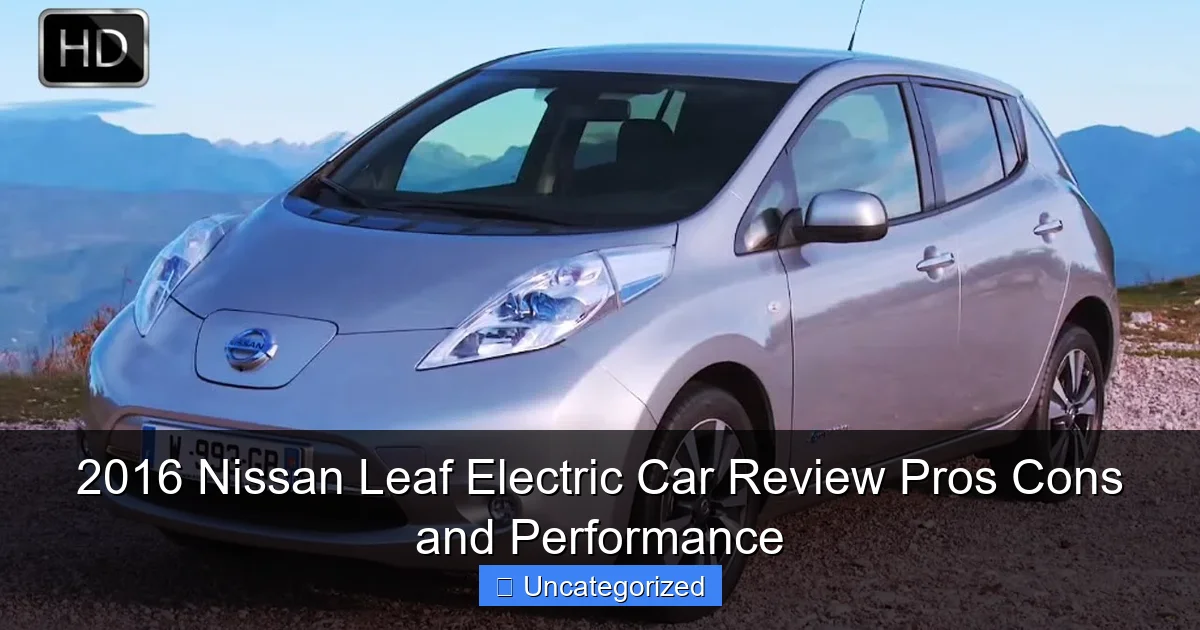
Featured image for 2016 nissan leaf electric car
Image source: i.ytimg.com
The 2016 Nissan Leaf delivers an affordable, eco-friendly ride with a peppy electric motor and up to 107 miles of range—ideal for city driving and short commutes. Its low running costs and zero emissions make it a standout in the EV market, though limited range and outdated tech compared to rivals may give some buyers pause.
Key Takeaways
- Affordable pricing: One of the cheapest EVs, ideal for budget-conscious buyers.
- Decent range: 84–107 miles per charge, suitable for daily commutes.
- Smooth ride: Quiet, comfortable drive with responsive electric motor.
- Limited fast charging: CHAdeMO port available but slower than rivals.
- Outdated infotainment: Basic tech features compared to newer models.
- Spacious interior: Roomy cabin and cargo space for its class.
📑 Table of Contents
- 2016 Nissan Leaf Electric Car: A Pioneering EV in the Modern Market
- Performance and Driving Experience: Smooth, Silent, and Surprising
- Range, Charging, and Battery Technology: The Heart of the Leaf
- Interior Design, Comfort, and Technology
- Ownership Costs, Incentives, and Long-Term Value
- Safety, Reliability, and Environmental Impact
- Conclusion: Is the 2016 Nissan Leaf Still a Smart Choice?
2016 Nissan Leaf Electric Car: A Pioneering EV in the Modern Market
The 2016 Nissan Leaf stands as a milestone in the evolution of affordable, mass-market electric vehicles. When it was first introduced in 2010, the Leaf broke new ground by proving that an electric car could be practical, accessible, and appealing to everyday drivers—not just tech enthusiasts or environmental idealists. By 2016, Nissan had refined the formula, introducing a more powerful motor, improved battery technology, and a more competitive range. The 2016 model year brought significant upgrades, particularly with the introduction of the Leaf SV and SL trims featuring the 30 kWh battery, which extended the driving range to a more usable 107 miles (EPA-estimated). This leap forward addressed one of the most common criticisms of earlier Leaf models: range anxiety.
For consumers considering an electric vehicle in the mid-2010s, the 2016 Nissan Leaf offered a compelling blend of value, innovation, and eco-friendliness. It was no longer just a novelty—it was a viable alternative to gasoline-powered compact cars. With zero tailpipe emissions, low operating costs, and a quiet, smooth ride, the Leaf appealed to urban commuters, eco-conscious families, and early adopters alike. Whether you’re a first-time EV buyer or a seasoned green driver, the 2016 Leaf delivers a real-world experience that balances practicality with forward-thinking technology. In this comprehensive review, we’ll explore the 2016 Nissan Leaf electric car in depth, covering its performance, design, technology, ownership costs, and long-term value—highlighting the pros, cons, and everything in between.
Performance and Driving Experience: Smooth, Silent, and Surprising
Powertrain and Acceleration
The 2016 Nissan Leaf is powered by an 80-kilowatt (107 horsepower) AC synchronous electric motor, delivering 187 lb-ft of torque. Unlike internal combustion engines, electric motors produce maximum torque instantly, resulting in brisk acceleration off the line. The Leaf can go from 0 to 60 mph in approximately 9.5 seconds—slower than many sporty compacts, but more than adequate for city driving and highway merging. What it lacks in raw speed, it makes up for in responsiveness. The throttle is tuned to be linear and predictable, making it easy to modulate speed in stop-and-go traffic.
Visual guide about 2016 nissan leaf electric car
Image source: i.ytimg.com
A key upgrade in the 2016 model was the availability of a 30 kWh lithium-ion battery (standard on SV and SL trims, optional on the base S model). This larger battery not only extended range but also improved energy delivery, reducing voltage sag during hard acceleration and enhancing overall performance consistency. Drivers report that the Leaf feels more stable and capable on highways compared to earlier 24 kWh models, especially when climbing hills or passing slower vehicles.
Regenerative Braking and E-Pedal
One of the standout features of the 2016 Leaf is its advanced regenerative braking system. When you lift off the accelerator, the car automatically begins to slow down using regenerative energy recovery—a feature Nissan calls “e-Pedal.” In the Leaf SL, the e-Pedal can be engaged manually, allowing drivers to control nearly all deceleration with just the accelerator pedal. This “one-pedal driving” is a game-changer in urban environments, where frequent stops are the norm.
For example, in a typical commute through downtown Los Angeles, a Leaf driver can navigate traffic lights and intersections without touching the brake pedal 90% of the time. The system recaptures kinetic energy, which is fed back into the battery, increasing efficiency and reducing wear on the physical brake pads. While it takes a few days to adapt, most drivers find the e-Pedal intuitive and highly effective. Pro tip: Use B-mode (available in all trims) for maximum regeneration, or switch to D-mode for a more traditional coasting feel when on open highways.
Handling and Ride Comfort
The 2016 Leaf features a MacPherson strut front suspension and a torsion beam rear setup, tuned for comfort rather than sportiness. The ride is soft and compliant, soaking up potholes and rough pavement with ease—ideal for city driving. However, the Leaf’s tall profile and relatively soft suspension mean it leans more in corners than, say, a Honda Fit or Toyota Yaris. This isn’t a car built for spirited driving, but for relaxed, efficient commuting.
The steering is light and precise, making the Leaf easy to maneuver in tight parking spots and crowded city streets. At higher speeds, the steering feels a bit vague, but that’s typical of many compact EVs. The low center of gravity—thanks to the floor-mounted battery pack—improves stability, reducing body roll and enhancing confidence during lane changes and emergency maneuvers.
Range, Charging, and Battery Technology: The Heart of the Leaf
EPA-Estimated Range and Real-World Performance
The 2016 Nissan Leaf comes in three trims: S, SV, and SL. The base S model retains the older 24 kWh battery, offering an EPA-estimated range of 84 miles. The SV and SL trims feature the newer 30 kWh battery, bumping the range to 107 miles—a 27% improvement. This may not sound like a lot by today’s standards (where 200+ miles is common), but in 2016, it was a major step forward and made the Leaf competitive with the Chevrolet Bolt and Tesla Model 3 (which wasn’t available until late 2017).
Real-world range varies significantly based on driving habits, climate, and terrain. In mild conditions (60–75°F) and city driving, owners report achieving 100–110 miles on a full charge. However, in cold weather (below 32°F), range can drop by 30–40% due to battery chemistry and heating demands. For example, a driver in Chicago during winter might only get 60–70 miles from the 30 kWh model. Similarly, highway driving at 70 mph reduces range by about 20% due to aerodynamic drag and constant high-speed motor use.
Tip: Use the Leaf’s built-in energy monitor to track your driving efficiency. Smooth acceleration, moderate speeds (55–65 mph), and pre-conditioning the cabin while plugged in can help maximize range.
Charging Options and Times
The 2016 Leaf supports three charging levels:
- Level 1 (120V): Standard household outlet. Adds about 4–5 miles of range per hour. A full charge takes 20–24 hours (30 kWh battery). Best for overnight charging at home.
- Level 2 (240V): Requires a home charger (Nissan offers a 240V unit). Adds 20–25 miles per hour. Fully charges the 30 kWh battery in 6–8 hours. Ideal for daily use and most home installations.
- DC Fast Charging (CHAdeMO): Available only on SV and SL trims. Can recharge the battery to 80% in about 30 minutes. Found at public charging stations and some dealerships. Great for road trips or emergency top-ups.
For example, a Leaf SL owner driving 50 miles daily can fully recharge in under 4 hours using a Level 2 charger—perfect for overnight charging. For longer trips, the CHAdeMO port allows drivers to add 60–70 miles of range during a 30-minute coffee break at a rest stop.
Battery Longevity and Degradation
Battery degradation is a common concern among EV owners. The 2016 Leaf uses a passive air-cooled battery system (unlike the liquid-cooled systems in newer EVs), which can lead to faster degradation in hot climates. Over time, repeated fast charging and high ambient temperatures accelerate capacity loss.
Most 2016 Leaf batteries retain 80–85% of their original capacity after 50,000 miles, assuming moderate use and proper care. Nissan offers an 8-year/100,000-mile battery warranty, which covers capacity loss below 70% (9 out of 12 bars on the battery indicator). Owners in Arizona or Texas may see faster degradation, while those in cooler climates like Washington or Minnesota report better longevity.
Maintenance tip: Avoid keeping the battery at 100% charge for long periods. Use the Leaf’s “Charge Timer” to finish charging just before you plan to drive. Also, limit DC fast charging to occasional use—reserve it for road trips.
Interior Design, Comfort, and Technology
Cabin Layout and Materials
The 2016 Leaf’s interior is functional and clean, with a focus on ergonomics and driver visibility. The dashboard features a simple, uncluttered design with a central instrument cluster that displays speed, range, and battery level. The center stack includes a 5-inch or 7-inch touchscreen (depending on trim), climate controls, and audio buttons. While the materials are primarily hard plastics, they are durable and resist scratches.
The seats are cloth on the S and SV, with leather-appointed seats standard on the SL. Front seats are supportive for long drives, though taller drivers may find headroom limited due to the panoramic sunroof (SL trim). Rear seats offer decent legroom for two adults, but three is a tight squeeze. The flat floor (no transmission tunnel) improves foot space, but the sloping roofline reduces headroom for back-seat passengers over 6 feet tall.
Infotainment and Connectivity
The 2016 Leaf SV and SL trims come with a 7-inch NissanConnect touchscreen with navigation, voice commands, and smartphone integration. The system supports Bluetooth audio, USB connectivity, and a 6-speaker audio system. Apple CarPlay and Android Auto are not available—a notable omission for a 2016 model. However, the built-in navigation is reliable, and the voice command system works well for making calls and entering destinations.
The Leaf also features a unique “Eco Route” function that calculates the most energy-efficient path to your destination, factoring in elevation, traffic, and weather. For instance, if you’re traveling from San Francisco to Sacramento, the system might suggest a longer but flatter route to conserve battery.
Tip: Use the Nissan Leaf app (available for iOS and Android) to monitor charging status, pre-heat or cool the cabin, and locate nearby charging stations remotely.
Storage and Practicality
The 2016 Leaf offers 24 cubic feet of cargo space with the rear seats up and 30 cubic feet when folded—slightly less than the Honda Fit but more than the Chevrolet Spark EV. The hatchback design provides excellent access to the cargo area, and the low load floor makes it easy to load groceries or luggage.
Interior storage includes a center console bin, door pockets, and a glovebox. The front center console has a small tray for phones and keys, and the SL trim adds a wireless charging pad (optional). Cup holders are well-placed, though the rear cup holders are small and better suited for bottles than large travel mugs.
Ownership Costs, Incentives, and Long-Term Value
Purchase Price and Available Incentives
The 2016 Nissan Leaf had a starting MSRP of $29,010 for the S trim, $35,120 for the SV, and $37,620 for the SL. However, federal and state incentives significantly reduced the effective cost. At the time, buyers could claim a $7,500 federal tax credit, and additional rebates were available in states like California ($2,500), Colorado ($5,000), and Georgia ($5,000). Some utility companies also offered charging station rebates.
For example, a buyer in California purchasing a $35,000 Leaf SV could reduce the net cost to $25,000 after incentives—making it competitive with a new Toyota Prius or Honda Civic. Even today, used 2016 Leafs (with 60,000–80,000 miles) sell for $8,000–$12,000, offering excellent value for budget-conscious EV shoppers.
Operating and Maintenance Costs
Electric vehicles have far lower operating costs than gasoline cars. The 2016 Leaf has no oil changes, spark plugs, or exhaust systems. Regenerative braking reduces brake wear—many Leaf owners report replacing brake pads only once every 80,000 miles or more. Tires may wear faster due to the Leaf’s heavy battery (3,400 lbs), but proper alignment and rotation can mitigate this.
Charging costs vary by region. At an average U.S. electricity rate of $0.14/kWh, a full charge (30 kWh) costs about $4.20 and provides 107 miles—roughly $0.04 per mile. Compare that to a gasoline car averaging 30 mpg at $3.50/gallon, which costs $0.12 per mile. Over 15,000 miles annually, the Leaf saves about $1,200 per year in fuel alone.
Annual maintenance costs average $300–$400, including tire rotations, cabin air filter changes, and software updates. No transmission service is needed.
Resale Value and Depreciation
The 2016 Leaf suffers from steeper depreciation than gasoline cars, primarily due to battery concerns and rapid EV advancements. However, its low purchase price (especially with incentives) and low operating costs make it a smart long-term investment. As of 2023, well-maintained 2016 Leafs with the 30 kWh battery retain about 35–40% of their original value—better than many early EVs but below industry averages.
To maximize resale value, keep detailed service records, avoid excessive fast charging, and store the car in a garage to protect the battery from extreme temperatures.
Safety, Reliability, and Environmental Impact
Safety Ratings and Features
The 2016 Nissan Leaf received a 4-star overall rating from the National Highway Traffic Safety Administration (NHTSA), with 4 stars for frontal crash and 5 stars for side impact. The Insurance Institute for Highway Safety (IIHS) gave it a “Good” rating in most categories, though it missed the Top Safety Pick award due to a “Marginal” rating in the small overlap front test.
Standard safety features include:
- Anti-lock brakes (ABS) with electronic brake-force distribution (EBD)
- Stability and traction control
- Six airbags (front, side, and curtain)
- Rearview camera
- Tire pressure monitoring system (TPMS)
The SL trim adds optional safety features like blind-spot monitoring, rear cross-traffic alert, and automatic emergency braking—uncommon for a compact EV in 2016.
Reliability and Common Issues
Overall, the 2016 Leaf is reliable, with few mechanical issues. The electric motor and drivetrain have proven durable, with many Leafs exceeding 100,000 miles without major repairs. Common reported issues include:
- Battery capacity loss (especially in hot climates)
- 12V auxiliary battery failure (common in all EVs; replace every 3–4 years)
- Heater core issues (some models require replacement)
- Infotainment screen glitches (fixed with software updates)
Most problems are covered under warranty or are inexpensive to fix. Nissan’s nationwide service network ensures good parts availability.
Environmental Benefits
The 2016 Nissan Leaf produces zero tailpipe emissions, reducing urban air pollution and greenhouse gas emissions. Over its lifetime, a Leaf produces about 30% less CO2 than a comparable gasoline car, even when accounting for electricity generation. When charged with renewable energy (solar, wind), the carbon footprint drops to near zero.
Additionally, the Leaf’s manufacturing process uses recycled materials, and the battery can be repurposed for home energy storage after its automotive life.
Conclusion: Is the 2016 Nissan Leaf Still a Smart Choice?
The 2016 Nissan Leaf electric car remains a solid choice for drivers seeking an affordable, efficient, and reliable EV. While newer models offer longer range and more tech, the 2016 Leaf delivers exceptional value, especially on the used market. Its 107-mile range (with the 30 kWh battery) is sufficient for most daily commutes, and its low operating costs make it cheaper to own than a gasoline car over time.
The pros are clear: smooth acceleration, regenerative braking, low maintenance, federal incentives (if purchased new), and a quiet, comfortable ride. The cons include limited range in cold weather, outdated infotainment (no CarPlay), and faster battery degradation in hot climates.
For city dwellers, suburban commuters, and eco-conscious buyers, the 2016 Leaf is a practical and sustainable transportation solution. It’s not the fastest or most luxurious EV, but it’s one of the most accessible and well-tested. As Nissan continues to innovate with the Leaf Plus and Ariya, the 2016 model stands as a testament to how far affordable electric mobility has come—and a reminder that the future of driving is already here.
| Feature | 2016 Leaf S (24 kWh) | 2016 Leaf SV (30 kWh) | 2016 Leaf SL (30 kWh) |
|---|---|---|---|
| Range (EPA) | 84 miles | 107 miles | 107 miles |
| Motor Power | 107 hp | 107 hp | 107 hp |
| Torque | 187 lb-ft | 187 lb-ft | 187 lb-ft |
| DC Fast Charging | No | Yes (CHAdeMO) | Yes (CHAdeMO) |
| Infotainment | 5-inch screen | 7-inch touchscreen with navigation | 7-inch touchscreen, navigation, Bose audio |
| Seats | Cloth | Cloth | Leather-appointed |
| MSRP (2016) | $29,010 | $35,120 | $37,620 |
Frequently Asked Questions
What is the range of the 2016 Nissan Leaf electric car?
The 2016 Nissan Leaf offers an EPA-estimated range of 84 to 107 miles, depending on the trim level (SV/SL with the 30 kWh battery provide the higher end). This makes it ideal for daily commutes and city driving but less suited for long road trips without careful planning.
How long does it take to charge the 2016 Nissan Leaf?
Using a Level 2 (240V) charger, the 2016 Nissan Leaf takes about 4-6 hours for a full charge. With a standard 120V household outlet, charging can take up to 20 hours, so a dedicated home charging station is recommended for convenience.
What are the pros and cons of the 2016 Nissan Leaf electric car?
Pros include low operating costs, smooth quiet ride, and available advanced features like heated seats and ProPilot assist. Cons are limited range compared to newer EVs, outdated infotainment, and slower DC fast-charging speeds than rivals.
Does the 2016 Nissan Leaf qualify for tax credits or incentives?
Yes, the 2016 Nissan Leaf originally qualified for a federal tax credit of up to $7,500 when purchased new, but availability depends on Nissan’s cumulative sales at the time. Some states and local utilities may still offer used EV incentives—check current programs.
How does the 2016 Nissan Leaf perform in cold weather?
Cold weather significantly reduces the 2016 Leaf’s battery range, sometimes by 25-40%. Preheating the cabin while plugged in helps conserve energy, but drivers should expect shorter trips in winter without fast-charging access.
Is the 2016 Nissan Leaf a good value in the used EV market?
Yes, the 2016 Nissan Leaf offers excellent value as a budget-friendly used EV with low maintenance costs and proven reliability. However, buyers should verify battery health (check degradation via the GID meter or dealership scan) before purchasing.