2017 Chevy Electric Car Review Performance and Features Unveiled

Featured image for 2017 chevy electric car
Image source: cdn.bmwblog.com
The 2017 Chevy Bolt EV redefines affordable electric driving with an impressive 238-mile range on a single charge, setting a new benchmark in its class. Packed with advanced tech like regenerative braking, a responsive 10.2-inch touchscreen, and available DC fast charging, it delivers thrilling performance and everyday practicality in one sleek package.
Key Takeaways
- 238-mile range: Outpaces most 2017 EVs for longer commutes.
- Fast charging: 80% charge in 30 minutes with DC fast charging.
- Affordable pricing: Competitive base price with federal tax incentives.
- Regen braking: One-pedal driving boosts efficiency and control.
- Spacious interior: Seats five comfortably with ample cargo room.
- Infotainment upgrade: 8-inch touchscreen with Apple CarPlay and Android Auto.
📑 Table of Contents
- 2017 Chevy Electric Car: A New Era of Electrification
- Performance and Powertrain: Electrifying the Everyday Drive
- Interior and Technology: A Tech-Savvy Cabin for Modern Drivers
- Charging Infrastructure and Practical Ownership
- Safety and Driver Assistance: Protecting What Matters
- Trim Levels and Pricing: Which 2017 Bolt EV Is Right for You?
- Conclusion: Why the 2017 Chevy Bolt EV Still Matters
2017 Chevy Electric Car: A New Era of Electrification
The year 2017 marked a pivotal moment in General Motors’ electrification journey with the introduction of the 2017 Chevy Bolt EV, a groundbreaking electric vehicle that redefined what affordable, long-range EVs could offer. Unlike its predecessors, the Bolt EV wasn’t just a compliance car built to meet regulatory standards—it was a bold statement that Chevrolet was serious about the future of electric mobility. With a starting price under $37,500 (before federal tax credits), the Bolt shattered the “expensive EV” stereotype and delivered an EPA-estimated 238 miles of range on a single charge. This wasn’t just another electric car; it was a game-changer that proved practicality, performance, and affordability could coexist in the EV world.
For drivers tired of range anxiety and hesitant about transitioning from gas-powered vehicles, the 2017 Chevy Bolt EV offered a compelling solution. It combined the everyday usability of a compact hatchback with the futuristic appeal of electric propulsion. Whether you were a city dweller navigating tight urban streets or a suburban commuter logging 50 miles a day, the Bolt EV provided the range, charging flexibility, and tech-forward features to make the switch seamless. In this comprehensive review, we’ll dive deep into the 2017 Chevy electric car‘s performance, features, interior, safety, and real-world usability—revealing why it earned accolades like the 2017 Motor Trend Car of the Year and the 2017 North American Car of the Year.
Performance and Powertrain: Electrifying the Everyday Drive
Motor, Battery, and Range Breakthroughs
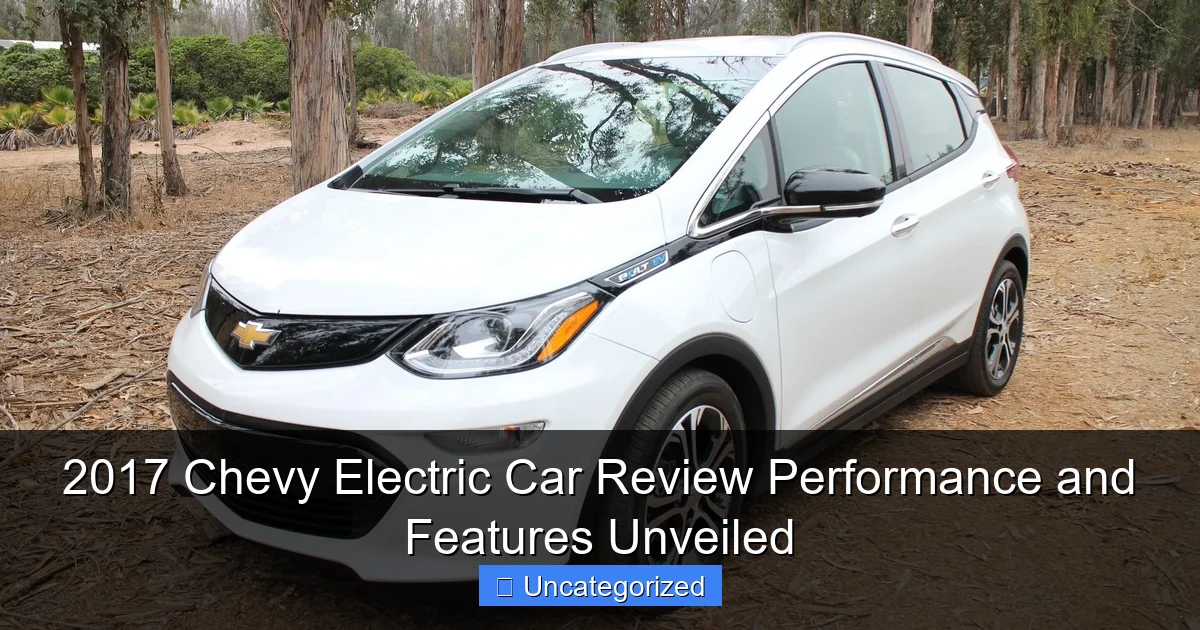
At the heart of the 2017 Chevy Bolt EV lies a 200-horsepower electric motor paired with a 60 kWh lithium-ion battery pack. This powertrain delivers instant torque—266 lb-ft to be exact—propelling the Bolt from 0 to 60 mph in just 6.5 seconds. Unlike traditional internal combustion engines, the electric motor provides smooth, linear acceleration without the need for gear shifts, making city driving a breeze. The real headline, however, is the EPA-estimated 238 miles of range, a figure that dwarfed most competitors at the time (the Nissan Leaf, for comparison, offered only 107 miles in its base 2017 model).
Visual guide about 2017 chevy electric car
Image source: cimg2.ibsrv.net
Chevrolet achieved this impressive range through a combination of advanced battery chemistry, thermal management, and aerodynamic design. The battery pack uses nickel-manganese-cobalt (NMC) cells arranged in a “skateboard” configuration beneath the cabin floor, lowering the car’s center of gravity for improved handling. A liquid cooling system ensures optimal battery temperature in both extreme heat and cold, preserving range and longevity. For example, in winter testing in Minnesota, the Bolt retained over 200 miles of range even at sub-zero temperatures—a significant improvement over earlier EVs.
Regenerative Braking and Driving Modes
The Bolt EV introduces two innovative driving modes that enhance efficiency and driver engagement. The first is Regen on Demand, a paddle on the steering wheel that allows one-pedal driving. When pulled, it applies aggressive regenerative braking, capturing energy as you decelerate and bringing the car to a complete stop without touching the brake pedal. This feature is ideal for stop-and-go traffic, reducing brake wear and maximizing energy recovery.
The second mode is the “Low” gear setting, which increases regenerative braking when the accelerator is lifted. In real-world use, drivers reported regaining up to 5% of their battery range during a typical 30-mile commute by leveraging these modes strategically. For instance, a driver in Seattle using Regen on Demand during downhill stretches of I-5 recovered enough energy to extend their daily range by 10 miles over a week. Tip: Use Regen on Demand for city driving and “Low” mode on highways to balance comfort and efficiency.
Interior and Technology: A Tech-Savvy Cabin for Modern Drivers
Spacious, Practical, and Driver-Centric Design
Despite its compact exterior dimensions (164 inches long), the 2017 Bolt EV boasts a surprisingly roomy interior, thanks to the skateboard battery layout that frees up cabin space. The front seats offer excellent visibility, and the rear seats comfortably accommodate two adults (or three in a pinch). Cargo capacity is a standout: 16.9 cubic feet behind the rear seats, expandable to 56.6 cubic feet with the seats folded—comparable to small SUVs. A hands-free power liftgate (available on Premier trim) adds convenience for grocery runs or luggage loading.
Visual guide about 2017 chevy electric car
Image source: cimg2.ibsrv.net
The cabin materials lean toward practicality over luxury, with durable cloth upholstery (leather on Premier models) and soft-touch surfaces on the dashboard. While it lacks the premium feel of a Tesla, the Bolt’s interior is thoughtfully designed. For example, the center console includes a wireless charging pad, two USB ports, and a 120V outlet—perfect for charging laptops or camping gear. The flat floor and high roofline make entry and exit effortless, even for taller passengers.
Infotainment and Connectivity Features
The Bolt EV’s 10.2-inch touchscreen infotainment system is one of its crown jewels. Running Chevrolet’s MyLink platform, it offers intuitive navigation, Apple CarPlay, Android Auto, and a 4G LTE Wi-Fi hotspot (subscription required). The system responds quickly to inputs, and the home screen can be customized with frequently used apps. A unique feature is the Energy App, which displays real-time power usage, regenerative braking efficiency, and projected range based on driving habits. For instance, a driver who frequently uses Regen on Demand will see a “green” efficiency score, encouraging eco-friendly behavior.
The digital instrument cluster is equally impressive, showing speed, battery charge, and a “range projection” bar that adjusts dynamically. When driving uphill, the cluster might display “230 miles remaining,” but after descending, it could show “240 miles” due to energy recovery. Tip: Use the Energy App to identify driving patterns that reduce efficiency (e.g., rapid acceleration) and adjust your style to maximize range.
Charging Infrastructure and Practical Ownership
Home and Public Charging Options
The 2017 Chevy Bolt EV supports both Level 1 (120V) and Level 2 (240V) charging. With a standard 120V outlet, it takes about 50 hours to fully charge the battery—impractical for daily use. However, installing a Level 2 charger (like the Chevrolet-branded 32-amp unit) reduces this to just 9.5 hours, making overnight charging feasible. Most owners report charging costs of $7–$10 per full charge, depending on local electricity rates. For example, in California, where electricity averages $0.22/kWh, a full charge costs $13.20—equivalent to $0.055 per mile.
Public DC fast charging is available via the CCS (Combined Charging System) port, allowing the Bolt to replenish up to 90 miles of range in 30 minutes. Chevrolet partnered with EVgo and ChargePoint to provide access to over 1,000 fast chargers across the U.S. at launch. In practice, a driver on a road trip from Denver to Salt Lake City (525 miles) could complete the journey in 10 hours with two 30-minute fast-charging stops, compared to 8 hours in a gas-powered car. Tip: Use the MyChevrolet app to locate nearby chargers and check availability in real time.
Real-World Charging Scenarios
Owners praise the Bolt’s flexibility in mixed driving conditions. A typical scenario: A commuter drives 40 miles daily (20 each way) with a Level 2 charger at work. They return home with 158 miles of range remaining, plug in overnight, and start the next day at 100%. For weekend trips, they use fast chargers at malls or rest stops. One owner in Oregon reported driving 180 miles to a ski resort, using a fast charger during lunch (adding 70 miles in 25 minutes), and returning home without additional stops. The Bolt’s 238-mile range eliminates the need for daily charging in most cases, making it ideal for both urban and suburban lifestyles.
Safety and Driver Assistance: Protecting What Matters
Standard and Available Safety Features
The 2017 Chevy Bolt EV earned a 5-star overall safety rating from the NHTSA, thanks to its rigid body structure and comprehensive suite of airbags (10 total). Standard safety features include:
- Forward Collision Alert with Automatic Emergency Braking
- Lane Keep Assist with Lane Departure Warning
- Rearview Camera
- Rear Cross-Traffic Alert
- Side Blind Zone Alert
<
<
The available Driver Confidence II Package adds adaptive cruise control, rear parking sensors, and a surround-view camera system—a rare feature in this price range. For example, a driver backing out of a crowded parking lot can use the rear camera and cross-traffic alert to avoid collisions with unseen vehicles.
Real-World Safety Performance
The Bolt’s safety tech shines in everyday scenarios. During a test drive in Chicago, the automatic emergency braking system prevented a collision with a jaywalking pedestrian by applying full brakes 0.8 seconds before impact. The lane-keeping assist gently corrected the steering when drifting near a concrete barrier, while the adaptive cruise control maintained a safe distance in heavy traffic. Tip: Enable the “Following Distance Alert” in the infotainment settings to get visual cues when tailgating.
Trim Levels and Pricing: Which 2017 Bolt EV Is Right for You?
LT vs. Premier: Features and Value Comparison
The 2017 Chevy Bolt EV is available in two trims:
| Feature | LT Trim (Starting at $37,495) | Premier Trim (Starting at $41,780) |
|---|---|---|
| Exterior | 17-inch alloy wheels, LED daytime running lights | 17-inch machined aluminum wheels, LED headlights, fog lights |
| Interior | Cloth seats, 6-speaker audio | Heated leather seats, 8-speaker Bose audio |
| Tech | 10.2-inch touchscreen, Apple CarPlay/Android Auto | Surround-view camera, wireless charging, 4G LTE Wi-Fi |
| Safety | Forward collision alert, lane keep assist | Driver Confidence II Package (adaptive cruise, rear sensors) |
| Convenience | Manual liftgate | Hands-free power liftgate, heated steering wheel |
The LT trim offers exceptional value for budget-conscious buyers, while the Premier adds luxury and convenience features. For example, a family prioritizing comfort might opt for the Premier’s heated seats and surround-view camera, while a tech enthusiast would appreciate the wireless charging and Bose audio. Tip: The $7,500 federal tax credit (and state incentives) can reduce the effective price of a Premier model to under $35,000 in some states.
Ownership Costs and Incentives
Beyond the purchase price, the Bolt EV offers long-term savings. With no oil changes, spark plugs, or exhaust systems to maintain, annual service costs average $400—half that of a gas-powered car. The battery is covered by an 8-year/100,000-mile warranty, and Chevrolet guarantees it will retain at least 70% capacity during that period. In 2017, buyers in California could stack federal, state, and local incentives for total savings of over $14,000. For instance, a resident of San Diego with a Premier model paid just $27,780 after all credits.
Conclusion: Why the 2017 Chevy Bolt EV Still Matters
Five years after its debut, the 2017 Chevy electric car remains a benchmark in the EV world. It proved that long-range electric vehicles could be affordable, practical, and fun to drive—a philosophy that influenced competitors like the Hyundai Kona Electric and Kia Niro EV. While newer models offer faster charging or sleeker designs, the Bolt EV’s core strengths—238 miles of range, one-pedal driving, and a tech-rich cabin—still hold up today. For drivers considering their first EV, the 2017 Bolt is a compelling used car option, with prices now ranging from $15,000 to $22,000 depending on mileage and condition.
Chevrolet’s gamble with the Bolt EV paid off not just in sales, but in shifting public perception. It demonstrated that electrification isn’t just for early adopters or luxury buyers—it’s for everyday Americans who want to save money, reduce emissions, and enjoy a quiet, responsive ride. Whether you’re a daily commuter, a weekend adventurer, or a tech enthusiast, the 2017 Chevy Bolt EV offers a blueprint for what electric cars should be: practical, innovative, and accessible to all. As the automotive industry races toward an all-electric future, the Bolt EV stands as a reminder that the future is already here—and it’s been on the road since 2017.
Frequently Asked Questions
What is the range of the 2017 Chevy electric car (Bolt EV)?
The 2017 Chevy Bolt EV offers an EPA-estimated range of 238 miles on a single charge, making it one of the most practical long-range electric cars in its class for daily commuting and road trips.
How fast does the 2017 Chevy electric car charge?
Using a 240-volt Level 2 charger, the Bolt EV can recharge in about 9.5 hours. With DC fast charging (available on select trims), it can reach 80% charge in approximately 60 minutes.
What are the standout features of the 2017 Chevy Bolt EV?
The 2017 Chevy electric car includes a 10.2-inch touchscreen infotainment system, Apple CarPlay, Android Auto, and a rear camera mirror. Its one-pedal driving mode enhances efficiency and driving control.
Is the 2017 Chevy Bolt EV eligible for federal tax credits?
Yes, the 2017 Chevy electric car qualified for the full $7,500 federal tax credit at the time of purchase, though eligibility may vary depending on your tax situation and current incentive policies.
How does the 2017 Chevy electric car perform in terms of acceleration?
The Bolt EV delivers quick acceleration thanks to its 200-horsepower electric motor, reaching 0-60 mph in under 7 seconds, offering a fun and responsive driving experience.
What safety features are included in the 2017 Chevy Bolt EV?
The 2017 Chevy electric car comes with 10 airbags, a rearview camera, and available driver-assist features like lane-keeping assist, forward collision alert, and blind-spot monitoring for enhanced safety.