Bright Orange Label Under Hood of Ford Electric Car Explained
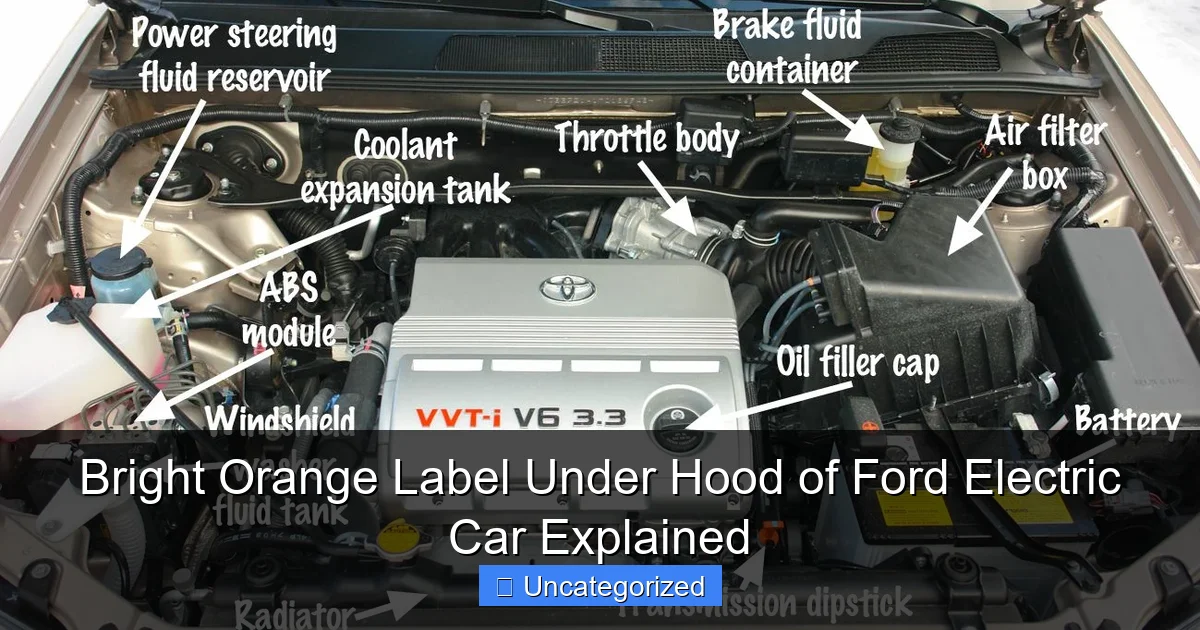
Featured image for bright orange label under hood of ford electric car differentiate
Image source: i.pinimg.com
The bright orange label under the hood of Ford electric cars signals high-voltage components, ensuring technician and owner safety during maintenance. This standardized warning differentiates EV systems from traditional engines, highlighting areas with live electrical circuits even when the vehicle is powered off. It’s a critical visual cue designed to prevent accidental contact and reinforce safe handling of the car’s advanced electric powertrain.
Key Takeaways
- Orange labels signal high-voltage components—never touch without proper training.
- Location matters: Found near battery, inverter, and motor connections for quick ID.
- Safety first: Always de-energize system before servicing labeled parts.
- Color standardization: Orange is industry-wide for EV high-voltage systems.
- Read manuals: Labels reference specific safety procedures in Ford’s guides.
- Inspect regularly: Ensure labels remain visible and undamaged over time.
📑 Table of Contents
- The Hidden Significance of the Bright Orange Label Under the Hood of a Ford Electric Car
- Why Is the Orange Label Used? Understanding the Safety Standard
- Components Marked with the Bright Orange Label: A Detailed Breakdown
- Safety Protocols: What to Do When You See the Orange Label
- How the Orange Label Enhances Maintenance and Troubleshooting
- Comparing Ford’s Orange Label System to Other EV Brands
- Conclusion: The Bright Orange Label Is More Than a Warning—It’s a Lifesaver
The Hidden Significance of the Bright Orange Label Under the Hood of a Ford Electric Car
When you pop open the hood of a modern Ford electric vehicle (EV), one striking feature immediately catches your eye: a bright orange label or tape wrapped around high-voltage components. It’s not just a design choice or a branding gimmick—this vivid orange marker is a critical safety and identification feature embedded deep into the engineering philosophy of Ford’s electric lineup, including the Mustang Mach-E, F-150 Lightning, and upcoming electric Transit vans. For new EV owners, technicians, and curious onlookers, this label often raises questions: What does it mean? Why orange? And why is it so prominent?
The bright orange label is more than just a visual cue—it’s a standardized warning system that communicates the presence of high-voltage electrical systems capable of delivering lethal currents. Unlike traditional internal combustion engine (ICE) vehicles, where the most dangerous components are often mechanical (belts, pulleys, hot surfaces), EVs store and distribute massive amounts of electrical energy in their powertrains. This energy, typically ranging from 300 to 800 volts DC, poses unique hazards during maintenance, repairs, or emergency situations. The orange label serves as a universal alert to first responders, mechanics, and even owners, signaling that special procedures and protective gear are required before any work begins. In this article, we’ll dive deep into the purpose, standards, safety protocols, and real-world implications of the bright orange label under the hood of Ford electric cars—and why it matters for everyone from DIY enthusiasts to professional service technicians.
Why Is the Orange Label Used? Understanding the Safety Standard
The Role of High-Voltage Electrical Systems in EVs
Electric vehicles rely on high-voltage (HV) systems to power the electric motor, charge the battery, and run auxiliary components like air conditioning and heating. These systems operate at voltages far higher than the standard 12-volt auxiliary battery found in all vehicles. For example, the Ford Mustang Mach-E operates at a nominal voltage of 400 volts, while the F-150 Lightning’s extended-range battery pack can reach 475 volts. Some newer models are transitioning to 800-volt architectures to enable ultra-fast charging and improved efficiency.
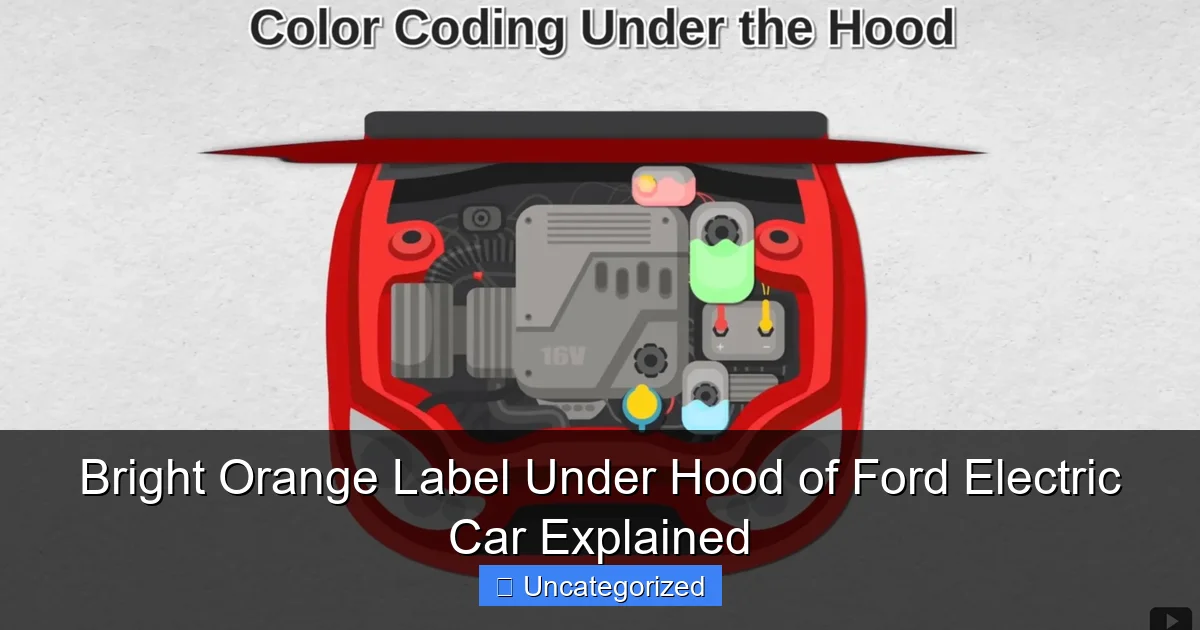
Visual guide about bright orange label under hood of ford electric car differentiate
Image source: the-sun.com
At these voltage levels, electrical hazards are not just theoretical—they are immediate and potentially fatal. A direct contact with a live high-voltage wire can cause severe burns, cardiac arrest, or even death. Unlike mechanical systems, electrical energy cannot be “turned off” simply by stopping the engine. Even when the vehicle is powered down, the high-voltage battery retains its charge, creating a persistent danger. The bright orange label is a visual safeguard designed to prevent accidental contact with these energized components.
Global Safety Standards and Color Coding
The use of orange for high-voltage identification is not unique to Ford—it follows global safety standards established by organizations such as:
- ISO 6469-3: International standard for electric road vehicle safety, specifying requirements for protection against electric shock.
- SAE J1772: North American standard for EV charging and safety, including labeling and insulation.
- NFPA 70E: U.S. standard for electrical safety in the workplace, which mandates high-visibility labeling for hazardous energy sources.
These standards mandate that all high-voltage components in EVs—including cables, connectors, junction boxes, and power electronics—must be clearly marked with bright orange insulation or labeling. This includes:
- Orange sheathing on high-voltage cables
- Orange warning labels on battery enclosures and inverters
- Orange tape or decals on service disconnects and HV contactors
Ford adheres strictly to these standards. The orange color is specifically chosen because it is highly visible, even in low-light conditions or under emergency lighting. It contrasts sharply with the black, gray, and metallic components typical under the hood, ensuring that the warning is not missed.
Real-World Example: Mustang Mach-E Service Manual
In the official Ford Mustang Mach-E service manual, technicians are instructed to “immediately recognize and respect all bright orange components as high-voltage hazards.” The manual includes diagrams showing the entire high-voltage circuit, from the battery pack to the electric drive unit, with every orange-marked part clearly labeled. For instance, the orange cable running from the battery to the inverter carries over 400 volts and must be treated with the same caution as a live power line during grid maintenance.
Components Marked with the Bright Orange Label: A Detailed Breakdown
High-Voltage Cables (Traction Cables)
The most common sight under the hood of a Ford EV is the thick, orange-sheathed cables connecting the battery pack, inverter, motor, and DC-DC converter. These cables are designed to handle hundreds of amps of current and are insulated with materials that resist heat, abrasion, and moisture. The orange color ensures that even if the cable is partially exposed, the hazard is immediately visible.
Tip for owners: Never attempt to cut, splice, or repair orange high-voltage cables yourself. These cables are factory-sealed and must be replaced as a complete assembly by certified technicians using specialized tools and safety protocols.
High-Voltage Junction Box (HVJB) and Service Disconnect
The high-voltage junction box, often located near the front of the engine bay, acts as the central distribution point for the EV’s electrical system. It contains fuses, relays, and a service disconnect—a manual switch that cuts power from the battery to the rest of the system. The entire HVJB is typically enclosed in a bright orange housing or labeled with orange warning stickers.
The service disconnect is a critical safety feature. Before performing any work on the high-voltage system, technicians must:
- Turn off the ignition and remove the key (or disable the vehicle via the app).
- Open the service disconnect (usually a bright orange lever or plug).
- Wait 5–10 minutes for capacitors to discharge.
- Verify zero voltage using a high-voltage meter.
This procedure is mandatory and is emphasized in Ford’s technician training programs. The bright orange color of the disconnect lever makes it easy to locate during emergencies, such as a crash or fire.
DC-DC Converter and On-Board Charger
Ford EVs use a DC-DC converter to step down the high-voltage DC from the battery to 12 volts to power the vehicle’s lights, infotainment, and control modules. The converter and its associated wiring are also marked with orange labels. Similarly, the on-board charger (which converts AC from the grid to DC for battery charging) is housed in an orange-tagged enclosure.
Example: In the F-150 Lightning, the DC-DC converter is located behind the front bumper, accessible by removing a cover. The cover itself has a bright orange warning sticker: “Danger: High Voltage. Do Not Remove Without De-Energizing.”
Electric Drive Unit (EDU) and Inverter
The electric drive unit combines the motor and inverter into a single assembly. The inverter converts DC from the battery into three-phase AC to power the motor. Because it handles high voltage and current, the inverter housing and its connections are clearly marked in orange. In some models, the entire EDU housing is orange or has large orange warning decals.
During a recent Ford service training session in Texas, technicians were shown how to safely disconnect the inverter for replacement. The instructor emphasized: “The moment you see orange, you stop and follow the HV shutdown procedure. No exceptions.”
Safety Protocols: What to Do When You See the Orange Label
For Vehicle Owners and DIY Enthusiasts
Many Ford EV owners are accustomed to performing basic maintenance like oil changes and tire rotations. However, EVs require a different mindset. The presence of the bright orange label should immediately signal: “Stop. Think. Don’t touch.”
Here are essential safety tips for owners:
- Never open orange-covered enclosures unless you are a certified EV technician.
- Do not use conductive tools (e.g., metal wrenches) near orange cables.
- Always assume high-voltage components are live, even if the car is off.
- Use insulated gloves and tools if you must perform any work near the engine bay (e.g., checking coolant levels).
- Keep the service disconnect engaged if you’re storing the vehicle for long periods (consult the manual).
Real-life incident: In 2022, a DIY mechanic in Colorado attempted to replace a coolant pump on his F-150 Lightning without disconnecting the high-voltage system. He accidentally brushed against an orange cable with a metal socket, causing an arc flash that damaged the inverter and required a $4,000 repair. Ford later issued a bulletin reminding owners to “respect the orange.”
For Emergency Responders (First Responders)
Firefighters, paramedics, and police officers are trained to recognize the orange label as part of EV emergency response protocols. The National Fire Protection Association (NFPA) provides free training materials that include:
- How to identify EVs by the orange labels and lack of exhaust pipes
- Where to find the high-voltage service disconnect (usually under the hood or in the trunk)
- How to safely extricate occupants without cutting orange cables
- Use of thermal imaging to detect hotspots in battery packs
Ford provides Emergency Response Guides (ERGs) for all its EVs, available online and in print. These guides include QR codes that link to video tutorials showing how to safely disable the high-voltage system. The bright orange label is the first visual cue responders use to initiate EV-specific procedures.
For Service Technicians
Certified Ford EV technicians undergo rigorous training in high-voltage safety. They use:
- Insulated gloves rated for 1,000 volts
- Face shields and flame-resistant clothing
- High-voltage meters to verify de-energization
- Lockout/tagout (LOTO) procedures to prevent accidental re-energizing
Technicians are also required to wear arc-flash-rated PPE when working on or near orange components. Ford’s training includes simulated high-voltage faults to prepare technicians for real-world scenarios.
How the Orange Label Enhances Maintenance and Troubleshooting
Faster Diagnosis and Repair
The bright orange labeling system isn’t just about safety—it also improves efficiency. By clearly marking high-voltage components, technicians can quickly identify which parts are part of the HV system, reducing diagnosis time. For example, if the vehicle won’t start, a technician can immediately rule out the orange-marked inverter or battery pack as the source of the issue (or confirm it) without disassembling non-HV components.
Ford’s diagnostic software, FordPass Pro, integrates with the orange labeling system. When a fault code is detected, the software highlights the affected component in orange on a 3D schematic, guiding the technician to the correct location.
Preventing Cross-Contamination with 12-Volt Systems
EVs have two electrical systems: high-voltage (orange) and low-voltage (black/white). The orange label helps prevent technicians from accidentally connecting 12-volt tools (like jump starters) to the wrong system. For instance, the 12-volt battery in a Ford EV is typically black, while the HV battery is orange. This color contrast reduces the risk of catastrophic damage.
Tip: Always use a high-voltage meter to test orange components. Never use a standard multimeter, which is not rated for high voltage and can explode if misused.
Training and Certification Programs
Ford partners with community colleges and technical schools to offer EV technician certification programs. These programs emphasize the importance of the orange label in safety and repair workflows. Students learn to:
- Identify all orange components in a Ford EV
- Follow proper shutdown and verification procedures
- Use insulated tools and PPE correctly
- Interpret warning labels and schematics
Graduates receive a Ford High-Voltage Safety Certification, which is required for employment at Ford-certified EV repair centers.
Comparing Ford’s Orange Label System to Other EV Brands
Standardization Across the Industry
While Ford uses bright orange labeling, other automakers follow the same global standards. Here’s how Ford compares to key competitors:
| Brand | HV Label Color | Service Disconnect Location | Emergency Response Guide | Notable Features |
|---|---|---|---|---|
| Ford (Mach-E, F-150 Lightning) | Bright Orange | Under hood (orange lever) | FordPass Pro, QR codes | Orange tape on all HV cables; detailed ERG |
| Tesla (Model Y, 3, S) | Orange | Trunk (under floor mat) | Tesla First Responder Guide | Orange insulation; battery pack labeled in orange |
| Chevrolet (Bolt EV) | Orange | Under hood (orange plug) | GM EV First Responder Guide | Orange warning stickers on all HV parts |
| Hyundai (Ioniq 5) | Orange | Under hood (orange switch) | Hyundai Emergency Response Manual | Orange cable sheathing; 800V system |
| BMW (i4) | Orange | Under hood (orange handle) | BMW EV Safety Guide | Orange labels with multilingual warnings |
As the table shows, Ford’s system is consistent with industry best practices. The bright orange label is universal, and the service disconnect is always clearly marked and easily accessible. Ford’s use of QR codes in its emergency response guides gives it an edge in accessibility, allowing first responders to access real-time safety information via smartphone.
Unique Features in Ford’s Approach
Ford goes beyond the minimum requirements by:
- Using orange tape on every high-voltage cable, even short jumper wires
- Labeling HV battery enclosures with large, multilingual warning decals
- Providing interactive training modules for technicians and first responders
- Offering free safety workshops at dealerships for local fire departments
This proactive approach has earned Ford recognition from safety organizations, including the National Safety Council.
Conclusion: The Bright Orange Label Is More Than a Warning—It’s a Lifesaver
The bright orange label under the hood of a Ford electric car is a powerful symbol of innovation, safety, and responsibility. It’s not just a piece of tape or a sticker—it’s a critical component of a comprehensive safety ecosystem that protects vehicle owners, service technicians, and emergency responders. From the Mustang Mach-E to the F-150 Lightning, Ford has embedded this high-visibility warning into every aspect of its EV design, ensuring that high-voltage hazards are never overlooked.
As electric vehicles become more common, understanding the meaning of the orange label will become essential knowledge for everyone. Whether you’re a new EV owner, a weekend mechanic, or a firefighter responding to a crash, that bright orange color should always trigger a moment of caution. It reminds us that while EVs are cleaner, quieter, and more efficient than traditional cars, they come with unique risks that demand respect and awareness.
By adhering to global safety standards, investing in training, and designing intuitive warning systems, Ford is setting a benchmark for EV safety. The next time you open the hood of your Ford electric car, take a moment to appreciate the bright orange label—not just as a warning, but as a promise: that your vehicle is engineered to protect you, even in the most dangerous situations. Respect the orange. Stay safe. Drive electric with confidence.
Frequently Asked Questions
What does the bright orange label under the hood of a Ford electric car mean?
The bright orange label under the hood of a Ford electric car identifies high-voltage components, ensuring safety for technicians and first responders. It serves as a visual warning for areas with dangerous electrical current.
Why is there a bright orange label in my Ford EV’s engine compartment?
The bright orange label in your Ford EV’s engine compartment highlights high-voltage wiring and parts, distinguishing them from 12V systems. This color-coding aligns with industry standards for electric vehicle safety.
Is the bright orange label under the hood unique to Ford electric cars?
While Ford uses the bright orange label under the hood for high-voltage systems, other automakers use similar color-coding (e.g., orange cables). The label’s design and placement may vary by brand but follow universal EV safety guidelines.
Can I touch the components marked with the bright orange label in my Ford EV?
No, never touch components marked with the bright orange label, as they carry high voltage even when the car is off. Always consult a certified technician for maintenance to avoid serious injury.
Does the bright orange label affect the maintenance of my Ford electric car?
The bright orange label helps mechanics quickly identify high-voltage systems, ensuring proper safety protocols during repairs. Routine maintenance of non-high-voltage parts (e.g., cabin air filter) remains unaffected.
Are there regulations requiring the bright orange label under the hood of Ford EVs?
Yes, global safety standards (e.g., UNECE R100) mandate high-voltage components in EVs be marked with bright orange labels. Ford complies with these rules to ensure technician and owner safety.