Chevy Bolt 2017 Electric Car Review Pros Cons and Performance
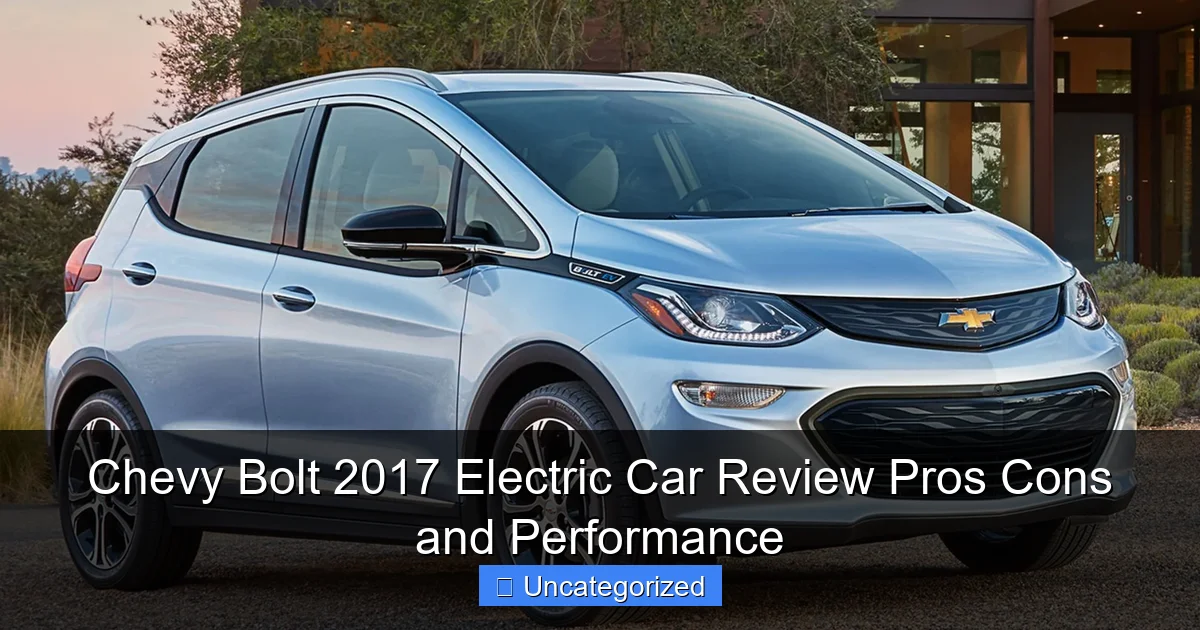
Featured image for chevy bolt 2017 electric car
Image source: blog.applechevy.com
The 2017 Chevy Bolt redefines affordable electric mobility with an impressive 238-mile range and nimble handling, making it a top contender in the EV market. While its cabin feels basic and fast-charging isn’t standard, the Bolt delivers outstanding value, zippy acceleration, and a tech-forward driving experience at a competitive price. It’s a game-changer for daily commuters seeking efficiency without compromise.
Key Takeaways
- Affordable EV: Priced competitively for budget-conscious electric car buyers.
- 238-mile range: Class-leading range for daily commutes and road trips.
- Quick acceleration: 0-60 mph in 6.5 seconds, fun to drive.
- Spacious interior: Roomy cabin and cargo space for its compact size.
- Regen braking: One-pedal driving enhances efficiency and control.
- Limited fast charging: Lacks widespread DC fast charging support.
📑 Table of Contents
- The Dawn of an Electric Era: The 2017 Chevy Bolt EV
- Performance and Powertrain: Where the Bolt Shines
- Design and Interior: Practicality Meets Innovation
- Technology and Safety: Smarts for the Modern Driver
- Pros and Cons: Weighing the Bolt’s Strengths and Weaknesses
- Ownership Experience and Long-Term Value
- Final Verdict: A Pioneer with Lasting Impact
The Dawn of an Electric Era: The 2017 Chevy Bolt EV
The automotive world was abuzz in 2017 with the arrival of the Chevy Bolt EV, a groundbreaking vehicle that signaled General Motors’ serious commitment to electric mobility. At a time when most electric cars were either luxury-priced or limited in range, the Bolt emerged as a game-changer, offering over 200 miles of range at an affordable price point. With a starting MSRP of just $37,495 (before incentives), it shattered the myth that practical EVs had to cost a fortune. For environmentally conscious drivers, tech enthusiasts, and budget-savvy commuters, the 2017 Bolt wasn’t just a car—it was a promise of a cleaner, more efficient future.
But what truly set the Bolt apart wasn’t just its price or range. It was the culmination of smart engineering, intuitive design, and a focus on real-world usability. From its compact yet spacious interior to its responsive handling, the Bolt aimed to prove that electric cars could be both practical and enjoyable. In this comprehensive review, we’ll dissect every aspect of the 2017 Chevy Bolt EV, from its performance metrics to its daily usability, helping you decide if it’s the right electric car for your lifestyle. Whether you’re a first-time EV buyer or a seasoned green driver, the Bolt’s story is one of innovation, compromise, and a bold step toward the future.
Performance and Powertrain: Where the Bolt Shines
Electric Powertrain Specifications
The heart of the 2017 Chevy Bolt is its 60 kWh lithium-ion battery pack and a single permanent-magnet electric motor mounted on the front axle. This setup delivers 200 horsepower and 266 lb-ft of torque, providing instant acceleration that’s characteristic of electric vehicles. Unlike internal combustion engines, the Bolt’s motor produces maximum torque from 0 RPM, resulting in a 0-60 mph time of approximately 6.5 seconds—a figure that outpaces many gas-powered compact cars in its class.

Visual guide about chevy bolt 2017 electric car
Image source: images.hgmsites.net
One of the Bolt’s most impressive achievements is its Environmental Protection Agency (EPA)-rated 238 miles of range on a single charge. This was a monumental leap in 2017, surpassing rivals like the Nissan Leaf (107 miles) and the BMW i3 (114 miles). For daily commuters, this range translates to over a week of typical driving without needing a recharge, making it ideal for city dwellers and suburban drivers alike.
Regenerative Braking and Driving Modes
Chevy equipped the Bolt with two levels of regenerative braking: standard and one-pedal driving. The latter, activated via a paddle on the steering wheel, allows drivers to decelerate and even come to a complete stop using only the accelerator pedal. This feature not only enhances efficiency by recapturing energy during braking but also reduces wear on the mechanical brake system.
- Standard mode: Regen kicks in when lifting off the accelerator, similar to engine braking in a gas car.
- One-pedal mode: Stronger regen slows the car significantly; ideal for stop-and-go traffic.
- Tip: Use one-pedal driving in urban areas to maximize energy recovery and reduce brake dust.
For example, a driver navigating downtown traffic can maintain speed and stop without touching the brake pedal, reducing fatigue and increasing range by up to 10% in city conditions.
Charging Capabilities and Real-World Efficiency
The Bolt supports both Level 1 (120V) and Level 2 (240V) charging, with the latter being far more practical for daily use. A full charge using a Level 2 charger (like a 7.2 kW home unit) takes about 9.5 hours, while Level 1 charging can take up to 60 hours—impractical for most users.
DC fast charging is available via the CCS (Combined Charging System) port, allowing the Bolt to regain 90 miles of range in 30 minutes when connected to a 50 kW charger. While this isn’t as fast as newer 150+ kW systems, it was competitive in 2017. For road trips, this means a 30-minute stop every 150 miles, making cross-country travel feasible.
Real-world efficiency averages 28-30 kWh per 100 miles, translating to an energy cost of about $3.50 per 100 miles (based on $0.12/kWh). Compared to a gas car averaging 30 mpg at $3.50/gallon (~$11.70 per 100 miles), the Bolt slashes fuel costs by over 70%.
Design and Interior: Practicality Meets Innovation
Exterior Styling and Aerodynamics
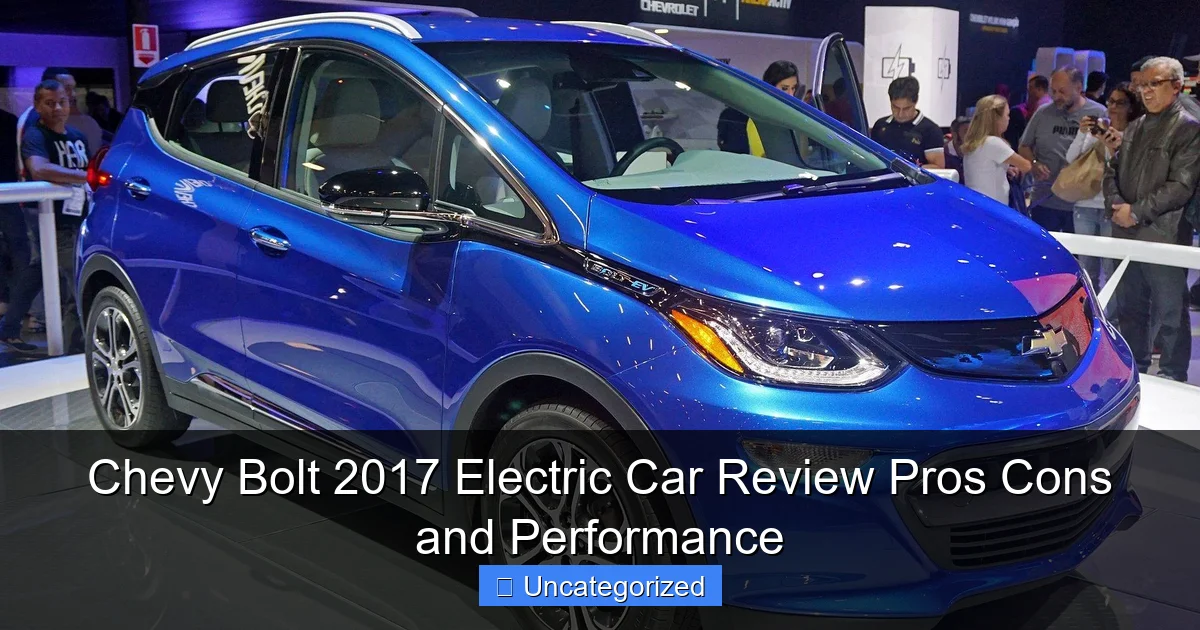
The 2017 Bolt’s exterior is a blend of futuristic flair and functional design. Its tall hatchback profile, short overhangs, and sloped roofline contribute to a drag coefficient of 0.32 Cd, which is excellent for a compact car. The front fascia features a closed-off grille (a hallmark of EVs) and LED daytime running lights, while the rear boasts a full-width light bar that gives it a distinctive nighttime signature.
Visual guide about chevy bolt 2017 electric car
Image source: carspecs.us
Available in colors like Kinetic Blue, Arctic Blue, and Mosaic Black, the Bolt stands out without being flashy. Its 17-inch aluminum wheels are designed for low rolling resistance, further enhancing efficiency. While some may find the styling polarizing, the design prioritizes aerodynamics and visibility—key factors in urban driving.
Interior Space and Materials
Step inside, and the Bolt surprises with its spaciousness. Despite its compact exterior (164 inches long), the interior feels airy thanks to a flat floor, tall roofline, and clever packaging. The battery is mounted under the floor, freeing up space for passengers and cargo.
- Front seats: Comfortable and supportive, with ample legroom for drivers up to 6’2″.
- Rear seats: Accommodate two adults or three kids; 36 inches of legroom is competitive for the class.
- Cargo space: 16.9 cubic feet behind the rear seats, expanding to 56.6 cubic feet with seats folded.
Materials are mostly hard plastics, but Chevy uses soft-touch surfaces on the dashboard and door armrests. The seats are available in cloth or leatherette, with the latter offering a more premium feel. While not luxury-level, the cabin is well-assembled and feels durable for daily use.
Infotainment and Connectivity
The Bolt comes standard with an 8-inch touchscreen infotainment system running Chevrolet’s MyLink software. It includes Apple CarPlay, Android Auto, Bluetooth, and a 4G LTE Wi-Fi hotspot. The interface is intuitive, with large icons and quick response times.
Key features include:
- Navigation: Integrated with charging station locations and range estimates.
- Energy monitoring: Real-time power usage, regen efficiency, and trip statistics.
- Remote control: The MyChevrolet app allows remote climate control, charging start/stop, and vehicle location tracking.
Pro tip: Use the “Energy” screen during drives to monitor how speed, climate control, and terrain affect range. For instance, maintaining 60 mph on a flat highway uses 20% less energy than 75 mph.
Technology and Safety: Smarts for the Modern Driver
Driver Assistance Features
The 2017 Bolt was ahead of its time in offering advanced safety tech. Standard features include:
- Forward Collision Alert: Warns of impending collisions.
- Lane Keep Assist with Lane Departure Warning: Gently corrects steering if the car drifts.
- Rear Cross-Traffic Alert: Detects vehicles approaching from the sides when reversing.
The Premier trim adds blind-spot monitoring, automatic emergency braking, and a surround-view camera system. While not a full self-driving suite, these features significantly reduce driver fatigue and accident risk. For example, the surround-view camera is invaluable when parking in tight urban spaces—a common scenario for EV owners.
Smart Energy Management
The Bolt’s energy management system is a standout feature. It allows drivers to:
- Set charging schedules to take advantage of off-peak electricity rates.
- Pre-condition the cabin while plugged in (saves battery range).
- Monitor regen efficiency and adjust driving style for maximum range.
Real-world example: A driver in California can schedule charging from 10 PM to 6 AM (when electricity rates are lowest) and pre-cool the cabin at 7:30 AM before leaving for work, all without draining the battery.
Over-the-Air Updates and Connectivity
While not as advanced as Tesla’s system, the Bolt supports over-the-air (OTA) updates for the infotainment and charging systems. These updates can improve navigation, add new features, or fix bugs. The 4G LTE connection also enables real-time traffic data and weather alerts, enhancing route planning.
Tip: Always keep the car connected to Wi-Fi at home to ensure updates download automatically.
Pros and Cons: Weighing the Bolt’s Strengths and Weaknesses
Pros: Why the Bolt Stands Out
- Class-leading range: 238 miles was unheard of for a sub-$40K EV in 2017.
- Affordable pricing: After federal tax credits ($7,500 in the U.S.), the effective price drops to $30K.
- Responsive handling: Tight turning radius (35.4 ft) and low center of gravity make it agile in cities.
- Spacious interior: More legroom than many compact SUVs.
- Low running costs: Estimated $450/year for electricity vs. $1,200+ for gas.
Practical example: A family with a 30-mile daily commute saves over $700/year on fuel alone, not accounting for lower maintenance costs.
Cons: Areas for Improvement
- Slow DC charging: 50 kW max limits road trip speed; newer EVs charge at 150+ kW.
- Basic interior materials: Hard plastics and lack of luxury touches may deter some buyers.
- No all-wheel drive: A limitation in snowy climates compared to rivals like the Kia Niro EV.
- Limited rear visibility: Thick rear pillars and high hatchback design reduce visibility.
- Regen paddle ergonomics: The paddle is small and can be awkward to use frequently.
Tip: For drivers in cold climates, pre-heating the cabin while plugged in minimizes battery drain. Use seat heaters instead of the cabin heater when possible—they use less energy.
Ownership Experience and Long-Term Value
Maintenance and Reliability
Electric cars like the Bolt have fewer moving parts than gas vehicles, resulting in lower maintenance costs. No oil changes, spark plugs, or transmission fluid are needed. Key maintenance items include:
- Tire rotations (every 7,500 miles).
- Brake fluid replacement (every 2 years).
- HVAC filter replacement (annually).
The 2017 Bolt has proven reliable, with few major issues reported. However, some owners noted battery degradation in extreme climates. Chevy’s 8-year/100,000-mile battery warranty provides peace of mind. Tip: Avoid leaving the car at 100% or 0% charge for extended periods to prolong battery life.
Resale Value and Incentives
The Bolt holds its value well for an EV, with 3-year depreciation averaging 35%—better than the industry average. Federal tax credits and state rebates (e.g., $2,000 in California) further improve value. Used Bolt prices in 2023 range from $12,000 to $18,000, making it an excellent used EV option.
Data Table: 2017 Chevy Bolt EV Key Specifications
| Category | Specification |
|---|---|
| Motor Power | 200 hp, 266 lb-ft torque |
| Battery Capacity | 60 kWh lithium-ion |
| Range (EPA) | 238 miles |
| 0-60 mph | 6.5 seconds |
| Charging (Level 2) | 9.5 hours (7.2 kW) |
| DC Fast Charging | 90 miles in 30 minutes (50 kW) |
| Cargo Space | 16.9 cu ft (rear seats up), 56.6 cu ft (seats down) |
| Starting MSRP | $37,495 |
Real-World Ownership Stories
Owners praise the Bolt for its practicality. One family in Colorado uses it for ski trips, noting that pre-heating the car in the garage minimizes battery drain in cold weather. A delivery driver in New York City reports averaging 300 miles between charges thanks to regen braking in traffic. However, some note that the infotainment system can freeze occasionally—a fixable issue with a reboot.
Final Verdict: A Pioneer with Lasting Impact
The 2017 Chevy Bolt EV wasn’t just a car—it was a statement. It proved that electric vehicles could be affordable, practical, and desirable without sacrificing range or performance. While newer EVs have surpassed it in speed, charging, and tech, the Bolt’s legacy endures. Its combination of 238-mile range, intuitive tech, and low running costs made it a benchmark for mass-market EVs.
For buyers today, the 2017 Bolt remains a smart choice, especially as a used vehicle. It’s ideal for:
- Urban commuters needing a reliable, efficient daily driver.
- Eco-conscious families wanting to reduce their carbon footprint.
- Tech-savvy drivers who appreciate smart energy management and connectivity.
Yes, it has flaws—slow DC charging, a basic interior, and limited rear visibility—but its strengths far outweigh its weaknesses. The Bolt’s true triumph is its role in accelerating the adoption of electric vehicles. By making EVs accessible to the mainstream, it paved the way for the electric revolution we see today. In the annals of automotive history, the 2017 Chevy Bolt will be remembered not just as a car, but as a catalyst for change.
Frequently Asked Questions
What is the range of the 2017 Chevy Bolt electric car?
The 2017 Chevy Bolt offers an EPA-estimated range of 238 miles on a full charge, making it one of the most practical long-range EVs in its price class. This range is ideal for daily commutes and even longer weekend trips with proper planning.
How fast does the Chevy Bolt 2017 charge?
The 2017 Chevy Bolt can charge at a rate of up to 80% in about 30 minutes using a DC fast charger (50 kW). With a standard Level 2 (240V) charger, a full charge takes roughly 9.5 hours, perfect for overnight charging.
Is the Chevy Bolt 2017 a good value compared to other electric cars?
Yes, the 2017 Chevy Bolt delivers excellent value with its long range, affordable price point, and strong standard features. It undercuts rivals like the Tesla Model 3 while offering comparable interior space and tech, making it a smart buy in the used EV market.
What are the main pros and cons of the 2017 Chevy Bolt electric car?
Pros include its impressive 238-mile range, nimble handling, and roomy hatchback interior. Cons involve a stiff ride, limited fast-charging speed compared to newer EVs, and a cabin with some hard plastics.
Does the 2017 Chevy Bolt have enough power for highway driving?
Absolutely. The Bolt’s 200-hp electric motor delivers instant torque, enabling quick acceleration from 0–60 mph in 6.5 seconds. It feels confident on highways, with smooth passing power and responsive steering for an enjoyable driving experience.
What safety features come standard on the 2017 Chevy Bolt electric car?
The 2017 Bolt includes standard features like 10 airbags, a rearview camera, and StabiliTrak electronic stability control. Available advanced safety tech includes forward collision alert, lane-keep assist, and blind-spot monitoring, enhancing driver confidence.