Chevy Bolt Electric Car 2018 Review Performance and Value

Featured image for chevy bolt electric car 2018
Image source: cdn.bmwblog.com
The 2018 Chevy Bolt delivers exceptional value as an affordable, long-range electric car with an EPA-estimated 238 miles on a single charge. Zippy acceleration and a well-tuned suspension make it fun to drive, while its spacious, tech-forward interior and low operating costs solidify its position as a top contender in the EV market. No other electric vehicle at this price point offers such a compelling blend of range, performance, and practicality.
Key Takeaways
- Affordable pricing: The 2018 Chevy Bolt offers great value under $30K after incentives.
- 238-mile range: Competitive EPA range for daily commutes and weekend trips.
- Quick acceleration: Instant torque delivers fun, responsive city and highway driving.
- Spacious interior: Roomy cabin and cargo area maximize practicality for its size.
- Regen braking: One-pedal driving enhances efficiency and reduces brake wear.
- Infotainment shines: User-friendly touchscreen with Apple CarPlay and Android Auto standard.
📑 Table of Contents
- Chevy Bolt Electric Car 2018: A Groundbreaking Leap in Affordable EVs
- Performance and Driving Experience: Power, Range, and Efficiency
- Interior Design and Technology: Space, Comfort, and Innovation
- Value and Cost of Ownership: Affordability Meets Long-Term Savings
- Competitors and Market Position: How the Bolt Stacks Up
- Common Issues and Reliability: What Owners Report
- Conclusion: The Bolt’s Enduring Appeal
Chevy Bolt Electric Car 2018: A Groundbreaking Leap in Affordable EVs
The 2018 Chevy Bolt EV burst onto the scene as a game-changer in the electric vehicle (EV) market, offering a compelling mix of long-range capability, practical design, and accessible pricing. At a time when most EVs struggled to break the 200-mile barrier or carried luxury price tags, the Bolt delivered an EPA-estimated 238 miles of range for under $37,500 (before incentives). This combination made it one of the first truly viable options for drivers seeking to go electric without breaking the bank. Whether you’re a city dweller navigating stop-and-go traffic or a suburban commuter with longer daily drives, the Bolt’s range and efficiency addressed the core anxieties of early EV adopters.
But the Bolt isn’t just about range. It represents a bold step toward democratizing electric mobility. With its hatchback practicality, intuitive technology, and surprising driving dynamics, the 2018 model proved that EVs could be both fun and functional. For environmentally conscious buyers, the Bolt’s zero-emission drivetrain and energy-saving features like regenerative braking made it a standout. Meanwhile, its competitive pricing—further reduced by federal tax credits and state incentives—positioned it as a value-packed alternative to gas-powered compact cars. In this review, we’ll dive deep into the Bolt’s performance, features, and real-world usability to see if it lives up to its revolutionary reputation.
Performance and Driving Experience: Power, Range, and Efficiency
The 2018 Chevy Bolt EV is powered by a single electric motor producing 200 horsepower and 266 lb-ft of torque, paired with a 60 kWh lithium-ion battery pack. Unlike gas-powered cars, electric motors deliver instant torque, giving the Bolt a punchy 0-60 mph time of around 6.5 seconds—faster than many compact SUVs and hot hatches. This responsiveness makes it ideal for urban driving, where quick acceleration from traffic lights and merging onto highways is crucial.

Visual guide about chevy bolt electric car 2018
Image source: c8.alamy.com
Range and Real-World Usability
The Bolt’s headline-grabbing 238-mile EPA range was a breakthrough in 2018, surpassing rivals like the Nissan Leaf (150 miles) and Tesla Model 3 (220 miles at the time). In real-world driving, owners reported consistent range between 200–240 miles, depending on driving habits and conditions. For example, a driver in a temperate climate might achieve 230 miles on a single charge with moderate speeds and minimal HVAC use. However, extreme cold (<32°F) can reduce range by 30–40% due to battery efficiency loss and increased energy demands for cabin heating.
- Tip: Use the Bolt’s “Eco” mode to maximize range by limiting HVAC output and smoothing acceleration.
- Tip: Precondition the battery while plugged in during winter to reduce cold-weather range loss.
Regen Braking and Driving Modes
The Bolt features two regenerative braking systems: standard regen and “One-Pedal Driving” (activated via the steering-wheel paddle). In One-Pedal mode, lifting off the accelerator triggers strong regenerative braking, allowing the car to decelerate to a stop without touching the brake pedal. This not only improves efficiency (recapturing up to 20% of energy) but also simplifies city driving. For instance, a driver navigating downtown traffic can use the accelerator pedal alone to accelerate, coast, and stop.
Additionally, the Bolt offers three drive modes: Normal, Sport, and Mountain. Sport mode sharpens throttle response for spirited driving, while Mountain mode reserves battery power for steep climbs. Most drivers stick to Normal for daily use, but Sport mode adds a fun, zippy feel to highway merges.
Charging Options and Speed
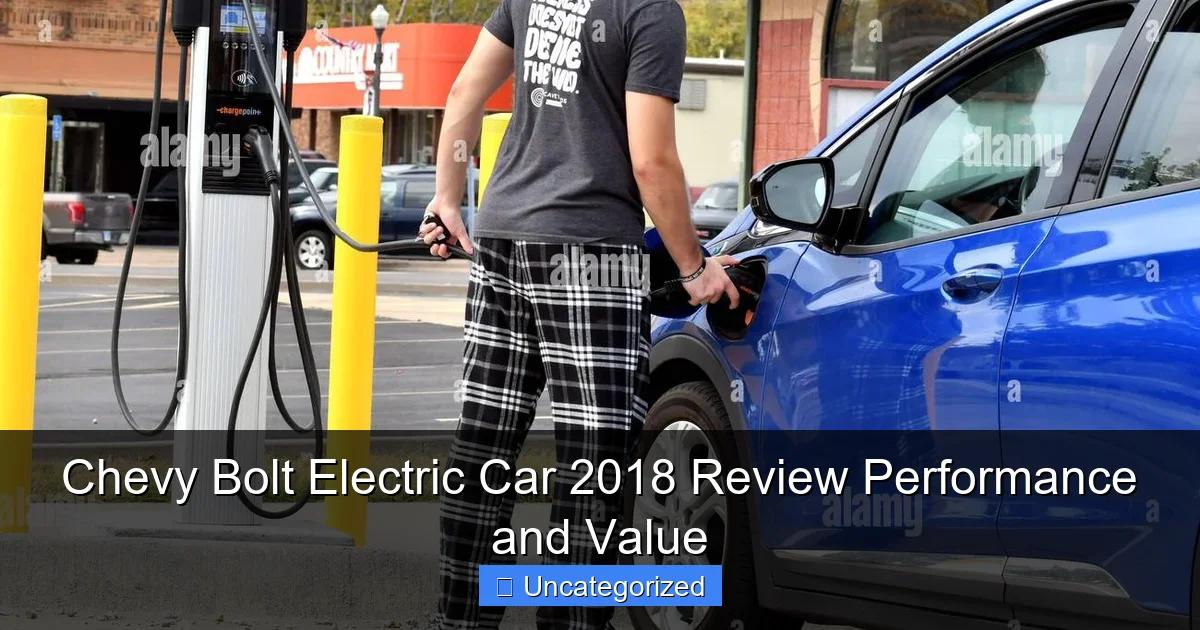
The Bolt supports both Level 1 (120V) and Level 2 (240V) charging, with a DC fast-charging port (optional on base models, standard on Premier). Here’s how charging breaks down:
- Level 1 (120V): Adds ~4 miles/hour. A full charge takes 50+ hours (impractical for most).
- Level 2 (240V): Adds ~25 miles/hour. A full charge takes ~9.5 hours (ideal for overnight home charging).
- DC Fast Charging (50 kW): Adds ~90 miles in 30 minutes (best for road trips).
Example: A driver with a 50-mile daily commute could fully recharge overnight using a Level 2 charger (2 hours), while a road tripper could add 180 miles in 60 minutes via DC fast charging.
Interior Design and Technology: Space, Comfort, and Innovation
The Bolt’s interior prioritizes practicality and modern tech, though materials lean toward budget-friendly plastics. The cabin feels spacious for a subcompact hatchback, thanks to a flat floor (no transmission tunnel) and upright seating. The front seats are supportive for long drives, while the rear seats offer ample legroom for adults—a rarity in EVs of this size.
Visual guide about chevy bolt electric car 2018
Image source: c8.alamy.com
Infotainment and Connectivity
The Bolt’s 10.2-inch touchscreen is the centerpiece of its tech suite, featuring Chevy’s MyLink system with intuitive menus, Apple CarPlay, Android Auto, and a built-in Wi-Fi hotspot. The interface responds quickly, and voice commands work reliably for navigation and climate control. For example, saying, “Find the nearest EV charger,” prompts the system to display options with real-time availability.
- Tip: Use the “Energy” app to monitor real-time power usage and optimize efficiency.
- Tip: Pair your smartphone to access remote features like preheating/cooling via the MyChevy app.
Driver Assistance and Safety Tech
The 2018 Bolt Premier trim includes advanced driver aids like:
- Lane Keep Assist: Gently steers back into the lane if drifting.
- Forward Collision Alert: Warns of impending impacts and applies brakes if needed.
- Rear Camera Mirror: Displays a live feed from a rear-facing camera (eliminates blind spots).
While the base LT trim lacks these features, it includes standard safety tech like a rearview camera, stability control, and 10 airbags. The Bolt earned a 5-star NHTSA safety rating, with top marks in frontal and side-impact tests.
Cargo and Storage Solutions
The Bolt’s hatchback design offers 16.9 cubic feet of cargo space (expandable to 56.6 cu ft with rear seats folded). The low load floor and wide opening make it easy to fit bulky items like strollers or luggage. Hidden compartments under the floor add extra storage for charging cables or emergency kits. For example, a family of four could pack two large suitcases and a week’s groceries with ease.
Value and Cost of Ownership: Affordability Meets Long-Term Savings
The 2018 Chevy Bolt starts at $37,495 (LT trim) and tops out at $41,895 (Premier trim). After the $7,500 federal tax credit (and additional state incentives in places like California or Colorado), the effective price drops to $30,000–$34,000—competitive with gas-powered compacts like the Honda Civic or Toyota Corolla.
Operating Costs: Electricity vs. Gasoline
Charging a Bolt costs significantly less than fueling a gas car. Using the U.S. average electricity rate ($0.14/kWh) and a 238-mile range:
- Annual charging cost (12,000 miles): ~$730.
- Equivalent gas cost (25 mpg, $3.50/gallon): ~$1,680.
Over five years, this saves $4,750 on fuel alone. Maintenance is also cheaper: no oil changes, spark plugs, or exhaust systems to worry about. The Bolt’s battery is covered by an 8-year/100,000-mile warranty, and most owners report minimal degradation (1–2% per year).
Resale Value and Incentives
The Bolt’s resale value is strong for an EV, retaining ~55% of its value after three years (per KBB data). This outperforms the Nissan Leaf (~40%) and matches the Tesla Model 3 (~58%). Buyers can also leverage:
- State rebates: Up to $2,500 in California, $5,000 in Colorado.
- HOV lane access: In states like California, EVs get solo driver access.
- Free public charging: Some employers and shopping centers offer free Level 2 charging.
Insurance and Taxes
Insurance costs for the Bolt are comparable to gas-powered compacts—around $1,200/year for full coverage. Some insurers offer discounts for EVs due to their safety ratings. Additionally, many states waive sales tax on EVs (e.g., Oregon) or offer tax credits (e.g., $1,000 in Georgia).
Competitors and Market Position: How the Bolt Stacks Up
In 2018, the Bolt faced limited competition in the affordable long-range EV segment. Key rivals included the Nissan Leaf Plus (226-mile range, $38,510) and Tesla Model 3 (220-mile range, $35,000 base). Here’s how the Bolt compares:
Chevy Bolt vs. Nissan Leaf Plus
- Range: Bolt (238 miles) vs. Leaf Plus (226 miles).
- Charging: Bolt supports 50 kW DC fast charging (Leaf Plus: 100 kW, but slower battery acceptance).
- Interior: Bolt has more rear legroom and a larger touchscreen.
- Price: Bolt is $1,000 cheaper after incentives.
Verdict: The Bolt wins for range, space, and value.
Chevy Bolt vs. Tesla Model 3
- Range: Bolt (238 miles) vs. Model 3 Standard (220 miles).
- Tech: Model 3 has a minimalist interior and Autopilot (Bolt has no driver-assist suite).
- Charging: Model 3 uses Tesla’s Supercharger network (faster, more widespread).
- Price: Model 3 base is cheaper, but options add up quickly.
Verdict: The Bolt is better for budget-focused buyers; the Model 3 excels in tech and charging infrastructure.
Data Table: 2018 Chevy Bolt vs. Competitors
| Model | Range (miles) | 0-60 mph (sec) | Base Price | DC Fast Charging |
|---|---|---|---|---|
| 2018 Chevy Bolt | 238 | 6.5 | $37,495 | 50 kW (optional) |
| 2018 Nissan Leaf Plus | 226 | 7.4 | $38,510 | 100 kW (standard) |
| 2018 Tesla Model 3 | 220 | 5.1 | $35,000 | 120 kW (standard) |
Common Issues and Reliability: What Owners Report
The 2018 Bolt is generally reliable, but some owners note minor quirks. The most common issues include:
Battery and Charging Concerns
- Slow DC Fast Charging: The Bolt’s 50 kW cap means longer stops vs. 150 kW+ rivals. However, its battery management system prevents overheating, enhancing longevity.
- Level 1 Charging: Many owners regret not installing a Level 2 charger at home. A $500–$1,000 installation pays for itself in convenience.
Interior and Build Quality
- Plastic Trim: The cabin uses hard plastics to cut costs. A $200 aftermarket dashboard cover can improve perceived quality.
- Wind Noise: Some drivers report excessive wind noise at highway speeds. Upgrading to premium tires (e.g., Michelin Energy Saver) helps.
Recalls and Fixes
Chevy issued a recall in 2019 for battery fire risks (later resolved with software updates). All 2018 Bolts received free battery replacements under warranty, boosting owner confidence.
Conclusion: The Bolt’s Enduring Appeal
The 2018 Chevy Bolt EV remains a landmark vehicle in the shift toward affordable electric mobility. Its 238-mile range shattered the “range anxiety” barrier, while its hatchback practicality and intuitive tech made it a daily driver’s dream. Though it lacks the luxury of a Tesla or the ultra-fast charging of newer EVs, the Bolt’s balance of performance, value, and efficiency is unmatched in its class. For buyers prioritizing cost savings, environmental impact, and real-world usability, the 2018 Bolt is a standout choice.
Whether you’re a first-time EV buyer or a seasoned eco-conscious driver, the Bolt delivers where it matters most: range, reliability, and value. As the EV market evolves, the Bolt’s legacy as a pioneer—proven by its 2018 model—will endure. If you’re in the market for a used EV, don’t overlook this trailblazing hatchback. It’s proof that going electric doesn’t require compromise.
Frequently Asked Questions
What is the range of the 2018 Chevy Bolt electric car?
The 2018 Chevy Bolt offers an EPA-estimated range of 238 miles on a single charge, making it a strong contender in the affordable EV segment. This range is ideal for daily commutes and even longer weekend trips with proper planning.
How does the 2018 Chevy Bolt’s performance compare to other electric cars?
The 2018 Chevy Bolt delivers quick acceleration with its 200-horsepower electric motor, going from 0-60 mph in about 6.5 seconds. Its low center of gravity and responsive handling provide a fun, agile driving experience compared to many rivals in its class.
Is the 2018 Chevy Bolt eligible for federal tax incentives?
Yes, the 2018 Chevy Bolt initially qualified for the full $7,500 federal EV tax credit, though availability may vary based on purchase timing and income limits. Buyers should verify current incentives with the IRS or a tax professional.
What charging options does the 2018 Chevy Bolt support?
The Bolt supports Level 1 (120V), Level 2 (240V), and DC fast charging. Using a DC fast charger, it can replenish up to 90 miles of range in just 30 minutes, adding convenience for long-distance travel.
How safe is the 2018 Chevy Bolt electric car?
The 2018 Chevy Bolt earned a 5-star overall safety rating from the NHTSA, thanks to its sturdy design and advanced driver-assist features like forward collision warning and lane-keeping assist. Standard airbags and stability control further enhance passenger protection.
What are the key tech features in the 2018 Chevy Bolt?
The 2018 Chevy Bolt comes with a 10.2-inch touchscreen, Apple CarPlay, Android Auto, and a rearview camera. Available features include wireless charging, a premium audio system, and a suite of safety tech for a well-rounded EV experience.