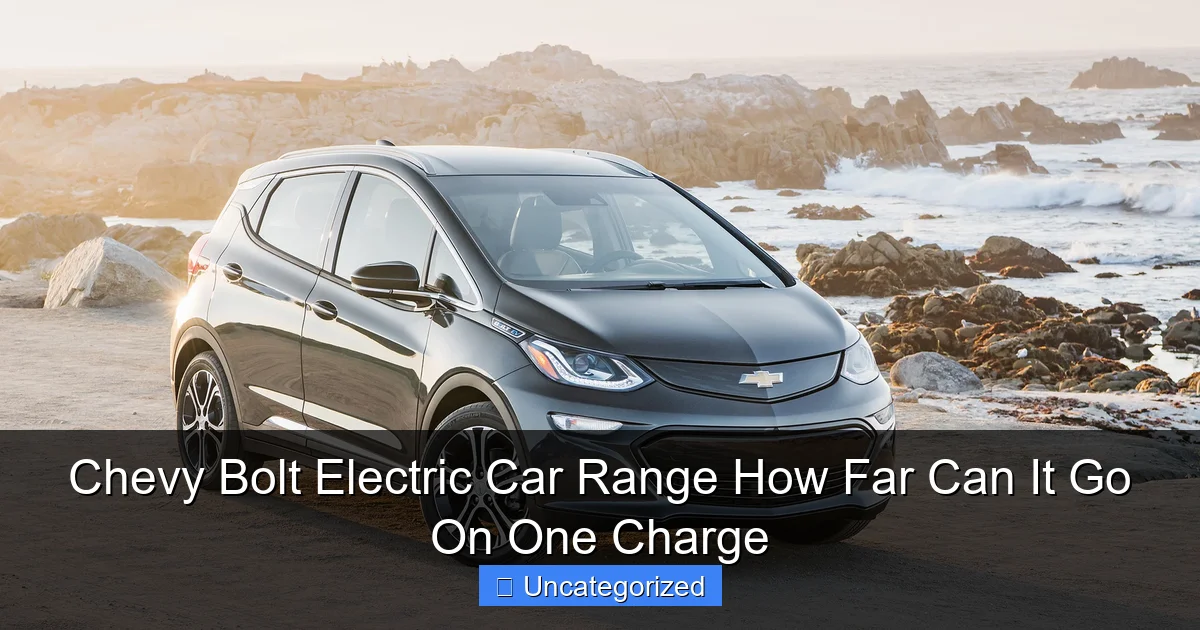
Chevy Bolt Electric Car Range How Far Can It Go On One Charge
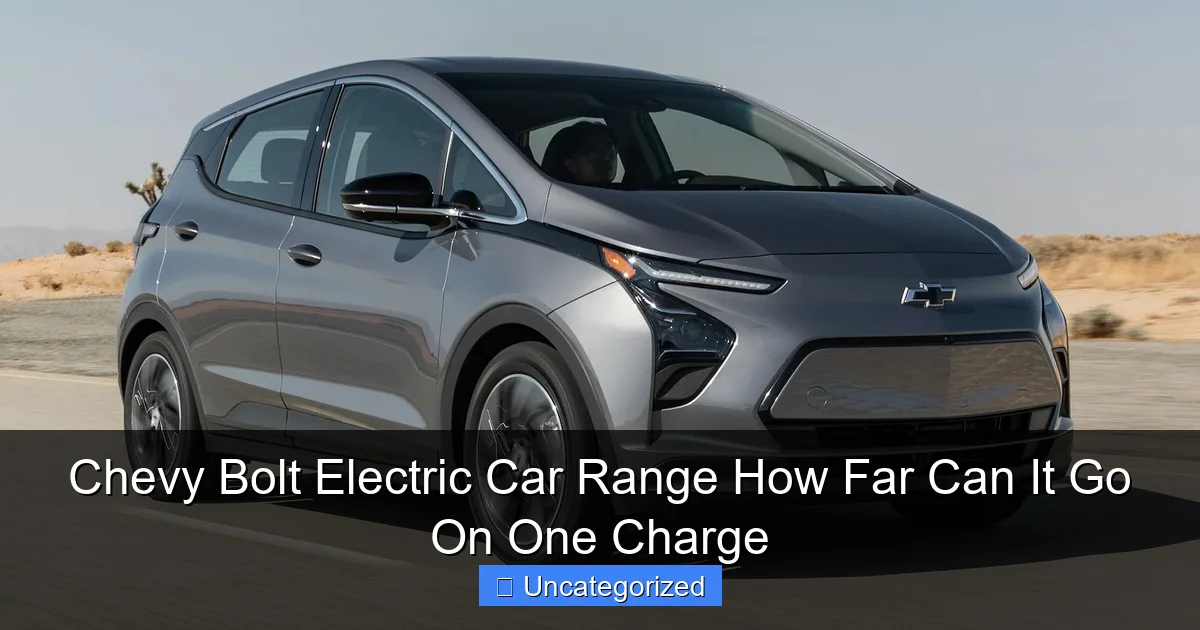
Featured image for chevy bolt electric car range
Image source: motortrend.com
The Chevy Bolt EV offers an impressive 259-mile range on a single charge, making it a top contender in the affordable electric car market. With real-world efficiency and fast-charging capability, it’s built for both daily commutes and longer road trips without range anxiety.
Key Takeaways
- 259-mile range: 2023 Chevy Bolt offers impressive EPA-estimated range per charge.
- Real-world driving: Expect 220–240 miles in mixed city/highway conditions.
- Regen braking: Maximize range using one-pedal driving and regenerative braking.
- Climate impact: Cold weather reduces range; precondition while plugged in.
- DC fast charging: Replenish 100 miles in 30 minutes with Level 3 charging.
- Home charging: Overnight Level 2 charging delivers full range daily.
📑 Table of Contents
- The Chevy Bolt: A Game-Changer in Electric Mobility
- Understanding the Chevy Bolt’s EPA-Estimated Range
- Factors That Affect the Chevy Bolt’s Real-World Range
- Maximizing Your Chevy Bolt’s Range: Practical Tips and Strategies
- Chevy Bolt Range in Different Scenarios: Case Studies and Examples
- Comparing the Chevy Bolt to Competitors and Future Outlook
- Conclusion: The Chevy Bolt’s Range – A Balanced Blend of Performance and Practicality
The Chevy Bolt: A Game-Changer in Electric Mobility
When the Chevrolet Bolt EV first hit the market in 2017, it was hailed as a breakthrough in affordable electric mobility. With a promise of over 200 miles of range at a time when most competitors struggled to breach the 150-mile barrier, the Bolt quickly captured the attention of eco-conscious drivers and tech enthusiasts alike. Fast forward to today, and the Chevy Bolt electric car range remains a key selling point in an increasingly competitive EV landscape. Whether you’re a daily commuter, a weekend road tripper, or a first-time electric vehicle (EV) owner, the Bolt’s range capabilities offer a compelling blend of practicality and innovation.
But just how far can the Chevy Bolt go on a single charge? And what factors influence its real-world range? In this comprehensive guide, we’ll explore every aspect of the Chevy Bolt’s electric range—from official EPA estimates to real-world driving experiences, charging strategies, and performance in varying conditions. Whether you’re considering a 2017 model or the latest 2023 Chevy Bolt EUV, understanding the nuances of its range will help you make an informed decision and get the most out of your EV ownership.
Understanding the Chevy Bolt’s EPA-Estimated Range
Official Range Figures Across Model Years
The Chevy Bolt electric car range has evolved significantly since its debut. The original 2017–2019 Chevy Bolt EV was rated by the EPA at 238 miles on a single charge—a figure that was revolutionary at the time. This range was achieved thanks to a 60 kWh lithium-ion battery pack and a highly efficient electric motor. The 2020 model saw a major upgrade with a larger 66 kWh battery, boosting the EPA-estimated range to 259 miles. This improvement was due to increased energy density, better thermal management, and minor aerodynamic tweaks.
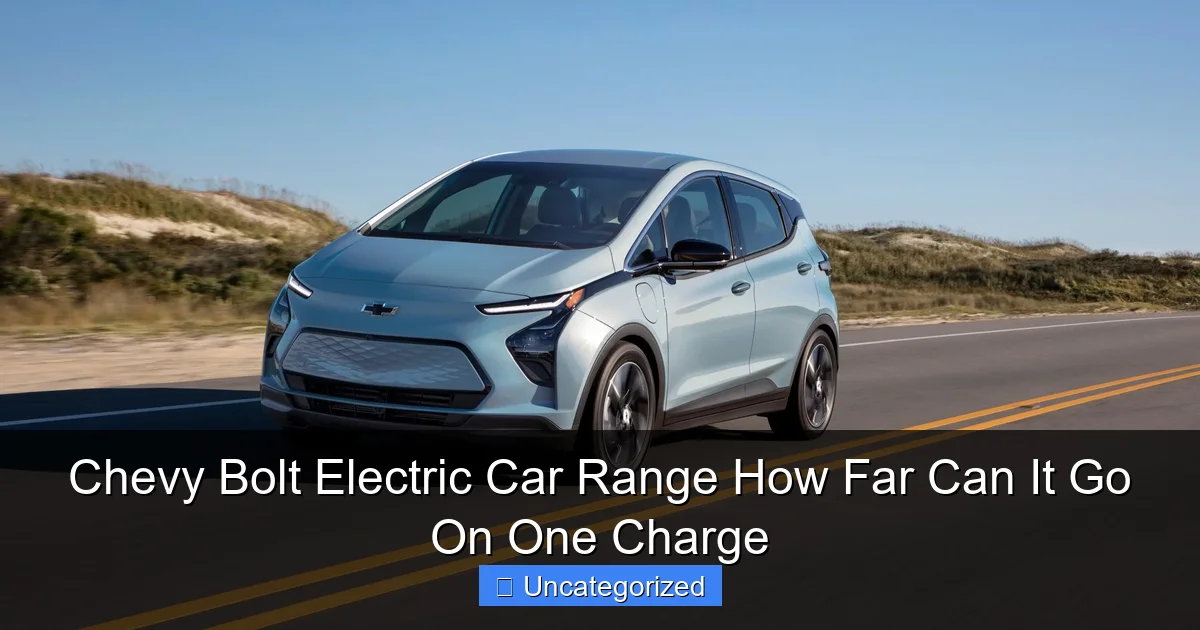
Visual guide about chevy bolt electric car range
Image source: carscoops.com
The 2022 and 2023 models, including the Bolt EV and the slightly larger Bolt EUV, maintain the 259-mile EPA rating. The Bolt EUV, despite its extended wheelbase and added features, matches the EV’s range thanks to shared battery and powertrain technology. This consistency across recent model years underscores Chevrolet’s commitment to delivering reliable, long-range performance without sacrificing affordability.
How EPA Testing Works and What It Means
The EPA uses a standardized five-cycle test to determine electric vehicle range, simulating city driving, highway driving, high-speed driving, aggressive acceleration, and air conditioning use. The test is conducted in controlled conditions, meaning real-world results can vary. The Chevy Bolt electric car range of 259 miles is derived from this lab-based methodology, which includes:
- City driving (FTP-75): Simulates stop-and-go traffic with frequent acceleration and braking.
- Highway (HWFET): Tests steady-speed cruising at 50–55 mph.
- High-speed (US06): Mimics highway driving with rapid acceleration and higher speeds.
- Aggressive driving (SC03): Evaluates performance under high-load conditions.
- Air conditioning (SFTP): Measures energy consumption with AC running.
While these tests provide a baseline, they don’t account for all real-world variables like weather, terrain, or driving style. As a result, your actual range may differ—sometimes significantly.
Real-World Range vs. EPA Estimates
Many Bolt owners report achieving close to the EPA estimate under ideal conditions. For example, a 2023 Bolt EUV driven on flat highways at 65 mph with mild temperatures and no HVAC use can easily hit 250+ miles. However, aggressive driving, cold weather, or hilly terrain can reduce range by 15–30%. A study by PlugShare analyzing over 10,000 Bolt trips found that the average real-world range across all conditions is approximately 220–235 miles—still impressive for a vehicle in its price class.
Factors That Affect the Chevy Bolt’s Real-World Range
1. Driving Speed and Highway vs. City Use
Speed is one of the most significant factors influencing the Chevy Bolt electric car range. Electric vehicles are most efficient at lower speeds, typically between 30–50 mph. At 65–75 mph, aerodynamic drag increases exponentially, reducing efficiency. For example:
Visual guide about chevy bolt electric car range
Image source: images.hgmsites.net
- Driving at 55 mph: ~250 miles range (95% of EPA)
- Driving at 70 mph: ~210 miles range (81% of EPA)
- Driving at 80 mph: ~180 miles range (70% of EPA)
City driving, with frequent stops and regenerative braking, often yields better efficiency than highway driving due to energy recovery. In stop-and-go traffic, the Bolt can achieve up to 3.5 miles per kWh—translating to over 230 miles of range.
2. Weather and Temperature Effects
Temperature plays a crucial role in battery performance. Cold weather (below 40°F) can reduce the Chevy Bolt’s range by 20–35%. This is due to:
- Increased battery resistance, slowing ion movement.
- Energy used to heat the cabin and battery pack.
- Reduced efficiency of regenerative braking.
Conversely, hot weather (>90°F) can also reduce range, though typically by 5–15%, mainly due to air conditioning use. A 2022 study by AAA found that EVs lose an average of 41% of their range at 20°F with the heater on. The Bolt, with its heat pump system (introduced in 2022 models), performs better than older EVs in cold weather, but pre-conditioning the cabin while charging can still preserve battery power.
3. Terrain and Elevation Changes
Driving uphill requires more energy, while downhill driving can recover some via regenerative braking. A trip through mountainous regions like the Rockies or the Appalachians can reduce range by 10–25%. For example, a 100-mile drive with 2,000 feet of elevation gain might consume 25–30 kWh, compared to 20 kWh on flat terrain.
However, the Bolt’s regenerative braking system—especially in “One-Pedal Driving” mode—can recover up to 30% of energy on descents, partially offsetting losses. Using the “L” drive mode maximizes regen, making it ideal for hilly areas.
4. Use of Climate Control and Accessories
The Bolt’s HVAC system is a major energy consumer. Running the heater or AC at high levels can reduce range by 10–20 miles per hour. For instance:
- Heater on high (72°F cabin in 30°F weather): ~15% range loss
- AC on high (72°F cabin in 90°F weather): ~10% range loss
Tips to minimize impact:
- Use seat heaters instead of cabin heat—much more efficient.
- Pre-heat or pre-cool the cabin while the car is charging.
- Use eco-mode HVAC settings, which reduce fan speed and temperature extremes.
5. Tire Pressure and Vehicle Load
Underinflated tires increase rolling resistance, reducing efficiency. The Bolt’s recommended tire pressure is 38 psi (front) and 36 psi (rear). A 5 psi drop can reduce range by 2–3%. Similarly, carrying heavy loads (e.g., luggage, cargo) adds weight, increasing energy consumption. For every 100 lbs of extra weight, expect a 1–2% range reduction.
Maximizing Your Chevy Bolt’s Range: Practical Tips and Strategies
Smart Driving Techniques
Adopting efficient driving habits can significantly extend the Chevy Bolt electric car range. Key techniques include:
- Smooth acceleration and braking: Avoid jackrabbit starts. Gradual acceleration uses less energy.
- Coasting and regen braking: Lift off the accelerator early to coast. Use “L” mode to maximize regen.
- Maintain steady speeds: Use cruise control on highways to avoid unnecessary speed fluctuations.
- One-pedal driving: In “L” mode, you can stop the car entirely using only the accelerator, reducing brake wear and recovering energy.
For example, a driver in Portland, OR, reported increasing their average range from 215 to 238 miles by using one-pedal driving and coasting techniques on their daily 45-mile commute.
Charging Strategy: When and How to Charge
While the Bolt doesn’t require full charging every time, strategic charging can preserve battery health and maximize usable range:
- Charge to 80% daily: Lithium-ion batteries degrade slower when kept between 20–80%. Reserve 100% charges for long trips.
- Use Level 2 (240V) charging at home: A 32-amp Level 2 charger adds ~25 miles per hour—ideal for overnight charging.
- DC fast charging for long trips: The Bolt supports up to 55 kW DC fast charging, adding ~100 miles in 30 minutes. Limit fast charging to once or twice per week to reduce battery stress.
Example: A driver planning a 200-mile round trip charges to 90% the night before, uses regen braking on downhill sections, and arrives home with 40 miles of range—no fast charging needed.
Pre-Conditioning and Climate Management
Pre-conditioning the cabin while the car is plugged in uses grid power instead of battery power, preserving range. Use the MyChevrolet app to schedule heating or cooling before departure. For cold mornings:
- Set the cabin to 70°F while charging.
- Use seat and steering wheel heaters instead of cabin heat.
- Keep windows clear with remote defrost.
This can save 20–30 miles of range in sub-zero temperatures.
Route Planning and Navigation Tools
The Bolt’s built-in navigation system (available in 2022+ models) includes EV-specific routing, showing:
- Estimated battery level at destination.
- Nearby charging stations.
- Elevation changes and traffic conditions.
Third-party apps like A Better Routeplanner (ABRP) or PlugShare provide even more detailed range projections based on your driving habits, weather, and vehicle settings.
Chevy Bolt Range in Different Scenarios: Case Studies and Examples
Daily Commuting: Urban and Suburban Use
For a 50-mile daily commute (25 miles each way) in a city like Austin, TX, the Bolt is ideal. With an average speed of 35 mph and moderate traffic, the car uses ~18 kWh of energy. Charging at home overnight (Level 2) ensures a full battery each morning. Even with AC use in summer, range rarely dips below 230 miles, providing a comfortable buffer.
Weekend Road Trips: 200–300 Mile Journeys
A 250-mile round trip from Denver to Colorado Springs (with mountain passes) requires careful planning. A driver charged to 100%, used cruise control at 65 mph, and activated regen braking on descents. They arrived with 45 miles of range. A DC fast charger at the destination added 80 miles in 25 minutes, enabling a stress-free return.
Winter Driving: Cold Weather Challenges
A 2023 Bolt EUV owner in Minneapolis reported a 28% range reduction in January (average temp: 15°F). By pre-heating the cabin, using seat heaters, and limiting speed to 60 mph, they achieved 185 miles—still sufficient for most daily needs. A Level 2 charger at work provided top-ups during the day.
Long-Distance Travel: Cross-State Adventures
A family drove from Chicago to Nashville (500 miles) using the Bolt EUV. They:
- Charged to 100% before departure.
- Stopped at two DC fast chargers (each 30 minutes).
- Averaged 55 mph to maximize range.
Total charging time: 1 hour. Final battery: 35%. Total trip time: 10 hours (including stops)—comparable to a gas-powered car.
Comparing the Chevy Bolt to Competitors and Future Outlook
How the Bolt Stacks Up Against Rivals
The Chevy Bolt electric car range of 259 miles positions it favorably against competitors in the affordable EV segment:
| Model | EPA Range (miles) | Base Price (2023) | DC Fast Charging Speed |
|---|---|---|---|
| Chevrolet Bolt EV | 259 | $26,500 | 55 kW |
| Chevrolet Bolt EUV | 247 | $27,800 | 55 kW |
| Hyundai Kona Electric | 258 | $34,000 | 75 kW |
| Kia Niro EV | 253 | $39,550 | 85 kW |
| Nissan Leaf (Plus) | 212 | $30,000 | 100 kW |
| Ford Mustang Mach-E (Standard) | 250 | $42,995 | 115 kW |
The Bolt offers the best range-to-price ratio in its class. While competitors like the Kona and Niro have faster charging, the Bolt’s range advantage and lower cost make it a top choice for budget-conscious buyers.
Future of the Chevy Bolt and Range Improvements
Chevrolet has announced the discontinuation of the Bolt line after 2023, but not before introducing a refreshed 2024 model with improved infotainment and safety features. The company plans to replace the Bolt with the Chevrolet Equinox EV in 2024, which is expected to offer a 300+ mile range and faster charging (190 kW). However, the Bolt’s legacy as a range leader will endure, and used models will remain highly desirable.
Ongoing advancements in battery technology—such as solid-state batteries and silicon-anode designs—could further boost range in future EVs. For now, the Chevy Bolt electric car range remains a benchmark for affordable, long-range electric mobility.
Conclusion: The Chevy Bolt’s Range – A Balanced Blend of Performance and Practicality
The Chevy Bolt’s electric range is more than just a number—it’s a reflection of thoughtful engineering, real-world usability, and value. With an EPA-estimated 259 miles, it outperforms most rivals in its price range, offering drivers the freedom to commute, explore, and travel without range anxiety. While factors like weather, speed, and terrain can impact real-world performance, smart driving habits, strategic charging, and climate management can help you consistently achieve 220+ miles—more than enough for 95% of daily driving needs.
Whether you’re navigating city streets, tackling mountain roads, or embarking on a cross-state adventure, the Bolt’s range capabilities, combined with its affordability and reliability, make it a standout in the EV market. As Chevrolet transitions to newer models, the Bolt remains a testament to how far affordable electric mobility has come—and how far it can go on a single charge. For drivers seeking a practical, efficient, and fun-to-drive EV, the Chevy Bolt isn’t just a choice; it’s a smart investment in the future of transportation.
Frequently Asked Questions
What is the Chevy Bolt electric car range on a full charge?
The 2023 Chevy Bolt EV offers an EPA-estimated range of 259 miles on a single charge, while the EUV (Electric Utility Vehicle) variant delivers 247 miles. This range is ideal for daily commutes and longer trips without frequent charging stops.
How does the Chevy Bolt’s range compare to other electric cars in its class?
The Chevy Bolt electric car range holds up well against competitors like the Hyundai Kona Electric (258 miles) and the Nissan Leaf (212 miles). Its affordable price point combined with over 240 miles of range makes it a standout in the compact EV segment.
Does cold weather reduce the Chevy Bolt’s range?
Yes, cold weather can reduce the Chevy Bolt’s range by up to 30-40% due to increased battery drain and cabin heating demands. Using the pre-conditioning feature while plugged in helps minimize this impact.
Can the Chevy Bolt’s range be increased with driving habits?
Adopting smooth acceleration, using regenerative braking, and maintaining steady speeds can help maximize the Chevy Bolt electric car range. Avoiding rapid acceleration and excessive highway speeds also improves efficiency.
How long does it take to recharge the Chevy Bolt to full range?
With a Level 2 charger (240V), the Chevy Bolt EV recharges in about 7 hours for a full charge, while the EUV takes roughly 7.5 hours. DC fast charging can restore 100 miles of range in just 30 minutes.
Does the Chevy Bolt’s range degrade over time?
Like all EVs, the Chevy Bolt’s range may slightly degrade over years of use, but GM’s battery warranty covers 8 years/100,000 miles, ensuring minimal degradation. Proper charging habits (avoiding full 100% charges daily) help prolong battery life.