Chevy Electric and Gas Car Showdown Which One Wins Your Garage
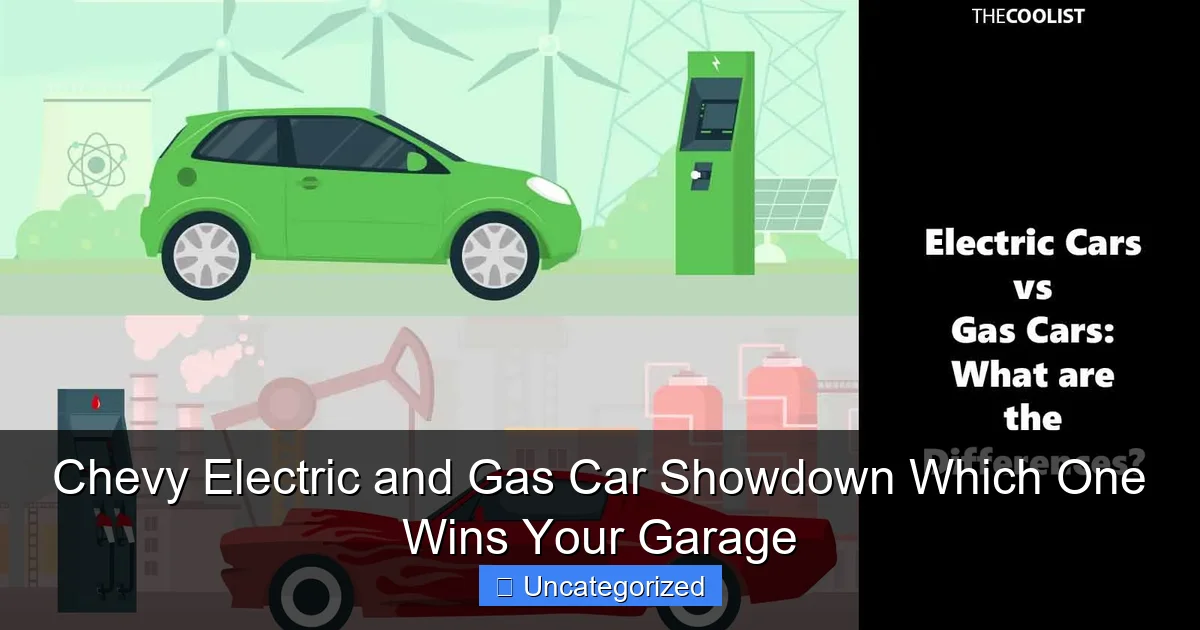
Featured image for chevy electric and gas car
Image source: cdn.thecoolist.com
Chevy’s electric and gas vehicles go head-to-head in performance, cost, and innovation—making the choice harder than ever. From the instant torque and lower maintenance of the Bolt EV to the proven power and range of the Silverado 1500, each excels in different driving lifestyles. Whether you’re chasing efficiency or rugged reliability, Chevy delivers compelling options for every driver.
Key Takeaways
- Chevy EVs offer lower fuel costs and reduced emissions for eco-conscious drivers.
- Gas models provide longer range and quicker refueling for road-trippers.
- EVs require less maintenance with fewer moving parts and no oil changes.
- Gas cars have higher upfront savings but may cost more long-term.
- Chevy’s EV lineup excels in tech with advanced features like Super Cruise.
- Gas engines deliver towing power ideal for heavy-duty tasks and hauling.
📑 Table of Contents
- The Future of Driving: Chevy Electric vs. Gas Car Showdown
- Performance and Driving Experience: Power vs. Precision
- Cost of Ownership: Upfront Price vs. Long-Term Savings
- Environmental Impact: Emissions, Sustainability, and Your Carbon Footprint
- Technology and Features: Connectivity, Safety, and Innovation
- Real-World Usability: Range, Charging, and Practicality
- Conclusion: Which Chevy Wins Your Garage?
The Future of Driving: Chevy Electric vs. Gas Car Showdown
When Chevrolet first rolled out its iconic Bel Air in the 1950s, few could have predicted that just a few decades later, the automaker would be at the center of one of the most transformative shifts in automotive history: the electric revolution. Today, Chevy stands at a crossroads—offering both gas-powered classics that have defined American muscle and electric vehicles (EVs) like the Bolt EV and the upcoming Silverado EV, signaling a bold new direction. For car buyers, this dual identity raises a critical question: Which one wins your garage?
The decision between a Chevy electric car and a gas-powered model isn’t just about horsepower or price tags—it’s about lifestyle, values, and long-term ownership experience. Are you drawn to the roar of a V8 engine and the freedom of a 400-mile tank? Or are you captivated by silent acceleration, lower maintenance, and the promise of zero emissions? With Chevrolet offering compelling options in both categories, the choice is more nuanced than ever. This comprehensive guide dives deep into performance, cost, environmental impact, technology, and real-world usability to help you decide whether a Chevy electric or gas car earns the prime spot in your driveway.
Performance and Driving Experience: Power vs. Precision
Engine Roar vs. Instant Torque
One of the most visceral differences between Chevy electric and gas cars lies in how they deliver power. Gas-powered Chevys—like the Chevrolet Camaro or Silverado 1500—rely on internal combustion engines (ICE) that build power through revving RPMs. The Camaro SS, for example, packs a 6.2L V8 producing 455 horsepower, with a deep, throaty exhaust note that enthusiasts adore. Acceleration is linear, and the gear shifts (especially in manual or performance-tuned automatics) create a dynamic, engaging experience.

Visual guide about chevy electric and gas car
Image source: png.pngtree.com
In contrast, Chevy electric models like the Bolt EV or Equinox EV use electric motors that deliver instant torque the moment you press the accelerator. The Bolt EV goes from 0 to 60 mph in just 6.5 seconds—faster than many gas-powered compact cars—without any lag. There’s no gear shifting, no engine noise, just seamless, silent thrust. For city driving, this makes EVs feel more responsive and agile, especially in stop-and-go traffic.
Tip: If you enjoy the sensory feedback of driving—engine sound, gear changes, and mechanical engagement—gas models offer a more traditional, emotional experience. But if you value smooth, immediate power and a quiet cabin, EVs win hands down.
Handling and Ride Comfort
Electric Chevys benefit from a lower center of gravity due to floor-mounted battery packs, which improves cornering stability. The Bolt EV, for instance, feels planted on winding roads, with minimal body roll. Additionally, regenerative braking systems allow for one-pedal driving—lifting off the accelerator slows the car significantly, which reduces brake wear and enhances control in urban settings.
Gas-powered Chevys, while heavier in the front (due to engine placement), often offer more customizable driving modes. The Chevrolet Tahoe and Suburban come with adaptive air suspension and magnetic ride control, allowing drivers to switch between sport, comfort, and off-road settings. For long highway drives or towing heavy loads, the familiarity and tuning of gas platforms can feel more reassuring.
Practical Example: A driver commuting 40 miles daily in a congested city will appreciate the Bolt EV’s quiet cabin, instant torque, and regenerative braking. Meanwhile, a weekend warrior hauling a boat to a lake might prefer the Silverado 1500’s 13,000-pound towing capacity and V8 reliability.
Cost of Ownership: Upfront Price vs. Long-Term Savings
Purchase Price and Incentives
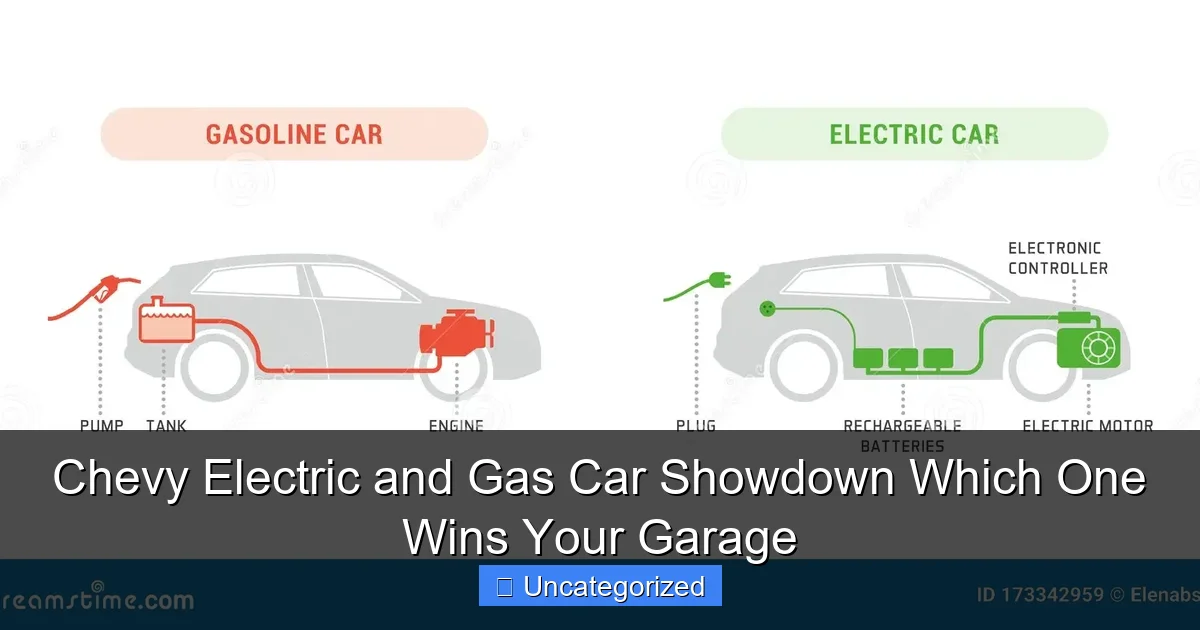
Historically, Chevy electric cars have carried a higher upfront cost than their gas counterparts. The 2024 Bolt EV starts at $26,500 (after federal tax credit), while the Bolt EUV begins at $28,800. In comparison, the gas-powered Chevrolet Equinox starts at $27,900—making them nearly comparable in price. However, the upcoming Equinox EV starts at $30,000, and the Silverado EV will begin around $40,000 (with high-end trims exceeding $90,000).
Visual guide about chevy electric and gas car
Image source: thumbs.dreamstime.com
The key differentiator? Federal and state incentives. As of 2024, the Bolt EV qualifies for a $7,500 federal tax credit (subject to eligibility), while many states offer additional rebates. California, for example, provides up to $2,000 in state incentives for EVs. Gas cars, by contrast, rarely receive such perks. Additionally, some utility companies offer EV purchase bonuses—like $1,000 off for installing a home charger.
Tip: Always check Plug In America or your state’s energy commission website for updated EV incentives. These can reduce the effective price gap significantly.
Fuel, Maintenance, and Depreciation
Electric Chevys shine in operating costs. Charging a Bolt EV at home (using a Level 2 charger) costs about $0.10–$0.15 per kWh. For a 250-mile range, that’s roughly $10–$15 in electricity—equivalent to about $1.50 per gallon. Gas prices, averaging $3.50–$4.50 per gallon, make filling a 15-gallon tank cost $50+.
Maintenance is another win for EVs. With no oil changes, spark plugs, or exhaust systems, Chevy electric cars have fewer moving parts. The Bolt EV’s 8-year/100,000-mile battery warranty and 3-year/36,000-mile bumper-to-bumper coverage reduce long-term risk. Gas Chevys, while reliable, require regular oil changes, transmission fluid flushes, and timing belt replacements—adding $1,000–$2,000 over 5 years.
However, depreciation remains a challenge. While EVs like the Bolt initially depreciated rapidly (due to battery tech concerns), recent improvements and incentives have stabilized values. Gas cars, especially trucks and SUVs, historically retain value better. The 2020 Silverado 1500, for example, retains ~60% of its value after 3 years, compared to ~50% for a 2020 Bolt EV.
Total Cost of Ownership (TCO) Comparison
Let’s compare a 5-year ownership scenario for two popular models:
| Cost Factor | Chevy Bolt EV (2024) | Chevy Equinox (2024, Gas) |
|---|---|---|
| Base Price | $30,000 (before $7,500 credit) | $27,900 |
| Effective Price (with credit) | $22,500 | $27,900 |
| Fuel/Energy (50,000 miles) | $3,000 (electricity) | $10,500 (gas at $3.50/gal) |
| Maintenance (5 years) | $1,200 | $2,500 |
| Insurance (annual avg) | $1,400 | $1,600 |
| 5-Year TCO | $31,700 | $45,400 |
Note: TCO includes depreciation (assumes 50% for EV, 45% for gas), insurance, and operating costs.
Even with higher initial depreciation, the Bolt EV’s lower fuel and maintenance costs make it significantly cheaper to own over five years—especially in high-mileage scenarios.
Environmental Impact: Emissions, Sustainability, and Your Carbon Footprint
Tailpipe Emissions and Air Quality
The most obvious environmental advantage of Chevy electric cars is zero tailpipe emissions. A Bolt EV produces no CO₂, NOx, or particulate matter while driving—critical for reducing urban air pollution. Gas Chevys, even with modern emissions controls, emit greenhouse gases and pollutants. A Silverado 1500, for example, emits ~5.5 tons of CO₂ annually (assuming 12,000 miles/year and 20 mpg).
But EVs aren’t emission-free. The electricity used to charge them comes from the grid, which in many regions relies on fossil fuels. However, the U.S. grid is getting cleaner: in 2023, 40% of electricity came from renewables. Even with a coal-heavy grid, EVs produce 60–70% fewer emissions over their lifetime than gas cars (Union of Concerned Scientists, 2023).
Battery Production and Recycling
EVs do have a higher environmental cost upfront due to battery manufacturing. Producing a 65 kWh Bolt EV battery generates ~8–10 tons of CO₂—equivalent to ~1.5 years of gas car emissions. However, this “carbon debt” is paid off within 2–3 years of driving, after which EVs become cleaner.
Chevy is investing in sustainable battery tech. The Bolt EV uses a cobalt-reduced lithium-ion battery, and GM’s Ultium platform (used in the Silverado EV) aims for 50% lower battery cost by 2025. GM also partners with recycling firms to recover up to 95% of battery materials.
Tip: To maximize EV sustainability, charge during off-peak hours (when grids use more wind/solar) or install solar panels. Apps like ChargePoint show real-time grid cleanliness.
Long-Term Sustainability
Gas cars face an uncertain future. With the U.S. aiming for 50% EV sales by 2030 and cities banning ICE vehicles (e.g., California’s 2035 ICE ban), resale value and usability could decline. EVs, meanwhile, benefit from expanding infrastructure and policy support. Chevy’s commitment to 30 new EVs by 2025 signals long-term viability.
Technology and Features: Connectivity, Safety, and Innovation
Infotainment and Connectivity
Both Chevy electric and gas cars use the Chevrolet Infotainment 3 system, with Apple CarPlay, Android Auto, and 4G LTE Wi-Fi. However, EVs often get enhanced features. The Equinox EV includes a 17.7-inch diagonal touchscreen (vs. 11.3 inches in gas models) and over-the-air (OTA) updates—allowing software improvements without a dealership visit.
Gas Chevys, like the Traverse, offer premium options like a 10-speaker Bose audio system and rear-seat entertainment. But EVs lead in digital integration. The Bolt EV’s app lets you pre-condition the cabin, schedule charging, and monitor battery health remotely.
Safety and Driver Assistance
All 2024 Chevys include Chevy Safety Assist: automatic emergency braking, lane-keep assist, and forward collision alert. But EVs often add advanced features. The Silverado EV includes Super Cruise (hands-free driving on mapped highways), while gas Silverados offer Adaptive Cruise Control (hands-on).
Crash safety is comparable. The Bolt EV earned a 5-star NHTSA rating, and the gas-powered Equinox scored 4 stars. EVs have an edge in rollover risk due to their low center of gravity.
Innovation and Future-Proofing
EVs are at the forefront of automotive innovation. The Silverado EV’s 400-mile range, 350 kW fast charging (10–80% in 10 minutes), and PowerBase (vehicle-to-home energy transfer) are game-changers. Gas models, while reliable, are nearing technological maturity. Chevy’s focus on EVs (e.g., $35 billion EV investment by 2025) suggests future software updates and features will prioritize electric platforms.
Practical Example: A family using a Bolt EV as a second car can leverage V2G (vehicle-to-grid) tech to power their home during outages—a feature absent in gas models.
Real-World Usability: Range, Charging, and Practicality
Range Anxiety vs. Gas Station Convenience
Range is the biggest concern for EV owners. The Bolt EV offers 259 miles (Bolt EUV: 247 miles), while the Silverado EV promises 400+ miles. Most Americans drive under 40 miles daily, so even a Bolt EV covers 6+ days of commuting on one charge. Gas Chevys, with 300–400 mile ranges, require refueling every 1–2 weeks.
But long trips? EVs face challenges. Public charging networks (e.g., Electrify America, EVgo) are growing—over 140,000 U.S. chargers in 2024—but are less reliable than gas stations. A 100-mile highway trip might require a 30-minute fast charge (vs. 5-minute gas fill-up). Apps like PlugShare help locate chargers, but rural areas remain underserved.
Tip: For road trips, plan charging stops using tools like A Better Route Planner (ABRP). Most Chevy EVs support 50–150 kW DC fast charging (10–80% in 30–45 minutes).
Home Charging and Infrastructure
EVs require home charging setups. A Level 1 charger (120V outlet) adds ~4 miles of range per hour—fine for overnight charging. For faster charging (25 miles/hour), a Level 2 charger (240V) is recommended. Installation costs $500–$2,000 (with utility rebates available).
Gas cars need no special infrastructure. But with 80% of EV charging happening at home, this one-time investment pays off long-term.
Space, Cargo, and Towing
Gas Chevys dominate in utility. The Silverado 1500 offers 2,280 lbs of payload and 13,300 lbs of towing capacity. The Suburban seats up to 9 with 144.7 cubic feet of cargo space. EVs are catching up: the Silverado EV matches gas towing (10,000 lbs) and adds a 7.5-foot “frunk” (front trunk) for storage.
For daily use, EVs like the Equinox EV offer 57 cubic feet of cargo space—comparable to gas models. But heavy towing (>5,000 lbs) can reduce EV range by 30–50%, whereas gas trucks see minimal impact.
Conclusion: Which Chevy Wins Your Garage?
The choice between a Chevy electric and gas car isn’t one-size-fits-all—it hinges on your priorities. If you value lower long-term costs, environmental sustainability, and cutting-edge tech, a Chevy EV like the Bolt or Equinox EV is a compelling choice. With federal incentives, minimal maintenance, and silent, responsive performance, EVs are ideal for urban drivers, eco-conscious families, and tech enthusiasts.
On the other hand, if you need heavy towing, long-distance reliability, or emotional driving engagement, gas-powered Chevys like the Silverado, Tahoe, or Camaro remain unmatched. They offer proven durability, widespread service networks, and the visceral thrill of combustion engines.
Final Verdict: For most daily drivers, a Chevy electric car wins—especially with rising fuel prices and expanding charging infrastructure. But for those who live in rural areas, tow frequently, or simply love the roar of a V8, a gas model is still a worthy contender. The future may be electric, but Chevy’s dual lineup ensures there’s a perfect fit for every driver. Whether you choose silent efficiency or roaring power, Chevrolet delivers American innovation—one garage at a time.
Frequently Asked Questions
What are the main differences between Chevy electric and gas car models?
The primary differences lie in powertrain, fueling, and emissions. Chevy electric cars, like the Bolt EV, run solely on battery power with zero emissions, while gas models like the Silverado rely on combustion engines, offering greater range flexibility but higher fuel costs and emissions.
Which Chevy electric and gas car is more cost-effective over time?
Electric Chevy models typically have lower long-term costs due to reduced maintenance (no oil changes, fewer moving parts) and lower “fuel” costs per mile. However, gas cars may have a lower upfront price, making the total cost comparison dependent on driving habits and local energy prices.
How does the driving range compare between Chevy electric and gas vehicles?
Gas-powered Chevys, such as the Tahoe, can travel 400–600 miles on a full tank, while electric models like the Blazer EV offer 250–300 miles per charge. For long-distance drivers, gas models still hold an edge, but EV range is rapidly improving.
Are Chevy electric cars eligible for tax incentives?
Yes, many Chevy electric and plug-in hybrid models qualify for federal and state tax credits, which can reduce the purchase price by thousands of dollars. Gas cars are generally not eligible, though some states offer incentives for low-emission vehicles.
Which Chevy electric and gas car offers better performance?
Electric Chevys deliver instant torque and smoother acceleration (e.g., Bolt EUV’s 0–60 mph in 6.5 seconds), while gas models excel in sustained high-speed performance and towing capacity, making them better for heavy-duty tasks like hauling trailers.
What charging or refueling infrastructure should I consider for a Chevy electric vs. gas car?
Gas cars use ubiquitous gas stations, while Chevy electric vehicles require access to home charging or public networks like DC fast chargers. EV owners benefit from planning routes around charging stations, whereas gas cars offer greater refueling flexibility.