Chevy Electric Car Range How Far Can It Go on a Single Charge
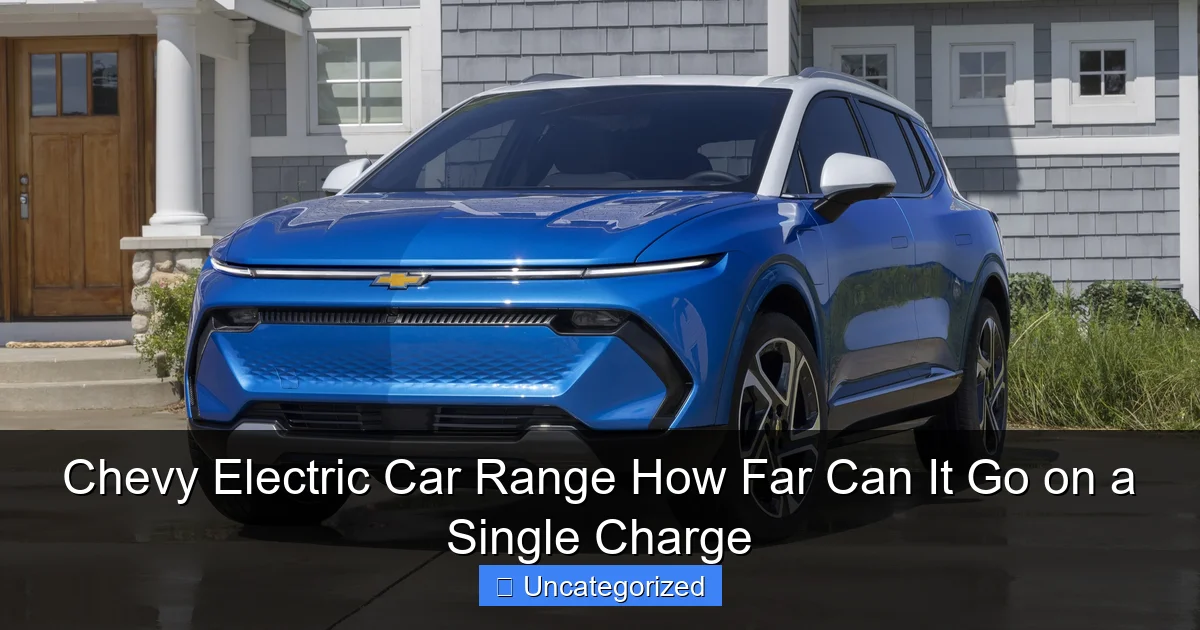
Featured image for chevy electric car range
Image source: automobilesreview.com
Chevy electric cars deliver an impressive range of up to 300 miles on a single charge, making them a top contender in the affordable EV market. With models like the Equinox EV and Blazer EV pushing boundaries, Chevy combines long-range capability with fast-charging technology to keep drivers on the road with minimal downtime.
Key Takeaways
- Chevy Bolt EV offers 259 miles: Ideal for daily commutes and long drives.
- Real-world range varies: Driving habits and terrain impact battery performance.
- Fast charging available: Replenish up to 100 miles in 30 minutes.
- Regenerative braking extends range: Use one-pedal driving to maximize efficiency.
- Check trim differences: Higher trims may offer slightly reduced range.
- Cold weather reduces range: Precondition the car to minimize winter losses.
📑 Table of Contents
- Chevy Electric Car Range: How Far Can It Go on a Single Charge?
- Understanding Chevy’s Electric Vehicle Lineup
- Factors That Affect Chevy Electric Car Range
- Maximizing Your Chevy EV’s Range: Tips and Best Practices
- Chevy vs. Competitors: How Does the Range Stack Up?
- Future Outlook: What’s Next for Chevy Electric Car Range?
- Conclusion
- Chevy Electric Car Range Comparison Table (2024)
Chevy Electric Car Range: How Far Can It Go on a Single Charge?
The electric vehicle (EV) revolution is in full swing, and Chevrolet is at the forefront, offering a diverse lineup of electric cars designed to meet the needs of modern drivers. As more consumers consider making the switch from gasoline-powered vehicles to electric, one of the most pressing questions remains: how far can a Chevy electric car go on a single charge? Range anxiety—the fear of running out of battery power before reaching a charging station—has long been a barrier to EV adoption. However, Chevrolet has been steadily improving its battery technology, aerodynamics, and energy efficiency to deliver competitive and reliable driving ranges across its electric models.
From the versatile Chevy Bolt EV to the rugged Silverado EV, Chevrolet is redefining what it means to drive electric. Whether you’re a city commuter, a long-distance traveler, or a family seeking a practical SUV, understanding the real-world range of Chevy’s electric vehicles is essential for making an informed purchase. This comprehensive guide dives deep into the Chevy electric car range, exploring how far each model can go, what factors influence range, and how to maximize your battery efficiency. We’ll also compare Chevy’s offerings to competitors, provide practical tips for extending range, and highlight what the future holds for Chevrolet’s electric ambitions.
Understanding Chevy’s Electric Vehicle Lineup
Current Models and Their Ranges
Chevrolet currently offers several electric vehicles, each tailored to different driving needs and lifestyles. As of 2024, the primary models in the Chevy electric lineup include:
- Chevy Bolt EV: A compact hatchback known for its affordability and efficiency, with an EPA-estimated range of 259 miles per charge.
- Chevy Bolt EUV: A slightly larger, crossover-styled version of the Bolt EV, offering 247 miles of range and additional tech features.
- Chevy Blazer EV: A midsize electric SUV with a range of 279–320 miles, depending on the trim and drivetrain configuration.
- Chevy Equinox EV: A compact SUV launching in late 2024, projected to offer up to 300 miles of range in its top trims.
- Chevy Silverado EV: An all-electric pickup truck with an impressive 400–450 miles of range on select configurations, making it one of the longest-range electric trucks on the market.
These vehicles represent a strategic shift by Chevrolet to cover multiple segments—from urban commuters to adventure-ready trucks—ensuring that there’s a Chevy EV for nearly every driver. The range figures above are EPA-estimated, which means they are tested under standardized conditions to provide a consistent benchmark for comparison.
How Chevy Measures Range: EPA vs. Real-World Driving
While EPA-estimated ranges are a useful starting point, real-world driving conditions can cause actual range to vary. The EPA uses a combination of city and highway driving cycles, including cold starts, air conditioning usage, and varying speeds, to simulate real-life conditions. However, factors like driving habits, weather, terrain, and accessory use can significantly impact how far a Chevy EV can go on a single charge.
For example, a Chevy Bolt EV might achieve close to 259 miles in mild weather with gentle acceleration and minimal HVAC use. But the same car could see its range drop to 200–220 miles in freezing temperatures with frequent highway driving and seat warmers turned on. Similarly, the Silverado EV’s 450-mile range assumes optimal conditions—real-world users report closer to 380–420 miles, depending on payload, towing, and driving style.
Chevrolet equips its EVs with advanced battery management systems and regenerative braking features to help mitigate range loss. These technologies recover energy during deceleration and help maintain consistent performance across different driving scenarios.
Factors That Affect Chevy Electric Car Range
Driving Habits and Speed
Your driving style has one of the most immediate impacts on Chevy electric car range. Aggressive acceleration, hard braking, and high-speed cruising all drain the battery faster than smooth, steady driving. For instance, maintaining a speed of 65 mph is far more efficient than frequent bursts to 75–80 mph. At highway speeds, aerodynamic drag increases exponentially, reducing range by up to 20–30% compared to city driving.
To maximize range, adopt an eco-driving mindset:
- Use cruise control on highways to maintain a consistent speed.
- Accelerate gradually and use regenerative braking to slow down when possible.
- Avoid sudden lane changes and rapid speed adjustments.
- Use the Bolt EV’s “One-Pedal Driving” mode, which allows you to accelerate and decelerate using only the accelerator pedal—maximizing energy recovery.
Weather and Climate Conditions
Temperature extremes—both hot and cold—have a dramatic effect on battery performance. Lithium-ion batteries, which power all Chevy EVs, are most efficient at around 70°F (21°C). In cold weather, chemical reactions in the battery slow down, reducing available energy. In hot weather, the battery management system may limit power output to prevent overheating.
Real-world data shows:
- In temperatures below 20°F (-6°C), Chevy EVs may lose 30–40% of their range due to reduced battery efficiency and increased cabin heating needs.
- Preconditioning the cabin while the car is still plugged in (using the MyChevrolet app) can save significant range—up to 10–15 miles on a cold winter day.
- In hot climates, using seat coolers instead of air conditioning can reduce energy consumption by 15–20%.
Chevy’s thermal management systems help, but proactive planning is key. For example, a driver in Minnesota using a Chevy Blazer EV might plan a longer charging stop on a winter road trip, while a Florida driver could rely on shade parking and pre-cooling the cabin during off-peak electricity hours.
Vehicle Load and Terrain
The heavier your Chevy EV is, the more energy it needs to move. Every additional 100 pounds of cargo, passengers, or towing weight can reduce range by 1–2%. For the Silverado EV, towing a 5,000-pound trailer can cut range by 50% or more, depending on speed and terrain.
Similarly, hilly or mountainous routes increase energy consumption. Climbing a steep grade requires more power, and while regenerative braking helps on descents, it doesn’t fully offset the energy used going uphill. A Chevy Equinox EV driving through the Rockies may see its 300-mile range reduced to 220–240 miles due to elevation changes.
Practical tip: Use route-planning apps like PlugShare or A Better Routeplanner (ABRP) that factor in elevation, traffic, and weather to estimate real-world range and locate charging stations along your route.
Accessories and Onboard Systems
While often overlooked, accessories like heated seats, defrosters, audio systems, and infotainment screens all draw power from the battery. For example:
- Heated seats use 50–100 watts each—using both front seats for an hour can reduce range by 1–2 miles.
- Defrosters and rear window heaters can consume 500–1,000 watts in cold weather, cutting range by 5–10 miles per hour of use.
- Running the air conditioner at full blast can reduce range by 10–15% in hot conditions.
To conserve energy, use accessories sparingly. Opt for heated steering wheels and seats instead of cabin heating, and use sunshades to keep the interior cool in summer.
Maximizing Your Chevy EV’s Range: Tips and Best Practices
Smart Charging Strategies
How and when you charge your Chevy EV can significantly impact battery health and usable range over time. Here are some best practices:
- Charge to 80–90% for daily use: Charging beyond 90% stresses the battery. Use the MyChevrolet app to set charging limits.
- Use Level 2 (240V) charging at home: This is faster and more efficient than Level 1 (120V) charging, adding 25–35 miles of range per hour.
- Charge during off-peak hours: Many utility companies offer lower rates at night. Schedule charging via the app to save money and reduce grid strain.
- Avoid frequent DC fast charging: While convenient for road trips, repeated use of fast chargers can degrade battery capacity over time. Use them only when necessary.
For example, a Chevy Bolt EUV owner who charges nightly to 85% using a Level 2 charger will maintain a consistent 210–215 miles of usable range, while minimizing battery wear.
Regenerative Braking and One-Pedal Driving
Chevy EVs feature strong regenerative braking systems that convert kinetic energy back into electricity during deceleration. The Bolt EV and Blazer EV offer multiple regen levels, including:
- Low regen: Feels like coasting in a gas car.
- High regen: Slows the car significantly when you lift off the accelerator—ideal for city driving.
- One-Pedal Driving (Bolt models): Lets you drive almost entirely with the accelerator pedal—lifting off brings the car to a complete stop using regen, saving brake wear and boosting efficiency.
Using high regen or one-pedal driving can increase real-world range by 5–10% in stop-and-go traffic. It also reduces reliance on friction brakes, lowering maintenance costs.
Route Planning and Navigation Tools
Chevy’s built-in navigation systems (especially in the Blazer EV and Silverado EV) integrate with real-time traffic, weather, and charging station data to optimize range. The system can:
- Suggest the most efficient route based on elevation and traffic.
- Display nearby charging stations with availability and pricing.
- Precondition the battery for fast charging at the next station.
Third-party apps like ChargePoint, Electrify America, and PlugShare also provide detailed charging station reviews, user tips, and real-time availability—helping you avoid “charging deserts” on long trips.
Regular Maintenance and Software Updates
Keeping your Chevy EV in top condition ensures optimal range. Key maintenance tips include:
- Check tire pressure monthly: Underinflated tires increase rolling resistance, reducing range by 3–5%.
- Use low-rolling-resistance tires: Designed specifically for EVs, these tires improve efficiency.
- Install software updates: Chevy regularly releases updates that improve battery management, regen efficiency, and HVAC performance.
For instance, a 2023 software update for the Bolt EV improved cold-weather range by 5–8% through better thermal management algorithms.
Chevy vs. Competitors: How Does the Range Stack Up?
Compact EVs: Bolt EV vs. Tesla Model 3, Hyundai Kona Electric
The Chevy Bolt EV’s 259-mile range is competitive in the compact EV segment. Here’s how it compares:
- Tesla Model 3 Standard Range: 272 miles – slightly better, but higher price point.
- Hyundai Kona Electric: 258 miles – nearly identical to the Bolt EV, with similar features.
- Kia Niro EV: 253 miles – slightly less range, but better interior materials.
The Bolt EV wins on value, offering more standard features and a lower starting price than most rivals.
Midsize SUVs: Blazer EV vs. Ford Mustang Mach-E, Tesla Model Y
The Chevy Blazer EV offers up to 320 miles (in the RS AWD trim), putting it ahead of many competitors:
- Ford Mustang Mach-E Extended Range: 312 miles – very close, but slightly less cargo space.
- Tesla Model Y Long Range: 330 miles – better, but higher cost and less interior comfort for some drivers.
- Volkswagen ID.4 Pro: 275 miles – less range, but strong reliability record.
The Blazer EV stands out with its GM Ultium platform, offering faster charging and better thermal management than older EV architectures.
Electric Trucks: Silverado EV vs. Ford F-150 Lightning, Rivian R1T
The Chevy Silverado EV is a game-changer in the electric truck market:
- Silverado EV RST First Edition: 450 miles – the longest range of any electric pickup.
- Ford F-150 Lightning Extended Range: 320 miles – strong towing, but less range.
- Rivian R1T: 314 miles – excellent off-road capability, but higher price.
With the ability to tow over 10,000 pounds and still achieve 400+ miles in optimal conditions, the Silverado EV is ideal for long-haul truckers and outdoor enthusiasts.
Future Outlook: What’s Next for Chevy Electric Car Range?
Advancements in Battery Technology
Chevrolet is investing heavily in next-generation battery tech through its Ultium platform. Future improvements include:
- Higher energy density batteries: Expected to increase range by 15–20% by 2026.
- Solid-state batteries: In development with partners like Honda, these could double range and reduce charging time to under 10 minutes.
- Wireless charging integration: Pilot programs are testing in-road charging, which could help maintain range during long commutes.
Expanding the EV Lineup
Chevy plans to launch several new EVs by 2027, including:
- Chevy Traverse EV: A full-size electric SUV targeting 350+ miles of range.
- Chevy Colorado EV: A midsize electric pickup with an estimated 300-mile range.
- Chevy Corvette E-Ray (plug-in hybrid): A high-performance hybrid with electric-only range for short commutes.
These models will leverage the Ultium platform’s flexibility, offering scalable battery packs and modular drivetrains to meet diverse range needs.
Improved Charging Infrastructure
Chevrolet is partnering with EVgo and ChargePoint to expand fast-charging access. By 2025, GM aims to install 40,000+ public charging ports across North America, reducing range anxiety for Chevy EV owners.
Additionally, the GM Energy ecosystem will offer home energy solutions, including solar panels and bidirectional charging, allowing Chevy EVs to power homes during outages—further enhancing their value.
Conclusion
So, how far can a Chevy electric car go on a single charge? The answer depends on the model, driving conditions, and your habits—but the numbers are impressive. From the 259-mile Bolt EV to the 450-mile Silverado EV, Chevrolet offers one of the most diverse and capable electric lineups on the market today. With smart driving techniques, proper maintenance, and the right charging strategy, Chevy EV owners can consistently achieve or even exceed their expected range.
As battery technology evolves and charging infrastructure expands, Chevy’s electric car range will only get better. Whether you’re driving across town or across the country, a Chevy EV can take you there—efficiently, affordably, and with the confidence that you won’t be left stranded. The future of driving is electric, and Chevrolet is leading the charge with vehicles that prove range anxiety is no longer a barrier.
When choosing your next Chevy EV, consider your daily commute, typical driving conditions, and long-term needs. With options spanning hatchbacks, SUVs, and trucks, there’s a Chevy electric car that fits your lifestyle—and your range requirements. The road ahead is long, clean, and fully charged.
Chevy Electric Car Range Comparison Table (2024)
| Model | EPA-Estimated Range | Real-World Range (Avg.) | Battery Size (kWh) | Charging Time (DC Fast, 10–80%) |
|---|---|---|---|---|
| Chevy Bolt EV | 259 miles | 230–250 miles | 65 | 30 minutes |
| Chevy Bolt EUV | 247 miles | 220–240 miles | 65 | 30 minutes |
| Chevy Blazer EV (RS AWD) | 320 miles | 290–310 miles | 100 | 20 minutes |
| Chevy Equinox EV (Premier) | 300 miles (projected) | 270–290 miles | 85 | 25 minutes |
| Chevy Silverado EV (RST) | 450 miles | 380–420 miles | 200 | 15 minutes |
Frequently Asked Questions
What is the Chevy electric car range on a single charge?
The Chevy electric car range varies by model, with the 2024 Chevrolet Bolt EV offering up to 259 miles and the Bolt EUV reaching 247 miles on a single charge. These ranges make them competitive in the affordable EV segment.
How does the Chevy Bolt’s range compare to other electric cars?
The Chevy Bolt’s range outperforms many budget-friendly EVs like the Nissan Leaf (149–212 miles) and matches rivals like the Tesla Model 3 Standard Range (272 miles). Its efficiency and price point make it a strong contender.
Does cold weather affect the Chevy electric car range?
Yes, extreme temperatures can reduce the Chevy electric car range by 20–40%. Using the Bolt’s “Hill Top Reserve” mode and pre-conditioning while plugged in helps minimize winter range loss.
Can the Chevy Bolt EUV go farther than the Bolt EV?
No, the Bolt EUV actually has a slightly shorter range (247 miles) compared to the Bolt EV (259 miles) due to its larger size and added weight. Both share the same 65 kWh battery pack.
How fast does the Chevy Bolt recharge?
Using a DC fast charger, the Bolt EV/EUV can regain up to 100 miles of range in 30 minutes. A Level 2 (240V) home charger fully recharges the battery in about 7 hours.
Is the Chevy electric car range enough for long road trips?
With 247–259 miles per charge and access to the expanding DC fast-charging network, the Bolt EV/EUV can handle road trips comfortably. Planning charging stops every 200 miles ensures smooth travel.