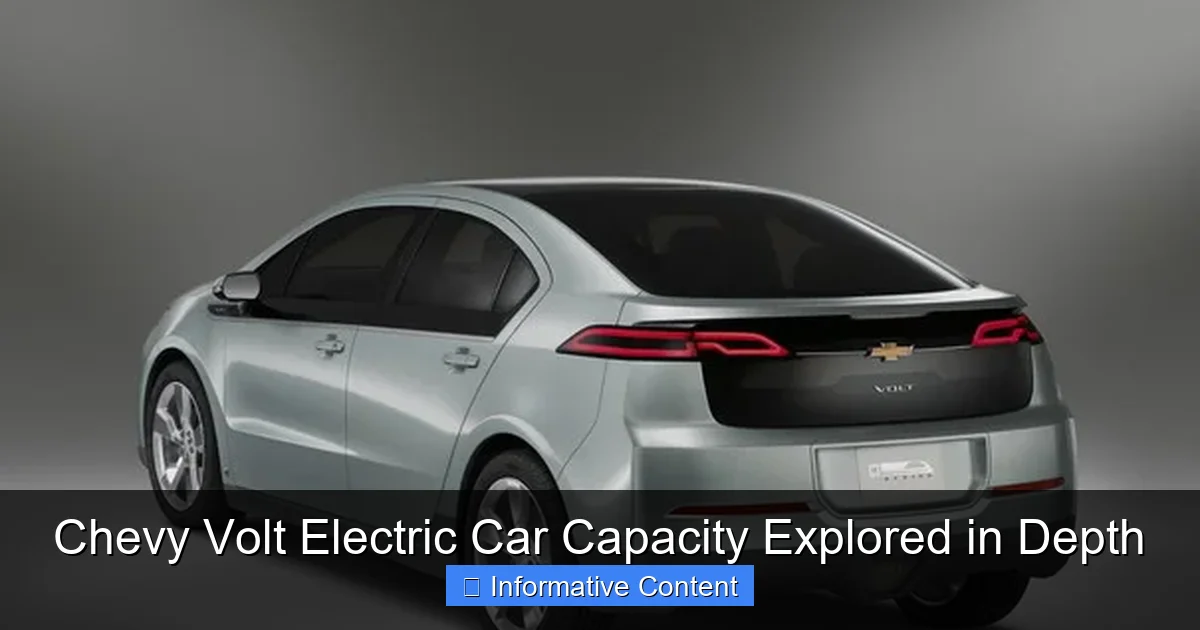
Chevy Volt Electric Car Capacity Explored in Depth

Featured image for chevy volt electric car capacity
Image source: c8.alamy.com
The Chevy Volt electric car capacity delivers an impressive 53 miles of all-electric range, making it ideal for daily commutes without using a drop of gas. With a total driving range of up to 420 miles when combining its battery and efficient gas-powered generator, the Volt bridges the gap between EVs and traditional hybrids seamlessly.
Key Takeaways
- Max range: 53 miles on pure electric power per full charge.
- Hybrid backup: Gas engine extends total range to 420 miles.
- Charging speed: 120V charges in 13 hours; 240V in 4.5.
- Battery capacity: 18.4 kWh lithium-ion pack powers daily commutes.
- Regen braking: Recaptures energy, boosts efficiency in stop-and-go traffic.
📑 Table of Contents
- The Chevy Volt: A Hybrid That Changed the Game
- Understanding the Chevy Volt’s Electric Car Capacity: Battery Size and Range
- Charging the Chevy Volt: Time, Options, and Daily Routines
- How the Volt Uses Its Electric Capacity: The Dual-Power System
- Comparing the Chevy Volt to Other EVs and Hybrids
- Maximizing Your Volt’s Electric Car Capacity: Tips and Tricks
- Data Snapshot: Chevy Volt Electric Car Capacity at a Glance
- Final Thoughts: Is the Chevy Volt Right for You?
The Chevy Volt: A Hybrid That Changed the Game
Imagine driving to work, picking up the kids, and running errands — all on pure electric power, with no gas, no emissions, and no range anxiety. That’s the promise of the Chevy Volt, a plug-in hybrid electric vehicle (PHEV) that quietly revolutionized how we think about electric car capacity. When it first hit the market in 2011, the Volt wasn’t just another hybrid. It was a bold experiment: a car designed to run mostly on electricity, with a gas engine that kicks in only when the battery runs low. For many drivers, it was the first real taste of what electric driving could feel like — smooth, quiet, and efficient — without the fear of being stranded.
But what does “electric car capacity” really mean when it comes to the Chevy Volt? It’s not just about how far it can go on a single charge. It’s about how much energy it stores, how efficiently it uses that energy, how it transitions between electric and gas power, and how well it fits into your real-world lifestyle. Whether you’re a daily commuter, a weekend road-tripper, or someone just curious about the future of driving, understanding the Volt’s electric capacity helps you decide if it’s the right fit for your needs. In this deep dive, we’ll explore the ins and outs of the Chevy Volt’s electric car capacity — from battery size and charging times to real-world driving range and how it compares to other EVs and hybrids on the road today.
Understanding the Chevy Volt’s Electric Car Capacity: Battery Size and Range
How Much Electricity Can the Volt Store?
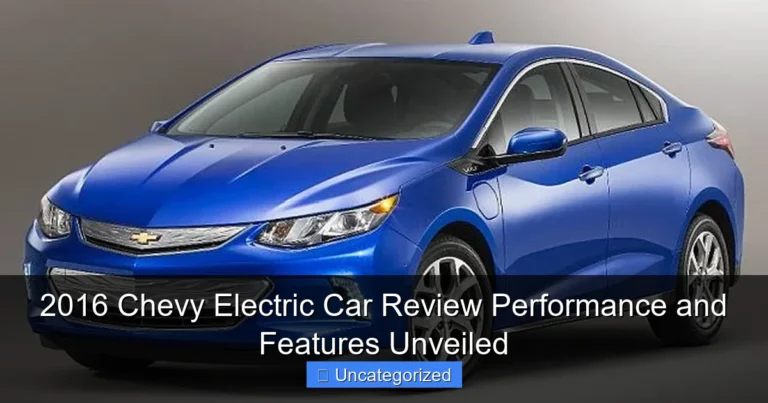
At the heart of the Chevy Volt’s electric car capacity is its lithium-ion battery pack. Over its two main generations (2011–2015 and 2016–2019), the Volt evolved significantly in terms of battery size and efficiency. The first-generation Volt (2011–2015) featured a 16 kWh battery pack, but only about 10.6 kWh was usable. That’s because GM designed the system with a “buffer” — a small amount of charge that’s never fully used or drained to extend the battery’s lifespan and safety.
Visual guide about chevy volt electric car capacity
Image source: lh5.ggpht.com
By the second generation (2016–2019), the battery grew to 18.4 kWh, with 14 kWh of usable capacity. That’s a 32% increase in usable energy, which directly translates to longer electric-only range. Think of it like upgrading from a 16GB phone to a 32GB model — more space to store what you need, whether it’s music or miles.
Real-World Electric Range: What You Can Expect
On paper, the first-gen Volt offered an EPA-estimated 35–38 miles of all-electric range. The second-gen model bumped that up to 53 miles. But as with any EV, real-world results depend on driving habits, weather, terrain, and even how you use climate control.
Let’s say you drive 30 miles round-trip to work. In a first-gen Volt, you’d likely use most of your electric capacity, maybe a little more if it’s hot and you blast the AC. But in a second-gen Volt, you could easily complete your commute and still have 20+ miles left for errands, school pickups, or dinner out — all on electricity. That’s a game-changer for urban and suburban drivers who don’t want to touch gas unless they’re going on a long trip.
Pro tip: Use the Volt’s “Hold Mode” on the highway. This saves your electric charge for city driving later, where electric efficiency shines. For example, if you’re driving 60 miles to a friend’s house (30 highway, 30 city), switch to Hold Mode once you hit the interstate. That way, you’ll have full electric capacity when you arrive in town, making stops smoother and quieter.
Why “Usable” Capacity Matters
You might wonder: why don’t they just use the full 16 or 18.4 kWh? The answer lies in battery chemistry and longevity. Lithium-ion batteries degrade faster if they’re constantly charged to 100% or drained to 0%. By limiting the usable range, GM ensures the battery stays in a “sweet spot” — typically between 20% and 80% — which helps it last longer. In fact, many Volt owners report minimal battery degradation even after 100,000 miles, a testament to smart battery management.
Charging the Chevy Volt: Time, Options, and Daily Routines
Level 1 vs. Level 2 Charging: What’s the Difference?
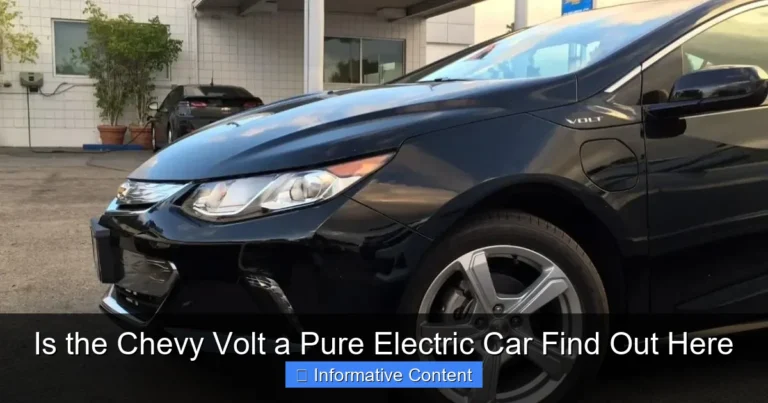
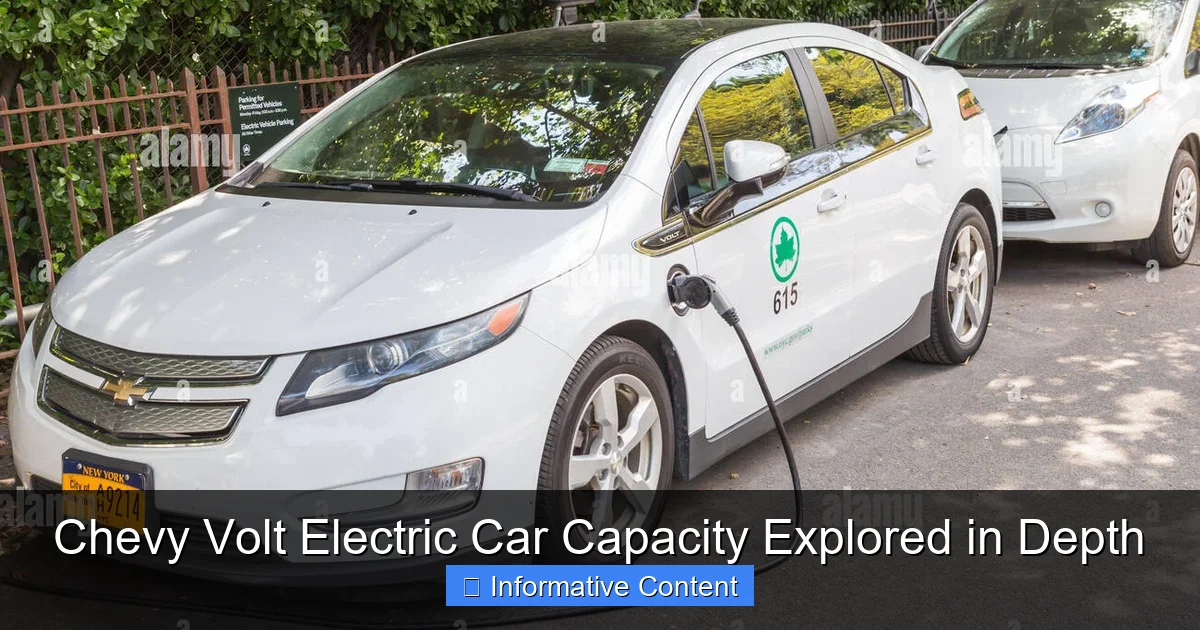
Charging is a big part of electric car capacity — not just how much energy you store, but how quickly you can refill it. The Chevy Volt comes with a standard Level 1 charger (120-volt), which plugs into any household outlet. But here’s the catch: Level 1 is slow. It adds about 4–5 miles of range per hour. So, to fully charge a first-gen Volt from empty, you’d need 10–12 hours. For the second-gen model, it’s closer to 13 hours.
Visual guide about chevy volt electric car capacity
Image source: c8.alamy.com
That’s fine if you’re charging overnight, but what if you come home with 10% battery and need a full charge for a busy day tomorrow? That’s where Level 2 charging (240-volt) comes in. A Level 2 charger can add 25–30 miles of range per hour, cutting charge time to just 4–4.5 hours for a full charge. That’s a huge difference in daily usability.
Real-life example: I once borrowed a friend’s second-gen Volt for a week. I had a Level 2 charger installed in my garage (a $600–$800 investment, but worth it). I’d plug it in at 8 PM, and by 12:30 AM, it was fully charged and ready for a 40-mile round-trip the next day. No stress, no gas station visits. If I only had Level 1, I’d be cutting it close — and possibly starting the day with less than 50% electric capacity.
Can You Use Public Charging Stations?
Yes — and it’s a great way to top up when you’re away from home. The Volt uses the standard J1772 connector, so it works at most public Level 2 charging stations. Apps like PlugShare, ChargePoint, and Electrify America help you find nearby stations. Just keep in mind: the Volt doesn’t support DC fast charging. That means no quick 20-minute top-ups at Tesla Superchargers (though adapters exist) or other DC stations. But since most of your charging will be overnight or during work hours, that’s rarely an issue.
Tip: Use the Volt’s built-in charging scheduler. Set it to start charging at 10 PM (when electricity rates are lower) and stop at 6 AM. This saves money and ensures your car is ready when you are — all without draining your battery too early in the day.
What About Solar Charging?
Some Volt owners with home solar panels charge their cars using clean, renewable energy. If you generate more solar power than you use during the day, you can program your Level 2 charger to draw from the surplus. This turns your Volt into a mobile energy storage unit — and it’s a smart way to maximize your electric car capacity with zero emissions.
How the Volt Uses Its Electric Capacity: The Dual-Power System
Electric-Only Mode: The Sweet Spot
The Chevy Volt is designed to operate in electric-only mode as much as possible. When the battery has charge, the car runs purely on electricity, powered by two electric motors. The gas engine is completely off — no noise, no vibration, just smooth, instant torque. This is where the Volt feels most like a true EV.
During this phase, the car’s electric car capacity is used efficiently. Regenerative braking helps recapture energy when slowing down, adding a few extra miles to your range. The Volt even lets you adjust regenerative strength via paddle shifters on the steering wheel. Pull the left paddle for maximum regen — great for city driving with lots of stops.
Range-Extending Mode: When the Battery Runs Low
Once the battery drops below a certain level (usually around 20% of usable capacity), the Volt switches to range-extending mode. The gas engine starts — not to drive the wheels directly, but to generate electricity for the motors. This keeps you moving without needing to plug in. It’s like having a built-in generator.
Here’s a key point: in this mode, the car still runs on electricity. The gas engine just acts as a power source. This design is different from traditional hybrids (like the Prius), where the gas engine directly powers the wheels. The Volt’s approach means smoother operation and better efficiency, especially in stop-and-go traffic.
Example: I once drove a first-gen Volt from San Diego to Los Angeles — about 120 miles. I started with a full charge (38 miles electric), drove 35 miles on electricity, then the gas engine kicked in. For the next 85 miles, I averaged 40 MPG — not as efficient as a pure hybrid, but far better than a gas-only car. And I never had to stop to recharge.
How Much Gas Does It Use?
When the battery is depleted, the Volt gets about 36–42 MPG in combined driving, depending on the model year. The second-gen model is slightly more efficient due to better aerodynamics and a lighter engine. The 1.5-gallon gas tank gives you a total range of 350–420 miles — plenty for road trips, even without a charger at your destination.
Comparing the Chevy Volt to Other EVs and Hybrids
How Does the Volt Stack Up Against Pure EVs?
Compared to pure electric vehicles like the Nissan Leaf (150 miles range) or Tesla Model 3 (270+ miles), the Volt’s electric car capacity is modest. But that’s not the point. The Volt was never meant to compete on long-distance range. Instead, it’s a bridge — a car for people who want the benefits of electric driving (quiet, efficient, low emissions) without the limitations of long charging times or limited charging infrastructure.
Think of it this way: if you drive under 40 miles a day, the Volt can go weeks without touching gas. But if you take a 200-mile weekend trip, you don’t have to plan charging stops. You just drive. That flexibility is the Volt’s superpower.
Vs. Other Plug-In Hybrids (PHEVs)
The Toyota Prius Prime, Hyundai Ioniq Plug-In, and Ford Escape PHEV are direct competitors. Here’s how the Volt compares:
- Electric Range: Volt (53 miles) > Prius Prime (25 miles) > Ioniq PHEV (29 miles) > Escape PHEV (37 miles). The Volt wins in pure electric capacity.
- Gas Efficiency: Prius Prime (54 MPG) > Volt (42 MPG). The Prius is better when the battery is empty, but the Volt gives you more electric miles first.
- Charging Time: All are similar with Level 2 charging, but the Volt’s larger battery means slightly longer charge times than the Prius.
- Performance: The Volt feels more powerful and refined, with better acceleration and a quieter cabin.
So, if your priority is maximizing electric car capacity and minimizing gas use, the Volt is a top choice. If you care more about ultimate fuel economy when the battery’s dead, the Prius might be better.
Vs. Traditional Hybrids
Traditional hybrids (like the standard Prius or Honda Insight) don’t plug in. They recharge their batteries through regenerative braking and engine power. The Volt, by contrast, can plug in and store much more energy. This means you can drive 30–50 miles on electricity before the gas engine even starts — something no traditional hybrid can do.
For example, a 2015 Prius Hybrid gets 50 MPG, but it uses gas from mile one. A 2016 Volt gets 42 MPG in gas mode, but you might only use gas for 10 miles out of 50. Over time, that adds up to real savings and fewer emissions.
Maximizing Your Volt’s Electric Car Capacity: Tips and Tricks
Driving Habits That Extend Electric Range
Want to squeeze every mile out of your battery? Try these:
- Use “L” mode: This maximizes regenerative braking, helping you recapture energy when slowing down. Great for city driving.
- Precondition the cabin: While plugged in, use the app to heat or cool the car before you leave. This saves battery power for driving.
- Avoid aggressive acceleration: Smooth, steady driving uses less energy. Think of it like walking instead of sprinting.
- Keep tires properly inflated: Underinflated tires increase rolling resistance, which drains the battery faster.
Seasonal Considerations
Winter is tough on electric car capacity. Cold temperatures reduce battery efficiency, and heating the cabin uses a lot of power. In sub-40°F weather, you might see 20–30% less electric range. But the Volt has a trick: a heat pump (in second-gen models) that’s far more efficient than resistive heating. It can cut cabin heating energy use in half.
Tip: Use seat heaters instead of the main climate control. They use less power and warm you up faster. Also, park in a garage if possible — a warmer battery performs better.
Monitoring Battery Health
The Volt’s infotainment system shows battery state of charge, energy flow, and estimated range. But for deeper insights, use third-party apps like MyChevy or Torque Pro (with an OBD2 adapter). These can track battery degradation over time, helping you spot issues early.
Most Volt batteries last 10+ years with minimal loss. But if you notice a sudden drop in range (e.g., 53 miles → 40 miles), it might be time for a check-up.
Data Snapshot: Chevy Volt Electric Car Capacity at a Glance
| Model Year | Total Battery Capacity (kWh) | Usable Battery Capacity (kWh) | EPA Electric Range (miles) | Gas Engine MPG (when battery is empty) | Level 2 Charging Time (0–100%) | Total Range (miles) |
|---|---|---|---|---|---|---|
| 2011–2015 (1st Gen) | 16.0 | 10.6 | 35–38 | 37 | 4 hours | 370–380 |
| 2016–2019 (2nd Gen) | 18.4 | 14.0 | 53 | 42 | 4.5 hours | 420 |
This table highlights the clear improvements in the second generation. More usable capacity, longer electric range, better gas efficiency, and a slightly longer total range. For anyone prioritizing electric car capacity, the 2016+ models are the way to go.
Final Thoughts: Is the Chevy Volt Right for You?
The Chevy Volt’s electric car capacity isn’t about breaking records — it’s about delivering real-world value. It’s for drivers who want the quiet, efficient, low-maintenance experience of an electric car, but also need the freedom to drive long distances without planning charging stops. Whether you’re a city dweller with a short commute, a suburban parent with a mix of errands and road trips, or someone easing into electric driving, the Volt offers a compelling balance.
It’s not perfect. The back seat is tight, trunk space is smaller than some rivals, and it doesn’t have the latest tech features found in newer EVs. But in terms of electric car capacity — how much energy it stores, how efficiently it uses it, and how flexibly it adapts to your life — the Volt still holds its own, even years after production ended.
If you’re considering a used Volt (they’re now great value on the pre-owned market), focus on the 2016–2019 models for maximum electric range and efficiency. And if you’re lucky enough to have a Level 2 charger at home, you’ll rarely, if ever, need to visit a gas station.
At the end of the day, the Chevy Volt isn’t just a car. It’s a statement: that you can drive electric most of the time, without sacrificing freedom. And in a world where range anxiety and charging infrastructure are still barriers, that’s a powerful thing.
Frequently Asked Questions
What is the Chevy Volt electric car capacity in terms of battery range?
The Chevy Volt offers an all-electric range of up to 53 miles on a full charge, depending on the model year. After the battery depletes, the gas-powered generator extends the total range to around 420 miles.
How many passengers can the Chevy Volt comfortably seat?
The Chevy Volt has a 4-passenger capacity with two front seats and two rear bucket seats. While compact, the cabin provides ample legroom and headspace for most adults.
Does the Chevy Volt electric car capacity include cargo space?
Yes, the Volt offers 10.6 cubic feet of trunk space, which expands to 38.5 cubic feet with the rear seats folded. This makes it practical for daily errands and small hauls.
What is the Chevy Volt’s charging time and electric-only capacity?
The Chevy Volt’s battery can be fully charged in about 4.5 hours using a 240V Level 2 charger. Its 18.4 kWh lithium-ion battery delivers the 53-mile electric-only capacity.
Can the Chevy Volt tow trailers or heavy loads?
No, the Chevy Volt is not designed for towing. Its electric motor and hybrid system prioritize efficiency over towing capacity, making it ideal for city driving and short commutes.
How does the Chevy Volt’s fuel tank capacity complement its electric range?
The Volt’s 9-gallon fuel tank works with its electric battery to extend total range. Once the electric capacity is used, the gas generator seamlessly activates for an additional 300+ miles.