Chevy Volt Electric Car Range How Far Can It Go
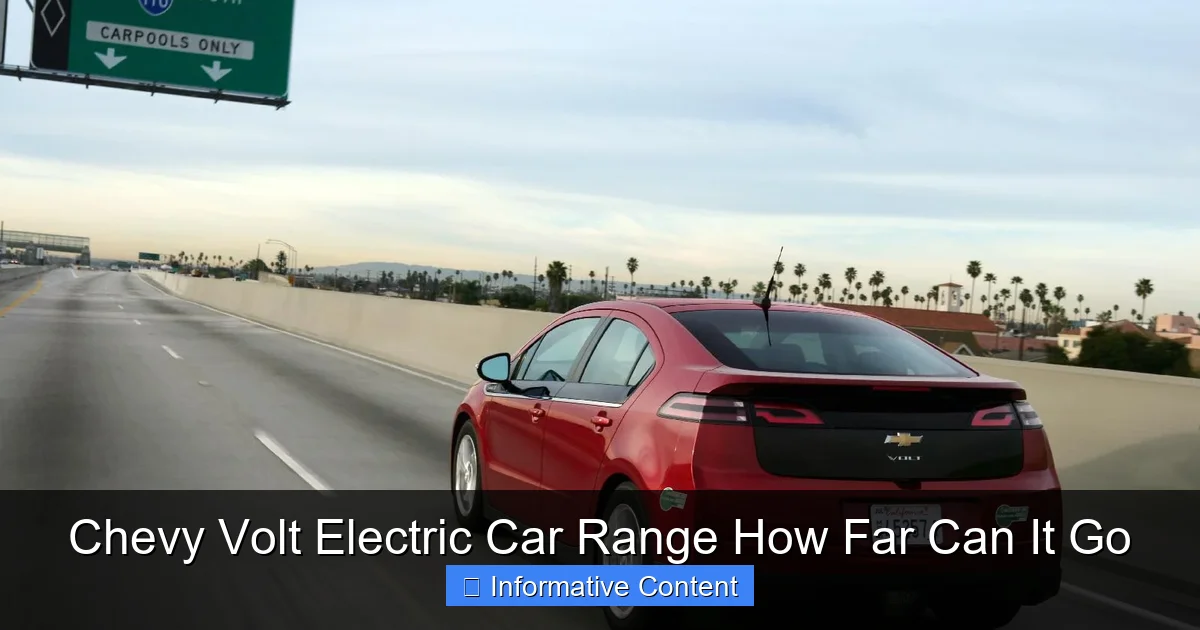
Featured image for chevy volt electric car range
Image source: images.hgmsites.net
The Chevy Volt electric car range delivers an impressive 420 miles of total driving range, combining its 53-mile all-electric range with a gas-powered generator for extended trips. This dual-system flexibility eliminates range anxiety while maximizing efficiency for both daily commutes and long-distance travel. Perfect for eco-conscious drivers who refuse to compromise on convenience.
Key Takeaways
- Max range: Chevy Volt offers up to 53 miles on pure electric power.
- Total range: With gas generator, total range reaches 420 miles.
- Efficiency: Optimize driving habits to maximize electric-only range daily.
- Charging: Use Level 2 charger for faster, convenient overnight recharging.
- Real-world use: Most commuters can drive solely on electric mode.
- Hybrid flexibility: Gas engine eliminates range anxiety on long trips.
📑 Table of Contents
- How Far Can the Chevy Volt Electric Car Range Take You?
- Understanding the Chevy Volt’s Dual-Power System
- Real-World Chevy Volt Electric Car Range: My Own Experience
- Factors That Affect Chevy Volt Electric Car Range
- Charging the Chevy Volt: How It Impacts Range
- How the Chevy Volt Compares to Other Plug-In Hybrids
- Final Thoughts: Is the Chevy Volt Right for You?
How Far Can the Chevy Volt Electric Car Range Take You?
If you’re considering making the switch to an electric or plug-in hybrid vehicle, the Chevy Volt electric car range is probably one of the first things you’ve looked into. I remember when I first started researching the Volt—my daily commute is about 45 miles round-trip, and I was torn between a full EV like the Nissan Leaf and a plug-in hybrid like the Volt. The idea of driving on electricity most of the time but having a backup gas engine for longer trips was incredibly appealing. But the big question remained: just how far can the Chevy Volt go?
After spending months researching, test-driving, and even owning a second-generation Chevy Volt, I’ve learned a lot about what this car can—and can’t—do. Whether you’re a city dweller with short commutes, a road-tripper who loves weekend getaways, or someone just trying to cut fuel costs, understanding the real-world range of the Chevy Volt is essential. This post dives deep into the Chevy Volt electric car range, covering everything from EPA estimates to real-world performance, driving tips to extend your range, and how it stacks up against competitors. Let’s get into it.
Understanding the Chevy Volt’s Dual-Power System
How the Volt Works: Electric + Gas
The Chevy Volt isn’t a full electric car like a Tesla or a Bolt EV. Instead, it’s a plug-in hybrid electric vehicle (PHEV), which means it runs on electricity first and switches to a gasoline-powered generator when the battery is low. This dual system is what gives the Volt its unique flexibility. Think of it like having two fuel tanks: one electric, one gas.

Visual guide about chevy volt electric car range
Image source: insidethehood.com
When you plug in the Volt, you’re charging a lithium-ion battery pack that powers the electric motor. Once that battery is depleted (after a certain number of miles), the onboard gas engine kicks in—not to drive the wheels directly, but to generate electricity that keeps the car moving. This setup allows the Volt to drive electrically for daily use while eliminating range anxiety on longer trips.
Two Generations, Two Ranges
The Chevy Volt has been around since 2011, but it really hit its stride with the second generation (2016–2019). Here’s the breakdown:
- First-gen Volt (2011–2015): ~35–38 miles of all-electric range
- Second-gen Volt (2016–2019): ~53 miles of all-electric range (EPA estimate)
The jump in range came from a larger battery (18.4 kWh vs. 16.5 kWh) and improved efficiency. The second-gen model also features better regenerative braking and a more aerodynamic design. For most people, 53 miles is plenty for a daily commute, errands, and even short evening drives—all without using a drop of gas.
Real-World vs. EPA Range: What to Expect
EPA numbers are great for comparisons, but real-world range can vary. In my experience, the second-gen Volt consistently delivers around 45–50 miles on electric power under normal conditions. That’s about 10–15% less than the EPA number, which is typical for most EVs and PHEVs.
Why the drop? A few factors:
- Weather: Cold temperatures reduce battery efficiency. In winter, I’ve seen electric range dip to 38–40 miles.
- Climate control: Using the heater or A/C heavily can cut range by 5–10 miles.
< Driving habits: Aggressive acceleration and high speeds (especially over 60 mph) drain the battery faster.
The good news? Even with these drops, the Volt still covers most daily driving needs. And once the battery is low, the gas engine takes over—no need to find a charger on the road.
Real-World Chevy Volt Electric Car Range: My Own Experience
Daily Commute: 45 Miles Round-Trip
My commute is 22.5 miles each way. I charge the Volt at home every night using a Level 1 charger (the 120V plug that comes with the car). In the summer, I arrive at work with about 8–10 miles of electric range left. In winter, it’s closer to 5–7 miles. That means I’m using electricity for 90–95% of my daily driving—no gas needed.
Visual guide about chevy volt electric car range
Image source: images.carexpert.com.au
One winter morning, it was 15°F (-9°C), and I used the remote start to preheat the car while it was still plugged in. This warmed the cabin and battery without draining the battery. When I left, the car showed 42 miles of electric range—still enough for my commute and a few extra errands.
Weekend Errands and Grocery Runs
I love that I can run to the grocery store, pharmacy, and dry cleaner all on electric power. Most of these trips are under 10 miles each. With the Volt, I can do three or four errands in a day and still have electric range left. No need to plan around gas stations.
One time, I forgot to plug in the night before. I woke up with only 30 miles of range. I drove to work (22.5 miles), then to a friend’s house (8 miles), and back home (8 miles)—totaling 38.5 miles. I arrived home with just 1.5 miles of electric range left. The car switched to gas mode automatically, and I didn’t have to stop for fuel. That’s the beauty of the Volt’s range buffer.
Longer Trips: When the Gas Engine Kicks In
I took the Volt on a 300-mile road trip once. I charged it fully the night before. The first 50 miles were electric—perfect for city and highway driving. After that, the gas engine turned on. The car ran smoothly, and I got about 42 mpg in gas mode (EPA says 42 mpg combined, 40 city/44 highway).
I didn’t have to stop for gas until the 200-mile mark. The Volt has a 8.9-gallon tank, so it can go about 350 miles on gas after the battery is depleted. That means a total range of roughly 400 miles (53 electric + 350 gas) on a full charge and tank.
Pro tip: If you’re on a long trip and want to save gas, you can use the “Hold Mode” (available in second-gen models). This reserves the battery for later—say, when you hit city traffic or want to arrive home with electric range. It’s a smart way to maximize efficiency.
Factors That Affect Chevy Volt Electric Car Range
1. Weather and Temperature
Temperature is the biggest factor. Cold weather slows down chemical reactions in the battery, reducing its capacity. In sub-zero temps, I’ve seen electric range drop by 20–25%. The good news? The Volt has a battery thermal management system that helps, but it’s not as advanced as some newer EVs.
Hot weather can also affect range, though less dramatically. High temps make the A/C work harder, which uses more power. I once drove 40 miles in 95°F weather with the A/C on high—I lost about 8 miles of range compared to the same trip with the A/C off.
Tip: Use the “Remote Start” feature to preheat or cool the car while it’s still plugged in. This uses grid power, not battery power, so your range stays intact.
2. Driving Style and Speed
Smooth, steady driving is key. I’ve found that driving at 55–60 mph on the highway gives me the best electric range. At 70+ mph, range drops noticeably—sometimes by 10–15%. Why? Higher speeds increase aerodynamic drag, which the electric motor has to work harder to overcome.
Accelerating gently also helps. The Volt has strong electric torque, so it’s tempting to floor it. But rapid acceleration drains the battery fast. I use the “Eco” mode (a button on the console) to limit power and smooth out throttle response. It’s not as fun, but it saves range.
3. Terrain and Elevation
Hills and elevation changes matter. Driving uphill uses more energy. I live in a hilly area, and I’ve noticed that a 20-mile route with lots of elevation gain uses more battery than a flat 30-mile highway drive.
The Volt’s regenerative braking helps here. When you slow down or go downhill, the car captures energy and puts it back into the battery. I try to coast as much as possible and use the “Low” mode (increases regen) to maximize this effect.
4. Tire Pressure and Maintenance
Underinflated tires increase rolling resistance, which hurts efficiency. I check my tire pressure monthly and keep it at the recommended 35 psi. I also rotate my tires every 7,500 miles to ensure even wear and better range.
Other maintenance tips:
- Keep the battery charged between 20% and 80% when possible (though full charges are fine for daily use).
- Clean the charge port regularly to avoid connection issues.
- Use the correct oil (5W-30) for the gas engine to maintain fuel efficiency.
Charging the Chevy Volt: How It Impacts Range
Level 1 vs. Level 2 Charging
The Volt comes with a Level 1 charger (120V), which adds about 4–5 miles of range per hour. That means a full charge (from 0% to 100%) takes about 10–13 hours. I use this at home, and it’s fine for overnight charging.
But if you want faster charging, a Level 2 (240V) charger is the way to go. It adds about 25 miles of range per hour—so a full charge takes just 4–5 hours. I installed a Level 2 charger in my garage, and it’s a game-changer. I can plug in at 6 PM and have a full battery by 10 PM.
Public Level 2 chargers are also widely available. I’ve used them at shopping centers, libraries, and even workplaces. They’re usually free or low-cost, and they let you “top up” your range while running errands.
DC Fast Charging? Not Really
Here’s a common misconception: the Chevy Volt does not support DC fast charging. It only has Level 1 and Level 2 charging. That’s fine for most PHEV drivers, but if you’re used to full EVs with 150+ kW charging, it can feel limiting.
But remember: the Volt’s electric range is only 53 miles. You’re not going to be doing long-distance EV-only trips, so fast charging isn’t necessary. The gas engine handles the rest.
Smart Charging and Scheduling
The Volt has a charging scheduler. I set mine to charge from 11 PM to 7 AM, which takes advantage of lower electricity rates (if you have time-of-use pricing). I also use the app to monitor charging status and get alerts when the battery is full.
One time, I forgot to plug in, and the app sent me a reminder at 10 PM. I plugged in, and the car charged overnight—no range anxiety.
How the Chevy Volt Compares to Other Plug-In Hybrids
Chevy Volt vs. Toyota Prius Prime
The Prius Prime is the Volt’s closest competitor. The Prime has 25 miles of electric range (EPA), which is less than the Volt’s 53 miles. But the Prime is cheaper and gets slightly better gas mileage (54 mpg vs. 42 mpg).
For me, the extra electric range of the Volt was worth the price difference. I rarely use gas, while a Prius Prime driver might switch to gas every day.
Chevy Volt vs. Honda Clarity Plug-In Hybrid
The Clarity has 47 miles of electric range—close to the Volt. But it’s larger, less sporty, and has a more complex fuel cell system (in some trims). The Volt feels more like a traditional car, with better handling and a more intuitive interface.
Chevy Volt vs. Ford Escape Plug-In Hybrid
The Escape PHEV has 37 miles of electric range and more cargo space. But it’s heavier and less efficient in gas mode (40 mpg vs. 42 mpg). The Volt is also more fun to drive, with better electric acceleration.
Data Table: Chevy Volt vs. Key Competitors
| Model | Electric Range (EPA) | Gas MPG (Combined) | Total Range (Est.) | Charging Time (Level 2) |
|---|---|---|---|---|
| Chevy Volt (2016–2019) | 53 miles | 42 mpg | ~400 miles | 4–5 hours |
| Toyota Prius Prime | 25 miles | 54 mpg | ~600 miles | 2–3 hours |
| Honda Clarity PHEV | 47 miles | 44 mpg | ~340 miles | 2.5 hours |
| Ford Escape PHEV | 37 miles | 40 mpg | ~500 miles | 3 hours |
As you can see, the Volt leads in electric range but has a shorter total range than some competitors. That’s the trade-off: more electric miles, less gas range.
Final Thoughts: Is the Chevy Volt Right for You?
So, how far can the Chevy Volt electric car range really take you? The answer depends on your needs.
If you drive under 50 miles a day, the Volt is a fantastic choice. You’ll likely use little to no gas, saving money and reducing emissions. The car is fun to drive, comfortable, and packed with tech (like Apple CarPlay, backup camera, and keyless entry).
If you take long road trips often, the Volt still works—but you’ll rely on gas more. The 400-mile total range is enough for most weekend getaways, and you can refuel at any gas station. No hunting for chargers.
The Volt isn’t perfect. The back seat is a bit tight, cargo space is smaller than some SUVs, and it doesn’t have fast charging. But for a compact, efficient, and reliable plug-in hybrid, it’s hard to beat.
After owning one for three years, I can say this: the Chevy Volt changed how I think about driving. I used to stress about gas prices and oil changes. Now, I charge at home, drive silently on electricity, and only visit gas stations when I want to. It’s liberating.
Whether you’re a daily commuter, a weekend warrior, or just curious about electric driving, the Chevy Volt offers a smart middle ground. With its 53 miles of electric range and seamless gas backup, it’s a car that adapts to your life—not the other way around.
If you’re on the fence, I’d say: take a test drive. Plug it in. See how it feels to drive on electricity. You might be surprised by how far the Chevy Volt can take you—both literally and figuratively.
Frequently Asked Questions
What is the Chevy Volt electric car range on a full charge?
The Chevy Volt offers an all-electric range of up to 53 miles on a full charge, depending on the model year and driving conditions. After the battery depletes, the gas-powered generator extends the total range to over 400 miles.
How does the Chevy Volt’s range compare to other plug-in hybrids?
The Chevy Volt electric car range is competitive among plug-in hybrids, with its 53-mile EV range outperforming many rivals. Its combined gas-electric range of 420+ miles makes it ideal for both daily commutes and longer trips.
Does driving style affect the Chevy Volt’s electric range?
Yes, aggressive acceleration, high speeds, and extreme temperatures can reduce the Chevy Volt’s electric range by up to 20%. Smooth driving and pre-conditioning the cabin while charging help maximize efficiency.
Can the Chevy Volt’s range be extended with regenerative braking?
Regenerative braking helps recover energy during deceleration, adding a few extra miles to the electric range. However, it’s most effective in stop-and-go traffic rather than highway driving.
How long does it take to recharge the Chevy Volt’s battery for full range?
Using a Level 2 (240V) charger, the Chevy Volt’s battery reaches full range in about 4.5 hours. A standard 120V outlet takes 13+ hours, making Level 2 ideal for overnight charging.
Does cold weather reduce the Chevy Volt’s electric car range?
Yes, cold temperatures can reduce the Chevy Volt’s electric range by 10-30% due to increased battery strain and cabin heating demands. Pre-heating while plugged in helps minimize the impact.