Did Henry Ford Make an Electric Car The Truth Revealed
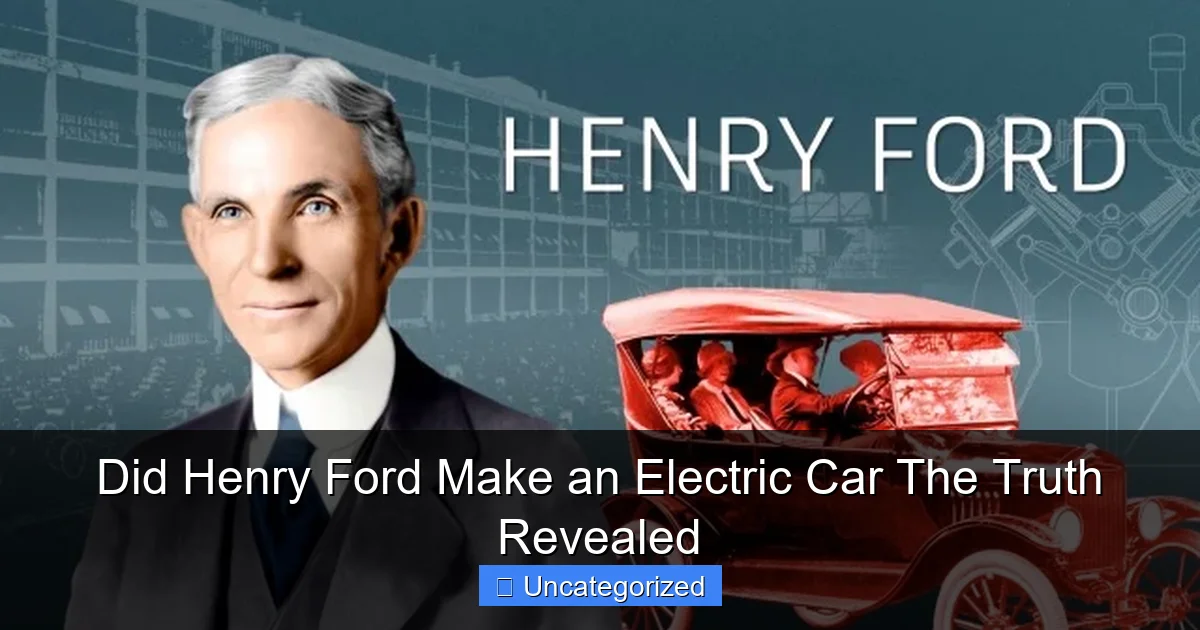
Featured image for did henry ford make an electric car
Image source: embed-ssl.wistia.com
Yes, Henry Ford developed an electric car in the early 1900s, partnering with inventor Thomas Edison to create a prototype in 1914. Though the vehicle never reached mass production due to limitations in battery technology and the rising dominance of gasoline-powered engines, Ford’s visionary effort revealed his interest in sustainable transportation over a century ago.
Key Takeaways
- Henry Ford never mass-produced an electric car despite early experiments.
- Edison collaboration explored electric vehicles, but gasoline won the race.
- 1914 prototype existed but lacked commercial viability for the era.
- Ford prioritized affordability—gasoline cars better matched his vision.
- Electric tech was limited by battery range and charging infrastructure.
- Modern EVs fulfill what Ford and Edison once envisioned together.
📑 Table of Contents
- Did Henry Ford Make an Electric Car? The Truth Revealed
- The Rise of Electric Vehicles in the Early 20th Century
- Henry Ford’s Relationship with Electric Vehicles
- Ford’s Strategic Focus on Gasoline and Mass Production
- The Legacy of Ford’s Electric Car Experiments
- Comparing Ford’s 1914 Electric Car to Modern EVs
- Conclusion: The Truth About Henry Ford and Electric Cars
Did Henry Ford Make an Electric Car? The Truth Revealed
When we think of Henry Ford, the first image that comes to mind is the iconic Model T, a gasoline-powered automobile that revolutionized transportation in the early 20th century. Ford’s legacy is deeply intertwined with the mass production of internal combustion engine vehicles, making the idea of him creating an electric car seem almost contradictory. Yet, the question persists: Did Henry Ford make an electric car? The answer lies not in a simple yes or no, but in a complex narrative of technological experimentation, industrial ambition, and the shifting tides of automotive innovation.
Electric vehicles (EVs) were not a futuristic concept in Ford’s time—they were contemporaries of gasoline cars. In fact, at the dawn of the automobile age, electric and steam-powered vehicles were serious competitors to gasoline engines. By exploring Ford’s ventures into electric mobility, we uncover a story of collaboration, missed opportunities, and the broader historical context that shaped the automotive industry. This blog post dives deep into Ford’s relationship with electric vehicles, separating myth from reality and revealing how his decisions influenced the trajectory of transportation for over a century.
The Rise of Electric Vehicles in the Early 20th Century
Electric Cars: The Original Alternative
Before the dominance of gasoline-powered cars, electric vehicles were a viable and even popular option. In the late 1800s and early 1900s, electric cars offered a quiet, clean, and user-friendly alternative to their noisy, hand-cranked gasoline counterparts. By 1900, electric vehicles accounted for 38% of all automobiles in the U.S., surpassing steam and gasoline cars in market share. Companies like Baker Electric, Detroit Electric, and Columbia Electric produced vehicles that were favored by urban dwellers, especially women, due to their ease of operation and lack of exhaust fumes.
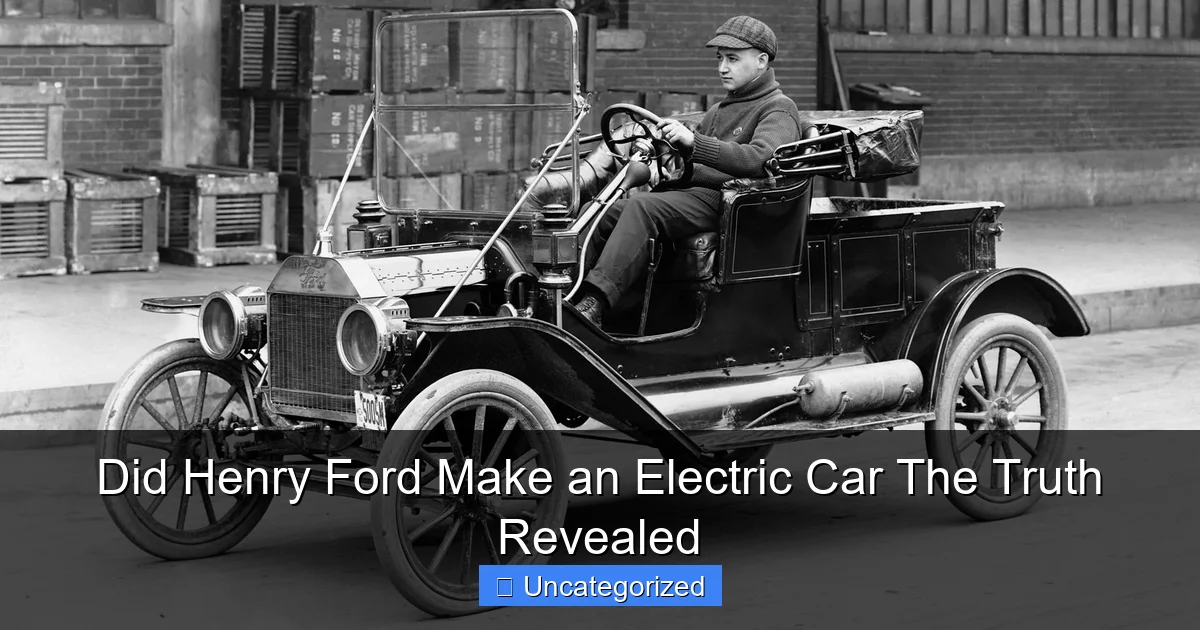
Visual guide about did henry ford make an electric car
Image source: assets.editorial.aetnd.com
Electric cars were ideal for short-distance travel, which was the norm in cities at the time. Their limited range—typically 50–80 miles per charge—was not a major drawback when most people traveled within city limits. Moreover, charging infrastructure was simpler: owners could plug into household electrical systems, a convenience gasoline cars lacked.
Why Electric Cars Lost the Race
Despite their early popularity, electric vehicles faced several critical disadvantages that led to their decline by the 1920s:
- Limited range: Battery technology was primitive. Lead-acid batteries were heavy, expensive, and had low energy density, restricting travel distance.
- Charging time: Recharging could take 6–10 hours, making long trips impractical.
- Fuel availability: Gasoline became cheaper and more widely available, especially as oil exploration expanded.
- Mass production: Henry Ford’s Model T, introduced in 1908, was produced using assembly line techniques that drastically reduced costs and increased accessibility.
Ford’s innovation wasn’t just the car itself—it was the system behind it. By 1914, the Model T sold for $440 (down from $850 in 1908), while electric cars remained expensive, often priced between $1,000 and $2,000. As gasoline infrastructure improved and rural roads expanded, the limitations of electric cars became insurmountable. By 1935, electric vehicles had all but disappeared from the U.S. market.
Henry Ford’s Relationship with Electric Vehicles
Early Experiments and Collaborations
Contrary to popular belief, Henry Ford did not entirely dismiss electric vehicles. In the 1910s, he explored the idea of creating an affordable electric car, particularly for women and urban drivers. One of the most significant collaborations was with Thomas Edison, the inventor of the phonograph and a pioneer in electrical engineering. Ford and Edison were close friends and shared a vision of a cleaner, more efficient transportation system.
In 1914, Ford announced plans to develop an electric car with Edison’s help. The goal was to create a vehicle powered by a lightweight, high-capacity battery—something that didn’t yet exist. Edison had been working on a nickel-iron battery (also known as the Edison battery), which he believed could outperform lead-acid batteries in terms of durability and efficiency. Ford envisioned a $500 electric car that would be as affordable as the Model T.
The 1914 Electric Car Prototype
Historical records and Ford Motor Company archives suggest that at least one prototype electric car was built in 1914. While not officially marketed or mass-produced, this vehicle was tested at Ford’s Highland Park factory. Key features included:
- A chassis similar to the Model T, adapted for electric propulsion.
- An Edison nickel-iron battery pack mounted beneath the floor.
- A top speed of around 25 mph and a range of 50–80 miles.
- Silent operation and no need for hand-cranking.
Despite promising early tests, the project never advanced beyond the prototype stage. Several factors contributed to its demise:
- Battery limitations: Edison’s nickel-iron battery was more durable but still too heavy and expensive for mass production.
- Market focus: Ford prioritized the Model T, which was selling at an unprecedented rate.
- Strategic shift: Ford believed gasoline engines were better suited for rural America, where long-distance travel was essential.
By 1915, the electric car project was quietly shelved. Ford later admitted that while the technology was interesting, it wasn’t viable for the market he wanted to dominate.
Ford’s Strategic Focus on Gasoline and Mass Production
The Model T and the Assembly Line Revolution
Henry Ford’s true genius lay not in inventing new technologies, but in scaling them. The Model T wasn’t the first gasoline car, nor was it the most advanced. What made it revolutionary was Ford’s implementation of the moving assembly line in 1913. This innovation reduced production time from 12 hours per car to just 90 minutes, slashing costs and enabling mass ownership.
The assembly line wasn’t just a manufacturing technique—it was a philosophy. Ford believed in standardization, efficiency, and affordability. Every Model T was painted black (the fastest-drying color) and built to exact specifications, allowing workers to specialize and streamline production. This approach made gasoline cars the default choice for millions of Americans.
Why Ford Bet on Gasoline
Ford’s decision to focus on gasoline vehicles was driven by practical and economic factors:
- Infrastructure: Gasoline was becoming cheaper and more widely available, while electricity was still limited to urban areas.
- Range and power: Gasoline engines offered greater range and could handle rough rural roads, which were unpaved and poorly maintained.
- Consumer demand: Rural farmers and suburban families needed vehicles that could travel long distances and carry heavy loads.
- Vertical integration: Ford owned rubber plantations, steel mills, and even coal mines, giving him control over the entire supply chain for gasoline cars.
Ford once famously said, “Any customer can have a car painted any color that he wants so long as it is black.” This quote encapsulates his belief in simplicity, uniformity, and cost efficiency—principles that were incompatible with the niche, expensive nature of early electric vehicles.
The Legacy of Ford’s Electric Car Experiments
Why the 1914 Prototype Was Forgotten
The 1914 electric car prototype never made it to production, and Ford never marketed an electric vehicle during his lifetime. The project faded into obscurity, overshadowed by the success of the Model T. However, the prototype’s existence is documented in:
- Ford Motor Company archives.
- Photographs from the Highland Park factory.
- Correspondence between Ford and Edison.
- Newspaper articles from 1914–1915.
Historians believe that Ford’s electric car experiment was more of a technological exploration than a serious business venture. It reflected his willingness to experiment but also his pragmatic approach to market demands. When the technology wasn’t ready and the infrastructure didn’t support it, Ford moved on.
Lessons for Modern EV Development
Ford’s early electric car project offers valuable lessons for today’s EV industry:
- Technology readiness: A product can be innovative, but it must be practical and affordable. Edison’s battery was durable but not scalable.
- Infrastructure matters: Just as gasoline stations enabled the Model T’s success, charging stations are critical for modern EVs.
- Consumer behavior: People choose vehicles based on convenience, cost, and lifestyle. Early EVs failed because they didn’t meet rural needs.
- Timing is everything: The 1914 prototype arrived too early. Today, with better batteries and renewable energy, EVs are finally viable.
Interestingly, Ford Motor Company has since embraced electric vehicles. The Ford Mustang Mach-E (2020) and F-150 Lightning (2022) are modern EVs that pay homage to Ford’s legacy while leveraging 21st-century technology.
Comparing Ford’s 1914 Electric Car to Modern EVs
Performance and Technology
While Ford’s 1914 prototype was a technological marvel for its time, modern EVs far surpass it in every metric. Below is a comparison of key specifications:
| Feature | Ford 1914 Electric Prototype | Ford Mustang Mach-E (2023) | Ford F-150 Lightning (2023) |
|---|---|---|---|
| Top Speed | 25 mph | 124 mph | 105 mph |
| Range | 50–80 miles | 247–314 miles | 240–320 miles |
| Charging Time | 6–10 hours (home) | 10 hours (Level 2), 40 min (DC fast) | 10 hours (Level 2), 41 min (DC fast) |
| Battery Type | Nickel-iron | Lithium-ion | Lithium-ion |
| Price (Adjusted) | ~$10,000 (1914 USD) | $42,000–$60,000 | $49,000–$90,000 |
| Production Scale | 1 prototype | Thousands/year | Thousands/year |
What Changed?
The leap from 1914 to 2023 is staggering. Key advancements include:
- Battery technology: Lithium-ion batteries are lighter, more energy-dense, and recharge faster than nickel-iron or lead-acid.
- Electric motors: Modern motors are more efficient, compact, and powerful.
- Regenerative braking: Recovers energy during deceleration, extending range.
- Smart systems: GPS, over-the-air updates, and driver-assistance features enhance usability.
- Renewable energy: EVs are now powered by cleaner electricity, reducing carbon footprints.
Ford’s early experiment was a glimpse of the future—one that took over a century to realize.
Conclusion: The Truth About Henry Ford and Electric Cars
So, did Henry Ford make an electric car? The answer is yes—but not in the way most people imagine. Ford did not mass-produce or sell an electric vehicle, but he did collaborate with Thomas Edison to build a prototype in 1914. This project was a bold experiment, driven by innovation and friendship, but ultimately abandoned due to technological and market limitations.
Ford’s legacy is not defined by his electric car, but by his ability to identify and scale the right technology at the right time. The Model T succeeded because it solved real-world problems—affordability, reliability, and accessibility—while electric cars of the era could not. However, Ford’s willingness to explore electric mobility shows that he was not opposed to alternative technologies; he simply prioritized what worked for his customers and his business.
Today, as the world embraces electric vehicles to combat climate change, Ford Motor Company is leading the charge with modern EVs like the Mach-E and Lightning. These vehicles are not just a tribute to Henry Ford’s vision but a realization of a century-old dream—one that combines innovation, mass production, and sustainability. The truth is, while Henry Ford didn’t make an electric car for his time, his legacy paved the way for the electric revolution we’re experiencing today.
Frequently Asked Questions
Did Henry Ford make an electric car?
While Henry Ford didn’t mass-produce a fully electric car under the Ford brand, he collaborated with Thomas Edison in the 1910s to explore an affordable electric vehicle. Prototypes were built, but high battery costs and the rise of cheap gasoline made the project unviable.
Why didn’t Henry Ford’s electric car succeed?
The Ford-Edison electric car project failed due to technological limitations—batteries were heavy, expensive, and had short lifespans. Meanwhile, the Model T’s affordability and expanding gas infrastructure cemented ICE vehicles as the future.
What was the name of Henry Ford’s electric car?
The vehicle was often called the “Edison-Ford” or “Ford electric car,” though it never had an official model name. It was a prototype developed during Ford and Edison’s partnership to create a low-cost EV.
Did Henry Ford make an electric car in the 1910s?
Yes, Ford and Edison built experimental electric vehicles between 1913 and 1915, but they never went into production. These early models were limited by battery tech and couldn’t compete with Ford’s gasoline-powered cars.
How does Henry Ford’s electric car vision compare to Ford’s EVs today?
Ford’s 1910s electric car project aimed for simplicity and affordability, much like today’s Ford electric vehicles (e.g., Mustang Mach-E). Modern EVs finally fulfill that vision thanks to advanced batteries and renewable energy support.
Did Henry Ford regret not pursuing electric cars?
Ford reportedly admired the quiet efficiency of electric cars but prioritized gasoline engines due to market demand and practicality. Over a century later, Ford Motor Company has embraced EVs, closing the loop on his early experiments.