Does Ford Have an All Electric Car Discover the Truth Here
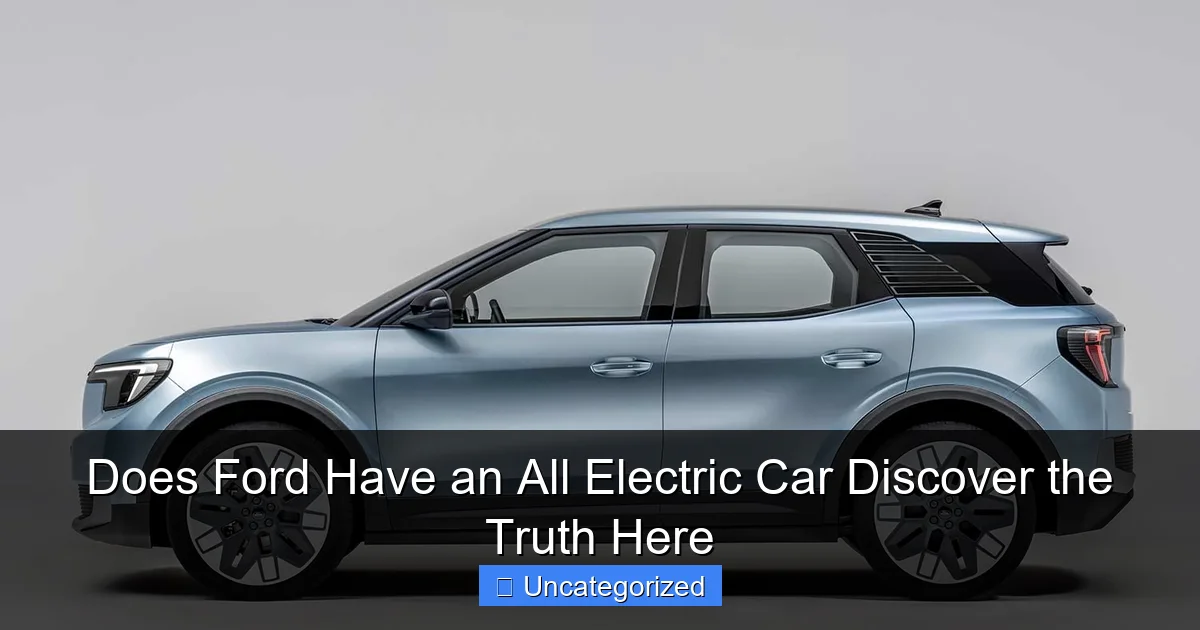
Featured image for does ford have an all electric car
Image source: autobics.com
Yes, Ford has fully electric vehicles, including the popular Mustang Mach-E and the F-150 Lightning, marking its major shift toward an electrified future. These all-electric models combine performance, innovation, and sustainability, proving Ford is serious about competing in the EV market.
Key Takeaways
- Yes, Ford offers all-electric models like the Mustang Mach-E and F-150 Lightning.
- Ford’s EV lineup is expanding with plans for more models by 2025.
- Charging infrastructure support includes access to 10,000+ stations via FordPass.
- Competitive pricing and incentives make Ford EVs affordable with tax credits.
- Impressive range and tech rival top competitors like Tesla and Rivian.
- Commercial EVs available including the E-Transit van for business use.
📑 Table of Contents
- Does Ford Have an All-Electric Car? Discover the Truth Here
- Ford’s Electric Evolution: From Concept to Reality
- Ford’s Current All-Electric Vehicle Lineup
- Technology and Innovation: What Sets Ford EVs Apart
- Charging Infrastructure and Ownership Experience
- The Future of Ford’s Electric Vehicle Strategy
- Conclusion: Ford Is All-In on Electric—And You Should Be Too
Does Ford Have an All-Electric Car? Discover the Truth Here
In an era where climate change and environmental sustainability dominate global conversations, the automotive industry is undergoing a revolutionary transformation. Electric vehicles (EVs) are no longer a futuristic dream—they’re a present-day reality, and major automakers are racing to electrify their fleets. Among these industry giants, Ford Motor Company stands out, not just for its century-old legacy but for its bold pivot toward an all-electric future. For decades, Ford has been synonymous with rugged trucks, iconic muscle cars, and family-friendly SUVs, but the question on many minds today is: Does Ford have an all-electric car? The answer is a resounding yes—and it’s far more expansive than you might think.
From the sleek Ford Mustang Mach-E to the game-changing F-150 Lightning, Ford has aggressively entered the EV market with models that blend performance, innovation, and practicality. Whether you’re a daily commuter, a weekend adventurer, or a fleet manager looking to cut emissions and fuel costs, Ford’s electric lineup offers compelling options. This comprehensive guide will take you through Ford’s current all-electric vehicles, their technological advancements, charging infrastructure, and what the future holds. By the end, you’ll not only know the truth about Ford’s electric offerings but also understand why the Blue Oval is positioning itself as a serious contender in the EV revolution.
Ford’s Electric Evolution: From Concept to Reality
The Turning Point: Ford’s 2021 EV Announcement
The pivotal moment in Ford’s electric journey came in 2021 when CEO Jim Farley declared, “We are all in on electric.” This wasn’t just marketing hype—it was backed by a $30 billion investment in electrification through 2025, including the development of new EV platforms, battery plants, and software systems. The goal? To deliver 2 million electric vehicles annually by 2026. This bold commitment signaled Ford’s departure from a hybrid-focused strategy to a full-scale embrace of battery-electric vehicles (BEVs).

Visual guide about does ford have an all electric car
Image source: busseys.co.uk
One of the most significant outcomes of this shift was the Ford Ion Park, a global battery center in Michigan dedicated to research and development of next-generation lithium-ion and solid-state batteries. This facility underscores Ford’s ambition to not only build EVs but also control the critical technology behind them—batteries—ensuring long-term competitiveness and innovation.
Breaking Away from the Past: A New Design Language
Ford’s all-electric vehicles aren’t just traditional models with batteries swapped for engines. They represent a complete rethinking of design, engineering, and user experience. For example, the Mustang Mach-E ditches the classic two-door coupe silhouette for a modern, SUV-like crossover, while the F-150 Lightning retains the truck’s iconic profile but adds futuristic lighting and a front trunk (“frunk”).
This new design language emphasizes aerodynamics, efficiency, and tech integration. Features like active grille shutters, low-drag wheel designs, and regenerative braking systems are standard across the lineup, maximizing range and performance. Additionally, Ford’s EVs come equipped with over-the-air (OTA) software updates, allowing owners to receive performance enhancements, new features, and security patches wirelessly—just like a smartphone.
Global Manufacturing and Supply Chain Transformation
To support its EV ambitions, Ford has overhauled its manufacturing strategy. The Dearborn Electric Vehicle Center in Michigan now produces the F-150 Lightning, while the Cuautitlán Assembly Plant in Mexico assembles the Mustang Mach-E for North American and global markets. These facilities are equipped with advanced robotics, AI-driven quality control, and sustainable practices—such as using 100% renewable energy in some operations.
Moreover, Ford is investing heavily in battery supply chains. Through partnerships with SK On, LG Energy Solution, and CATL, Ford is securing raw materials like lithium, nickel, and cobalt, while also building three new battery plants in the U.S. (Kentucky and Tennessee) to reduce reliance on overseas production and ensure supply chain resilience.
Ford’s Current All-Electric Vehicle Lineup
1. Ford Mustang Mach-E: The Electric SUV with a Muscle Car Soul
The Mustang Mach-E is Ford’s first dedicated all-electric vehicle, launched in 2020. It combines the legendary Mustang name with a modern, five-door SUV design. Available in multiple trims—from the base Select to the high-performance GT—the Mach-E offers a range of 224 to 314 miles on a single charge (EPA estimates), depending on configuration.
- Performance: The GT model delivers 480 horsepower and 634 lb-ft of torque, accelerating from 0 to 60 mph in just 3.5 seconds.
- Technology: Features a 15.5-inch SYNC 4A touchscreen, Ford Co-Pilot360 2.0 driver-assist suite, and BlueCruise hands-free highway driving (available on select models).
- Charging: Supports 150 kW DC fast charging, adding up to 61 miles of range in 10 minutes.
Tip: Opt for the Extended Range battery if you frequently drive long distances or live in areas with limited fast-charging infrastructure.
2. Ford F-150 Lightning: The Electric Workhorse
The F-150 Lightning is Ford’s answer to electrifying America’s best-selling vehicle for over 40 years. Launched in 2022, this all-electric pickup retains the F-150’s ruggedness while adding cutting-edge EV features. With a starting price of $49,995 (before incentives), it’s competitively priced for a full-size electric truck.
- Range: Up to 320 miles (Standard Range: 240 miles).
- Power: 580 horsepower and 775 lb-ft of torque, with a towing capacity of 10,000 lbs.
- Unique Features: A 14.1-cubic-foot frunk (front trunk), Pro Power Onboard (up to 9.6 kW of exportable power), and Intelligent Backup Power (can power a home during outages).
Practical Example: A homeowner in Texas can use the F-150 Lightning to power essential appliances during a blackout—turning the truck into a mobile generator.
3. Ford E-Transit: Electrifying the Commercial Fleet
For businesses, Ford offers the E-Transit, an all-electric version of its popular cargo van. Designed for delivery services, tradespeople, and fleet operators, the E-Transit delivers a 126-mile range and supports 115 kW DC fast charging. It’s available in multiple configurations—low, medium, and high roof, with cargo capacities up to 487.3 cubic feet.
- Cost Savings: Ford estimates 40% lower maintenance costs and 50% lower fuel costs compared to gas-powered Transits.
- Smart Features: Includes Ford Telematics for route optimization and remote diagnostics.
Tip: Small businesses can leverage federal and state EV tax credits (up to $7,500) when purchasing the E-Transit.
Technology and Innovation: What Sets Ford EVs Apart
SYNC 4A Infotainment and Connectivity
Ford’s EVs are powered by the SYNC 4A system, a massive leap forward in automotive tech. The 15.5-inch touchscreen features split-screen functionality, voice-activated controls, and seamless integration with Apple CarPlay, Android Auto, and FordPass (a mobile app for remote start, charging status, and vehicle locator).
Unique to SYNC 4A is its AI-driven predictive navigation, which learns your driving habits and suggests charging stations, traffic routes, and parking spots. It also supports over-the-air updates, meaning your car gets smarter over time—no dealership visits required.
BlueCruise: Hands-Free Driving
Ford’s BlueCruise technology (available on Mach-E and F-150 Lightning) enables hands-free driving on over 130,000 miles of pre-mapped highways in North America. Using LiDAR, radar, and cameras, BlueCruise maintains lane position, adjusts speed, and handles traffic—while monitoring driver attention via an infrared camera.
Tip: BlueCruise is subscription-based (starting at $600/year), but Ford often offers free trial periods with new vehicle purchases.
Advanced Battery and Charging Systems
Ford uses lithium-ion NMC (Nickel Manganese Cobalt) batteries in its EVs, optimized for thermal management and longevity. The F-150 Lightning, for instance, features a liquid-cooled battery pack that maintains optimal temperature even in extreme conditions.
On the charging front, Ford partners with Electrify America and ChargePoint to offer two years of free DC fast charging on select models. Additionally, Ford’s FordPass Charging Network provides access to over 19,500 charging stations across the U.S. and Canada.
Charging Infrastructure and Ownership Experience
Home Charging: The Foundation of EV Ownership
For most EV owners, home charging is the primary method. Ford includes a 120V Level 1 charger with every EV, but for faster charging, Ford offers the Ford Connected Charge Station (a 240V Level 2 charger). This unit can add 20-25 miles of range per hour and is Wi-Fi-enabled for scheduling and monitoring via the FordPass app.
- Installation Tip: Hire a licensed electrician to install a dedicated 40-amp circuit for optimal performance.
- Cost: The Ford charger costs $799, but many states offer rebates (e.g., California’s $500 rebate).
Public Charging: Networks and Compatibility
Ford EVs use the CCS (Combined Charging System) connector, ensuring compatibility with most public chargers. Key networks include:
- Electrify America: 3,500+ DC fast chargers (up to 350 kW).
- ChargePoint: 20,000+ Level 2 and DC stations.
- EVgo: 800+ fast chargers, primarily in urban areas.
Pro Tip: Use the FordPass app to locate chargers, check availability, and start sessions remotely.
Charging Speed Comparison Table
| Charger Type | Voltage | Range Added (per hour) | Time to 80% (F-150 Lightning) |
|---|---|---|---|
| Level 1 (120V) | 120V | 3-5 miles | ~50 hours |
| Level 2 (240V) | 240V | 20-25 miles | ~10 hours |
| DC Fast Charging | 400-800V | 150-200 miles | ~41 minutes |
The Future of Ford’s Electric Vehicle Strategy
Next-Generation EVs: What’s Coming in 2025 and Beyond
Ford’s EV roadmap includes several upcoming models:
- Explorer EV: An all-electric version of the popular SUV, expected in 2025.
- Lincoln EV: A luxury SUV based on Ford’s new GE2 platform, targeting premium buyers.
- Compact Electric Pickup: A smaller, more affordable truck for urban users, potentially priced under $30,000.
These models will leverage Ford’s next-generation battery technology, including lithium iron phosphate (LFP) batteries for cost-sensitive models and solid-state batteries (in development) for future high-performance variants.
Sustainability Goals: Carbon Neutrality and Circular Economy
Ford aims to achieve carbon neutrality by 2050, with interim targets like 100% renewable energy in global operations by 2035. The company is also investing in battery recycling through partnerships with Redwood Materials to recover up to 95% of critical materials from old EV batteries.
Additionally, Ford is exploring vehicle-to-grid (V2G) technology, allowing EVs to supply power back to the grid during peak demand—turning cars into mobile energy storage units.
Challenges and Opportunities
Despite its progress, Ford faces challenges: battery supply chain constraints, charging infrastructure gaps in rural areas, and competition from Tesla, GM, and Rivian. However, Ford’s strengths—brand loyalty, truck dominance, and dealer network—position it well to overcome these hurdles.
Opportunity: By focusing on commercial EVs (like the E-Transit) and affordable models, Ford can capture markets overlooked by luxury-focused competitors.
Conclusion: Ford Is All-In on Electric—And You Should Be Too
So, does Ford have an all-electric car? Absolutely. From the sporty Mustang Mach-E to the rugged F-150 Lightning and the versatile E-Transit, Ford offers a diverse and innovative lineup of electric vehicles that cater to a wide range of drivers and businesses. These aren’t just EVs—they’re statements of intent, showcasing Ford’s commitment to sustainability, performance, and technological leadership.
What sets Ford apart is its ability to blend heritage with innovation. The F-150 Lightning isn’t just an electric truck; it’s a reimagining of America’s most beloved vehicle. The Mustang Mach-E carries the spirit of a performance icon into the electric age. And with BlueCruise, SYNC 4A, and a growing charging network, Ford is building an ecosystem that makes EV ownership seamless and rewarding.
As Ford continues to expand its EV portfolio, invest in battery tech, and push toward carbon neutrality, it’s clear the company is not just adapting to the future—it’s helping to shape it. Whether you’re a first-time EV buyer or a seasoned enthusiast, Ford’s electric vehicles offer a compelling mix of range, performance, utility, and value. The future is electric, and with Ford, it’s already here.
Frequently Asked Questions
Does Ford have an all-electric car available today?
Yes, Ford offers multiple all-electric vehicles, including the popular Ford Mustang Mach-E and the Ford F-150 Lightning pickup truck. These models are fully electric with no gasoline engine, delivering zero-emission driving.
What is Ford’s most popular all-electric car?
The Ford Mustang Mach-E is Ford’s top-selling all-electric car, combining sporty performance with SUV practicality. It offers multiple battery options and ranges up to 314 miles on a single charge.
Is the Ford F-150 Lightning an all-electric car or hybrid?
The Ford F-150 Lightning is a fully all-electric car (truck), not a hybrid. It features dual electric motors, a targeted range of 240–320 miles, and advanced tech like Pro Power Onboard for worksites.
Are Ford’s all-electric cars eligible for tax credits?
Yes, both the Ford Mustang Mach-E and F-150 Lightning qualify for federal tax credits up to $7,500 (subject to IRS rules). Check local incentives for additional savings on Ford’s all-electric vehicles.
How long does it take to charge a Ford all-electric car?
Charging times vary by model: the Mustang Mach-E can gain 59 miles of range in 10 minutes with a DC fast charger. A full home charge (Level 2) typically takes 8–10 hours.
What’s the range of Ford’s all-electric car lineup?
Ford’s all-electric cars range from 240 miles (F-150 Lightning) to 314 miles (Mustang Mach-E Extended Range). Real-world range depends on driving habits, terrain, and battery size.