Does Ford Provide Electric Car Options for 2024 Buyers
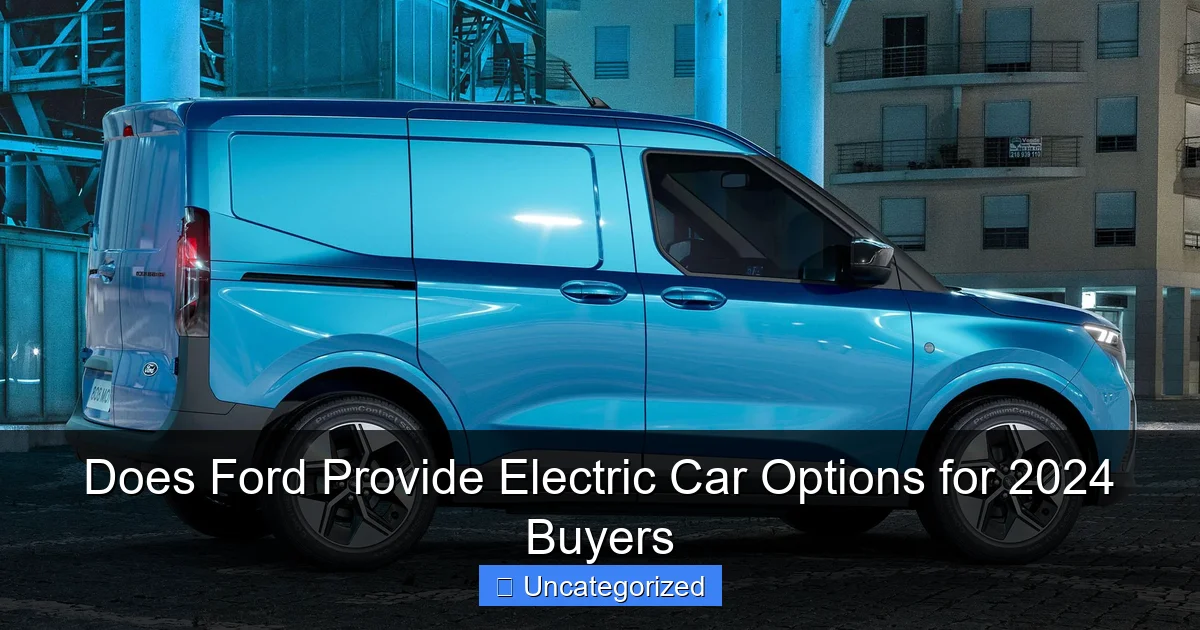
Featured image for does ford provides electric car
Image source: images.carexpert.com.au
Yes, Ford offers multiple electric vehicle options for 2024 buyers, including the popular Mustang Mach-E, F-150 Lightning, and E-Transit van, showcasing its strong commitment to electrification. These models combine innovative technology, impressive range, and competitive pricing, making Ford a compelling choice in the growing EV market.
Key Takeaways
- Ford offers multiple electric models in 2024, including the Mustang Mach-E and F-150 Lightning.
- Expanding EV lineup shows Ford’s commitment to electrification and sustainability goals.
- Competitive pricing available with federal tax credits lowering upfront costs for buyers.
- Fast-charging network access via partnerships improves long-distance travel convenience.
- Strong performance specs rival gas-powered vehicles with instant torque and acceleration.
- Home charging solutions offered, simplifying daily use for new EV owners.
📑 Table of Contents
- Does Ford Provide Electric Car Options for 2024 Buyers?
- Ford’s 2024 Electric Vehicle Lineup: What’s Available?
- Performance, Range, and Charging: How Do Ford EVs Stack Up?
- Cost, Incentives, and Ownership: Is a Ford EV Worth It?
- Charging at Home and on the Road: Practical Tips
- Future of Ford EVs: What’s Coming After 2024?
- Conclusion: Ford Is All-In on Electrification
Does Ford Provide Electric Car Options for 2024 Buyers?
The automotive industry is undergoing a transformative shift toward electrification, driven by consumer demand for sustainable transportation and stricter emissions regulations worldwide. As one of America’s most iconic automakers, Ford has positioned itself at the forefront of this revolution. With bold promises of an all-electric future, the question on many buyers’ minds is: Does Ford provide electric car options for 2024 buyers? The short answer is a resounding yes—but the full picture is far more nuanced, exciting, and packed with innovation.
Ford’s commitment to electric vehicles (EVs) is no longer a distant vision. In 2024, the company offers a growing lineup of fully electric models, hybrid variants, and plug-in hybrids, catering to a wide range of consumer needs—from urban commuters to off-road adventurers and commercial fleet operators. With over $50 billion invested in electrification through 2026, Ford is not just dipping its toes into the EV market; it’s diving in headfirst. This blog post explores Ford’s current electric offerings, their performance, pricing, charging infrastructure, and future roadmap to help you make an informed decision in 2024.
Ford’s 2024 Electric Vehicle Lineup: What’s Available?
As of 2024, Ford has expanded its electric portfolio beyond a single model, offering multiple EVs across different vehicle segments. These models are designed to appeal to diverse buyer preferences, from performance enthusiasts to practical family drivers. Below is a breakdown of Ford’s current electric car lineup.
Visual guide about does ford provides electric car
Image source: images.carexpert.com.au
1. Ford Mustang Mach-E
The Ford Mustang Mach-E is Ford’s flagship all-electric SUV and a direct response to the Tesla Model Y. Launched in 2021, it has undergone significant upgrades for the 2024 model year, including improved battery range, faster charging, and enhanced interior technology. The Mach-E comes in several trims: Select, Premium, California Route 1, GT, and the high-performance GT Performance Edition.
- Range: Up to 320 miles (EPA-estimated) on the extended-range RWD model.
- Power: 266 hp (base) to 480 hp (GT Performance).
- 0-60 mph: As fast as 3.5 seconds in the GT trim.
- Charging: 10–80% in approximately 45 minutes using a DC fast charger.
For 2024, the Mach-E features a redesigned front fascia, a larger 15.5-inch touchscreen with SYNC 4A, and over-the-air (OTA) software updates. It’s ideal for buyers seeking a stylish, tech-forward SUV with sporty handling and strong range.
2. Ford F-150 Lightning
The F-150 Lightning is Ford’s electrified version of America’s best-selling vehicle for over four decades. It’s not just an EV truck—it’s a game-changer in the pickup segment. The Lightning combines rugged utility with cutting-edge EV technology, offering dual-motor all-wheel drive, a massive front trunk (frunk), and innovative features like Pro Power Onboard (up to 9.6 kW of exportable power).
- Range: 240 miles (standard) to 320 miles (extended battery).
- Payload: Up to 2,235 lbs.
- Towing: Up to 10,000 lbs (with Max Trailer Tow Package).
- Power: 452 hp (standard) to 580 hp (extended range).
For 2024, Ford has improved the Lightning’s towing range with a new “Tow Technology Package” that includes trailer brake control, blind-spot monitoring, and enhanced cooling systems. It’s perfect for contractors, campers, and anyone who needs a powerful, versatile electric pickup.
3. Ford E-Transit
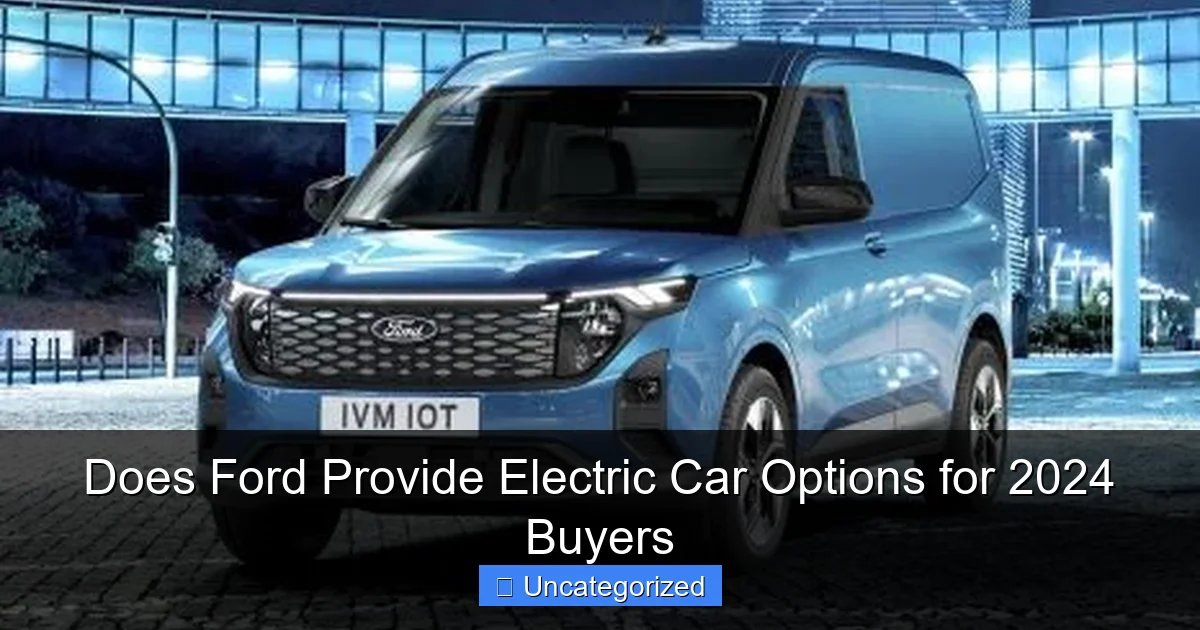
Targeting commercial buyers, the E-Transit is Ford’s all-electric cargo van, designed for last-mile delivery, fleet operations, and small businesses. With zero emissions and lower operating costs, it’s a smart choice for eco-conscious companies.
- Range: Up to 159 miles (EPA-estimated).
- Cargo Capacity: Up to 487.3 cu. ft.
- Charging: 10–80% in about 34 minutes (DC fast charging).
- Payload: Up to 3,800 lbs (depending on configuration).
Ford has also introduced the E-Transit Custom for international markets, with plans to expand availability. For 2024, Ford offers over 60 upfit solutions, making it highly customizable for delivery, utility, and service vehicles.
4. Ford Escape PHEV (Plug-in Hybrid)
While not fully electric, the Ford Escape Plug-in Hybrid (PHEV) deserves mention for buyers not yet ready to go 100% electric. It offers 37 miles of all-electric range (EPA) and can switch to hybrid mode for longer trips. It’s a great bridge between traditional gas vehicles and full EVs.
- Total Range: Over 500 miles.
- MPGe: 100 MPGe combined.
- Charging: Fully charges in ~3.5 hours with a Level 2 charger.
This model is ideal for suburban families or drivers with longer commutes who want to reduce fuel consumption without range anxiety.
Performance, Range, and Charging: How Do Ford EVs Stack Up?
When evaluating electric vehicles, performance, range, and charging capabilities are critical factors. Ford has made significant strides in all three areas, but how do their EVs compare to competitors like Tesla, Hyundai, and Chevrolet?
Real-World Range and Efficiency
Ford’s EVs are designed with real-world usability in mind. The Mustang Mach-E and F-150 Lightning both offer competitive EPA-estimated ranges, but actual performance varies based on driving conditions, climate, and load. For example:
- The Mach-E’s extended-range RWD model achieves ~300 miles in mild climates but drops to ~250 miles in cold weather.
- The F-150 Lightning with the extended battery can tow 7,700 lbs for ~150 miles, which is typical for heavy-duty EVs.
- The E-Transit’s 159-mile range is sufficient for urban delivery routes but may require mid-shift charging for longer routes.
Tip: Use Ford’s FordPass App to monitor real-time range, battery status, and pre-condition the cabin while charging to improve efficiency.
Charging Infrastructure and Compatibility
Ford has partnered with Electrify America to provide 200 kW DC fast charging at over 800 stations nationwide. Additionally, Ford EV owners get two years of free fast charging at Electrify America locations (terms apply).
- Home Charging: Ford recommends a 240V Level 2 charger (sold separately) for overnight charging. Installation typically costs $500–$1,200.
- Public Charging: All Ford EVs use the CCS (Combined Charging System) connector, compatible with most U.S. fast-charging networks.
- Ford BlueOval Charge Network: A unified platform that integrates over 100,000 charging points across North America, including Tesla Superchargers (via adapter in 2024).
Pro Tip: Schedule charging during off-peak hours (e.g., 10 PM–6 AM) to reduce electricity costs and avoid network congestion.
Performance Highlights
Ford EVs deliver strong performance across the board:
- The F-150 Lightning GT accelerates from 0–60 mph in under 4 seconds, rivaling sports cars.
- The Mustang Mach-E GT offers adaptive suspension, Brembo brakes, and track mode for spirited driving.
- All Ford EVs feature regenerative braking, with one-pedal driving mode for smoother urban commutes.
Compared to Tesla, Ford EVs may have slightly lower peak charging speeds, but they offer better towing capability, cargo space, and ruggedness—especially in the Lightning.
Cost, Incentives, and Ownership: Is a Ford EV Worth It?
One of the biggest considerations for 2024 buyers is cost—not just the sticker price, but total ownership value, including incentives, fuel savings, and maintenance.
2024 Pricing Overview
Here’s a breakdown of starting MSRP (Manufacturer’s Suggested Retail Price) for Ford’s 2024 electric models:
| Model | Trim | Starting MSRP | Tax Credit Eligible |
|---|---|---|---|
| Mustang Mach-E | Select | $42,995 | Yes (up to $3,750) |
| Mustang Mach-E | GT Performance | $61,995 | No |
| F-150 Lightning | Pro | $49,995 | Yes (up to $7,500) |
| F-150 Lightning | Platinum | $85,995 | No |
| E-Transit | Cargo Van | $51,000 | Yes (up to $7,500) |
| Escape PHEV | SE | $35,995 | Yes (up to $6,843) |
Note: Tax credit eligibility depends on battery component sourcing and final assembly location. As of 2024, the Mach-E and F-150 Lightning qualify for partial or full federal incentives under the Inflation Reduction Act (IRA).
Federal and State Incentives
The federal EV tax credit offers up to $7,500 for qualifying vehicles. However, starting in 2024, eligibility is based on:
- Final assembly in North America.
- Critical minerals and battery components sourced from the U.S. or free-trade partners.
- MSRP cap of $80,000 for vans/trucks and $55,000 for cars.
Ford has adjusted battery sourcing to meet these rules, making the Mach-E and F-150 Lightning eligible for partial credits (up to $3,750 and $7,500, respectively). Many states also offer additional rebates, such as:
- California: Up to $2,000 Clean Vehicle Rebate.
- New York: $2,000 Drive Clean Rebate.
- Colorado: $5,000 state tax credit.
Tip: Check your state’s DMV website for current incentives before purchasing.
Total Cost of Ownership
EVs generally have lower maintenance costs than gas vehicles. Ford estimates that:
- Owners save $6,000–$10,000 in fuel and maintenance over 5 years.
- No oil changes, spark plugs, or exhaust system repairs.
- Regenerative braking reduces brake wear by up to 50%.
Additionally, Ford offers an 8-year/100,000-mile battery warranty and roadside assistance through FordPass.
Charging at Home and on the Road: Practical Tips
Charging is one of the most common concerns for new EV buyers. Ford simplifies the process with a range of tools and partnerships, but preparation is key.
Home Charging Setup
For daily charging, a Level 2 (240V) charger is ideal. Ford sells its own Ford Connected Charge Station for $799, but third-party options (like ChargePoint or Grizzl-E) are also compatible.
- Installation: Hire a licensed electrician to install a dedicated 50-amp circuit.
- Time to Full Charge: 8–12 hours for Mach-E/Lightning; 3–4 hours for Escape PHEV.
- Smart Features: Schedule charging, monitor energy use, and receive alerts via the FordPass app.
Tip: If you live in an apartment or condo, check with your landlord about installing a shared charging station or using public chargers nearby.
On-the-Road Charging
Ford’s integration with the BlueOval Charge Network makes long-distance travel easier. Key features include:
- Real-time charger availability and status via the in-vehicle navigation.
- Automatic route planning with charging stops.
- Payment integration—no need for multiple apps.
For road trips, plan your route using tools like PlugShare or ChargeHub. The F-150 Lightning’s extended battery can travel ~300 miles, so plan a charging stop every 2.5–3 hours.
Emergency Charging and Roadside Assistance
Ford offers FordPass Roadside Assistance, which includes:
- On-demand mobile charging (in select areas).
- Towing to the nearest charging station if the battery runs out.
- 24/7 customer support.
Pro Tip: Always keep at least 20% battery for safety, and download offline maps in case of poor connectivity.
Future of Ford EVs: What’s Coming After 2024?
Ford isn’t stopping at its 2024 lineup. The company has a bold roadmap for the next decade, focusing on innovation, affordability, and sustainability.
Next-Gen Electric Platforms
Ford is developing three new EV platforms:
- TE1: For large trucks and SUVs (e.g., next-gen F-150 Lightning).
- TE2: For midsize vehicles (replacing Mach-E in 2026).
- TE3: For affordable compact EVs (under $25,000, launching 2026–2027).
These platforms will feature faster charging (up to 150 kW), longer range (400+ miles), and improved thermal management.
New Models on the Horizon
Ford plans to launch several new EVs by 2026:
- Electric Explorer: A global SUV based on the European Explorer, with U.S. launch expected in 2025.
- Affordable Compact SUV: A sub-$30,000 model to compete with the Chevrolet Bolt and Hyundai Kona Electric.
- Electric Super Duty: A fully electric F-250 or F-350 for heavy-duty work.
Sustainability and Battery Innovation
Ford is investing in lithium iron phosphate (LFP) batteries for lower-cost, longer-lasting cells. It’s also building three battery plants in Kentucky and Tennessee through its BlueOval SK joint venture with SK On.
- Goal: Produce enough batteries for 600,000 EVs annually by 2026.
- Recycling: Ford is piloting battery recycling programs to recover up to 95% of materials.
These efforts aim to reduce dependency on rare earth minerals and lower EV prices over time.
Conclusion: Ford Is All-In on Electrification
So, does Ford provide electric car options for 2024 buyers? Absolutely. With the Mustang Mach-E, F-150 Lightning, E-Transit, and Escape PHEV, Ford offers a diverse, capable, and increasingly affordable range of electric vehicles. Whether you’re a city dweller, a truck owner, a business operator, or a family driver, there’s a Ford EV tailored to your needs.
What sets Ford apart in 2024 is its holistic approach—not just building EVs, but supporting them with a robust charging network, strong incentives, and a clear vision for the future. While challenges remain—such as charging infrastructure gaps and battery supply chain issues—Ford’s investments and partnerships position it as a serious contender in the global EV race.
For buyers considering a switch to electric, Ford’s 2024 lineup represents a smart, practical, and exciting entry point. With competitive pricing, real-world range, and legendary American engineering, Ford isn’t just keeping up with the EV revolution—it’s helping lead it. The road ahead is electric, and Ford is ready to take you there.
Frequently Asked Questions
Does Ford provide electric car options in 2024?
Yes, Ford offers several fully electric vehicles in 2024, including the Mustang Mach-E, F-150 Lightning, and E-Transit van. These models cater to diverse needs, from SUVs to work trucks.
What are Ford’s most popular electric car models this year?
The Mustang Mach-E and F-150 Lightning are Ford’s top-selling electric cars in 2024, combining performance, range, and tech. The E-Transit is also a standout for commercial buyers.
How much does Ford’s electric car lineup cost in 2024?
Ford’s electric cars start at around $42,000 for the base Mustang Mach-E and go up to $55,000+ for the F-150 Lightning. Pricing varies by trim, range, and features.
Does Ford provide electric car charging solutions?
Yes, Ford includes access to the BlueOval™ Charge Network, with over 84,000 chargers across North America. Buyers also get home charging installation support for their electric car.
What is the range of Ford’s 2024 electric vehicles?
Ford’s 2024 electric cars offer ranges from 247 miles (E-Transit) up to 320 miles (F-150 Lightning Extended Range). The Mach-E averages 250–300 miles, depending on the configuration.
Are Ford’s electric cars eligible for tax credits in 2024?
Yes, select Ford electric car models, like the F-150 Lightning and Mustang Mach-E, qualify for federal tax credits up to $7,500. Eligibility depends on battery sourcing and buyer income.