Electric Car Price in Pakistan 2026 Latest Updates and Trends

Featured image for electric car price in pakistan 2026
Image source: i.ytimg.com
Electric car prices in Pakistan are projected to drop significantly by 2026, driven by increased local assembly, government incentives, and rising competition among EV manufacturers. With new models expected from global and regional brands, consumers can anticipate more affordable options and improved charging infrastructure across major cities, making electric mobility a realistic choice for the masses.
Key Takeaways
- Prices will drop: EV costs in Pakistan to fall due to increased local production.
- Government incentives: Tax breaks and subsidies will boost affordability by 2026.
- More models available: Diverse options from Chinese and global automakers expected.
- Charging infrastructure expanding: Faster adoption with improved public charging networks.
- Battery tech advances: Longer range and lower maintenance to drive demand.
- Resale value rises: Stronger market confidence will stabilize EV resale prices.
📑 Table of Contents
- The Future is Electric: What to Expect for Electric Car Prices in Pakistan in 2026
- Current State of Electric Cars in Pakistan (2024–2025)
- Projected Electric Car Prices in Pakistan (2026)
- Key Trends Shaping the 2026 EV Market
- Challenges and Opportunities for Buyers in 2026
- How to Choose the Right Electric Car in 2026
- Conclusion: The Road Ahead for Electric Mobility in Pakistan
The Future is Electric: What to Expect for Electric Car Prices in Pakistan in 2026
The automotive landscape in Pakistan is undergoing a dramatic transformation, driven by rising fuel costs, increasing environmental awareness, and government incentives for sustainable transportation. As the world shifts toward cleaner energy, electric vehicles (EVs) are no longer a futuristic concept but a tangible reality on Pakistani roads. With the government’s ambitious National Electric Vehicle Policy (NEVP) aiming to achieve 30% electric vehicle adoption by 2030 and 90% by 2040, the momentum is undeniable. By 2026, the electric car market in Pakistan is expected to reach a pivotal turning point—offering more models, improved infrastructure, and, most importantly, more competitive pricing.
For consumers, the burning question remains: What will electric car prices in Pakistan look like in 2026? This comprehensive guide dives into the latest updates, market trends, technological advancements, and policy changes shaping the EV ecosystem. Whether you’re a first-time car buyer, a tech enthusiast, or an environmentally conscious citizen, understanding the trajectory of electric vehicle costs is crucial. From locally assembled EVs to imported luxury models, we’ll explore how pricing is evolving, what factors are driving changes, and how you can make a smart, future-proof purchase. As we approach 2026, the dream of owning an affordable, efficient, and stylish electric car is becoming more accessible than ever.
Current State of Electric Cars in Pakistan (2024–2025)
Market Overview and Key Players
As of 2024–2025, Pakistan’s electric vehicle market is in its growth phase, with several automakers launching or preparing to launch EV models. Major players include MG Pakistan (with the MG ZS EV), Hyundai Nishat (offering the Hyundai Kona Electric), and BYD (through a partnership with Al-Haj Automotive). Additionally, local startups like EVision and Green Wheels are introducing compact EVs and two-wheelers, signaling a shift toward homegrown innovation.
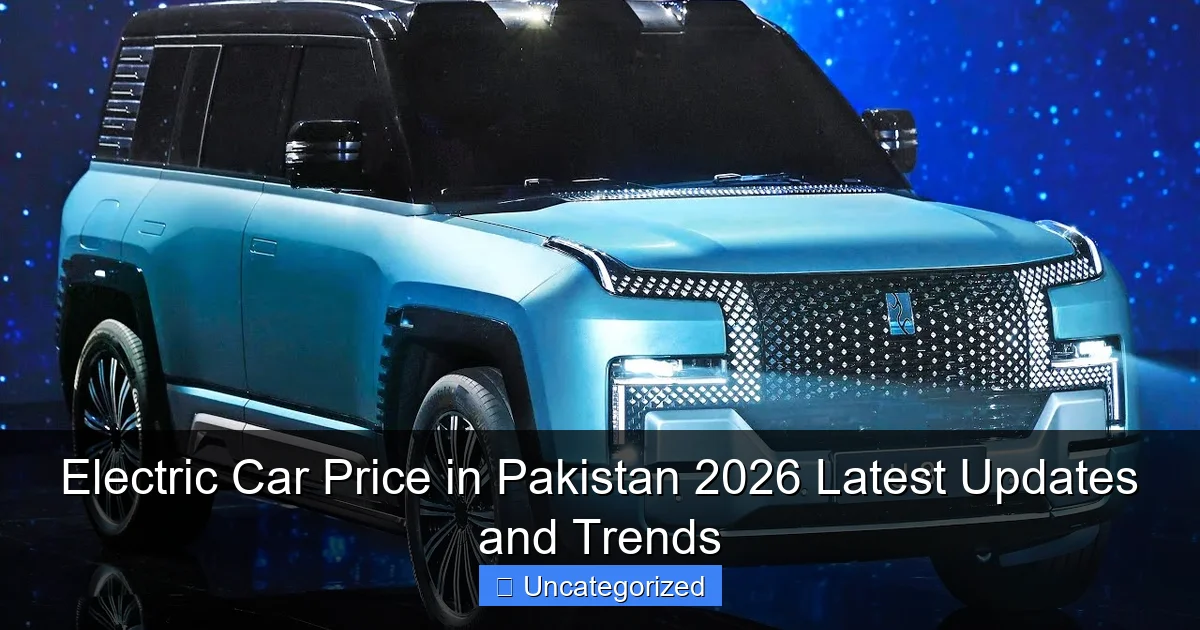
Visual guide about electric car price in pakistan 2026
Image source: i.ytimg.com
The current electric car price in Pakistan ranges from PKR 5.5 million for entry-level models like the MG ZS EV to over PKR 15 million for premium imports such as the Tesla Model 3 (via private imports). While these prices are still higher than conventional vehicles, they are significantly lower than pre-2020 levels due to policy reforms and reduced import duties.
Government Policies Driving Adoption
The National Electric Vehicle Policy 2020–2025 has been instrumental in reducing EV costs. Key incentives include:
- Zero customs duty on fully imported electric cars (CBU) for the first five years
- 50% reduction in sales tax on locally assembled EVs (CKD/SKD)
- Exemption from federal excise duty for EVs
- Reduced registration and token taxes in provinces like Punjab and Sindh
These measures have already reduced the effective cost of EVs by 15–25%, making them more competitive with hybrid vehicles. For instance, the MG ZS EV, priced at PKR 6.2 million in 2023, dropped to PKR 5.8 million in 2024 after tax revisions. Experts predict that by 2026, further policy refinements could reduce prices by another 10–15%.
Consumer Awareness and Infrastructure Growth
Despite progress, challenges remain. Charging infrastructure is still limited, with approximately 80 public charging stations nationwide—mostly in major cities like Karachi, Lahore, and Islamabad. However, companies like Charge Point Pakistan and EV Connect are expanding networks, with plans to install 500+ stations by 2026. Additionally, awareness campaigns by the Ministry of Climate Change and private EV clubs are helping dispel myths about EV range, charging time, and maintenance.
Tip: Before purchasing an EV in 2026, check the availability of charging stations along your regular commute routes. Use apps like EV Map PK to locate nearby chargers and plan your trips efficiently.
Projected Electric Car Prices in Pakistan (2026)
Price Forecasts by Vehicle Segment
By 2026, electric car prices in Pakistan are expected to become more segmented, offering options across budget, mid-range, and luxury categories. Here’s a breakdown of projected price ranges:
| Vehicle Segment | Projected Price Range (PKR) | Examples (Expected Models) | Key Features |
|---|---|---|---|
| Entry-Level (Compact SUV/Hatchback) | 4.5 million – 6 million | BYD Dolphin, MG ZS EV (updated), Hyundai Ioniq 5 (local assembly) | 300–400 km range, 50–70 kWh battery, basic ADAS |
| Mid-Range (Family Sedan/SUV) | 6 million – 9 million | BYD Atto 3, Hyundai Kona Electric (2026 model), Tesla Model 3 (local CKD) | 400–500 km range, 70–80 kWh battery, advanced infotainment, OTA updates |
| Premium (Luxury/Performance) | 9 million – 15 million+ | BYD Han, Tesla Model Y, Porsche Taycan (local assembly pilot) | 500+ km range, 80–100 kWh battery, luxury interiors, fast charging |
Factors Influencing 2026 Pricing
Several key factors will determine how electric car prices evolve by 2026:
- Local Assembly (CKD/SKD): As more manufacturers shift from CBU to CKD (Completely Knocked Down) assembly, prices could drop by 15–20%. For example, BYD’s local plant in Karachi (slated for 2025) could reduce the price of the BYD Dolphin from PKR 6.5 million to PKR 5.2 million by 2026.
- Battery Technology Advancements: Solid-state batteries and sodium-ion batteries (cheaper and safer than lithium-ion) are expected to enter the market by 2026, reducing battery costs by up to 30%. This could directly lower EV prices.
- Economies of Scale: Increased production volume will reduce per-unit costs. With EVision targeting 10,000 units annually by 2026, prices for compact EVs may fall below PKR 4 million.
- Government Incentives: The NEVP may introduce additional subsidies for low-income buyers, such as low-interest loans or cash rebates, further improving affordability.
Example: The BYD Dolphin, currently imported at PKR 6.5 million, could see a 18% price reduction to PKR 5.3 million by 2026 due to local assembly and battery cost savings.
Comparison with Hybrid and ICE Vehicles
By 2026, electric cars are expected to reach price parity with hybrid vehicles in the mid-range segment. For instance:
- A BYD Atto 3 (EV) may cost PKR 7.8 million, comparable to a Toyota Prius (hybrid) at PKR 8.1 million.
- However, EVs will still be pricier than ICE (internal combustion engine) cars like the Honda City (PKR 5.2 million), but with lower long-term costs.
When factoring in total cost of ownership (fuel, maintenance, taxes), EVs could become the more economical choice by 2026, especially with rising petrol prices.
Key Trends Shaping the 2026 EV Market
Battery Technology and Range Improvements
Battery innovation is the cornerstone of EV adoption. By 2026, Pakistan will likely see EVs with:
- 500+ km range on a single charge (up from 350–400 km in 2024)
- Ultra-fast charging (10–80% in 15–20 minutes) using 800V architectures
- Longer battery lifespan (10+ years or 200,000+ km)
For example, the BYD Han (expected in 2026) will feature a blade battery with 600 km range and a 10-year warranty. This reduces “range anxiety” and boosts consumer confidence.
Expansion of Charging Infrastructure
Charging accessibility will be a game-changer. By 2026, Pakistan could have:
- 1,500+ public charging stations (up from ~80 in 2024)
- Fast-charging corridors on major highways (e.g., Lahore–Karachi M-9)
- Home charging kits bundled with EV purchases
Companies like Engro Energy and Shell Pakistan are investing in solar-powered charging hubs, aligning with the government’s renewable energy goals.
Rise of Local EV Startups and Innovation
Homegrown EV brands are gaining traction. In 2026, expect:
- EVision’s “Nexa” series of compact EVs (PKR 3.9 million–4.5 million)
- Green Wheels’ electric SUV with 350 km range (PKR 5.8 million)
- Collaborations with Chinese tech firms for AI-driven infotainment and autonomous features
These startups are focusing on affordability and local customization, such as climate-adapted batteries for Pakistan’s hot weather.
Digital Integration and Smart Features
EVs in 2026 will be “smart” vehicles with:
- Over-the-air (OTA) updates for software and performance
- Mobile app integration for remote charging, climate control, and diagnostics
- AI-powered navigation that optimizes routes based on traffic and charging points
For instance, the Hyundai Ioniq 5 will feature a “Digital Side Mirror” and augmented reality HUD (Heads-Up Display), enhancing safety and convenience.
Challenges and Opportunities for Buyers in 2026
Overcoming Infrastructure Gaps
Despite progress, infrastructure remains a hurdle. In 2026, rural areas may still lack charging stations. To mitigate this:
- Buy EVs with long-range batteries (400+ km) for intercity travel
- Install home charging units (cost: PKR 150,000–250,000) with solar compatibility
- Use portable chargers as a backup
Tip: Check if your residential society allows home charger installations. Some complexes in Lahore and Karachi now offer EV-ready parking.
Financing and Affordability
While prices are falling, EVs still require significant upfront investment. By 2026, expect:
- Low-interest EV loans (5–7% interest) from banks like Meezan Bank and HBL
- Leasing programs with monthly payments as low as PKR 70,000
- Government subsidies for first-time EV buyers (e.g., PKR 500,000 cashback)
For example, a PKR 6 million EV with a 5-year loan at 6% interest would cost PKR 110,000/month—comparable to a mid-range ICE car.
After-Sales Service and Maintenance
EV maintenance is simpler (no oil changes, fewer moving parts), but requires specialized technicians. By 2026:
- Major cities will have dedicated EV service centers (e.g., MG, BYD)
- Mobile service vans will provide on-site repairs
- Battery leasing options may reduce initial costs (e.g., pay PKR 20,000/month for battery)
Example: The BYD Atto 3 offers free battery and motor maintenance for 8 years or 160,000 km.
Resale Value and Market Maturity
As the EV market matures, resale values will stabilize. In 2026:
- EVs with proven reliability (e.g., BYD, Hyundai) will retain 60–70% value after 5 years
- Battery health reports will become standard in resale transactions
- Certified pre-owned EV programs may emerge
Buyers should prioritize models with strong after-sales support and long warranties.
How to Choose the Right Electric Car in 2026
Assessing Your Needs and Budget
Start by evaluating:
- Daily commute: A 300 km range is sufficient for city use; opt for 400+ km for long trips
- Budget: Set a price cap (e.g., PKR 7 million) and explore financing
- Charging access: Ensure home or workplace charging is feasible
Tip: Use online tools like EV Calculator PK to compare total ownership costs across models.
Key Features to Prioritize
Look for these features in 2026 EVs:
- Fast charging capability (DC charging support)
- Advanced safety (ADAS, 360° cameras)
- Warranty coverage (8–10 years on battery/motor)
- Infotainment and connectivity (Apple CarPlay, Android Auto)
Test Drives and Dealerships
Always test drive before buying. By 2026, major dealerships will offer:
- Virtual test drives via AR/VR
- Extended trial periods (3–7 days)
- Trade-in options for ICE/hybrid vehicles
Visit authorized dealers in Lahore, Karachi, and Islamabad for the best deals and after-sales support.
Conclusion: The Road Ahead for Electric Mobility in Pakistan
The electric car revolution in Pakistan is accelerating, and by 2026, the market will be unrecognizable from its 2024 state. With electric car prices in Pakistan expected to drop by 20–30% due to local assembly, technological advancements, and policy support, EVs will transition from niche to mainstream. From the affordable BYD Dolphin to the luxurious Tesla Model Y, consumers will have unprecedented choice and value.
However, success hinges on infrastructure development, consumer education, and continued government commitment. For buyers, the key is to act strategically—research thoroughly, leverage financing options, and choose models with strong after-sales support. As Pakistan moves toward a greener, smarter future, electric cars won’t just be an option; they’ll be the smartest investment for your wallet and the planet.
The road to 2026 is electric. Are you ready to drive it?
Frequently Asked Questions
What will be the average electric car price in Pakistan in 2026?
The average electric car price in Pakistan in 2026 is expected to range between PKR 4 million to PKR 12 million, depending on the model, battery capacity, and import policies. Prices may decrease slightly due to local assembly incentives and growing competition among EV manufacturers.
Will electric cars become more affordable in Pakistan by 2026?
Yes, electric cars are likely to become more affordable by 2026 as the government plans to expand local EV production and reduce import duties. Increased demand and advancements in battery technology could further drive down costs, making EVs accessible to a wider audience.
Which factors will influence electric car prices in Pakistan in 2026?
Key factors include government EV policies, battery import costs, local manufacturing growth, and global supply chain stability. Additionally, currency exchange rates and charging infrastructure development will play a role in determining the final electric car price in Pakistan 2026.
Are Chinese electric cars expected to dominate the 2026 market in Pakistan?
Chinese EVs are expected to lead due to competitive pricing, established supply chains, and early market entry. Models from brands like BYD, NIO, and MG could significantly influence the electric car price in Pakistan 2026 with budget-friendly and mid-range options.
Will luxury electric car prices in Pakistan drop by 2026?
Luxury EVs like Tesla or BMW may see modest price reductions by 2026, primarily due to potential local assembly of premium components. However, high-end models will remain premium-priced, targeting niche buyers despite policy incentives.
How will government policies impact EV prices in Pakistan by 2026?
New EV policies, such as tax exemptions, reduced customs duties, and subsidies for local manufacturing, could lower upfront costs. These measures aim to boost EV adoption and stabilize electric car prices in Pakistan 2026.


