Electric Car Rebate Ontario Doug Ford Explained

Featured image for electric car rebate ontario doug ford
Image source: thinkpol.ca
Ontario no longer offers a provincial electric car rebate—the program was discontinued by Premier Doug Ford’s government in 2018. Despite rising demand for EVs, the province currently provides no direct incentives, leaving buyers to rely on federal iZEV rebates and other non-provincial programs to reduce costs.
Key Takeaways
- No provincial rebates: Ontario currently offers zero electric car rebates under Doug Ford’s leadership.
- Federal incentives still apply: Claim up to $5,000 via Canada’s iZEV program for eligible EVs.
- Check used EV options: Federal incentives may cover used electric cars—review eligibility carefully.
- HOV lane access: Ontario’s green plate program allows EV drivers in HOV lanes, solo or not.
- Act fast on federal grants: iZEV funding is first-come, first-served—apply immediately after purchase.
- Monitor policy changes: Ontario’s EV landscape could shift with elections or climate commitments.
📑 Table of Contents
- Understanding the Electric Car Rebate Ontario Doug Ford Landscape
- The End of the Ontario EV Incentive: What Changed Under Doug Ford?
- Current Incentives: Federal, Municipal, and Utility Programs
- Maximizing Savings: Smart Strategies for Ontario EV Buyers
- Charging Infrastructure and Hidden Costs in Ontario
- Future Outlook: Will Ontario Restore EV Rebates?
- Summary Table: Current EV Incentives in Ontario (2024)
Understanding the Electric Car Rebate Ontario Doug Ford Landscape
The electric vehicle (EV) revolution is accelerating across Canada, and Ontario—once a leader in EV incentives—has undergone significant policy shifts under the leadership of Premier Doug Ford. For environmentally conscious drivers, cost-conscious families, and forward-thinking businesses, understanding the current electric car rebate Ontario Doug Ford framework is essential. While the province once offered one of North America’s most generous EV incentive programs, the landscape has changed dramatically since 2018, sparking confusion, debate, and renewed interest in what’s possible today.
When the Ontario government under Premier Doug Ford took office in 2018, one of its first major policy moves was to cancel the province’s longstanding Electric Vehicle Incentive Program (EVIP), which had provided rebates of up to $14,000 for zero-emission vehicles (ZEVs). This decision sent shockwaves through the EV community, with critics arguing it would slow adoption and hurt Ontario’s climate goals. However, the story doesn’t end there. Since then, a mix of federal incentives, municipal programs, and evolving market dynamics have reshaped the EV affordability equation—meaning that while provincial rebates are no longer available, there are still meaningful ways to save on your electric car purchase in Ontario. This guide dives deep into the electric car rebate Ontario Doug Ford legacy, what’s available now, and how you can maximize savings in today’s market.
The End of the Ontario EV Incentive: What Changed Under Doug Ford?
The 2018 Cancellation of the EVIP
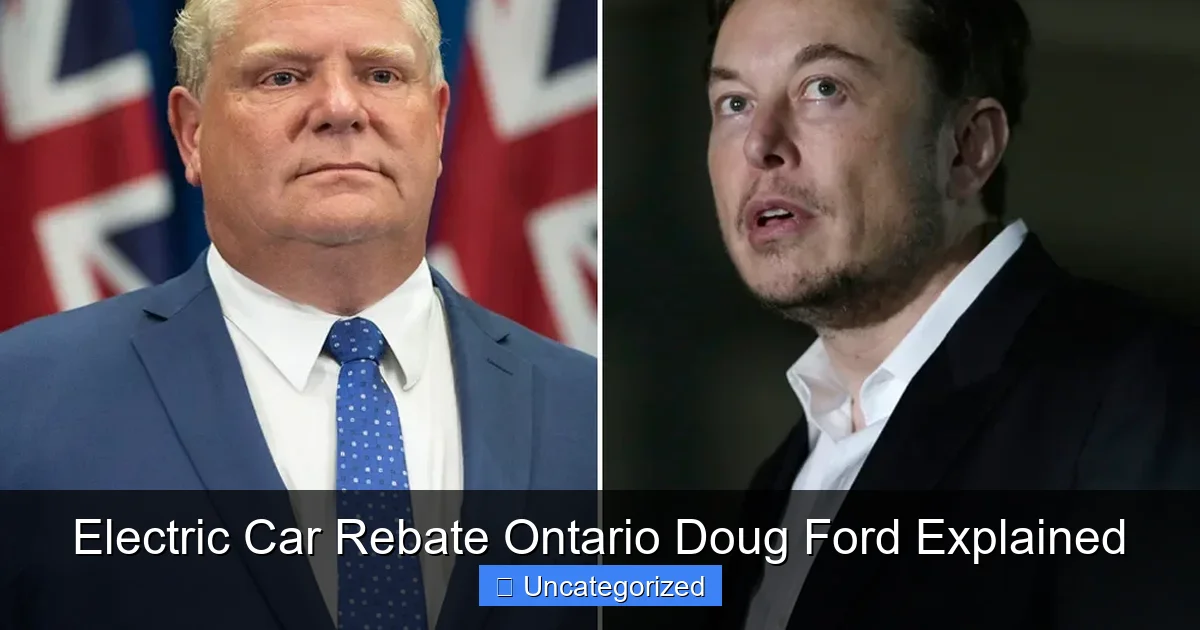
In July 2018, the newly elected Progressive Conservative government under Premier Doug Ford announced the immediate termination of Ontario’s Electric Vehicle Incentive Program (EVIP). This program, launched in 2010, had provided point-of-sale rebates ranging from $5,000 to $14,000 depending on the vehicle type and battery capacity. For example, a fully electric Nissan Leaf with a 62 kWh battery qualified for the full $14,000 rebate, while plug-in hybrids received up to $8,000. The cancellation was part of a broader cost-cutting and environmental policy rollback, including the scrapping of the cap-and-trade system.
Visual guide about electric car rebate ontario doug ford
Image source: smartcdn.gprod.postmedia.digital
The government justified the move by arguing that the program was too costly—approximately $200 million annually—and that EV adoption had reached a point where incentives were no longer necessary. Critics, including environmental groups and auto industry stakeholders, countered that the rebates were essential for encouraging early adopters and accelerating the transition to clean transportation. Data from the time showed that EV sales in Ontario dropped by over 50% in the months following the cancellation, suggesting a strong correlation between incentives and consumer behavior.
Impact on EV Adoption and Market Trends
The cancellation of the provincial rebate had immediate and lasting effects on Ontario’s EV market. According to Statistics Canada, EV registrations in Ontario fell from a peak of 11,342 in 2017 to just 5,871 in 2018. While sales have since rebounded—reaching over 30,000 in 2023—the growth has been slower than in provinces like British Columbia and Quebec, where provincial rebates remain active. For instance, B.C. offers up to $4,000 in rebates, and Quebec provides up to $7,000, creating a stark contrast with Ontario’s zero-provincial-incentive model.
Despite the lack of provincial support, EV adoption in Ontario has been driven by three key factors: federal incentives, declining vehicle prices, and rising fuel and maintenance savings. The average price of a new EV in Canada has dropped by nearly 30% since 2018, making them more accessible even without provincial rebates. Additionally, the federal iZEV program has helped bridge the affordability gap, offering up to $5,000 off eligible vehicles.
Public and Industry Reaction
The decision to eliminate the rebate was met with widespread backlash. Auto dealers reported a sharp decline in EV inquiries, and manufacturers like Nissan and Tesla expressed concern about Ontario’s competitiveness in the EV market. Environmental advocates warned that the move undermined Ontario’s climate commitments, especially as transportation accounts for nearly 35% of the province’s greenhouse gas emissions.
However, some economists and policy analysts argued that the rebate was regressive, benefiting higher-income households who could already afford premium EVs. A 2019 study by the C.D. Howe Institute found that over 70% of EVIP recipients earned above the provincial median income. This debate continues to shape discussions around equity in green transportation policy.
Current Incentives: Federal, Municipal, and Utility Programs
The Federal iZEV Program: Ontario’s Primary Rebate
While Ontario no longer offers its own rebates, the federal Incentives for Zero-Emission Vehicles (iZEV) program remains a critical source of savings for Ontarians. Administered by Transport Canada, the iZEV program provides point-of-sale rebates of up to $5,000 for eligible battery electric vehicles (BEVs) and fuel cell electric vehicles (FCEVs), and $2,500 for plug-in hybrid electric vehicles (PHEVs).
Eligibility criteria include:
- Vehicle must be purchased or leased in Canada
- Manufacturer’s suggested retail price (MSRP) must be $65,000 or less for cars, $70,000 for SUVs, vans, and pickup trucks
- Vehicle must be new and never registered
- Lease terms must be at least 12 months
For example, the 2024 Hyundai Ioniq 5 (MSRP: $54,999) qualifies for the full $5,000 rebate, while the plug-in hybrid Toyota RAV4 Prime (MSRP: $51,450) qualifies for $2,500. The rebate is applied at the dealership, meaning you pay less upfront. As of 2024, the iZEV program has helped over 250,000 Canadians go electric.
Municipal and Regional Incentives
While the provincial government offers no direct rebates, several Ontario municipalities have stepped in to fill the gap. These programs vary widely but can add hundreds or even thousands of dollars in savings.
- Toronto GreenTO: Offers a $1,000 rebate for EVs and PHEVs purchased or leased within city limits. Applicants must be residents and use the vehicle primarily in Toronto.
- Waterloo Region: Provides a $2,000 rebate for EVs, funded through the local climate action plan.
- Ottawa: Offers a $500 rebate for EV chargers installed at home, plus free public charging for city residents.
- Halton Region: Rebates of up to $1,000 for EVs and $500 for home chargers.
These programs are often administered through local sustainability offices and may have limited annual funding, so early application is recommended. Check your city or region’s official website for current details and deadlines.
Utility and Energy Company Rebates
Ontario’s electricity providers and energy agencies offer additional incentives focused on charging infrastructure and energy efficiency. These are especially valuable for homeowners installing Level 2 chargers.
- Save on Energy (IESO): Offers rebates of up to $750 for the purchase and installation of a Level 2 home charger. The program is open to all Ontario residents and can be combined with municipal rebates.
- Hydro One: Provides a $500 rebate for EV chargers in rural and remote communities.
- Toronto Hydro: Offers a $350 rebate for home charger installations and free public charging at select locations.
Tip: When applying for multiple rebates (e.g., federal + municipal + utility), submit all applications at once to avoid missing deadlines. Some programs require proof of purchase and charger installation before disbursing funds.
Maximizing Savings: Smart Strategies for Ontario EV Buyers
Stacking Incentives for Maximum Benefit
One of the most effective ways to reduce the cost of an EV in Ontario is to stack multiple incentives. While you can’t combine provincial rebates (since they don’t exist), you can often combine federal, municipal, and utility programs. Here’s a real-world example:
Sarah, a Toronto resident, purchases a 2024 Chevrolet Equinox EV (MSRP: $53,000, eligible for iZEV). She applies for:
- $5,000 federal iZEV rebate
- $1,000 Toronto GreenTO rebate
- $750 Save on Energy charger rebate
Total savings: $6,750. Her effective purchase price is reduced from $53,000 to $46,250—a 12.7% discount.
Important: Not all rebates can be combined. Always check program rules. For example, some municipal programs exclude vehicles that have already received federal funding, though most do not.
Timing Your Purchase and Lease
Timing matters when buying an EV. Consider these tips:
- Buy in Q4: Dealers often offer deeper discounts at year-end to meet sales targets.
- Lease strategically: The iZEV rebate applies to leases of 12+ months. Leasing can also lock in lower payments if battery technology improves rapidly.
- Watch for manufacturer promotions: Brands like Tesla, Ford, and Hyundai often run limited-time offers (e.g., $1,000 cashback or free charging for a year).
Example: In 2023, Ford offered a “$0 Down, $0 Payments for 90 Days” promotion on the F-150 Lightning, making it more accessible despite no provincial rebate.
Used EV Incentives and the Secondary Market
Ontario’s lack of new EV rebates has boosted demand for used EVs. While the iZEV program doesn’t cover used vehicles, other savings are available:
- Lower purchase price: A 2022 Tesla Model 3 can cost $10,000–$15,000 less than a new one.
- Extended warranty transfer: Many manufacturers allow warranty transfers to second owners.
- Home charger rebates still apply: You can install a Level 2 charger and claim the Save on Energy rebate, even with a used EV.
Tip: Use platforms like CarGurus, Autotrader, or Kijiji to filter for EVs with clean vehicle history reports and remaining battery warranty.
Charging Infrastructure and Hidden Costs in Ontario
Home Charging: Setup and Savings
Charging at home is the most convenient and cost-effective way to power your EV. A Level 2 charger (240V) costs $600–$1,200 to purchase and install, but rebates can cover up to $750.
Installation tips:
- Hire a licensed electrician certified by the Electrical Safety Authority (ESA).
- Check your electrical panel capacity—older homes may need a panel upgrade ($2,000–$5,000).
- Install the charger close to your parking spot to minimize wiring costs.
Example: Mark in Ottawa installs a $1,000 charger. He receives a $500 Ottawa rebate and a $750 Save on Energy rebate. After rebates, he pays only $250 out of pocket.
Public Charging Networks and Accessibility
Ontario has over 3,000 public charging stations, operated by networks like ChargePoint, Flo, Electrify Canada, and Petro-Canada. While most Level 2 chargers are free or low-cost, DC fast chargers typically charge $0.40–$0.60 per kWh.
Key networks in Ontario:
- Electrify Canada: 100+ fast chargers along major highways (e.g., 401, 407).
- Petro-Canada: “Charge & Go” stations with free charging for the first 30 minutes.
- Hydro One: 250+ rural chargers, many free to use.
Tip: Use apps like PlugShare or ChargeHub to locate nearby chargers, check availability, and compare pricing.
Hidden Costs and Long-Term Ownership
While EVs have lower fuel and maintenance costs, consider these factors:
- Insurance: EVs can be 10–20% more expensive to insure due to higher repair costs.
- Winter range loss: Cold weather can reduce range by 20–40%. Use seat and steering wheel heaters instead of cabin heating to conserve energy.
- Road taxes: Ontario charges a $120 annual “ZEV tax” for battery electric vehicles (not PHEVs), starting in 2023.
Despite these costs, the average EV owner in Ontario saves $1,200–$1,800 per year on fuel and maintenance compared to a gas-powered car.
Future Outlook: Will Ontario Restore EV Rebates?
Political and Policy Developments
As of 2024, there is no indication that the Ontario government under Doug Ford plans to restore the EVIP. However, pressure is mounting from multiple fronts:
- Climate targets: Ontario aims to reduce emissions by 30% below 2005 levels by 2030. Transportation remains a major challenge.
- Federal requirements: Canada’s ZEV mandate requires 20% of new light-duty vehicle sales to be zero-emission by 2026, rising to 100% by 2035. Provinces without rebates may need to act.
- Economic opportunity: With automakers like Ford and GM investing billions in Ontario EV plants, a supportive policy environment could attract more jobs and innovation.
In 2023, the Ontario NDP and Green Party introduced private member’s bills to restore EV rebates, but both were defeated. However, public support for incentives remains high—a 2024 Abacus Data poll found that 68% of Ontarians support bringing back EV rebates.
Potential for New Incentives
If rebates return, they may look different from the pre-2018 model. Possible formats include:
- Income-based rebates: Higher rebates for low- and middle-income households.
- Used EV incentives: To promote equity and affordability.
- Charger installation grants: Expanded funding for public and workplace charging.
Premier Ford has stated he prefers “market-driven solutions” over government subsidies, but with federal funding available through the Canada Infrastructure Bank and other programs, a hybrid approach—combining public and private investment—may be on the horizon.
What You Can Do Now
Until provincial rebates return, Ontarians can:
- Maximize federal, municipal, and utility incentives
- Advocate for policy change through local councils and MPPs
- Support businesses and organizations that promote EV adoption
- Stay informed through resources like the Ontario EV Association and Plug’n Drive
The electric car rebate Ontario Doug Ford debate is far from over. While the current landscape is less generous than in the past, smart consumers can still achieve significant savings—and help shape a cleaner, more sustainable future.
Summary Table: Current EV Incentives in Ontario (2024)
| Incentive | Provider | Amount | Eligibility | Notes |
|---|---|---|---|---|
| iZEV Rebate | Federal Government | Up to $5,000 (BEV), $2,500 (PHEV) | MSRP ≤ $65k (car), ≤ $70k (SUV/truck) | Point-of-sale; lease or purchase |
| Toronto GreenTO | City of Toronto | $1,000 | Toronto resident; vehicle used in city | Annual cap; apply early |
| Save on Energy Charger Rebate | IESO | Up to $750 | Level 2 charger installation | Must be installed by licensed electrician |
| Waterloo Region EV Rebate | Regional Municipality of Waterloo | $2,000 | Resident; new EV purchase/lease | Limited funding; first-come, first-served |
| Hydro One Rural Charger Rebate | Hydro One | $500 | Rural customers installing Level 2 charger | Must be in Hydro One service area |
The electric car rebate Ontario Doug Ford narrative is complex, but it’s not a story of lost opportunity. While provincial incentives are absent, a robust ecosystem of federal, municipal, and utility programs—combined with falling EV prices—makes electric driving more accessible than ever. By understanding the current landscape, stacking available rebates, and planning strategically, Ontario drivers can go electric with confidence, savings, and a clear conscience. The road ahead is electric—and the journey is well within reach.
Frequently Asked Questions
What is the current electric car rebate in Ontario under Doug Ford’s government?
As of 2024, Ontario no longer offers a provincial electric car rebate, as the previous incentive program was discontinued in 2018 under Premier Doug Ford. Buyers must now rely on federal incentives like the iZEV program, which provides up to $5,000 for eligible EVs. Ontario focuses instead on charging infrastructure and HOV lane access for EVs.
Why did Doug Ford cancel the Ontario electric car rebate?
Doug Ford’s government eliminated the provincial EV rebate in 2018 to cut costs, arguing it primarily benefited wealthier residents. The move aligned with broader platform goals to reduce government spending, though critics noted it slowed EV adoption in Ontario.
Are there any new electric car rebate Ontario programs planned for 2024?
No new provincial electric car rebate Ontario programs are currently announced. The government prioritizes expanding charging networks and offering non-financial incentives like EV HOV lane access, while federal rebates remain available.
How does Ontario’s lack of EV rebate compare to other provinces?
Unlike Quebec or British Columbia, Ontario has no active provincial electric car rebate under Doug Ford. This makes Ontario one of the few Canadian provinces without direct EV purchase incentives, relying solely on federal funding.
Can I combine federal and Ontario EV incentives?
Yes, you can claim the federal iZEV rebate ($5,000) alongside Ontario-specific benefits like HOV lane permits for EVs. However, there’s no additional Ontario electric car rebate to stack with federal programs.
What EV incentives does Doug Ford’s government currently offer?
While no cash rebates exist, Ontario provides EV owners with HOV lane access (even with one occupant) and funds public charging stations. The province also offers used EV buyers a $1,000 rebate through the “Used EV Incentive Program.”