Electric Cars Made by Ford The Future of Driving is Here
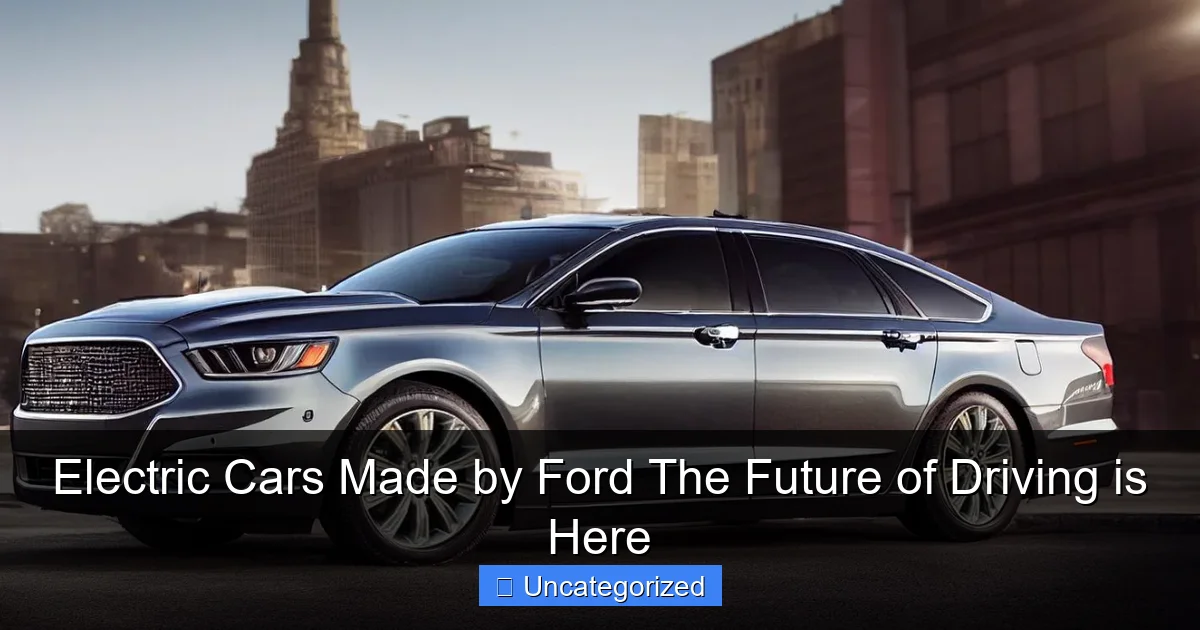
Featured image for electric cars made by ford
Image source: fordusamodel.com
Ford’s electric cars are revolutionizing the auto industry with cutting-edge technology, impressive range, and sustainable performance. From the Mustang Mach-E to the F-150 Lightning, Ford delivers powerful, eco-friendly vehicles that combine innovation with everyday practicality. The future of driving is here—and it’s electric, efficient, and unmistakably Ford.
Key Takeaways
- Ford’s electric lineup includes the Mustang Mach-E, F-150 Lightning, and E-Transit van.
- Zero emissions driving helps reduce your carbon footprint and fuel costs.
- Advanced tech features like BlueCruise offer hands-free driving on highways.
- Fast charging capability delivers 50+ miles of range in 10 minutes.
- Built for durability with rigorous testing and extended battery warranties.
- Home and public charging solutions simplify daily EV ownership.
📑 Table of Contents
- The Electric Revolution: Ford’s Bold Leap into the Future
- Ford’s Electric Vision: Strategy and Commitment
- Ford’s Electric Lineup: Models That Define the Future
- Technology and Innovation: The Brains Behind the Brawn
- Charging and Range: Practicality for Real Life
- Ownership Experience: Cost, Maintenance, and Incentives
- The Road Ahead: Why Ford Leads the EV Charge
The Electric Revolution: Ford’s Bold Leap into the Future
The automotive world is undergoing a seismic shift. As climate concerns intensify and technology accelerates, electric vehicles (EVs) are no longer a niche experiment—they’re the inevitable future of transportation. And no legacy automaker is embracing this transformation more aggressively than Ford Motor Company. Once synonymous with the roar of V8 engines and the legacy of the Model T, Ford is now redefining its identity as a leader in the electric revolution. With a clear vision, massive investments, and a lineup of innovative electric cars, Ford is proving that the future of driving isn’t just coming—it’s already here.
From the iconic Mustang Mach-E to the rugged F-150 Lightning, Ford’s electric vehicle (EV) portfolio is designed to meet the needs of diverse drivers: eco-conscious commuters, adventure-seeking SUV lovers, and even hardworking tradespeople. But what sets Ford apart in a crowded EV market? It’s not just about swapping gas tanks for batteries. Ford is leveraging its century of automotive expertise, integrating cutting-edge technology, and prioritizing real-world usability. Whether you’re a first-time EV buyer or a seasoned car enthusiast, Ford’s electric cars offer a compelling blend of performance, practicality, and forward-thinking innovation.
Ford’s Electric Vision: Strategy and Commitment
From ICE to EV: A Strategic Pivot
Ford’s journey into electrification began in earnest around 2017, but it wasn’t until 2021 that the company announced its Ford+ Plan—a bold roadmap to invest $50 billion in EVs and battery technology by 2026. This wasn’t just a side project; it was a full-scale reorientation of the company’s future. By 2030, Ford aims for 50% of its global sales to be electric, a target that underscores its commitment to sustainability and innovation.
Visual guide about electric cars made by ford
Image source: evshift.com
Unlike some competitors who started from scratch, Ford is using its existing strengths: manufacturing scale, supply chain mastery, and brand loyalty. The company is converting traditional plants into EV hubs—like the Rouge Electric Vehicle Center in Michigan, where the F-150 Lightning is built—proving that legacy automakers can adapt and thrive in the EV era.
Investing in Battery Tech and Infrastructure
A key pillar of Ford’s strategy is battery technology. In 2021, Ford partnered with SK Innovation to form BlueOval SK, a joint venture that will build three battery plants in the U.S. (two in Kentucky, one in Tennessee) by 2025. These plants will produce 129 GWh of battery capacity annually, enough to power over 1 million EVs. Ford is also investing in lithium iron phosphate (LFP) batteries, which are cheaper, longer-lasting, and more sustainable than traditional nickel-based cells.
On the infrastructure side, Ford’s BlueOvel Charge Network offers access to over 84,000 charging stations across North America. The FordPass Charging Network app helps drivers locate and pay for charging, with features like real-time availability and route planning. For home charging, Ford provides the 80-amp Ford Connected Charge Station, which can add up to 30 miles of range per hour.
Real-World Impact: Sustainability and Cost Savings
Ford’s electrification isn’t just about cars—it’s about reducing the company’s carbon footprint. The F-150 Lightning, for example, produces zero tailpipe emissions and can save owners up to $1,000 per year in fuel costs compared to a gas-powered F-150. Ford also uses recycled materials in EV production, such as ocean plastics in the Mach-E’s carpet and recycled aluminum in battery enclosures.
Tip: If you’re considering a Ford EV, calculate your potential savings using the Ford Fuel Savings Calculator on their website. Input your daily commute and electricity rates to see how much you could save annually.
Ford’s Electric Lineup: Models That Define the Future
Mustang Mach-E: The Electric Pony
The Mustang Mach-E is Ford’s flagship electric SUV, blending the spirit of the Mustang with modern EV tech. Launched in 2020, it’s available in multiple trims: Select, Premium, GT, and GT Performance Edition. The Mach-E offers a range of 224 to 314 miles (EPA-estimated), with the GT Performance Edition hitting 60 mph in just 3.5 seconds.
Key features include:
- Ford Co-Pilot360 with advanced driver-assist systems (e.g., adaptive cruise control, lane-keeping assist).
- 15.5-inch touchscreen with SYNC 4A, offering over-the-air updates and voice-activated navigation.
- One-pedal driving with regenerative braking, reducing brake wear and increasing efficiency.
Example: A Mach-E GT owner in Colorado reported a 90% reduction in maintenance costs over two years compared to their previous gas-powered SUV, thanks to fewer moving parts and regenerative braking.
F-150 Lightning: The Electric Workhorse
The F-150 Lightning is Ford’s game-changer—an electric version of America’s best-selling truck. With a towing capacity of 10,000 pounds (when properly equipped) and a payload of 2,000 pounds, it’s designed for both work and play. The base model offers 240 miles of range, while the extended-range version hits 320 miles.
Standout features:
- Pro Power Onboard: A built-in generator that can power tools, appliances, or even a home during outages (up to 9.6 kW).
- Hands-free driving (BlueCruise) on over 130,000 miles of pre-mapped highways.
- Megacab front trunk with 400 liters of storage—perfect for tools, camping gear, or groceries.
Tip: If you’re a contractor, the F-150 Lightning’s Pro Power Onboard can replace a portable generator, saving you hundreds of dollars in fuel and maintenance.
E-Transit: Electrifying the Workplace
The E-Transit is Ford’s electric van, targeting delivery services, tradespeople, and small businesses. With a range of 126 miles (ideal for urban routes) and a payload of 3,800 pounds, it’s a practical choice for fleets. The E-Transit features:
- 12-inch touchscreen with SYNC 4 for route optimization and real-time traffic updates.
- Low floor height (8.5 inches lower than gas models), making loading/unloading easier.
- Ford Telematics, which tracks vehicle usage, battery health, and driver behavior for fleet managers.
Example: A delivery company in New York City reported a 40% reduction in operating costs after switching to E-Transit vans, thanks to lower fuel and maintenance expenses.
Future Models: What’s Coming Next?
Ford has teased several upcoming EVs, including:
- Explorer Electric: A family-friendly SUV with 3-row seating and an estimated 300+ miles of range (launching 2025).
- All-Electric Puma: A compact SUV for Europe, featuring a 450 km (280-mile) range.
- Next-Gen Electric Pickup: A smaller, more affordable truck aimed at urban buyers (expected 2026).
Technology and Innovation: The Brains Behind the Brawn
SYNC 4A: The Smartest Infotainment System
Ford’s SYNC 4A infotainment system is the brain of its EVs, offering:
- Over-the-air updates that improve performance, add features, and patch security flaws.
- Cloud-connected navigation with real-time traffic, weather, and charging station data.
- Voice control (powered by Alexa) for hands-free calling, music, and climate control.
<
Tip: Use the “Find My Car” feature in the FordPass app to locate your EV in a crowded parking lot—it even shows the exact level in multi-story garages.
BlueCruise: Hands-Free Driving
Ford’s BlueCruise system allows hands-free driving on pre-mapped highways (called Blue Zones). It uses:
- Cameras and radar to monitor the road and keep the vehicle centered in its lane.
- Driver-facing camera to ensure attention is on the road (if you look away, the system alerts you).
- Adaptive cruise control that maintains speed and distance from other vehicles.
Example: A Mach-E owner in Texas used BlueCruise for a 300-mile highway trip and reported a 20% reduction in driver fatigue compared to manual driving.
FordPass App: Control Your EV from Your Phone
The FordPass app lets you:
- Start/stop charging and monitor battery status.
- Lock/unlock doors and pre-condition the cabin (heat/cool).
- Find nearby charging stations and pay for charging.
- Schedule service appointments and access roadside assistance.
Vehicle-to-Load (V2L) and Vehicle-to-Home (V2H)
Ford’s EVs support V2L (powering devices via outlets) and V2H (powering your home during outages). The F-150 Lightning’s Pro Power Onboard can keep a home running for up to 3 days on a full charge, making it a backup generator in disguise.
Charging and Range: Practicality for Real Life
Charging Options: Home, Public, and Fast
Ford offers three charging solutions:
- Level 1 (120V): Adds 3-5 miles of range per hour (ideal for overnight charging).
- Level 2 (240V): Adds 20-30 miles per hour (recommended for home use).
- DC Fast Charging: Adds 50-100 miles in 10-20 minutes (available at public stations).
Tip: For the fastest home charging, install a 240V outlet (like a dryer plug). Ford’s 80-amp charger can fully charge an F-150 Lightning in about 8 hours.
Range Comparison: How Ford EVs Stack Up
Below is a comparison of Ford’s EV range and charging capabilities:
| Model | EPA-Estimated Range | DC Fast Charging (10-80%) | Home Charging (0-100%) |
|---|---|---|---|
| Mustang Mach-E (Standard) | 224 miles | 45 minutes | 11 hours (Level 2) |
| Mustang Mach-E (Extended) | 314 miles | 40 minutes | 14 hours (Level 2) |
| F-150 Lightning (Standard) | 240 miles | 41 minutes | 13 hours (Level 2) |
| F-150 Lightning (Extended) | 320 miles | 44 minutes | 19 hours (Level 2) |
| E-Transit | 126 miles | 30 minutes | 8 hours (Level 2) |
Maximizing Range: Tips for EV Owners
To get the most out of your Ford EV:
- Use Eco Mode to reduce power consumption.
- Pre-condition the cabin while plugged in to save battery.
- Avoid rapid acceleration—smooth driving saves energy.
- Keep tires properly inflated (low pressure increases drag).
Ownership Experience: Cost, Maintenance, and Incentives
Total Cost of Ownership: EVs vs. Gas Cars
While Ford’s EVs have a higher upfront cost (e.g., F-150 Lightning starts at $50,000 vs. $30,000 for a gas model), they save money over time:
- Fuel Savings: At $0.13/kWh, driving 15,000 miles/year costs ~$700 in electricity vs. ~$2,000 in gas.
- Maintenance Savings: EVs have fewer moving parts (no oil changes, spark plugs, or exhaust systems).
- Tax Incentives: The U.S. federal tax credit offers up to $7,500 for new EV purchases (subject to eligibility).
Warranty and Service
Ford EVs come with:
- 8-year/100,000-mile battery warranty (covers capacity loss below 70%).
- 3-year/36,000-mile bumper-to-bumper warranty.
- Mobile service vans that perform minor repairs at your home or office.
Resale Value and Market Trends
Ford’s EVs hold their value well. The Mach-E retains 65% of its value after 3 years (vs. 50% for gas SUVs). The F-150 Lightning’s popularity has led to a resale premium, with some models selling for above MSRP in the used market.
The Road Ahead: Why Ford Leads the EV Charge
Ford’s electric cars aren’t just vehicles—they’re a statement. A statement that legacy automakers can innovate, that performance and sustainability aren’t mutually exclusive, and that the future of driving is electric, practical, and accessible. From the Mustang Mach-E’s sporty appeal to the F-150 Lightning’s rugged versatility, Ford is proving that EVs can meet the diverse needs of drivers worldwide.
But Ford’s success isn’t just about technology. It’s about trust. With over a century of automotive experience, Ford understands what drivers want: reliability, value, and a seamless transition to electric mobility. Whether you’re a city dweller, a weekend adventurer, or a hardworking tradesperson, Ford has an electric car that fits your life. The future of driving isn’t just here—it’s Made by Ford.
Frequently Asked Questions
What electric cars are made by Ford?
Ford currently offers several popular electric vehicles, including the Mustang Mach-E, F-150 Lightning, and the E-Transit van. These models combine Ford’s legacy of performance with cutting-edge electric technology, catering to SUV, truck, and commercial vehicle buyers.
How far can Ford’s electric cars go on a single charge?
Depending on the model and configuration, Ford’s electric vehicles offer ranges between 230 to over 300 miles. For example, the F-150 Lightning can reach up to 320 miles, making it ideal for both daily commutes and longer trips.
Are electric cars made by Ford eligible for tax credits?
Yes, many Ford electric vehicles, including the Mustang Mach-E and F-150 Lightning, qualify for federal tax credits of up to $7,500, subject to current IRS guidelines. Buyers should verify eligibility based on income, vehicle price, and battery component requirements.
How long does it take to charge a Ford electric car?
Charging times vary: Level 2 (240V) home chargers can fully recharge a Ford EV in 8–10 hours, while DC fast chargers can provide up to 50–80% charge in about 30–45 minutes. FordPass Power My Trip helps drivers locate compatible stations.
What technology features do Ford’s electric cars include?
Ford’s EVs come equipped with SYNC 4A infotainment, over-the-air updates, BlueCruise hands-free driving, and FordPass Connect. These features enhance convenience, safety, and connectivity for a modern driving experience.
Can the F-150 Lightning power my home during an outage?
Yes! The F-150 Lightning’s Intelligent Backup Power feature can power your home for days during an outage using its 131 kWh extended-range battery. It seamlessly integrates with a home’s electrical system via the Ford Charge Station Pro.