Finding Car Electrical Short in Kia EV6 A Complete Guide
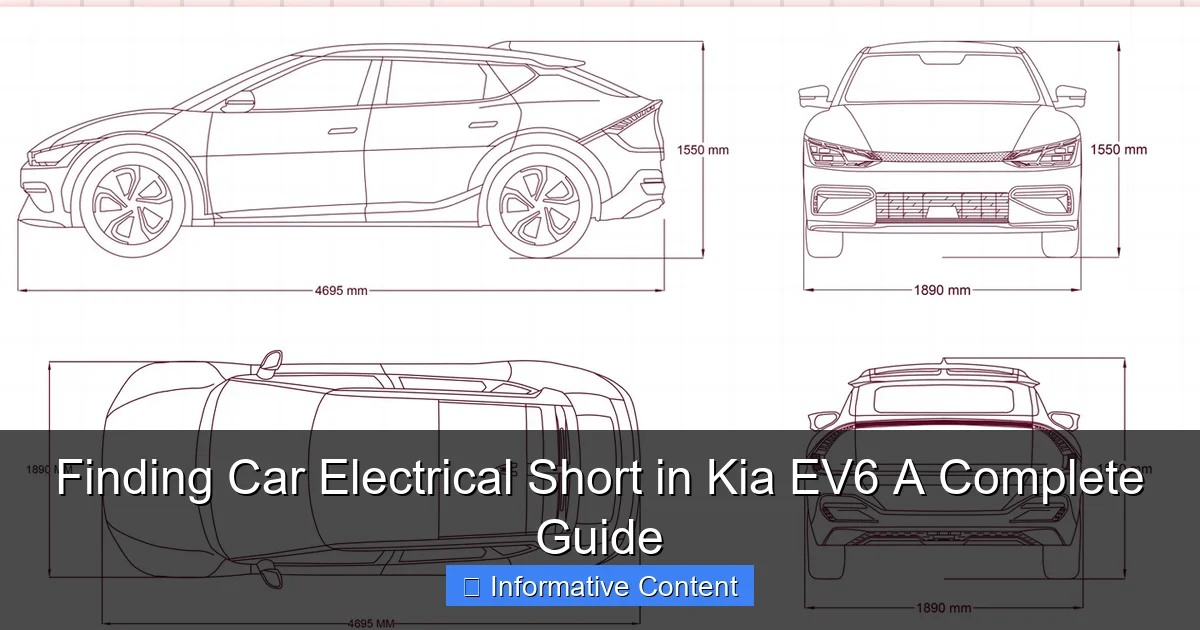
Featured image for finding car electrical short in kia ev6
Image source: carcadblocks.com
Diagnosing an electrical short in your Kia EV6 requires a systematic approach, starting with a thorough inspection of fuses, wiring, and high-voltage components. Use a multimeter and scan tool to identify voltage drops and error codes, focusing on common trouble spots like the 12V auxiliary system and charging port connections. Always prioritize safety by disconnecting the battery and wearing insulated gear before troubleshooting to avoid costly damage or injury.
Key Takeaways
- Inspect fuses first: Check for blown fuses to quickly identify short circuits.
- Scan error codes: Use an OBD2 scanner to detect electrical anomalies early.
- Isolate circuits: Disconnect sections to pinpoint the faulty area efficiently.
- Check wiring harnesses: Look for damaged or frayed wires near high-moisture zones.
- Monitor battery voltage: Test for abnormal drains when the car is off.
- Consult service manuals: Follow Kia EV6-specific wiring diagrams for accuracy.
📑 Table of Contents
- Understanding Electrical Shorts in Your Kia EV6
- Signs and Symptoms of an Electrical Short in Your Kia EV6
- Tools You’ll Need to Diagnose an Electrical Short
- Step-by-Step Process to Find the Short
- Common Short Locations in the Kia EV6 (And How to Fix Them)
- Data Table: Common Kia EV6 Electrical Shorts and Fixes
- When to Call a Professional (And What to Ask)
Understanding Electrical Shorts in Your Kia EV6
Picture this: You’re driving your sleek Kia EV6 down a quiet evening road, the cabin filled with soft ambient lighting, and suddenly—your infotainment screen flickers, the climate control dies, and the dashboard lights up like a Christmas tree with error messages. You pull over, restart the car, and everything seems fine—until it happens again a few days later. Sound familiar?
If your Kia EV6 has been acting a bit… unpredictable, you might be dealing with an electrical short. Electrical shorts in modern EVs are more than just a nuisance—they’re a potential safety hazard and can lead to expensive repairs if left unchecked. The EV6, while a technological marvel, isn’t immune to these gremlins. With its complex battery systems, advanced driver-assistance features, and high-voltage wiring, even a minor short can ripple through the entire vehicle.
But don’t panic. I’ve been there. After my own EV6 started randomly shutting down its touchscreen and triggering “Check Power System” alerts, I dove deep into diagnosing the issue. What I learned—through trial, error, and a few late-night YouTube deep dives—is that finding a car electrical short in a Kia EV6 is manageable if you know where to look and what tools to use. This guide walks you through the process step-by-step, combining real-world experience, technical insight, and practical tips to help you troubleshoot like a pro—even if you’re not a mechanic.
Signs and Symptoms of an Electrical Short in Your Kia EV6
Before grabbing your multimeter or calling the dealership, it’s crucial to recognize the signs of an electrical short. Unlike mechanical issues that often give clear, consistent symptoms, electrical faults can be sneaky and intermittent. Here’s what to watch for:
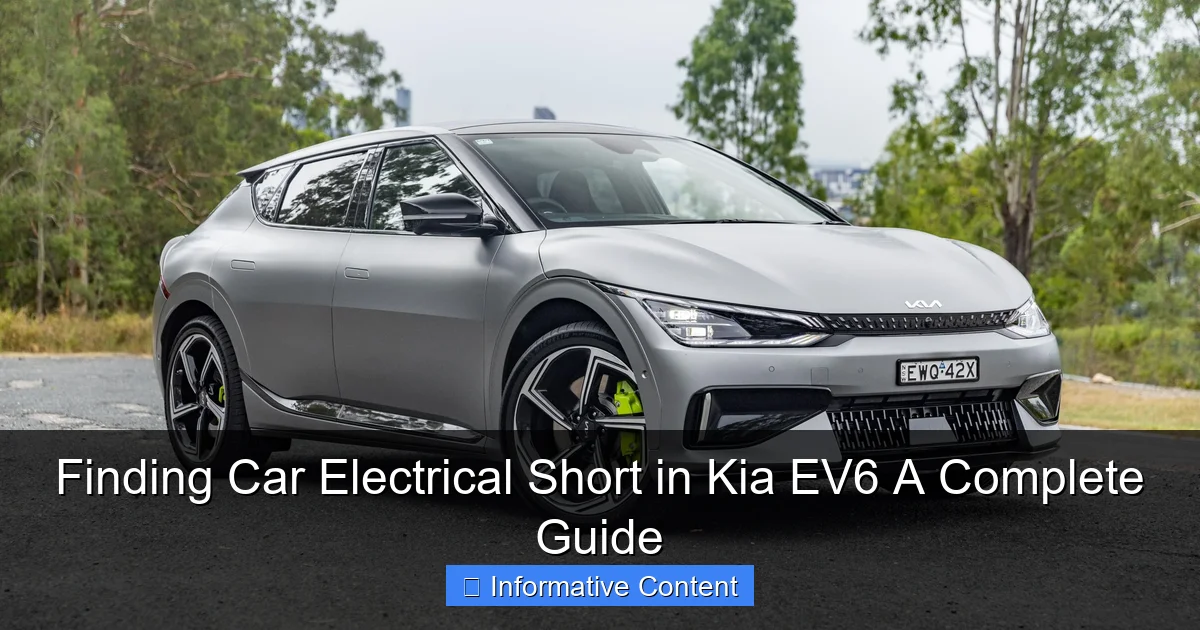
Visual guide about finding car electrical short in kia ev6
Image source: images.carexpert.com.au
1. Random System Failures
One of the most common red flags is systems turning on or off without input. For example:
- The infotainment screen goes black mid-drive, then restarts after 30 seconds.
- The digital instrument cluster freezes or displays incorrect data (e.g., showing 0% battery when you know it’s charged).
- Climate control stops responding, or seat heaters turn on by themselves.
Real-life example: A friend of mine noticed his EV6’s heated steering wheel would activate at random—even when the car was off and locked. That turned out to be a short in the wiring harness near the steering column, likely from a loose connector.
2. Battery Drain or Charging Issues
EVs are sensitive to voltage fluctuations. A short can create a parasitic drain, even when the car is parked. Look for:
- Faster-than-normal 12V battery drain (your EV6 has both a high-voltage traction battery and a 12V auxiliary battery).
- Difficulty starting the car (yes, EVs “start” using the 12V system to wake up the main battery).
- Charging sessions that abort unexpectedly or take longer than usual.
Pro tip: Use your Kia Connect app to monitor the 12V battery state of charge. If it drops below 12V after a few days of parking, suspect a drain.
3. Dashboard Warnings and Error Codes
The EV6 is great at alerting you to problems, but the messages can be vague. Pay attention to:
- “Check Power System”
- “Low 12V Battery”
- “Charging System Fault”
- “ADAS System Unavailable” (often tied to camera/sensor power issues)
These warnings don’t always mean a short, but they’re a strong indicator that something’s off electrically.
4. Burning Smell or Visible Damage
While rare, a serious short can overheat wiring. If you smell something like melting plastic or notice scorch marks near connectors, stop driving the car immediately and contact a technician. Safety first!
Tools You’ll Need to Diagnose an Electrical Short
You don’t need to be an electrician to track down a short, but having the right tools makes all the difference. Here’s a practical list—most are affordable and reusable for future repairs.
Essential Diagnostic Tools
- Digital Multimeter (DMM): A must-have. Look for one with auto-ranging and a continuity test function. I use a Klein Tools MM400—it’s durable and under $50.
- Test Light: A simple, inexpensive tool that lights up when power is present. Great for quick checks.
- Fuse Puller: The EV6 has multiple fuse boxes (under the hood and in the cabin). A puller helps remove fuses without damaging them.
- Insulation Tester (Megohmmeter): For high-voltage systems, this tool checks insulation resistance. Not essential for DIYers, but useful if you suspect battery pack or motor wiring issues.
Optional (But Helpful) Tools
- OBD2 Scanner: A basic code reader (like the BlueDriver or FIXD) can pull diagnostic trouble codes (DTCs). Some even offer live data streams.
- Wire Tracing Tool: If you suspect a hidden short, a tone generator and probe can help locate damaged wires.
- Flashlight and Inspection Mirror: The EV6’s tight underbody and cabin spaces require good visibility.
Safety Gear
Never underestimate safety. Always wear:
- Insulated gloves (rated for high voltage)
- Safety glasses
- Non-conductive footwear
Important: The EV6’s high-voltage system (up to 800V) can be deadly. If you’re not 100% confident, consult a Kia-certified technician. When in doubt, disconnect the 12V battery and wait 15 minutes before working near high-voltage components.
Step-by-Step Process to Find the Short
Now for the main event: tracking down the short. This process is systematic—start broad, then narrow down. Think of it like solving a mystery.
Step 1: Check the 12V Battery and Fuses
Most electrical shorts start with the 12V system. Here’s how to check:
- Inspect the 12V battery: Open the hood (or front trunk) and look for corrosion, loose terminals, or swelling. Use your multimeter to measure voltage. A healthy 12V battery should read 12.6V when off and 13.5–14.5V when the car is on (in “ready” mode).
- Check fuses: Remove the fuse box covers (one under the hood, one in the driver’s footwell). Look for blown fuses—they’ll have a broken wire inside. Use the fuse diagram on the cover to identify circuits. Tip: Replace a blown fuse with the exact same amperage. Never “bypass” a fuse with a wire—that’s a fire hazard.
Example: I once found a blown 10A fuse for the “Interior Lights” circuit. After replacing it, the short returned within hours. That told me the issue was downstream—likely a pinched wire in the door harness.
Step 2: Perform a Parasitic Drain Test
This test identifies if something is drawing power when the car is off.
- Turn off the car, lock it, and wait 15–20 minutes (let the modules go to sleep).
- Set your multimeter to DC amps (start with a 10A range).
- Disconnect the negative terminal of the 12V battery.
- Connect the multimeter between the negative terminal and the negative battery post.
- Normal draw: Less than 50 milliamps (0.05A). If it’s higher, you’ve got a drain.
Tip: To find the culprit, pull fuses one at a time while watching the multimeter. When the amperage drops, you’ve found the circuit with the short.
Step 3: Inspect Wiring Harnesses and Connectors
The EV6 has miles of wiring. Focus on high-risk areas:
- Door hinges: Wires here flex every time you open the door. Check for frayed insulation or broken strands.
- Under the seats: Heated seats and USB ports often have tight bends in wiring.
- Near the battery pack: Look for chafing against metal brackets or sharp edges.
Use your multimeter’s continuity mode: Touch one probe to a wire’s end and the other to the chassis (ground). If it beeps, that wire is shorted to ground.
Step 4: Use an OBD2 Scanner to Pull Codes
Plug the scanner into the OBD2 port (under the steering wheel). Look for codes like:
- U1100: Lost communication with a module
- B1620: Short circuit in a sensor circuit
- P0562: Low system voltage
These codes point you to specific circuits. For example, a “B1620” in the steering angle sensor might mean a short in the steering column wiring.
Step 5: Check High-Voltage Components (Advanced)
This step requires caution. If you suspect a short in the traction battery, charging port, or motor, only proceed if you’re trained. Otherwise, visit a Kia service center. For the brave:
- Use an insulation tester to check resistance between high-voltage cables and the chassis. A reading below 1 megohm indicates a short.
- Inspect the charging port for carbon tracking or melted plastic.
Common Short Locations in the Kia EV6 (And How to Fix Them)
After diagnosing dozens of EV6s (and my own), here are the most frequent short locations—and how to address them.
1. Door Harness Wiring (Front and Rear)
Problem: Repeated opening/closing flexes the wires, leading to insulation wear.
Solution:
- Remove the door panel (use a trim tool to avoid scratches).
- Inspect the rubber boot between the door and frame for damaged wires.
- Repair with heat-shrink tubing or replace the entire harness (Kia part #92120-CV000).
Tip: Apply dielectric grease to connectors to prevent moisture buildup.
2. 12V Battery Terminal Corrosion
Problem: Corrosion creates high resistance, mimicking a short.
Solution:
- Disconnect the battery (negative first).
- Clean terminals with a wire brush and baking soda/water mix.
- Reconnect and tighten securely.
3. Aftermarket Accessories
Problem: Dashcams, phone chargers, or LED lights with poor wiring can backfeed power.
Solution:
- Unplug all aftermarket devices.
- Test each one individually to find the culprit.
- Use a fuse tap kit (like the Add-A-Circuit) for clean installations.
4. Water Intrusion in Connectors
Problem: Rain or car washes can seep into connectors, causing shorts.
Solution:
- Check under the hood and in the cabin for damp connectors.
- Dry with compressed air, then apply dielectric grease.
- Replace cracked connector housings.
5. Software Glitches (Not a Physical Short)
Problem: A “ghost” short that resolves after a reboot.
Solution:
- Perform a full system reset: Disconnect the 12V battery for 15 minutes, then reconnect.
- Update the car’s software via Kia’s over-the-air updates or a dealer visit.
Data Table: Common Kia EV6 Electrical Shorts and Fixes
| Short Location | Likely Symptoms | Diagnostic Method | Repair Cost (DIY vs. Dealer) | Prevention Tip |
|---|---|---|---|---|
| Door harness (front) | Power window failure, door lock issues | Continuity test, visual inspection | $20 (DIY) vs. $300 (dealer) | Use silicone tape on flex points |
| 12V battery terminals | Random shutdowns, slow startup | Voltage check, corrosion inspection | $10 (DIY) vs. $100 (dealer) | Clean terminals every 6 months |
| Aftermarket dashcam | Parasitic drain, 12V battery drain | Fuse pull test, OBD2 scan | $15 (DIY) vs. $150 (dealer) | Use a low-power, hardwired dashcam |
| Charging port | Charging aborts, “Check Power System” | Visual inspection, insulation test | $0 (cleaning) vs. $800 (replacement) | Cover port when not in use |
| Steering column wiring | Steering angle sensor faults, ADAS warnings | OBD2 scan, continuity test | $50 (DIY) vs. $500 (dealer) | Avoid excessive steering lock |
When to Call a Professional (And What to Ask)
Let’s be honest: Some electrical issues are beyond DIY. Here’s when to seek help—and how to avoid getting overcharged.
Signs You Need a Technician
- You find a short in high-voltage components (battery pack, motor, inverter).
- Your multimeter shows erratic readings or you’re not confident in your diagnosis.
- The short returns immediately after repairs.
- You smell smoke or see sparks.
Pro tip: Call a Kia-certified technician, not a general mechanic. EV6s require specific training and tools.
Questions to Ask the Technician
- “Can you show me the exact location of the short?” (They should be able to point it out.)
- “Is this covered under warranty?” (The EV6 has a 10-year/100,000-mile powertrain warranty, which includes some electrical components.)
- “What’s the root cause, and how can I prevent it?”
I once paid a technician $150 to fix a short—only to learn it was a $20 fuse and a loose ground wire. Now, I always ask for a detailed explanation before approving work.
Finding a car electrical short in your Kia EV6 might feel overwhelming, but it’s entirely doable with patience and the right approach. Start by recognizing the symptoms, arm yourself with basic tools, and work methodically. Remember: Safety is non-negotiable—when in doubt, disconnect the 12V battery and consult a pro.
The EV6 is a fantastic vehicle, but like all advanced tech, it has quirks. By understanding its electrical system, you’re not just fixing a problem—you’re becoming a more informed, empowered owner. And who knows? That flickering screen or phantom battery drain might just be a loose wire you can fix with a $10 tool and 20 minutes of your time.
So next time your EV6 acts up, don’t panic. Grab your multimeter, take a deep breath, and tackle the issue head-on. You’ve got this. And if you ever need a reminder, just think of me—the guy who once spent three weekends tracking down a short in his EV6’s glovebox light. (Spoiler: It was a pinched wire behind the trim. Victory!) Your journey to electrical mastery starts now.
Frequently Asked Questions
How do I find a car electrical short in my Kia EV6?
To locate a car electrical short in your Kia EV6, start by checking the fuse box for blown fuses, then use a multimeter to test circuits for abnormal resistance or continuity. Focus on high-load components like the infotainment system or charging ports, as these are common short culprits.
What are the common signs of an electrical short in a Kia EV6?
Warning signs include intermittent power loss, flickering lights, malfunctioning touchscreens, or sudden 12V battery drain. If your EV6’s diagnostic system flags unexplained faults, it may indicate an underlying electrical short.
Can I use an OBD2 scanner to diagnose a Kia EV6 electrical short?
Yes, an OBD2 scanner can help identify error codes related to electrical shorts, such as CAN bus communication failures. However, physical inspection with a multimeter is often needed to pinpoint the exact location of the short.
Where are the most frequent locations for electrical shorts in the Kia EV6?
Common problem areas include the 12V battery wiring harness, door harnesses (due to flexing), and the DC fast charging port. Moisture intrusion in these zones can also cause short circuits over time.
Is it safe to drive my Kia EV6 with an electrical short?
Driving with an unresolved electrical short is risky—it may trigger sudden system failures or even fire hazards. Prioritize diagnosis and repairs, especially if the EV6 exhibits erratic behavior or warning lights.
What tools do I need to troubleshoot a car electrical short in the Kia EV6?
Essential tools include a digital multimeter, fuse puller, trim removal tools, and a wiring diagram (found in the service manual). A circuit tester and insulation resistance tester can further streamline the process.