Florida Tax Credit Electric Car Incentives Explained
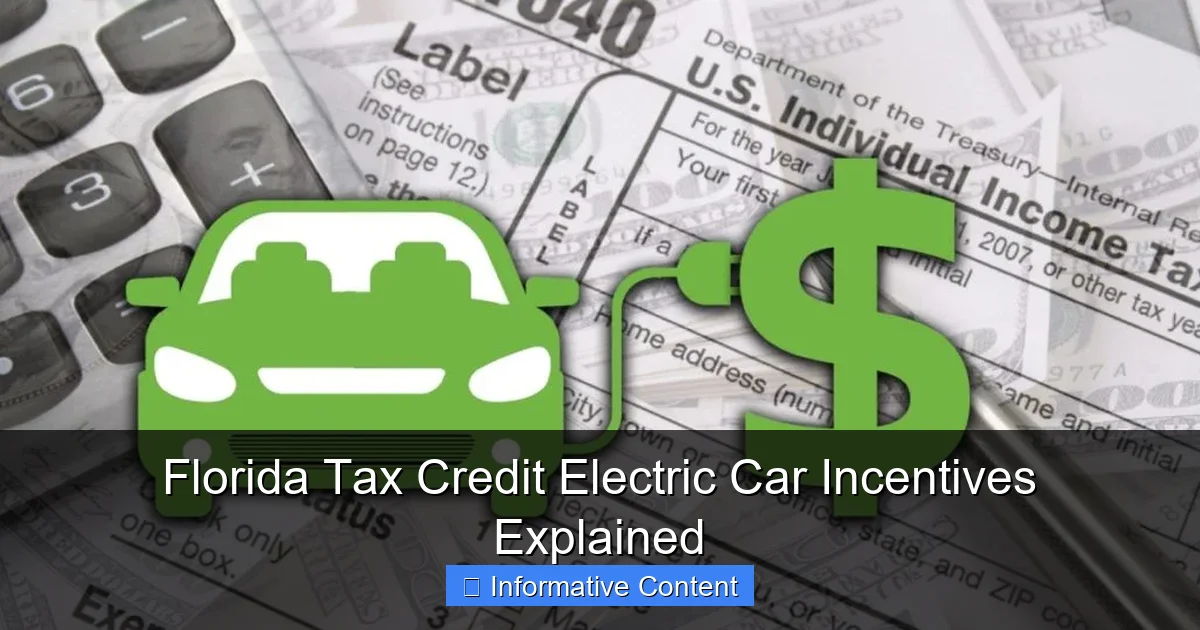
Featured image for florida tax credit electric car
Image source: electriccarcommunity.com
Florida does not currently offer a state income tax credit for electric car purchases, but residents can still benefit from the federal tax credit of up to $7,500 under the Inflation Reduction Act—making EV ownership more affordable despite the absence of direct state incentives. Additional savings may come through local utility rebates and HOV lane access, enhancing the overall value of going electric in the Sunshine State.
Key Takeaways
- No state tax credit: Florida does not offer a direct EV tax credit.
- Federal credit available: Claim up to $7,500 via federal EV tax credit.
- HOV lane access: EV drivers can use carpool lanes with proper decal.
- Local incentives vary: Check county/city for rebates or reduced fees.
- Home charger savings: Some utilities offer rebates for EV charger installation.
- Registration discounts: Reduced annual fees for EVs in select counties.
📑 Table of Contents
- Why Florida’s Electric Car Incentives Are Worth Your Attention
- Understanding the Florida Tax Credit Electric Car Landscape
- Beyond Tax Credits: Other Florida EV Incentives You Should Know
- How to Maximize Your Savings: A Step-by-Step Guide
- Real-World Examples: How Floridians Are Saving
- Challenges and Considerations: What to Watch Out For
- Data Table: Florida EV Incentives at a Glance
- The Bottom Line: Is an EV Right for You?
Why Florida’s Electric Car Incentives Are Worth Your Attention
Thinking about going electric in the Sunshine State? You’re not alone. More Florida drivers are making the switch to electric vehicles (EVs) every year—and for good reason. With rising gas prices, environmental concerns, and a growing network of charging stations, the move to electric makes sense. But what really sweetens the deal are the Florida tax credit electric car incentives and other financial perks that can save you thousands.
Now, I know what you’re thinking: “Tax credits? Sounds complicated.” And honestly, it *can* be—especially when you’re trying to navigate state rules, federal rebates, and manufacturer deals all at once. But here’s the good news: Florida has a surprisingly generous set of incentives designed to make EVs more affordable. Whether you’re buying a new Tesla, a used Nissan Leaf, or even installing a home charger, there are ways to cut costs and drive green without breaking the bank.
Understanding the Florida Tax Credit Electric Car Landscape
Let’s start with the basics. Unlike some states with direct state-level EV tax credits, Florida doesn’t offer a standalone state income tax credit for buying an electric car—yet. But don’t let that discourage you. Florida makes up for it with a mix of exemptions, sales tax breaks, and federal incentives that, when combined, can significantly reduce your out-of-pocket costs.
Visual guide about florida tax credit electric car
Image source: getelectricvehicle.com
Florida’s Sales Tax Exemption: A Big Win for Buyers
Here’s one of the most valuable perks: Florida fully exempts electric vehicles from the state sales tax. That’s right—no 6% (or higher) sales tax on your EV purchase. If you’re buying a $40,000 Tesla Model 3, that’s a $2,400 savings right off the top. In counties with local sales taxes (some go as high as 7.5%), the savings could be even higher.
This exemption applies to new and used EVs, as long as they meet certain criteria:
- The vehicle must be powered solely by electricity stored in a battery
- It must have a battery capacity of at least 4 kilowatt-hours (kWh)
- It must be capable of being charged from an external source
So, even a used 2018 Chevrolet Bolt qualifies—great news for budget-conscious buyers.
Federal Tax Credit: The $7,500 Game-Changer
While Florida doesn’t have its own income tax credit, you can still take advantage of the federal EV tax credit—up to $7,500 for new qualifying EVs. This credit is non-refundable, meaning it reduces your federal tax liability dollar-for-dollar. If you owe $5,000 in taxes, the credit wipes that out. If you owe less than $7,500, you can only claim up to what you owe (no cash back).
As of 2024, the federal credit has new rules:
- Only EVs assembled in North America qualify
- Battery components and critical minerals must meet sourcing requirements
- MSRP caps: $80,000 for SUVs, vans, and trucks; $55,000 for cars
- Buyer income limits: $300,000 (married), $225,000 (head of household), $150,000 (single)
For example, a 2024 Tesla Model Y (assembled in Texas) with a $52,000 MSRP and a buyer earning $120,000 qualifies for the full $7,500. But a Lucid Air (assembled in Arizona, but with a $100,000 MSRP) wouldn’t qualify due to the price cap.
Pro tip: The federal credit can now be transferred to the dealer at the time of purchase (starting in 2024), meaning you can get the $7,500 as an instant rebate—no waiting for your tax return!
Used EV Credit: $4,000 for Pre-Owned Electric Cars
Florida buyers also benefit from a new federal incentive: the used EV tax credit. If you buy a used electric car for $25,000 or less, you may qualify for a credit of up to $4,000 (or 30% of the sale price, whichever is lower).
Requirements:
- The car must be at least 2 years old
- The sale must be through a licensed dealer (private sales don’t count)
- The buyer must be the first person to claim the credit for this vehicle
- Buyer income must be under $150,000 (single), $225,000 (head of household), or $300,000 (married)
Imagine buying a 2020 Tesla Model 3 for $24,000 from a dealership. You save $1,440 in Florida sales tax (6% of $24,000) *and* get a $4,000 federal credit. That’s $5,440 in total savings—nearly 23% off the sticker price!
Beyond Tax Credits: Other Florida EV Incentives You Should Know
Tax credits and sales tax exemptions are just the beginning. Florida offers a range of additional incentives that make EV ownership easier and more affordable. Let’s break them down.
Home Charger Rebates and Installation Support
One of the biggest hurdles for new EV owners is charging. But Florida has you covered. Several utilities and local governments offer rebates for home EV charger installation.
For example:
- Florida Power & Light (FPL) offers a $500 rebate for installing a Level 2 charger (240-volt). You must enroll in their EV program, which includes a free smart charger.
- JEA (Jacksonville) provides a $250 rebate for qualifying Level 2 chargers.
- Orlando Utilities Commission (OUC) offers up to $250 for charger installation and a $200 credit for off-peak charging.
These rebates can cover 50–100% of the cost of a $500–$700 Level 2 charger. Plus, off-peak charging programs let you charge at night (when electricity is cheaper), saving even more.
Tip: Always check with your utility provider—rebate programs change, and some require pre-approval.
HOV Lane Access: Drive Solo, Skip the Traffic
Here’s a perk many people don’t know about: EVs can use Florida’s High-Occupancy Vehicle (HOV) lanes—even with just one person. This is huge for commuters in Miami, Tampa, or Orlando, where traffic can be brutal.
To qualify, your EV must display a special HOV decal from the Florida Department of Highway Safety and Motor Vehicles (FLHSMV). The cost? Just $5. Apply online or at a local tax collector’s office. The decal is valid for 4 years.
Imagine driving from downtown Miami to Fort Lauderdale during rush hour—without being stuck in bumper-to-bumper traffic. That’s time, stress, and fuel (well, electricity) saved.
Utility Discounts and Time-of-Use Rates
Many Florida utilities offer special electric rates for EV owners. These “time-of-use” (TOU) plans charge lower rates during off-peak hours (usually 10 p.m. to 6 a.m.).
For example:
- FPL’s EV Rate Plan charges as low as $0.08/kWh at night vs. $0.12/kWh during peak hours.
- TECO (Tampa Electric) offers a $300 annual credit for enrolling in their EV program.
If you charge 400 kWh per month (average for a daily commute), switching to off-peak rates could save you $15–$20 per month—over $200 a year.
How to Maximize Your Savings: A Step-by-Step Guide
Now that you know the incentives, let’s talk strategy. How do you stack these deals to get the biggest bang for your buck? Here’s a practical, real-world plan.
Step 1: Pick the Right Vehicle
Not all EVs qualify for every incentive. Before you shop:
- Check the federal tax credit list to see if your dream car qualifies.
- Look for vehicles with MSRPs under $55,000 (for cars) or $80,000 (for SUVs/trucks).
- Consider used EVs—they’re eligible for both the $4,000 credit and Florida’s sales tax exemption.
Example: A 2023 Hyundai Kona Electric ($34,000 MSRP) qualifies for the $7,500 federal credit and saves $2,040 in sales tax. Total savings: $9,540.
Step 2: Time Your Purchase
Timing matters. The federal tax credit transfer (instant rebate) started in 2024, so if you’re buying a new EV, do it at the dealership—not later via your tax return. This gives you immediate savings.
Also, watch for manufacturer incentives. Tesla, Ford, and others often run limited-time promotions (e.g., $1,000 off, free Supercharging). Stack these with the federal credit for maximum impact.
Step 3: Apply for Utility Rebates
After buying your EV:
- Contact your utility provider to apply for a home charger rebate.
- Enroll in an off-peak charging program (if available).
- Schedule your charger installation—some programs require a licensed electrician.
Pro tip: Some rebates are first-come, first-served. Apply early!
Step 4: Get Your HOV Decal
Don’t forget the HOV lane decal. It’s a small cost for a big benefit. Apply online at flhsmv.gov and have it mailed to you in a week.
Real-World Examples: How Floridians Are Saving
Let’s put this into perspective with two real-life scenarios from Florida EV owners.
Case Study 1: The Miami Commuter
Sarah, a graphic designer in Miami, bought a new 2024 Chevrolet Bolt EUV for $38,000.
- Savings from Florida sales tax exemption: $2,280 (6% of $38,000)
- Federal tax credit (instant rebate at dealer): $7,500
- FPL home charger rebate: $500
- HOV decal: $5 (one-time)
Total savings: $10,285 (over 27% off the purchase price). Plus, she now zips through I-95 traffic using the HOV lane.
Case Study 2: The Tampa Family
The Garcias, a family of four in Tampa, bought a used 2021 Nissan Leaf for $22,000.
- Savings from sales tax exemption: $1,320
- Federal used EV credit: $4,000
- TECO off-peak charging credit: $300/year
First-year savings: $5,620. They charge at night for $0.09/kWh and save $15/month on electricity vs. gas.
Challenges and Considerations: What to Watch Out For
While Florida’s incentives are great, there are a few pitfalls and limitations to keep in mind.
No Direct State Income Tax Credit (Yet)
Florida has no personal income tax, so a state EV credit wouldn’t work the same way as in, say, Colorado or California. However, there’s growing support for a point-of-sale rebate (similar to the federal transfer credit). Keep an eye on the Florida legislature—this could change soon.
Charging Infrastructure Gaps
While urban areas like Miami and Orlando have plenty of public chargers, rural regions (e.g., North Florida, the Panhandle) are still catching up. If you’re planning long road trips, use apps like PlugShare or ChargePoint to map charging stations.
Tip: The federal government is funding 500,000 new chargers nationwide—many in Florida—over the next 5 years.
Insurance Costs
EVs can be more expensive to insure due to higher repair costs and battery replacement risks. Get quotes from multiple insurers (e.g., Geico, Progressive, State Farm) and ask about EV-specific discounts.
Data Table: Florida EV Incentives at a Glance
| Incentive | Type | Amount | Who Qualifies? | Notes |
|---|---|---|---|---|
| Florida Sales Tax Exemption | State | Full exemption (6%+) | All EV buyers | Applies to new and used EVs |
| Federal EV Tax Credit | Federal | Up to $7,500 | New EV buyers (income limits apply) | Instant transfer at dealer (2024+) |
| Federal Used EV Credit | Federal | Up to $4,000 | Used EV buyers (income limits apply) | Must buy from a dealer |
| Home Charger Rebates | Utility/Local | $250–$500 | Utility customers (e.g., FPL, TECO) | Varies by provider; often requires pre-approval |
| HOV Lane Decal | State | $5 (one-time) | EV owners | Valid for 4 years; apply via FLHSMV |
| Off-Peak Charging Credits | Utility | $200–$300/year | Enrolled EV owners | Requires smart meter enrollment |
The Bottom Line: Is an EV Right for You?
So, should you take advantage of the Florida tax credit electric car incentives and make the switch? If you’re tired of gas prices, care about the environment, or just want a smoother, quieter ride, the answer is likely yes.
Florida’s combination of sales tax exemption, federal credits, utility rebates, and HOV access makes it one of the most EV-friendly states in the South. And with more incentives on the horizon—like expanded charger networks and potential state-level rebates—the future looks even brighter.
Remember: the key is to plan ahead. Research your vehicle, time your purchase, and stack every incentive you can. Whether you’re buying new or used, installing a home charger or using public stations, there’s a path to significant savings.
So go ahead—take that test drive. Talk to your utility. Apply for that HOV decal. The road to affordable, eco-friendly driving in Florida is wide open. And with these incentives, you’re not just buying a car. You’re investing in a smarter, cleaner future.
Frequently Asked Questions
What is the Florida tax credit for electric cars?
The Florida tax credit for electric cars offers a rebate of up to $2,000 for new EV purchases or leases through the Florida Tax Credit Electric Car program. This incentive aims to encourage eco-friendly vehicle adoption across the state.
Who qualifies for the electric car tax credit in Florida?
Florida residents who purchase or lease a new electric vehicle (EV) from a licensed dealer are eligible for the tax credit. The vehicle must be registered in Florida and meet program requirements.
How do I apply for the Florida tax credit electric car incentive?
You can apply online through the Florida Department of Highway Safety and Motor Vehicles (FLHSMV) portal after purchasing or leasing your EV. Required documents typically include your sales contract and vehicle registration.
Does Florida offer additional incentives beyond the tax credit?
Yes, Florida provides perks like HOV lane access for EVs, reduced registration fees, and utility company rebates. Some local governments may also offer charging station incentives.
Is the federal EV tax credit still available in Florida?
Yes, Florida residents can claim the federal EV tax credit (up to $7,500) alongside the state’s Florida tax credit electric car rebate, maximizing savings on EV purchases.
Do used electric cars qualify for Florida incentives?
Currently, Florida’s primary tax credit applies only to new EVs. However, some utility providers offer separate rebates for used EVs—check with local programs for details.