Ford and Electric Cars The Future of Driving Unveiled
Featured image for ford and electric cars
Image source: vroom.zone
Ford is revolutionizing the electric vehicle market with its bold $50 billion investment in EVs by 2026, signaling a decisive shift toward sustainable, high-performance transportation. With models like the F-150 Lightning and Mustang Mach-E already gaining traction, Ford is proving that innovation and tradition can power the future of driving.
Key Takeaways
- Ford invests $50B in EVs through 2026, signaling long-term commitment.
- Mustang Mach-E leads Ford’s EV lineup with 300+ mile range options.
- F-150 Lightning redefines electric trucks with 10,000 lbs towing capacity.
- BlueOval Charging Network ensures seamless long-distance EV travel nationwide.
- Ford Pro simplifies commercial EV adoption with tailored fleet solutions.
- Over-the-air updates future-proof vehicles with continuous performance upgrades.
📑 Table of Contents
- Ford and Electric Cars: The Future of Driving Unveiled
- Ford’s Electrification Strategy: A Bold Roadmap to 2030
- Ford’s Electric Vehicle Lineup: Models That Define the Future
- Technology and Innovation: What Sets Ford EVs Apart
- Charging Infrastructure and Ownership Experience
- Environmental Impact and Sustainability Goals
- Data Snapshot: Ford EVs at a Glance
- Conclusion: Driving the Electric Revolution
Ford and Electric Cars: The Future of Driving Unveiled
The automotive industry is undergoing a seismic shift, and at the heart of this transformation lies the electrification of vehicles. Among the legacy automakers leading the charge is Ford, a company synonymous with innovation, rugged reliability, and American ingenuity. From the Model T to the F-150 Lightning, Ford has consistently redefined mobility. Now, the company is betting big on electric cars, signaling a bold new era where performance, sustainability, and cutting-edge technology converge. As climate concerns intensify and governments push for zero-emission transportation, Ford’s pivot to electric vehicles (EVs) is not just a business decision—it’s a cultural and technological revolution.
Ford’s journey into the electric future is more than just a lineup of new cars; it’s a comprehensive strategy involving manufacturing overhauls, supply chain innovation, and a reimagining of what a Ford can be. With over a century of engineering expertise, Ford is leveraging its strengths to compete with Tesla, Rivian, and other EV pioneers. The stakes are high, and the opportunities are immense. This blog post explores Ford’s electric ambitions, the models that are shaping the future, the infrastructure and technology behind them, and what this means for consumers, the environment, and the broader automotive landscape. Buckle up—because the future of driving is here, and Ford is driving it.
Ford’s Electrification Strategy: A Bold Roadmap to 2030
From Legacy to Innovation: Ford’s EV Vision
Ford’s electrification strategy is anchored in its Ford+ Plan, a multi-billion-dollar initiative unveiled in 2021 that prioritizes EVs, software integration, and customer-centric services. The company has committed to investing over $50 billion in EVs through 2026, with a goal of achieving 50% global EV sales by 2030. This isn’t just about adding electric models to the lineup—it’s about transforming Ford into a mobility company that delivers connected, sustainable, and intelligent vehicles.
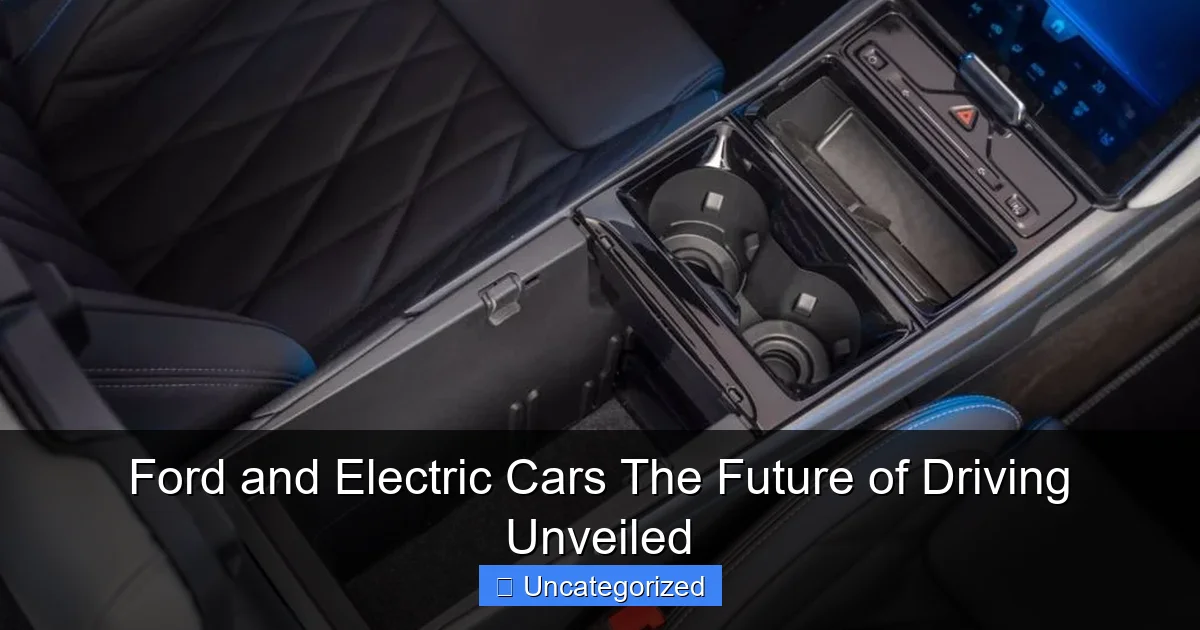
Visual guide about ford and electric cars
Image source: weudealerimagesprd.blob.core.windows.net
The strategy is built on three pillars: electric vehicles, connected services, and autonomous technology. Ford aims to leverage its vast manufacturing network, particularly in the U.S., to scale EV production efficiently. The company is also investing heavily in battery technology, including partnerships with SK Innovation and the development of its own BlueOval SK battery plants in Kentucky and Tennessee. These facilities are expected to produce enough battery cells for 1.2 million EVs annually by 2026.
Manufacturing and Supply Chain Overhaul
One of the biggest challenges in the EV transition is retooling factories and securing raw materials. Ford has taken a proactive approach by:
- Converting existing plants: The Rouge Electric Vehicle Center in Dearborn, Michigan, was repurposed to build the F-150 Lightning, proving that legacy facilities can be adapted for EV production.
- Vertical integration: Ford is securing lithium, nickel, and cobalt through long-term contracts and exploring recycling programs to reduce dependency on mining.
- Localized supply chains: By building battery plants and EV assembly lines in North America, Ford reduces shipping costs and aligns with U.S. government incentives like the Inflation Reduction Act.
This strategic shift isn’t without risks—supply chain disruptions and raw material price volatility remain concerns—but Ford’s proactive stance positions it as a leader in sustainable manufacturing.
Ford’s Electric Vehicle Lineup: Models That Define the Future
The F-150 Lightning: Electrifying America’s Best-Selling Truck
The F-150 Lightning is arguably Ford’s most significant EV launch. As the electric version of America’s best-selling vehicle for 40+ years, it bridges the gap between traditional truck buyers and EV adopters. Key features include:
- Range: Up to 320 miles (Extended Range model).
- Power: 563 horsepower, 775 lb-ft torque, 0-60 mph in 4.5 seconds.
- Utility: 2,235 lbs payload capacity, 10,000 lbs towing capacity.
- Innovation: Pro Power Onboard (9.6 kW of exportable power), Mega Power Frunk (14.1 cu-ft storage).
For contractors, campers, and families, the Lightning offers a practical, high-performance EV without sacrificing the ruggedness of the F-150. Pro Tip: Use the Lightning’s vehicle-to-grid (V2G) capability to power homes during outages—a feature that’s gaining traction in hurricane-prone areas.
Mustang Mach-E: Performance Meets Practicality
The Mustang Mach-E is Ford’s answer to the Tesla Model Y. Blending the Mustang’s sporty DNA with SUV practicality, it appeals to both performance enthusiasts and eco-conscious drivers. Highlights include:
- Range: Up to 314 miles (California Route 1 trim).
- Performance: GT model hits 60 mph in 3.5 seconds.
- Tech: 15.5-inch touchscreen, Ford SYNC 4A, over-the-air updates.
- Charging: 10-minute fast charge adds 61 miles (150 kW DC fast charging).
The Mach-E’s success (over 100,000 sold in 2022) proves that EVs can be both fun and functional. Pro Tip: Opt for the Extended Range battery if you frequently drive long distances—the extra cost is worth the peace of mind.
E-Transit: Electrifying Commercial Fleets
Ford isn’t just targeting consumers—it’s revolutionizing commercial transport with the E-Transit, an all-electric version of its popular cargo van. With 126 miles of range, 30% lower maintenance costs, and 100% torque at 0 mph, it’s ideal for delivery services, tradespeople, and municipal fleets. Ford offers multiple configurations (cargo van, cutaway, chassis cab) and integrates telematics for fleet management.
Future Models: The All-Electric Explorer, Puma, and More
Ford’s 2025–2030 roadmap includes:
- All-electric Explorer: A midsize SUV with 300+ miles of range.
- Electric Puma: A compact SUV for European markets.
- Next-gen F-Series EV: A larger, more capable truck than the Lightning.
Technology and Innovation: What Sets Ford EVs Apart
BlueCruise: Ford’s Answer to Tesla Autopilot
BlueCruise, Ford’s hands-free driver-assist system, is a game-changer. Available on the F-150 Lightning, Mach-E, and E-Transit, it enables true hands-free driving on over 130,000 miles of pre-mapped highways in North America. Unlike Tesla’s Autopilot, BlueCruise uses a driver-facing camera to monitor attention, ensuring safety. Key features:
- Adaptive Cruise Control with lane centering.
- Intersection Assist to prevent collisions at crossings.
- Over-the-air updates to improve functionality.
Pro Tip: Subscribe to BlueCruise for $600/year or buy it outright for $2,100—ideal for long-haul drivers.
Ford SYNC and Software Integration
Ford’s SYNC 4A system is the brain of its EVs, offering:
- Voice-activated controls (e.g., “Find the nearest charging station”).
- Wireless Apple CarPlay/Android Auto.
- OTA (Over-the-Air) updates that enhance performance, security, and features.
- FordPass App: Remote start, charge scheduling, and vehicle diagnostics.
Unlike Tesla, Ford retains physical controls for critical functions, reducing driver distraction.
Battery and Charging Technology
Ford is investing in:
- Solid-state batteries: Partnering with Solid Power for faster charging and longer lifespan.
- Charging network: Access to over 84,000 charging stations via FordPass, including 12,000 DC fast chargers.
- Home charging: Ford Connected Charge Station (19.2 kW) for 30 miles per hour of charging.
Pro Tip: Use Ford’s “Plug & Charge” feature to pay at public stations automatically—no app or card needed.
Charging Infrastructure and Ownership Experience
Home Charging: The Cornerstone of EV Ownership
For 90% of Ford EV owners, home charging is the primary method. Ford offers:
- Ford Connected Charge Station: 240V Level 2 charger ($799 + installation).
- FordPass Power My Trip: Route planning with charging stops.
- Smart charging: Schedule charging during off-peak hours to save money.
Pro Tip: Install a 50-amp circuit to future-proof your home for faster charging speeds.
Public Charging: Ford’s Network and Partnerships
Ford EV owners get access to:
- FordPass Rewards: Free charging at Electrify America stations (up to 250 kWh).
- Partnerships: ChargePoint, EVgo, and Greenlots.
- Plug & Charge: Seamless payment without an app.
However, Ford still lags behind Tesla’s Supercharger network in reliability and density. The company plans to expand its network by 2025.
Maintenance and Total Cost of Ownership
Ford EVs offer significant savings:
- Lower fuel costs: $1,000/year saved vs. gas vehicles.
- Reduced maintenance: No oil changes, fewer moving parts.
- Tax credits: Up to $7,500 under the Inflation Reduction Act.
Pro Tip: Use Ford’s “Total Cost of Ownership” calculator to compare EVs vs. gas models.
Environmental Impact and Sustainability Goals
Reducing Carbon Footprint
Ford’s EVs are part of a broader sustainability strategy:
- Carbon neutrality: Aiming for 2050, with 50% emissions cut by 2035.
- Renewable energy: 100% renewable electricity for global operations by 2035.
- Recycling: Closed-loop battery recycling to reduce waste.
For example, the F-150 Lightning’s battery is 95% recyclable.
Ethical Sourcing and Social Responsibility
Ford prioritizes:
- Conflict-free minerals: Auditing supply chains for cobalt and lithium.
- Diversity in hiring: 30% diverse suppliers by 2025.
- Community engagement: Training programs for EV-related jobs.
Challenges and Criticisms
Ford faces scrutiny over:
- Scope 3 emissions: Indirect emissions from suppliers and customers.
- Recycling infrastructure: Limited U.S. capacity for battery recycling.
- EV adoption rates: Only 3% of U.S. vehicle sales are EVs (2023).
Data Snapshot: Ford EVs at a Glance
| Model | Range (Miles) | Starting Price | 0-60 mph (Sec) | Key Feature |
|---|---|---|---|---|
| F-150 Lightning | 230–320 | $49,995 | 4.5 | Pro Power Onboard |
| Mustang Mach-E | 224–314 | $42,995 | 3.5 (GT) | SYNC 4A |
| E-Transit | 126 | $45,000 | 6.5 | Fleet Telematics |
| All-Electric Explorer (2025) | 300+ | $45,000 (est.) | 5.0 (est.) | BlueCruise |
Conclusion: Driving the Electric Revolution
Ford’s foray into electric cars is more than a product lineup—it’s a vision for the future of mobility. By combining its century-old expertise with bold innovation, Ford is proving that legacy automakers can lead the EV revolution. The F-150 Lightning, Mustang Mach-E, and E-Transit aren’t just vehicles; they’re statements of intent. They represent a future where sustainability, performance, and practicality coexist.
For consumers, Ford’s EVs offer a compelling mix of range, technology, and value. For the planet, they’re a step toward reducing transportation’s carbon footprint. And for the automotive industry, they set a benchmark for what’s possible. As Ford continues to expand its EV portfolio, invest in infrastructure, and push the boundaries of technology, one thing is clear: the future of driving is electric, and Ford is steering it with confidence.
Whether you’re a truck enthusiast, a tech-savvy commuter, or a fleet manager, Ford’s electric cars provide a roadmap to a cleaner, smarter, and more exciting driving experience. The road ahead is electric—and Ford is leading the way.
Frequently Asked Questions
What electric cars does Ford currently offer?
Ford’s current electric lineup includes the Mustang Mach-E, F-150 Lightning, and E-Transit van, catering to SUV, truck, and commercial vehicle markets. These models highlight Ford’s commitment to electrifying its most iconic nameplates.
How does the F-150 Lightning compare to traditional gas-powered F-150s?
The F-150 Lightning delivers instant torque, lower maintenance costs, and comparable towing capacity to its gas counterparts, while offering unique features like Pro Power Onboard for worksite electricity. It retains the ruggedness of the F-150 series with a fully electric powertrain.
What is Ford’s plan for future electric cars?
Ford plans to invest $50 billion in EVs through 2026, targeting 2 million global EV production by 2026 and launching 9 new electric models, including a next-gen electric truck. This aligns with their “Ford+” strategy to lead in electrification.
How long does it take to charge a Ford electric car?
Ford electric cars like the Mustang Mach-E can charge from 10% to 80% in ~45 minutes using a DC fast charger. With a Level 2 home charger, full charging takes 8-10 hours, ideal for overnight use.
Are Ford electric cars eligible for government incentives?
Yes, many Ford electric cars qualify for federal tax credits (up to $7,500) and state-level incentives, depending on the model and buyer eligibility. The Inflation Reduction Act has updated criteria, so check current guidelines.
What is Ford’s BlueOval charging network?
Ford’s BlueOval network provides access to over 84,000 chargers across North America, including DC fast chargers, simplifying long-distance travel for Ford EV owners. It integrates seamlessly via the FordPass app for real-time availability and payments.