Ford and GM Raise Electric Car Prices What You Need to Know
Featured image for ford and gm raise electric car prices
Image source: energy.gov
Ford and GM have raised electric car prices across key models, citing rising battery costs and supply chain challenges. This shift impacts affordability for popular vehicles like the Ford F-150 Lightning and Chevrolet Blazer EV, with increases ranging from $3,000 to $8,000. Buyers should act fast—federal tax credits and current inventory may still offer savings before further adjustments.
Key Takeaways
- Ford and GM increased EV prices due to rising battery and material costs.
- Higher prices may affect demand as buyers weigh affordability against incentives.
- Tax credits still apply for eligible models, softening the price hike impact.
- Compare trims carefully as some offer better value despite the increases.
- Watch for future adjustments as automakers adapt to market and supply changes.
📑 Table of Contents
The Electric Vehicle Price Surge: What’s Happening?
The electric vehicle (EV) revolution has been one of the most transformative shifts in the automotive industry over the past decade. From sleek, high-tech sedans to rugged, all-electric pickup trucks, EVs are no longer niche offerings—they’re becoming mainstream. However, as demand surges and technology evolves, two of America’s largest automakers, Ford and General Motors (GM), have recently made headlines by raising prices on their electric car lineups. This move has sparked concern among consumers, investors, and industry analysts alike, prompting questions about affordability, market dynamics, and the future of EV adoption.
For years, automakers and policymakers have championed the idea of making EVs more accessible to the average consumer. Federal tax credits, state incentives, and aggressive manufacturer rebates have helped bridge the price gap between traditional internal combustion engine (ICE) vehicles and their electric counterparts. But with Ford and GM raising electric car prices, this progress seems to be hitting a snag. The increases aren’t just minor adjustments—some models have seen price hikes of thousands of dollars in a matter of months. What’s driving this shift? And more importantly, what does it mean for you, the consumer? In this comprehensive guide, we’ll break down the reasons behind the price increases, explore how they’re impacting the market, and provide actionable insights to help you navigate this evolving landscape.
Why Are Ford and GM Raising EV Prices?
Soaring Battery and Raw Material Costs
One of the primary drivers behind the price hikes is the skyrocketing cost of battery materials. Lithium, cobalt, nickel, and other critical minerals used in EV batteries have seen dramatic price fluctuations in recent years. According to industry reports, lithium carbonate prices surged by over 400% between 2021 and 2022, driven by supply chain disruptions, geopolitical tensions, and surging demand. These materials are essential for producing high-capacity batteries, and their rising costs directly impact manufacturing expenses.
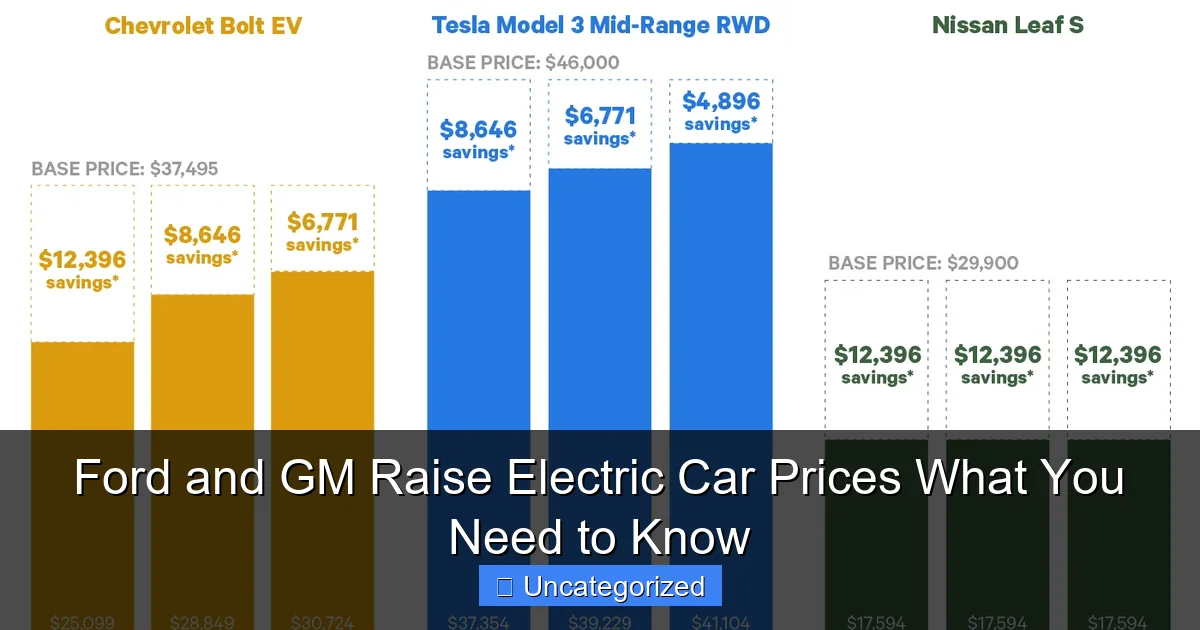
Visual guide about ford and gm raise electric car prices
Image source: res.cloudinary.com
For example, the Ford F-150 Lightning, which relies on a large lithium-ion battery pack, has seen its starting price increase by over $10,000 since its initial launch. Similarly, GM’s Chevrolet Blazer EV saw a $7,000 price bump shortly after its release. Automakers argue that these adjustments are necessary to maintain profitability and ensure long-term sustainability in the face of rising input costs.
Supply Chain Disruptions and Inflation
The global supply chain has been under immense pressure since the pandemic, and the EV sector is no exception. From semiconductor shortages to delays in battery production, automakers have faced significant challenges in scaling up production. These disruptions have led to increased labor and logistics costs, which are inevitably passed on to consumers. Additionally, inflationary pressures across the economy have driven up the cost of everything from steel to software development, further contributing to the price increases.
GM, for instance, cited “unprecedented inflationary pressures” when announcing a $5,000 price hike for the 2024 Cadillac Lyriq. Ford echoed similar sentiments, noting that supply chain volatility has made it difficult to maintain stable pricing across its EV lineup.
Investment in New Technologies and Platforms
Both Ford and GM are heavily investing in next-generation EV platforms, such as Ford’s BlueOval City and GM’s Ultium platform. These platforms are designed to improve range, performance, and charging speeds, but they come with substantial upfront costs. Automakers are betting that these investments will pay off in the long run, but in the short term, they’re contributing to higher vehicle prices.
For instance, the Ultium platform allows GM to produce vehicles with ranges exceeding 400 miles and ultra-fast charging capabilities. However, the R&D and production costs associated with this technology are reflected in the final price tag. Ford’s new electric Explorer, built on a dedicated EV platform, is priced significantly higher than its ICE counterpart, despite offering similar features.
How the Price Hikes Are Impacting the EV Market
Consumer Sentiment and Affordability Concerns
The price increases have sparked a wave of concern among potential EV buyers. A recent survey by Consumer Reports found that 68% of respondents cited high upfront costs as a major barrier to EV adoption. With Ford and GM raising electric car prices, this barrier is becoming even more pronounced. For middle-income families, the added thousands of dollars can be the difference between purchasing an EV and opting for a more affordable ICE vehicle.
Take the Ford Mustang Mach-E, for example. Once positioned as a competitively priced SUV, its base price has climbed from $43,000 to over $50,000 in just two years. Similarly, the Chevrolet Bolt EV, which was once one of the most affordable EVs on the market, saw its price increase by $1,500 in 2023, despite being a compact car. These hikes are making it harder for automakers to meet their goal of making EVs accessible to the masses.
Competitive Landscape and Market Share
The price hikes are also reshaping the competitive landscape. While Ford and GM are raising prices, other automakers like Tesla and Hyundai are holding the line—or even cutting prices—to gain market share. Tesla’s aggressive pricing strategy, for instance, has made models like the Model Y more competitive than ever. In response, Ford and GM are facing pressure to justify their higher price tags through superior features, brand loyalty, or long-term value.
However, this strategy carries risks. If consumers perceive that Ford and GM’s EVs aren’t worth the extra cost, they may turn to competitors. On the flip side, some analysts argue that the price increases could signal a shift toward premium EV offerings, with Ford and GM targeting higher-income buyers who prioritize performance and luxury over affordability.
Impact on Federal Tax Credits and Incentives
Another critical factor is the interplay between price hikes and federal tax credits. Under the Inflation Reduction Act (IRA), EVs must meet specific price and sourcing criteria to qualify for a $7,500 tax credit. For example, SUVs and trucks must have a base price under $80,000, while cars must be under $55,000. With Ford and GM raising electric car prices, some models are now just above these thresholds, putting them out of reach for the credit.
The Ford F-150 Lightning, for instance, now starts at $59,000, but higher trims exceed $80,000, making them ineligible for the credit. This could deter buyers who were counting on the incentive to offset the higher upfront cost. GM’s Cadillac Lyriq, priced at $62,000, also falls into a gray area, as its eligibility depends on trim level and battery sourcing.
Breaking Down the Price Increases: A Model-by-Model Analysis
Ford’s Electric Lineup: From the F-150 Lightning to the E-Transit
Ford has been one of the most aggressive automakers in the EV space, with models like the F-150 Lightning, Mustang Mach-E, and E-Transit leading the charge. However, each of these vehicles has seen significant price adjustments:
- F-150 Lightning: The base Pro model started at $39,974 in 2022 but now starts at $49,995—a 25% increase. Higher trims like the Platinum exceed $90,000.
- Mustang Mach-E: Once starting at $43,895, the base Select model now starts at $51,995, with the GT Performance Edition topping $60,000.
- E-Transit: Ford’s electric van has seen a $3,000 price hike, with the base model now starting at $51,000.
These increases reflect Ford’s shift toward premium features and larger battery packs, but they’re also a response to rising material and production costs.
GM’s Electric Portfolio: The Ultium Effect
GM’s Ultium platform has enabled a diverse range of EVs, from the affordable Chevrolet Bolt to the luxury Cadillac Lyriq. However, the platform’s costs are evident in the pricing:
- Chevrolet Blazer EV: Initially announced at $44,995, the base model now starts at $51,995, with the RS trim exceeding $60,000.
- Cadillac Lyriq: The base model’s price rose from $58,590 to $62,090, with higher trims approaching $75,000.
- Chevrolet Silverado EV: The Work Truck trim starts at $39,900, but the higher-end RST trim is priced at $105,000.
GM argues that the Ultium platform’s scalability and performance justify the higher prices, but consumers are watching closely to see if the value proposition holds up.
Data Table: Price Changes Across Key Models
| Model | Original Price (2022) | Current Price (2024) | Price Increase | Key Features |
|---|---|---|---|---|
| Ford F-150 Lightning (Pro) | $39,974 | $49,995 | $10,021 (25%) | 320-mile range, 452 hp |
| Chevrolet Blazer EV (LT) | $44,995 | $51,995 | $7,000 (15.5%) | 279-mile range, AWD |
| Ford Mustang Mach-E (Select) | $43,895 | $51,995 | $8,100 (18.5%) | 250-mile range, 266 hp |
| Cadillac Lyriq (Tech) | $58,590 | $62,090 | $3,500 (6%) | 312-mile range, 340 hp |
What This Means for Buyers: Tips and Strategies
Timing Your Purchase: When to Buy (or Wait)
If you’re in the market for an EV, timing is everything. With Ford and GM raising electric car prices, it’s worth considering whether to buy now or wait for potential price corrections. Here are a few strategies:
- Buy now if you qualify for incentives: If your income and vehicle choice make you eligible for federal or state tax credits, acting quickly could save you thousands. For example, the Chevrolet Bolt EV still qualifies for the full $7,500 credit, making it a smart buy despite its price hike.
- Wait for lease deals: Automakers often offer lower lease rates than purchase prices. Ford and GM may introduce special lease programs to offset high upfront costs.
- Monitor used EV markets: As new models get pricier, used EVs are becoming a more attractive option. A lightly used Ford Mach-E or Chevy Bolt could offer significant savings.
Leveraging Incentives and Rebates
Even with higher prices, there are still ways to reduce your out-of-pocket costs. Start by researching:
- Federal tax credits: Check the IRS website to confirm if your chosen model qualifies. Note that some trims may no longer be eligible.
- State and local incentives: States like California, New York, and Colorado offer additional rebates and HOV lane access for EVs.
- Manufacturer discounts: Ford and GM occasionally offer cash rebates or low-interest financing. For example, GM’s “EVeryone” program provides $2,000 off select models.
Alternative Options: Competitors and Used EVs
If Ford and GM’s price hikes are too steep, consider alternatives:
- Tesla: The Model Y and Model 3 remain competitively priced, with the Model 3 starting under $40,000 after federal credits.
- Hyundai/Kia: The Ioniq 5 and EV6 offer strong value, with prices starting under $45,000 and ranges exceeding 300 miles.
- Used EVs: A 2021 Ford Mustang Mach-E or 2020 Chevy Bolt could save you 20-30% compared to new models.
The Future of EV Pricing: What’s Next?
Will Prices Stabilize or Keep Rising?
The big question on everyone’s mind is whether Ford and GM raising electric car prices is a temporary blip or a long-term trend. While some factors like battery costs may stabilize as production scales up, others—such as inflation and supply chain volatility—could persist. Analysts at McKinsey & Company predict that EV prices will remain elevated through 2025, with gradual declines thereafter as battery technology improves and supply chains recover.
The Role of Innovation and Economies of Scale
Long-term, the key to lower prices lies in innovation and economies of scale. Both Ford and GM are investing billions in new battery plants and EV factories, which should reduce per-unit costs over time. For example, GM’s Ultium Cells joint venture aims to cut battery costs by 40% by 2025. Similarly, Ford’s BlueOval City is designed to produce 100,000 EVs annually, leveraging scale to drive down prices.
Policy and Market Forces
Government policies will also play a crucial role. The IRA’s emphasis on domestic battery production and critical mineral sourcing could reduce reliance on volatile global markets. Meanwhile, consumer demand—driven by rising fuel costs and environmental awareness—will continue to shape pricing strategies. If demand remains strong, automakers may have less incentive to lower prices, at least in the short term.
In conclusion, the decision by Ford and GM to raise electric car prices reflects a complex interplay of market forces, technological investments, and economic pressures. While these hikes pose challenges for affordability, they also signal a maturing EV industry where innovation and performance are becoming key differentiators. For consumers, the takeaway is clear: do your research, leverage available incentives, and consider all options—new, used, or leased—before making a purchase. As the market evolves, staying informed will be your best tool for navigating the road ahead.
Frequently Asked Questions
Why have Ford and GM raised electric car prices?
Ford and GM raised electric car prices due to rising battery material costs, supply chain constraints, and increased demand for EVs. These factors have driven up production expenses, forcing automakers to adjust pricing to maintain profitability.
How much have Ford and GM increased their electric car prices?
Exact price hikes vary by model, but recent increases range from $3,000 to $6,000 for popular EVs like the Ford F-150 Lightning and Chevrolet Silverado EV. Check the latest MSRP updates on official manufacturer sites for model-specific details.
Does the price increase affect existing reservations for Ford and GM EVs?
Yes, in many cases—Ford and GM have revised pricing for existing reservations, requiring buyers to pay the new rates. Some reservation holders received price adjustment notices, so check your email for updates or contact customer support.
Are Ford and GM the only automakers raising electric car prices?
No, other manufacturers like Tesla and Rivian have also adjusted EV prices in recent years. However, Ford and GM’s electric car price increases are notable due to their large-scale production and market influence.
Will the Ford and GM EV price hikes impact federal tax credits?
Price increases may affect eligibility for the $7,500 federal tax credit, which has MSRP caps. For example, GM’s pricier Silverado EV could push some trims over the $80,000 limit for trucks/SUVs. Verify credit eligibility with the IRS.
Are there alternatives to Ford and GM electric cars amid the price increases?
Yes, brands like Hyundai, Kia, and Volkswagen offer competitive EVs at lower price points. If you’re reconsidering due to Ford and GM’s hikes, explore models like the Ioniq 5 or ID.4 for potentially better value.