Ford Ditching Electric Cars What You Need to Know
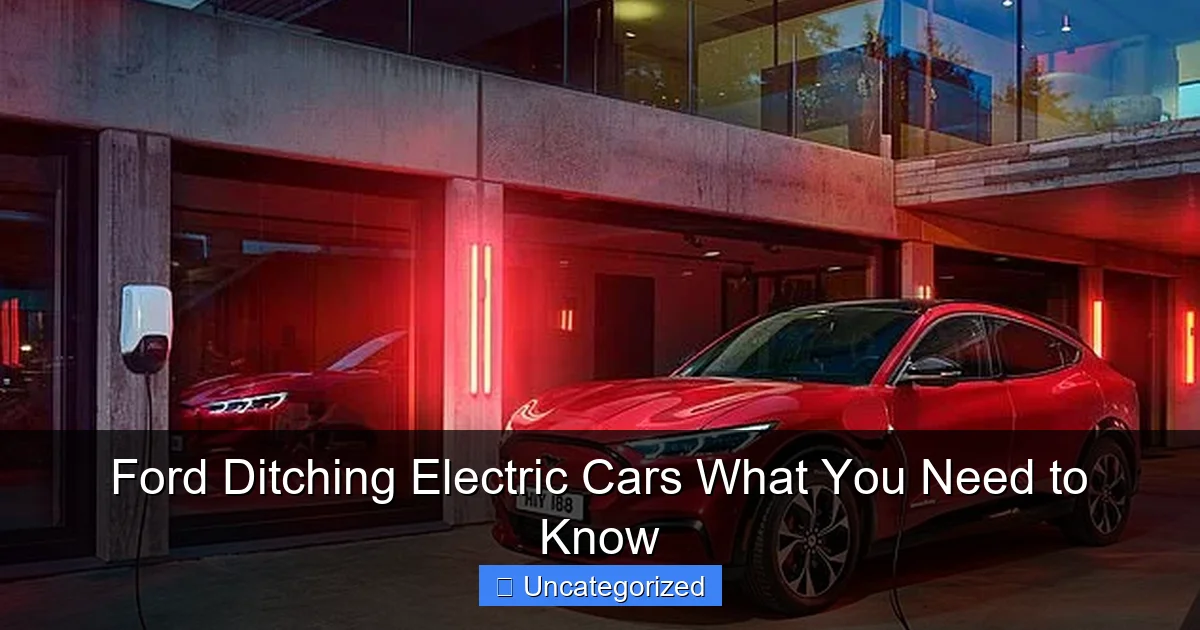
Featured image for ford ditching electric cars
Image source: i.dailymail.co.uk
Ford is shifting gears by scaling back its electric car ambitions, prioritizing hybrid and gas-powered models due to slowing EV demand and profitability challenges. This strategic pivot includes delaying $12 billion in EV investments and refocusing on trucks and SUVs, signaling a major industry shift as automakers reassess the pace of electrification.
Key Takeaways
- Ford shifts focus: Prioritizing hybrids and trucks over pure EVs.
- EV demand slows: Market response pushes Ford to adjust strategy.
- Investment pivot: Billions redirected to hybrid and ICE development.
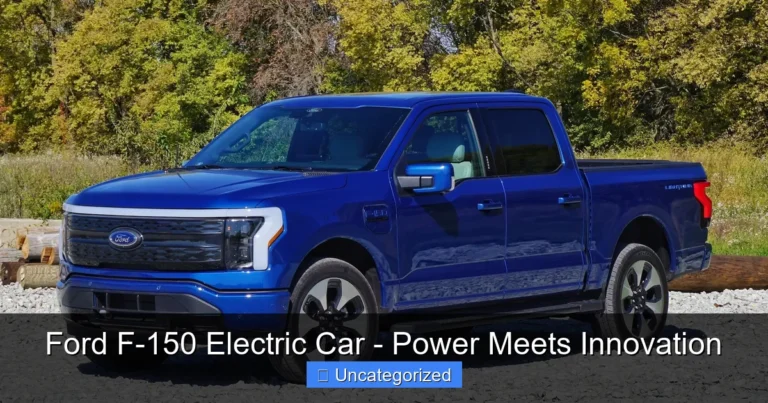
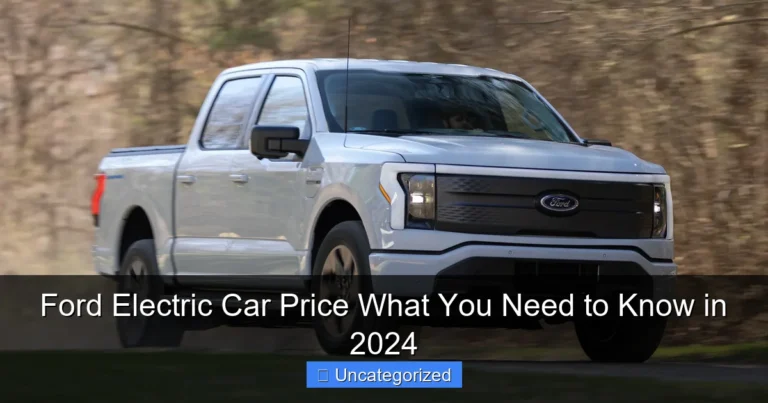
- F-150 Lightning impact: Flagship EV production scaled back significantly.
- Charging network pause: Ford delays EV infrastructure investments.
- Consumer advice: EV buyers should evaluate hybrid alternatives now.
📑 Table of Contents
- Ford Ditching Electric Cars: What You Need to Know
- Why Is Ford Pulling Back from Electric Vehicles?
- Ford’s New Strategy: Hybrids, ICE, and a Phased EV Approach
- What This Means for Ford Buyers and Enthusiasts
- The Broader Impact on the Auto Industry and Environment
- What’s Next for Ford? A Look Ahead
- Data Table: Ford’s Powertrain Strategy (2024–2026)
- Conclusion: A Strategic Retreat or a Smart Pivot?
Ford Ditching Electric Cars: What You Need to Know
The automotive world has been buzzing with a seismic shift in strategy: Ford ditching electric cars — or at least, that’s the narrative circulating in headlines and industry reports. For years, Ford positioned itself as a leader in the EV revolution, with bold promises like the $50 billion investment in electrification and the launch of the Mustang Mach-E and F-150 Lightning. Yet, in a surprising pivot, the automaker has begun scaling back its EV ambitions, delaying production targets, canceling models, and reallocating funds toward hybrid and internal combustion engine (ICE) vehicles. This sudden reversal has left consumers, investors, and environmental advocates wondering: what’s really happening behind the scenes?
Ford’s decision isn’t a simple abandonment of electric vehicles but rather a strategic recalibration in response to market realities. While the company isn’t completely exiting the EV space, it’s shifting gears — focusing on profitability, consumer demand, and supply chain challenges. This pivot raises critical questions about the future of electric mobility, the role of legacy automakers in the green transition, and what this means for car buyers today. Whether you’re an EV enthusiast, a Ford loyalist, or a pragmatic shopper trying to navigate the evolving automotive landscape, understanding Ford’s new direction is essential. In this comprehensive guide, we’ll unpack the reasons behind Ford’s shift, analyze its implications, and provide practical advice for consumers caught in the crossfire.
Why Is Ford Pulling Back from Electric Vehicles?
The narrative of Ford ditching electric cars may sound dramatic, but the reality is more nuanced. Ford isn’t abandoning EVs altogether — it’s retrenching. The automaker has faced a perfect storm of economic, technological, and market-driven challenges that have forced a reevaluation of its electrification strategy. Let’s break down the key factors driving this pivot.
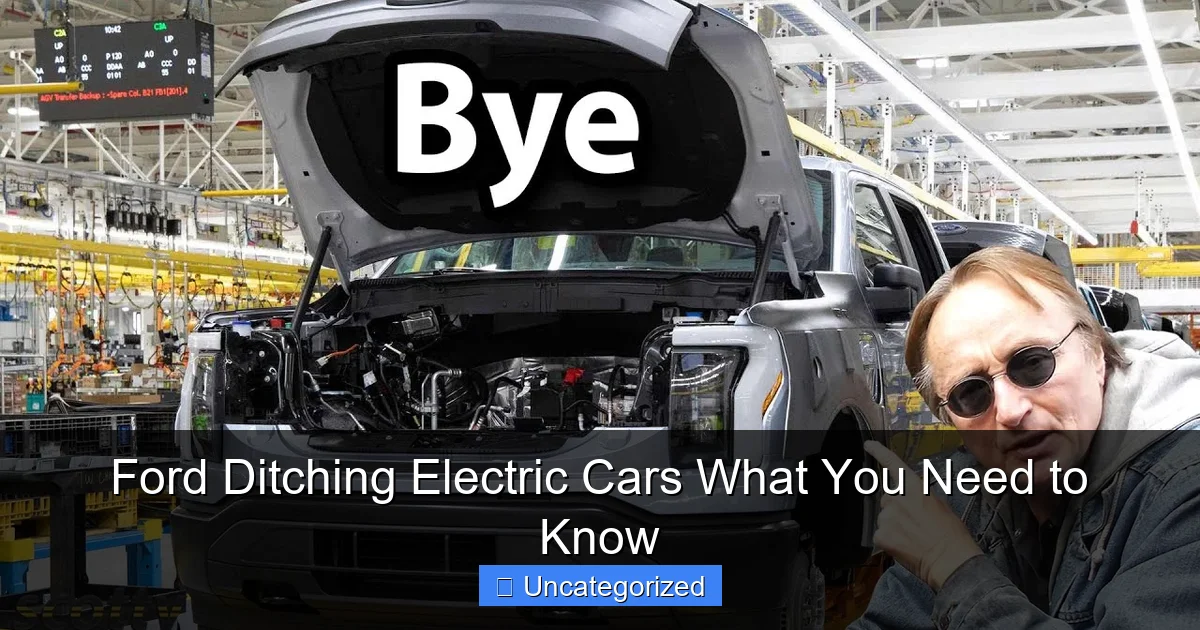
Visual guide about ford ditching electric cars
Image source: evshift.com
1. Slowing Consumer Demand for EVs
Despite years of government incentives and media hype, EV adoption in the U.S. has plateaued. According to the Alliance for Automotive Innovation, EV sales accounted for just 8.6% of total U.S. light-duty vehicle sales in 2023 — up from 6.7% in 2022, but far below the 20% target many automakers had projected. Ford’s own F-150 Lightning, once a flagship EV, saw sales drop by 40% year-over-year in Q4 2023. The Mustang Mach-E, while still selling, has also faced declining interest, particularly as competitors like Tesla and Hyundai offer more affordable and longer-range options.
Why the slowdown? A 2023 McKinsey & Company survey found that 45% of U.S. consumers cite high upfront costs, 38% worry about charging infrastructure, and 29% express concerns about battery life and resale value. Ford’s EVs, while innovative, are priced at a premium — the F-150 Lightning starts at $49,995, while the Mach-E begins at $42,995. With inflation and rising interest rates, many buyers are opting for cheaper, proven ICE or hybrid alternatives.
2. Profitability and Production Costs
EVs are expensive to build. Ford’s CFO, John Lawler, admitted in early 2024 that the company’s EV division is losing $3 billion annually — a staggering figure that’s unsustainable in the current economic climate. Unlike Tesla, which built its EV business from the ground up, Ford must retrofit existing factories, retrain workers, and develop new supply chains for batteries and software. The F-150 Lightning, for example, requires a completely different assembly line than the gas-powered F-150, increasing capital expenditure and operational complexity.
Additionally, battery costs — though declining — remain a major expense. Ford’s BlueOval SK joint venture with SK On is investing billions in Kentucky and Tennessee battery plants, but these won’t reach full capacity until 2026. In the meantime, Ford is burning cash to produce EVs at a loss, a strategy that’s only viable if long-term demand materializes. With sales lagging, the company is prioritizing short-term profitability over long-term vision.
3. Supply Chain and Battery Challenges
The EV supply chain is fragile. Ford relies heavily on lithium, cobalt, and nickel — minerals concentrated in geopolitically sensitive regions like China, the Democratic Republic of Congo, and Indonesia. Trade tensions, export restrictions, and environmental concerns have disrupted supply chains. For instance, Ford had to halt F-150 Lightning production in early 2023 due to a battery shortage from its supplier, SK On.
Moreover, Ford’s decision to cancel its next-generation three-row electric SUV (originally slated for 2025) was directly tied to battery costs. The company realized that producing a large EV with a 300+ mile range would require a 135-kWh battery pack — too expensive and inefficient for mass-market appeal. Instead, Ford is shifting focus to smaller, more affordable EVs and extending the life of hybrid models.
Ford’s New Strategy: Hybrids, ICE, and a Phased EV Approach
Rather than a full retreat, Ford is adopting a “multi-pathway” strategy — a term CEO Jim Farley has used to describe the company’s new approach to powertrain diversification. This means Ford isn’t ditching EVs entirely but is instead balancing them with hybrids, plug-in hybrids (PHEVs), and even new ICE vehicles to meet diverse consumer needs and regulatory requirements.
1. Doubling Down on Hybrids
Hybrids are Ford’s new golden child. The company plans to increase hybrid production by 400% by 2026, with models like the F-150 Hybrid, Escape Hybrid, and Maverick Hybrid leading the charge. The Maverick Hybrid, in particular, has been a breakout success — starting at just $23,400, it offers 42 mpg city and has a 50% lower carbon footprint than the gas-only model.
Why hybrids? They offer the best of both worlds: improved fuel efficiency without the range anxiety or charging infrastructure concerns of full EVs. They’re also cheaper to produce and more profitable — Ford’s hybrid vehicles carry higher margins than their EV counterparts. In 2023, hybrid sales grew by 25% in the U.S., while EV sales grew by just 4%. Ford is betting big on this trend.
2. Extending the Life of ICE Vehicles
Contrary to earlier predictions, Ford is not retiring its gas-powered lineup. The F-150, America’s best-selling vehicle for 42 years, will continue with ICE and hybrid variants. The company is even investing in a new generation of EcoBoost engines, which offer better fuel economy and lower emissions than previous models.
This move aligns with consumer preferences. A 2024 Consumer Reports study found that 62% of U.S. drivers plan to keep their next car for 10+ years — a timeline that favors reliable, familiar ICE vehicles over unproven EV technology. Ford is also responding to regulatory flexibility: the Biden administration’s revised 2030 emissions targets allow automakers to meet standards through a mix of EVs, hybrids, and ICE improvements, not just pure electrification.
3. A Phased, Profitable EV Rollout
Ford isn’t abandoning EVs — it’s slowing them down. The company has delayed the launch of its next-generation EVs, including a mid-size pickup and a three-row SUV, from 2025 to 2026 or later. It’s also shifting focus to smaller, more affordable EVs (under $30,000) and commercial EVs like the E-Transit van, which has seen strong demand from delivery fleets.
Crucially, Ford is adopting a “profit-first” approach to EVs. Instead of flooding the market with loss-making models, it’s developing EVs with higher margins — think compact crossovers, work trucks, and performance variants. The upcoming “Project T3” electric truck, for example, will use a new flexible platform that reduces production costs by 30% compared to the F-150 Lightning.
What This Means for Ford Buyers and Enthusiasts
Ford’s pivot has significant implications for current and prospective buyers. Whether you’re considering a new Ford, holding onto an older model, or debating an EV purchase, here’s what you need to know.
1. EV Buyers: Proceed with Caution
If you’re eyeing a Ford EV, understand that support and innovation may slow. Ford has reduced R&D spending on EV software and battery tech, and future updates may be less frequent. The F-150 Lightning’s “BlueCruise” hands-free driving system, for example, hasn’t received a major update since 2022.
Tip: If you’re set on an EV, consider the Mustang Mach-E or E-Transit — these models are likely to remain in Ford’s lineup longer than niche EVs. Check for manufacturer incentives (e.g., $7,500 federal tax credit) and dealer discounts, which are more common now due to slower sales.
2. Hybrid and ICE Buyers: More Options, Better Value
With Ford expanding its hybrid and ICE lineup, buyers have more choices than ever. The Maverick Hybrid is a standout — it’s affordable, efficient, and practical for city drivers. The F-150 Hybrid offers towing capacity (up to 12,700 lbs) and fuel economy (24 mpg combined), making it ideal for work and recreation.
Tip: Test drive both hybrid and ICE versions of the same model. The Maverick, for example, has a $2,500 price premium for the hybrid, but you’ll save $500–$800 annually on fuel. Use online calculators (like the U.S. Department of Energy’s “Vehicle Cost Calculator”) to compare long-term costs.
3. Resale Value and Future-Proofing
Ford’s shift could impact resale values. EVs, especially early models, depreciate faster than hybrids or ICE vehicles. The F-150 Lightning, for example, lost 35% of its value in the first year, according to iSeeCars. Hybrids, by contrast, retain 55–60% of their value after three years.
Tip: If you plan to sell in 3–5 years, opt for a hybrid or ICE model. If you’re keeping the car long-term, an EV may still be viable — but ensure your home charging setup is reliable and consider battery replacement costs (typically $5,000–$15,000 after 10 years).
The Broader Impact on the Auto Industry and Environment
Ford’s pivot isn’t an isolated event — it’s part of a larger trend. Automakers like GM, Toyota, and Volkswagen are also scaling back EV ambitions or emphasizing hybrids. This has far-reaching consequences for the auto industry, the environment, and policy.
1. A Slowed EV Transition
The U.S. is falling behind in the global EV race. While China dominates EV production (accounting for 60% of global sales), the U.S. share is shrinking. Ford’s retrenchment could delay the Biden administration’s goal of 50% EV sales by 2030. It also weakens the case for massive investments in charging infrastructure — if demand doesn’t materialize, why build more chargers?
2. Environmental Trade-Offs
Hybrids are cleaner than ICE vehicles but less so than EVs. A hybrid F-150 emits about 30% less CO2 than a gas-powered model, while an EV emits zero tailpipe emissions. Ford’s strategy may reduce emissions in the short term but could stall progress in the long run.
However, there’s a silver lining: hybrids are a pragmatic bridge to electrification. They introduce consumers to electric driving (e.g., electric-only mode at low speeds) and reduce reliance on fossil fuels. If hybrids become a stepping stone to full EVs, Ford’s approach could still benefit the environment.
3. Policy and Regulatory Reactions
Automakers’ retreat from EVs is forcing policymakers to reconsider mandates. California’s plan to ban new ICE sales by 2035 may face legal challenges, and federal tax credits could be restructured to favor hybrids. Ford’s strategy highlights the need for a flexible, consumer-driven transition — not top-down mandates that ignore market realities.
What’s Next for Ford? A Look Ahead
Ford’s “multi-pathway” strategy is a high-stakes gamble. Success depends on several factors: consumer acceptance, technological breakthroughs, and regulatory stability. Here’s what to watch for in the coming years.
1. The 2026 EV Reboot
Ford’s next-generation EVs, launching around 2026, will be smaller, cheaper, and more efficient. The “Project T3” truck, for example, will use a new battery chemistry (possibly solid-state) to cut costs and extend range. If these models succeed, Ford could reignite its EV momentum.
2. Software and Connectivity
EVs aren’t just about batteries — they’re about software. Ford is investing in AI-driven infotainment, over-the-air updates, and vehicle-to-grid (V2G) technology. The F-150 Lightning’s “Intelligent Backup Power” feature, which can power a home during outages, is a glimpse of this future.
3. Global Markets
Ford’s U.S. pivot doesn’t mean it’s giving up globally. In Europe, where EV adoption is higher, Ford plans to go all-electric by 2030. The Explorer EV and Puma EV are tailored for European tastes — smaller, efficient, and urban-friendly. This regional approach could help Ford stay competitive worldwide.
Data Table: Ford’s Powertrain Strategy (2024–2026)
| Vehicle Type | 2024 Focus | 2025–2026 Plans | Key Models |
|---|---|---|---|
| Electric Vehicles (EVs) | Reduce production; delay new launches | Launch affordable, small EVs; focus on commercial | F-150 Lightning, E-Transit, Project T3 truck |
| Plug-in Hybrids (PHEVs) | Expand lineup | Increase production by 200% | Escape PHEV, Explorer PHEV (Europe) |
| Hybrids (HEVs) | Double production | 400% growth by 2026 | F-150 Hybrid, Maverick Hybrid, Escape Hybrid |
| ICE Vehicles | Maintain strong lineup | Introduce new EcoBoost engines | F-150, Ranger, Bronco, Explorer |
Conclusion: A Strategic Retreat or a Smart Pivot?
The story of Ford ditching electric cars is less about retreat and more about recalibration. In a market where EVs are growing but not booming, Ford has chosen a pragmatic path — one that prioritizes profitability, consumer choice, and operational flexibility over aggressive electrification targets. This isn’t the end of Ford’s EV journey but a necessary detour to ensure long-term survival in a rapidly changing industry.
For consumers, Ford’s strategy offers something rare in today’s polarized auto market: balance. Whether you’re an eco-conscious buyer, a cost-focused shopper, or a performance enthusiast, Ford’s multi-pathway approach means there’s likely a vehicle that fits your needs — without forcing you to choose between innovation and practicality. As the automotive landscape evolves, Ford’s willingness to adapt may prove to be its greatest strength.
The road ahead is uncertain, but one thing is clear: the future of transportation isn’t a one-size-fits-all solution. Ford’s pivot reminds us that the best strategy isn’t always the fastest or the boldest — sometimes, it’s the smartest.
Frequently Asked Questions
Why is Ford ditching electric cars?
Ford is shifting focus from fully electric vehicles (EVs) to hybrid and flex-fuel models due to slower-than-expected EV adoption and profitability concerns. The company aims to balance sustainability goals with market demand and cost efficiency.
Is Ford completely abandoning its electric car lineup?
No, Ford isn’t fully abandoning EVs but is scaling back near-term investments in favor of hybrid technology. Models like the Mustang Mach-E and F-150 Lightning will continue, but new EV projects face delays or reevaluation.
How does “Ford ditching electric cars” impact current EV owners?
Existing Ford EV owners will still receive software updates, service, and charging support. However, future model availability and long-term resale values may be affected by this strategic pivot.
What alternatives is Ford offering instead of electric cars?
Ford is expanding hybrid options, including plug-in hybrids (PHEVs), and investing in flex-fuel vehicles that use gasoline-ethanol blends. These aim to bridge the gap for customers hesitant to go fully electric.
Will Ford’s decision affect the used EV market?
Yes, reduced new EV production could limit supply in the used market, potentially stabilizing prices for current models. Buyers may also see more certified pre-owned Ford EVs with extended warranties.
What does this mean for Ford’s future in the EV race?
Ford’s “ditching electric cars” strategy delays its EV ambitions but allows time to refine battery tech and charging infrastructure. The company plans to re-enter the EV market more competitively in the 2030s.