Ford Electric and Gas Car Showdown Which One Wins
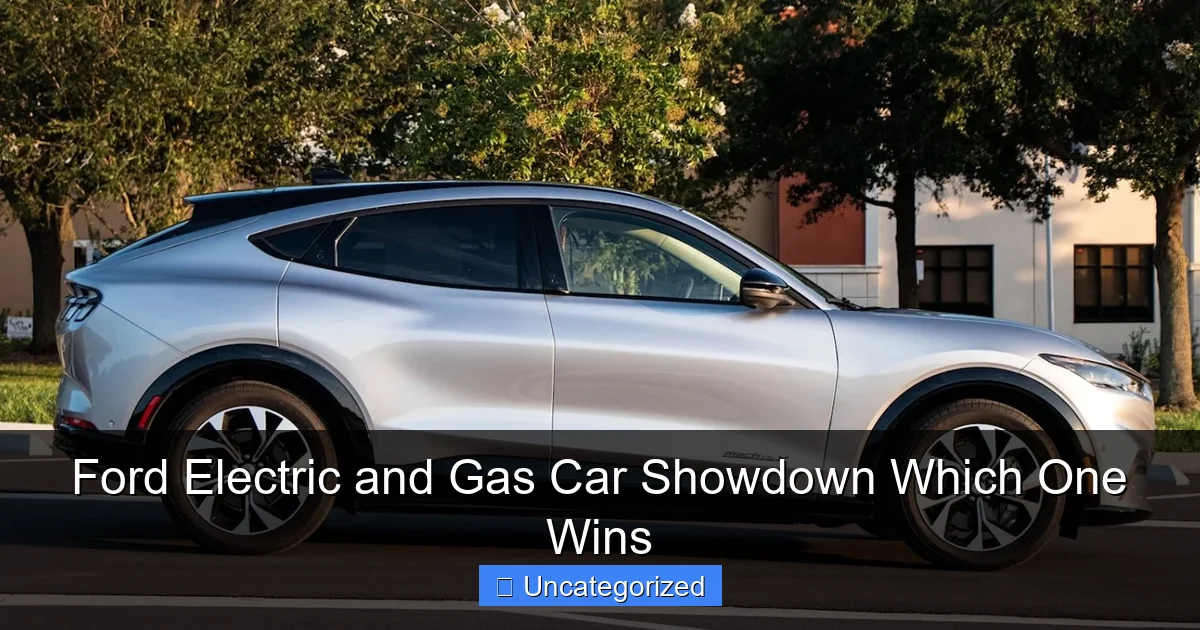
Featured image for ford electric and gas car
Image source: newfordmodel.com
Ford’s electric vehicles lead in innovation and long-term savings, offering instant torque, lower maintenance, and access to tax incentives, making them ideal for eco-conscious drivers. While gas-powered Fords still win on upfront cost and refueling convenience, the growing EV charging network and improved battery range are rapidly closing the gap—making the choice more about lifestyle than limitations.
Key Takeaways
- Electric wins on fuel costs: Lower long-term expenses with no gas needed.
- Gas offers longer range: Ideal for road trips without charging stops.
- EVs need charging infrastructure: Home or public charging access is essential.
- Gas cars depreciate faster: Electric models hold value longer in most cases.
- Maintenance favors EVs: Fewer moving parts mean less frequent repairs.
- Performance differs significantly: Electric delivers instant torque; gas offers traditional power.
📑 Table of Contents
- The Future of Ford: Electric vs. Gas Showdown
- Performance and Driving Experience: Power, Torque, and Feel
- Cost of Ownership: Upfront Price, Maintenance, and Long-Term Savings
- Environmental Impact: Emissions, Sustainability, and the Bigger Picture
- Technology and Innovation: Infotainment, Connectivity, and Smart Features
- Lifestyle Fit: Which Ford Matches Your Needs?
- Conclusion: The Verdict in the Ford Electric vs. Gas Showdown
The Future of Ford: Electric vs. Gas Showdown
The automotive world is undergoing a seismic shift, and Ford Motor Company stands at the epicenter of this transformation. For over a century, the iconic blue oval has symbolized American innovation, reliability, and performance—from the Model T to the F-150. But today, Ford faces its most pivotal decision yet: how to balance its rich legacy of gas-powered vehicles with the rising tide of electric vehicles (EVs). With climate concerns, government regulations, and consumer demand pushing automakers toward electrification, Ford has responded with bold investments in both worlds. The question now is not just which technology wins, but which Ford electric and gas car delivers the best value, performance, and long-term ownership experience.
As Ford rolls out models like the F-150 Lightning, Mustang Mach-E, and E-Transit alongside stalwarts like the F-150 V8, Explorer, and Edge, car buyers are caught in a crossroads. Do you embrace the silent torque and zero emissions of an electric Ford, or stick with the familiar roar of a gasoline engine? This comprehensive guide dives deep into the Ford electric and gas car showdown, comparing performance, cost of ownership, environmental impact, driving experience, technology, and real-world practicality. Whether you’re a daily commuter, a weekend adventurer, or a fleet manager, we’ll help you determine which side of the Ford lineup deserves your keys.
Performance and Driving Experience: Power, Torque, and Feel
Instant Torque vs. Linear Power Delivery
One of the most dramatic differences between Ford’s electric and gas vehicles lies in how power is delivered. Electric Fords like the Mustang Mach-E GT produce maximum torque the moment the accelerator is pressed. This results in neck-snapping acceleration—0 to 60 mph in under 4 seconds for the Mach-E GT Performance Edition. The F-150 Lightning delivers a staggering 775 lb-ft of torque, launching from 0 to 60 mph in around 4.5 seconds, outperforming many high-performance gas trucks.
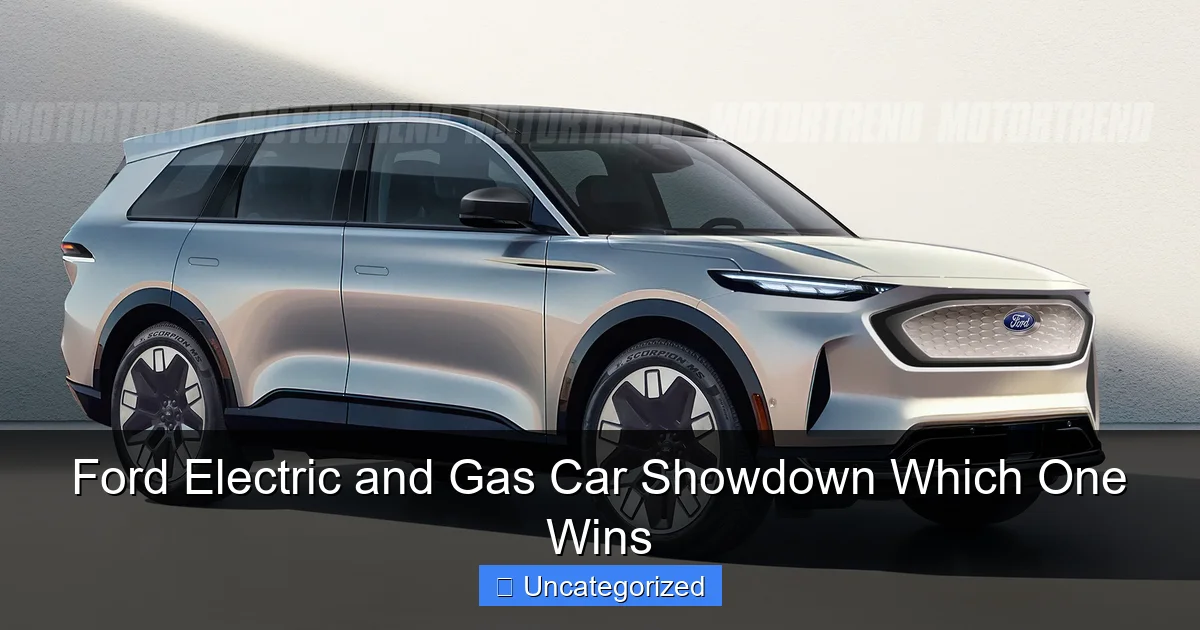
Visual guide about ford electric and gas car
Image source: motortrend.com
In contrast, gas-powered Fords rely on internal combustion engines (ICE) that build power through revving. The F-150 with the 3.5L PowerBoost Hybrid V6 offers 430 horsepower and 570 lb-ft of torque, with a smooth, linear power curve that many drivers find more predictable and engaging. The Explorer ST with its 3.0L EcoBoost V6 hits 60 mph in 5.2 seconds—impressive, but not instant.
Tip: If you value immediate responsiveness and a “push-you-back-into-the-seat” feel, an electric Ford is unmatched. But if you enjoy the sound, vibration, and progressive power buildup of a roaring engine, a gas-powered Ford may deliver more emotional satisfaction.
Handling, Weight Distribution, and Ride Quality
Electric Fords benefit from a low center of gravity due to battery placement under the floor. This improves cornering stability and reduces body roll. The Mustang Mach-E, for example, feels planted in turns, with precise steering and minimal understeer. The F-150 Lightning, despite its hefty 6,000+ lb curb weight, handles surprisingly well thanks to adaptive suspension and torque vectoring.
Gas-powered Fords, especially trucks and SUVs, have evolved significantly. The 2023 F-150 uses high-strength steel and aluminum to reduce weight while improving rigidity. The Explorer features a rear-biased AWD system and optional air suspension, offering a balanced ride. However, traditional ICE vehicles often have higher centers of gravity, which can affect agility.
Practical example: A driver navigating mountain roads in Colorado will appreciate the Mach-E’s low center of gravity and regenerative braking, while a rural hauler might prefer the F-150 V8’s towing stability and familiarity.
Driving Range and Refueling/Recharging Dynamics
Electric Fords currently offer competitive but not class-leading range. The F-150 Lightning delivers up to 320 miles (extended range), while the Mustang Mach-E ranges from 247 to 314 miles depending on configuration. The E-Transit offers 126–159 miles—ideal for urban delivery routes.
Gas-powered Fords dominate in range. A full tank in a F-150 can exceed 700 miles, and the Escape Hybrid achieves over 500 miles. Refueling takes 5–10 minutes at any gas station, while recharging an electric Ford requires planning. DC fast charging can replenish 15–80% in 40–60 minutes, but Level 2 (home or public) takes 8–12 hours.
Tip: For road trips or remote areas with sparse charging infrastructure, a gas or hybrid Ford remains the safer bet. For daily commutes under 40 miles, an electric Ford is more than sufficient.
Cost of Ownership: Upfront Price, Maintenance, and Long-Term Savings
Purchase Price and Incentives
Electric Fords typically carry a higher upfront cost than their gas counterparts. The F-150 Lightning starts at $54,995 (Standard Range), while the gas F-150 XL starts at $36,570—a $18,425 difference. The Mustang Mach-E starts at $43,895, compared to the gas Mustang GT at $43,090 (similar price but different value).
However, federal and state incentives can narrow the gap. The Inflation Reduction Act offers a $7,500 tax credit for qualifying EVs, including the Mach-E and F-150 Lightning (if assembled in the U.S. and meet battery sourcing criteria). Some states add $2,000–$5,000 in rebates. Gas-powered Fords are not eligible for most EV incentives.
Pro tip: Always check your state’s DMV website and the IRS EV tax credit portal. A $7,500 credit on a $55,000 Lightning drops the effective price to $47,500—much closer to the gas F-150’s price point.
Maintenance and Repair Costs
Electric vehicles are inherently lower maintenance. With fewer moving parts (no engine, transmission, exhaust, or oil), EVs eliminate oil changes, spark plug replacements, and timing belt services. Ford estimates that F-150 Lightning owners save $1,000 over five years on maintenance compared to gas trucks.
Gas-powered Fords require regular maintenance: oil changes every 7,500–10,000 miles, transmission fluid flushes, brake pad replacements (more frequent due to friction braking), and engine tune-ups. However, Ford’s 5-year/60,000-mile powertrain warranty and 3-year/36,000-mile bumper-to-bumper coverage provide peace of mind.
Real-world example: A fleet manager running 10 E-Transit vans reports a 30% reduction in downtime compared to gas Transits, primarily due to fewer service visits.
Fuel vs. Electricity: The Long-Term Math
Electricity is significantly cheaper per mile than gasoline. At $0.14/kWh and 3.5 miles/kWh (Mach-E efficiency), driving 15,000 miles annually costs about $600. The same miles in a gas F-150 (20 mpg) at $3.50/gallon cost $2,625—over four times more.
But electricity prices vary by region (e.g., $0.10 in Idaho vs. $0.30 in California), and home charging requires a Level 2 charger ($500–$1,500 installed). Gas prices are more volatile but universally accessible.
Data table: 5-Year Cost Comparison (15,000 miles/year)
| Cost Factor | F-150 Lightning (Electric) | F-150 XLT (Gas V6) |
|---|---|---|
| Upfront Price | $54,995 | $42,000 |
| Tax Credit (Federal) | $7,500 | $0 |
| Electricity Cost (5 years) | $3,000 | N/A |
| Gasoline Cost (5 years) | N/A | $13,125 |
| Maintenance (5 years) | $1,200 | $2,500 |
| Total 5-Year Cost | $51,695 | $57,625 |
Even with a higher sticker price, the F-150 Lightning saves over $6,000 in five years—electric wins on long-term cost.
Environmental Impact: Emissions, Sustainability, and the Bigger Picture
Tailpipe Emissions and Carbon Footprint
Electric Fords produce zero tailpipe emissions. Over a 150,000-mile lifespan, a Mach-E prevents approximately 45 tons of CO2 compared to a gas Mustang. The F-150 Lightning avoids 60+ tons versus a gas F-150.
However, EVs are not emission-free. Electricity generation (coal, natural gas, renewables) contributes to their “well-to-wheel” footprint. In coal-heavy regions (e.g., West Virginia), an EV’s carbon advantage is smaller. But in states with >50% renewable energy (e.g., Washington, California), EVs are 70–80% cleaner.
Tip: Pair your electric Ford with a home solar system or green energy plan to maximize environmental benefits.
Battery Production and Recycling
EV batteries require lithium, cobalt, and nickel—minerals linked to environmental degradation and ethical concerns. Ford is investing in battery recycling through its BlueOval SK joint venture. The company aims to recycle 95% of battery materials by 2030.
Gas vehicles rely on steel, aluminum, and petroleum—also resource-intensive, but with established recycling chains. ICE engines last 200,000+ miles with proper maintenance, while EV batteries typically degrade 10–20% over a decade.
Ford’s commitment: The automaker plans to use 100% renewable energy in global manufacturing by 2035 and achieve carbon neutrality by 2050.
Lifecycle Analysis: Which Is Truly Greener?
A lifecycle analysis (manufacturing, use, disposal) shows that after 12,000–15,000 miles, EVs break even with gas cars in carbon emissions. After 50,000 miles, EVs are clearly superior. By 100,000 miles, an electric Ford emits 50% less CO2 than a gas counterpart.
For drivers who keep vehicles 10+ years, electric is the greener choice. For short-term owners (<3 years), the environmental benefit is less pronounced.
Technology and Innovation: Infotainment, Connectivity, and Smart Features
Ford SYNC and Infotainment Systems
All new Fords feature the SYNC 4 or SYNC 4A system, with 12–15″ touchscreens, wireless Apple CarPlay/Android Auto, and over-the-air (OTA) updates. Electric Fords, however, often get enhanced software:
- F-150 Lightning: “Intelligent Range” predicts battery life based on weather, terrain, and driving habits.
- Mustang Mach-E: “One Pedal Driving” mode and “Phone As A Key” technology.
- E-Transit: Fleet-focused telematics for route optimization and energy usage.
Gas-powered Fords offer similar tech but lack EV-specific features like vehicle-to-load (V2L)—the F-150 Lightning can power tools, homes, or even charge another EV.
Driver Assistance and Safety
Ford’s Co-Pilot360 suite is standard on most models, including:
- Pre-Collision Assist with AEB
- Lane-Keeping System
- Blind Spot Monitoring
Electric Fords often include BlueCruise 1.2, a hands-free highway driving system (available on Lightning and Mach-E). Gas models offer it as an option, typically at $1,995 extra.
Practical example: A driver on I-95 can enable BlueCruise in their Mach-E, reducing fatigue during a 200-mile commute—a feature not standard on gas Fords.
Charging Infrastructure and Smart Integration
Ford’s FordPass app integrates with BlueOval Charge Network, giving EV owners access to 100,000+ public chargers (including 800+ DC fast chargers). The app shows real-time charger availability, pricing, and route planning.
Gas Fords rely on traditional fuel station networks, but Ford offers FordPay for contactless fuel payments at participating stations. No “charging anxiety” here—just drive in, fill up, and go.
Lifestyle Fit: Which Ford Matches Your Needs?
Urban Commuters and City Drivers
For city dwellers with short commutes and access to home/work charging, electric Fords are ideal. The Mustang Mach-E offers 314 miles of range, compact size for parking, and low noise pollution. The E-Transit suits delivery drivers with predictable routes and overnight charging.
Gas Fords like the Escape Hybrid or Edge are viable alternatives if charging is inconvenient. Hybrids offer 40+ mpg in city driving with no range anxiety.
Adventurers and Road Trippers
For off-roading, towing, or cross-country trips, gas-powered Fords still dominate. The F-150 Raptor (gas) can tow 14,000 lbs and handle rugged terrain, while the Lightning maxes out at 10,000 lbs and requires careful charging planning.
The Expedition (gas) seats 8, offers 9,300 lbs towing, and has a 720-mile range—perfect for family road trips. The Explorer Hybrid strikes a balance, with 5,000 lbs towing and 500+ mile range.
Fleet Operators and Business Owners
Electric Fords shine in commercial use. The E-Transit saves $10,000+ over five years in fuel and maintenance per vehicle. Municipalities and delivery services benefit from lower operating costs and zero emissions.
Gas Fords like the Transit-350 HD remain better for high-mileage, long-haul routes without reliable charging.
Conclusion: The Verdict in the Ford Electric vs. Gas Showdown
The Ford electric and gas car debate isn’t about one technology being universally superior—it’s about matching the right vehicle to your lifestyle. For long-term cost savings, environmental impact, and cutting-edge tech, electric Fords like the F-150 Lightning and Mustang Mach-E are the future. They offer instant performance, lower maintenance, and a quiet, smooth ride that transforms daily driving into a premium experience. With federal incentives and plummeting battery costs, the upfront price gap is shrinking fast.
But for drivers who value range, towing capacity, off-road capability, or simply the visceral feel of a roaring engine, gas-powered Fords like the F-150, Explorer, and Mustang GT remain compelling choices. They’re battle-tested, widely supported, and perfect for adventures beyond the city limits.
The winner? It depends on you. If you drive under 50 miles daily, have access to charging, and prioritize sustainability and tech, go electric. If you tow heavy loads, take frequent road trips, or live in a rural area, stick with gas. And don’t forget Ford’s hybrid options—the F-150 PowerBoost and Escape Hybrid—which offer the best of both worlds.
Ford’s dual strategy—investing in both electric and gas—reflects a pragmatic vision: the future isn’t one-size-fits-all. By embracing innovation while honoring its legacy, Ford ensures that no matter your needs, there’s a blue oval ready to take you forward. The showdown isn’t over—it’s just getting started.
Frequently Asked Questions
What are the main differences between Ford electric and gas car models?
Ford electric cars, like the Mustang Mach-E and F-150 Lightning, run on battery power with zero emissions, while gas models like the Ford Explorer or F-150 use internal combustion engines. Electric vehicles offer lower long-term fuel costs, while gas cars typically have longer range and faster refueling times.
Is a Ford electric car more expensive than a gas car?
Upfront costs for Ford electric vehicles are often higher due to battery technology, but federal/state incentives and lower maintenance can offset the price difference over time. Gas-powered Ford models generally have lower purchase prices but higher fuel and maintenance expenses.
How does charging a Ford electric car compare to refueling a gas car?
Charging a Ford EV at home or public stations takes longer (30 minutes to 12+ hours) than filling a gas tank (5-10 minutes). However, EV owners can “refuel” overnight at home, avoiding gas station visits entirely.
Which Ford vehicle has better long-term value: electric or gas?
Ford electric and gas car models each have advantages: EVs save money on fuel and maintenance, while gas cars depreciate slower in some markets. Resale value depends on location, battery health (for EVs), and shifting fuel prices.
Can Ford electric cars handle cold weather as well as gas models?
Ford electric vehicles experience reduced range in extreme cold (up to 30-40%), but newer models include heat pumps and battery preconditioning to mitigate this. Gas cars are less affected by cold but have lower fuel efficiency in winter.
What Ford models offer both electric and gas car options?
The Ford F-150 and Escape are available in both electric (F-150 Lightning, Escape Plug-In Hybrid) and traditional gas/hybrid variants. This lets buyers choose based on driving habits, budget, and charging access.