Ford Electric Car Charge Time How Fast Can You Recharge
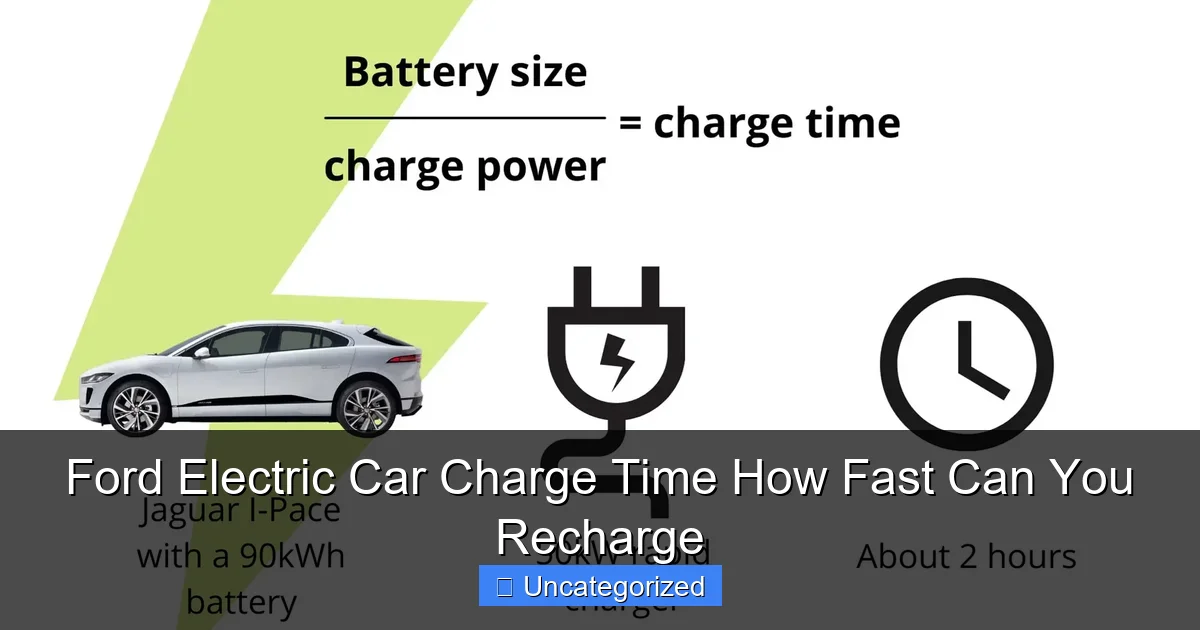
Featured image for ford electric car charge time
Image source: car-images.bauersecure.com
Ford electric car charge time ranges from 30 minutes for a 10-80% fast charge using DC stations to 8-12 hours with Level 2 home charging, depending on the model and battery size. Mustang Mach-E and F-150 Lightning offer flexible options, with extended-range variants gaining up to 50 miles in just 10 minutes at peak charging speeds—ideal for road trips and daily use.
Key Takeaways
- Ford EVs charge fastest with DC fast charging: Replenish 80% in 30-45 minutes.
- Home charging takes 8-12 hours: Use Level 2 for overnight convenience.
- Charge speed varies by model: Mustang Mach-E and F-150 Lightning differ significantly.
- Plan trips using FordPass app: Locate fast chargers and estimate charging stops.
- Precondition the battery for faster charging: Activate via app in cold weather.
- Public Level 2 chargers take 4-6 hours: Ideal for workplaces or shopping centers.
📑 Table of Contents
- The Future of Driving: Charging Your Ford Electric Vehicle
- Understanding Charging Levels: Level 1, Level 2, and DC Fast Charging
- Ford Electric Car Charge Time by Model: A Detailed Breakdown
- Factors That Influence Charging Speed
- Optimizing Your Charging Routine: Tips and Best Practices
- Comparing Ford EVs to the Competition: Charging Time Benchmark
- Conclusion: Charging Into the Future with Ford
The Future of Driving: Charging Your Ford Electric Vehicle
The transition to electric vehicles (EVs) is no longer a distant dream; it’s a reality that’s unfolding at an accelerating pace. Among the pioneers of this revolution is Ford, a brand synonymous with American automotive innovation. As Ford’s electric lineup—including the Mustang Mach-E, F-150 Lightning, and the upcoming Explorer Electric—continues to expand, one question remains at the forefront of every potential buyer’s mind: How fast can you recharge a Ford electric car?
Understanding the nuances of Ford electric car charge time is critical for both new adopters and seasoned EV enthusiasts. Charging speed isn’t just about convenience—it impacts road trip planning, daily commutes, and even the overall value proposition of an electric vehicle. With advancements in battery technology, charging infrastructure, and onboard charging systems, Ford is pushing the boundaries of what’s possible. In this comprehensive guide, we’ll explore the factors that influence charging times, break down real-world examples, and provide practical tips to help you get the most out of your Ford EV. Whether you’re considering your first electric Ford or looking to optimize your current charging routine, this article will equip you with the knowledge you need to drive confidently into the electric future.
Understanding Charging Levels: Level 1, Level 2, and DC Fast Charging
Level 1 Charging: The Slow and Steady Option
Level 1 charging is the most basic form of EV charging, using a standard 120-volt household outlet. It’s the default option for many new EV owners because it requires no additional equipment—simply plug the included portable charger into any regular wall socket. However, when it comes to Ford electric car charge time, Level 1 is the slowest method available.
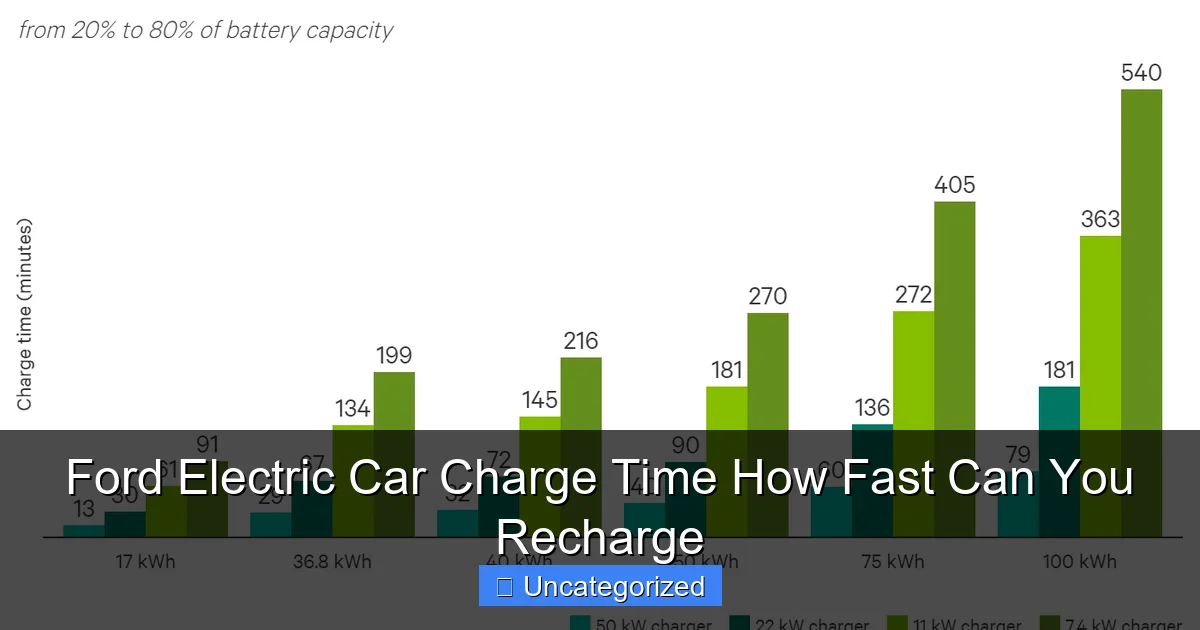
Visual guide about ford electric car charge time
Image source: res.cloudinary.com
- Typical charge rate: 2–5 miles of range per hour
- Full charge (from 0% to 100%): Up to 40–50 hours for a 300-mile-range model like the F-150 Lightning
- Best for: Overnight charging at home, short daily commutes, or as a backup option
For example, if your Mustang Mach-E has a 70 kWh battery and you’re only driving 20 miles a day, Level 1 might suffice. But for anything more demanding, it quickly becomes impractical. Ford includes a Level 1 cord with all its EVs, but most owners upgrade to Level 2 for faster and more efficient charging.
Level 2 Charging: The Sweet Spot for Daily Use
Level 2 charging operates at 240 volts—the same as a household dryer or electric oven—and is the recommended method for home and workplace charging. Most Ford EV owners install a Level 2 charger (like the Ford Connected Charge Station) in their garage or driveway.
- Typical charge rate: 20–30 miles of range per hour
- Full charge (0–100%): 8–12 hours, depending on battery size and charger output (7.4 kW vs. 11.5 kW)
- Best for: Overnight charging, daily top-ups, and consistent home charging
Let’s say you have an F-150 Lightning with a 131 kWh extended-range battery. With a 9.6 kW Level 2 charger (common for home installations), you can expect a full charge in about 14 hours. But with a 19.2 kW-capable charger (supported by Ford’s 80-amp station), that time drops to around 7–8 hours. This makes Level 2 the ideal balance between speed, cost, and convenience for most Ford EV owners.
DC Fast Charging (Level 3): Speed for Long Journeys
When time is of the essence—especially on road trips—DC fast charging (Level 3) is your best friend. Unlike Level 1 and Level 2, which convert AC power to DC in the car, DC fast chargers deliver direct current straight to the battery, enabling much faster charging.
- Typical charge rate: 100–200+ miles of range in 30 minutes
- Charge time (10–80%): 20–40 minutes, depending on the charger and vehicle
- Best for: Long-distance travel, quick top-ups, and public charging
Ford EVs support CCS (Combined Charging System) connectors, which are widely available across North America. The Mustang Mach-E can charge at up to 150 kW, while the F-150 Lightning supports up to 155 kW. On a 350 kW DC fast charger, both can add over 50 miles in just 10 minutes. However, it’s important to note that charging slows significantly above 80% to protect battery health.
Ford Electric Car Charge Time by Model: A Detailed Breakdown
Mustang Mach-E: Sporty Performance Meets Efficient Charging
The Ford Mustang Mach-E is one of Ford’s most popular electric SUVs, offering a blend of performance, style, and range. Available in several configurations (Standard, Extended Range, GT), the Mach-E’s charging times vary based on battery size and charger type.
- Standard Range (70 kWh battery):
- Level 2 (11.5 kW): ~7–8 hours (0–100%)
- DC Fast (150 kW): ~38 minutes (10–80%)
- Extended Range (91 kWh battery):
- Level 2 (11.5 kW): ~9–10 hours (0–100%)
- DC Fast (150 kW): ~42 minutes (10–80%)
Real-world example: On a road trip from Chicago to Indianapolis (~180 miles), a Mach-E with 80% charge (approx. 220 miles of range) can reach its destination with minimal stress. If needed, a 30-minute DC fast charge at a nearby Electrify America station can add ~120 miles of range—more than enough for a comfortable arrival.
F-150 Lightning: Power and Practicality for Work and Play
The F-150 Lightning redefines what a pickup truck can be, combining Ford’s legendary durability with all-electric power. With two battery options—Standard (98 kWh) and Extended Range (131 kWh)—charging times reflect its larger capacity.
- Standard Range (98 kWh):
- Level 2 (11.5 kW): ~9–10 hours (0–100%)
- DC Fast (150 kW): ~41 minutes (10–80%)
- Extended Range (131 kWh):
- Level 2 (11.5 kW): ~12–13 hours (0–100%)
- DC Fast (150 kW): ~50 minutes (10–80%)
Tip: The F-150 Lightning supports vehicle-to-everything (V2X) capabilities, including powering your home during outages. When charging, consider using off-peak hours to reduce electricity costs and maximize efficiency.
Future Models: Explorer Electric and Beyond
While the Explorer Electric hasn’t launched yet, Ford has confirmed it will support 19.2 kW Level 2 charging and 200 kW DC fast charging, setting a new benchmark for mid-size electric SUVs. Based on Ford’s current platform (GE2), we can expect:
- Level 2 (19.2 kW): ~6–7 hours (0–100%) for a 100 kWh battery
- DC Fast (200 kW): ~25–30 minutes (10–80%)
This represents a significant improvement over current models, reducing Ford electric car charge time even further and enhancing long-distance usability.
Factors That Influence Charging Speed
Battery State of Charge (SoC) and Charging Curves
One of the most critical—and often misunderstood—factors affecting Ford electric car charge time is the charging curve. Unlike gasoline, which flows at a consistent rate, EV batteries charge fastest at lower states of charge and slow down as they approach 80–100%.
- At 10–20% SoC: Charging is near peak speed (e.g., 150 kW for Mach-E)
- At 50–60% SoC: Charging rate drops to ~70–90 kW
- At 80–100% SoC: Charging slows dramatically to ~20–30 kW to prevent battery degradation
Why does this matter? Because a 10–80% charge is much faster than a 10–100% charge. For example, the F-150 Lightning might take 50 minutes to go from 10% to 80% on a 150 kW charger, but the final 20% could take another 30–40 minutes. Smart charging strategies focus on topping up to 80–90% for daily use.
Ambient Temperature and Battery Thermal Management
Temperature plays a huge role in charging efficiency. Cold batteries charge slower because lithium-ion cells are less reactive in low temperatures. Ford EVs use advanced battery thermal management systems to maintain optimal temperature, but extreme cold still impacts performance.
- In sub-zero conditions (below 0°C / 32°F): DC fast charging can be 20–30% slower
- Preconditioning the battery (via the FordPass app) before a fast charge can restore up to 50% of lost speed
- High temperatures (above 35°C / 95°F) can also trigger thermal throttling to protect the battery
Tip: If you’re planning a winter road trip, use the FordPass app to precondition your battery while still plugged in at home. This ensures the battery is at the ideal temperature when you reach a fast charger, minimizing Ford electric car charge time.
Charger Power and Network Compatibility
Not all DC fast chargers are created equal. A 350 kW charger might sound impressive, but your Ford EV can only accept up to 150–155 kW. Additionally, charger reliability and network uptime matter.
- Electrify America: Most reliable network for Ford EVs; supports CCS and offers Ford owners free charging for a limited time
- EVgo and ChargePoint: Widely available but may have lower uptime in rural areas
- Third-party chargers: Always check compatibility—some older chargers use CHAdeMO (not supported by Ford)
Real-world data: A 2023 study found that Ford EVs charge 10–15% faster on Electrify America chargers compared to older EVgo units due to better maintenance and higher power output consistency.
Optimizing Your Charging Routine: Tips and Best Practices
Home Charging: Setting Up a Smart System
For most Ford EV owners, home charging is the backbone of their routine. To minimize Ford electric car charge time and maximize efficiency:
- Install a Ford Connected Charge Station (19.2 kW): This is Ford’s fastest Level 2 option, cutting charging time by up to 30% compared to standard 11.5 kW units.
- Use off-peak electricity rates: Schedule charging between 10 PM and 6 AM to take advantage of lower utility costs.
- Enable battery preconditioning: Set your departure time in the FordPass app so the battery is warm and ready to charge when you plug in.
Example: A Mach-E owner in California schedules charging from 11 PM to 5 AM. The car charges at 19.2 kW, reaching 90% by morning—ready for a 150-mile commute with no range anxiety.
On-the-Road Charging: Planning for Long Trips
Long-distance travel requires a strategic approach to charging. Use tools like:
- FordPass App: Shows real-time charger availability, power output, and estimated charging time
- PlugShare and A Better Routeplanner (ABRP): Help plan trips with charging stops based on your vehicle and driving style
- Ford BlueCruise (on select models): Allows hands-free driving, reducing fatigue on long stretches
Pro tip: Aim to charge from 10% to 80% at each stop. This minimizes dwell time and keeps your battery in a healthy range. On a 500-mile trip, you might only need 2–3 charging stops, each lasting 25–35 minutes.
Maintaining Battery Health for Long-Term Performance
Frequent fast charging can degrade battery capacity over time. To preserve your Ford EV’s range:
- Limit DC fast charging to 1–2 times per week unless necessary
- Keep SoC between 20% and 80% for daily use; reserve 100% charges for road trips
- Use Ford’s battery health monitoring tools in the app to track degradation
Studies show that EVs charged primarily with Level 2 lose only 5–10% of capacity after 100,000 miles, compared to 15–20% for those using DC fast charging daily.
Comparing Ford EVs to the Competition: Charging Time Benchmark
How does Ford electric car charge time stack up against rivals like Tesla, Chevrolet, and Hyundai? Let’s compare key models using a standardized 10–80% DC fast charge metric:
| Vehicle | Battery Size (kWh) | Max DC Charge Rate (kW) | 10–80% Charge Time (min) | Range (EPA) |
|---|---|---|---|---|
| Ford F-150 Lightning (Ext. Range) | 131 | 155 | 50 | 320 miles |
| Ford Mustang Mach-E (Ext. Range) | 91 | 150 | 42 | 314 miles |
| Tesla Model Y (Long Range) | 75 | 250 | 25 | 330 miles |
| Chevrolet Silverado EV | 170 | 350 | 40 | 400 miles |
| Hyundai Ioniq 5 | 77.4 | 350 | 18 | 303 miles |
While Ford doesn’t lead in peak charge rate, its real-world performance is competitive. The F-150 Lightning’s 50-minute 10–80% time is impressive for a large truck, and the Mach-E’s 42-minute charge is on par with most SUVs. Additionally, Ford’s integration with Electrify America gives owners access to a reliable and expanding fast-charging network.
Conclusion: Charging Into the Future with Ford
Ford electric car charge time is no longer a barrier to adoption—it’s a manageable, even convenient, part of the EV experience. With a clear understanding of charging levels, model-specific capabilities, and smart charging strategies, Ford owners can enjoy the benefits of electric driving without sacrificing time or convenience. From the Mustang Mach-E’s sporty efficiency to the F-150 Lightning’s rugged versatility, Ford is proving that electric doesn’t mean slow.
As battery technology improves and charging infrastructure expands, we can expect even faster Ford electric car charge times in the coming years. The upcoming Explorer Electric and next-generation F-Series EVs will likely push the envelope further, offering 200+ kW charging and ultra-fast home stations. But for now, the tools are already in your hands: a reliable home charger, a growing network of fast chargers, and a suite of smart features in the FordPass app.
The future of driving is electric, and with Ford leading the charge, that future is faster, cleaner, and more accessible than ever. Whether you’re charging overnight at home or topping up on a cross-country adventure, one thing is clear—your Ford EV is always ready to go the distance.
Frequently Asked Questions
How long does it take to fully charge a Ford electric car?
Ford electric car charge time varies by model and charger type. Most models, like the Mustang Mach-E and F-150 Lightning, take 8–14 hours on a Level 2 (240V) charger for a full charge.
What’s the fastest way to recharge a Ford EV?
Using a DC fast charger (Level 3), you can recharge a Ford electric car to 80% in 30–45 minutes. This is ideal for road trips, as it minimizes downtime compared to slower charging methods.
Can I reduce Ford electric car charge time at home?
Yes, installing a Level 2 home charging station can significantly cut charge time versus a standard 120V outlet. A 240V charger delivers 25–35 miles of range per hour, making daily charging much more convenient.
Does Ford offer free charging or fast-charging networks?
Ford partners with Electrify America to provide complimentary DC fast charging for new EV purchases. This includes access to over 3,500 fast chargers across the U.S., streamlining long-distance travel.
How does weather affect Ford electric car charge time?
Cold temperatures can slow charging speeds by 20–30% due to battery chemistry. Preconditioning your EV while plugged in helps maintain optimal charge rates in winter conditions.
What’s the difference between Ford electric car charge times for SUVs vs. trucks?
The F-150 Lightning (truck) typically charges slower than the Mustang Mach-E (SUV) due to its larger battery. For example, the Lightning gains ~15 miles/minute on a DC fast charger, while the Mach-E achieves ~20 miles/minute.