Ford Electric Car Distance How Far Can It Go on a Single Charge
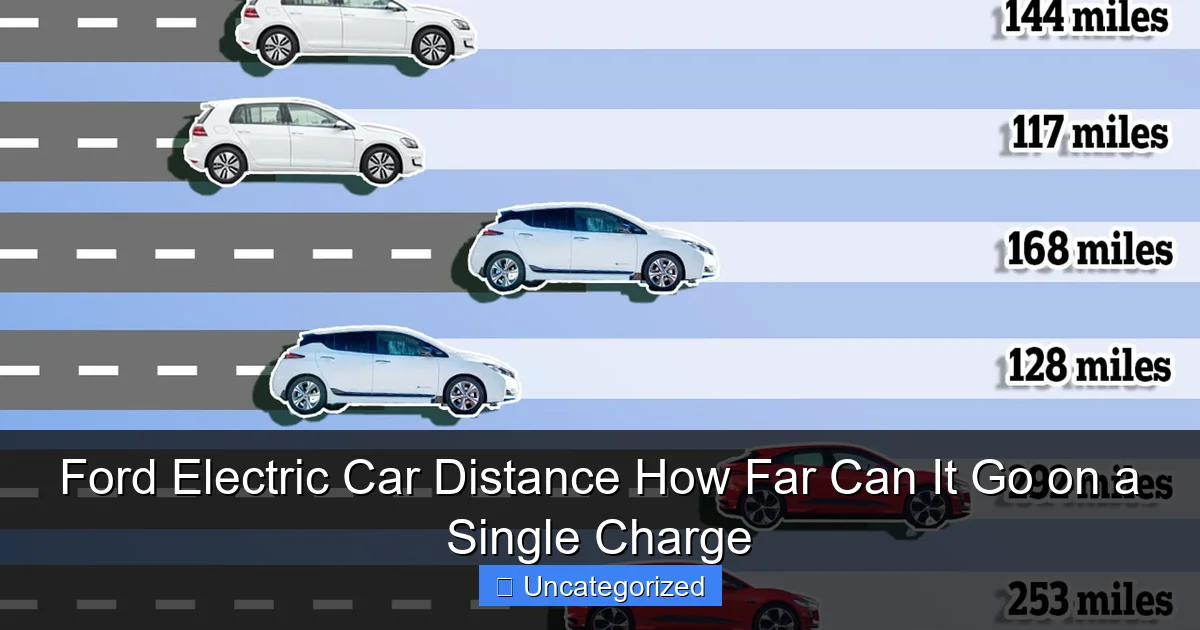
Featured image for ford electric car distance
Image source: electriccarspedia.com
Ford electric cars can travel up to 300–320 miles on a single charge, with models like the Mustang Mach-E and F-150 Lightning offering competitive range for daily commutes and road trips. Real-world performance depends on driving habits, terrain, and weather, but Ford’s efficient battery tech ensures reliable distance across its EV lineup.
Key Takeaways
- Range varies by model: Choose Ford EVs based on your daily distance needs.
- F-150 Lightning leads: Up to 320 miles on a single charge.
- E-Transit excels commercially: Delivers 159 miles ideal for urban routes.
- Charging speed matters: Use DC fast charging for quick top-ups on long trips.
- Real-world factors affect range: Temperature, terrain, and driving style impact distance.
- Plan trips with FordPass: Access charging stations and route planning tools easily.
📑 Table of Contents
- The Future of Driving: How Far Can Ford Electric Cars Go?
- Understanding Ford Electric Car Range: What You Need to Know
- Ford Electric Car Lineup: Range Comparison and Real-World Performance
- Maximizing Your Ford Electric Car Distance: Proven Tips and Strategies
- Charging Infrastructure and Range Confidence: How Ford Supports Long-Distance Travel
- Comparing Ford Electric Car Distance to Competitors
- Conclusion: Ford Electric Car Distance—Ready for the Road Ahead
The Future of Driving: How Far Can Ford Electric Cars Go?
In an era where sustainability and efficiency are no longer optional but essential, Ford has stepped boldly into the electric vehicle (EV) arena with a lineup designed to meet the demands of modern drivers. As the automotive world shifts from internal combustion engines to battery-powered alternatives, one of the most pressing questions remains: how far can a Ford electric car go on a single charge? For many potential buyers, range anxiety—the fear of running out of power mid-journey—is a significant barrier to adopting EVs. Ford understands this concern and has responded with innovative battery technology, intelligent energy management systems, and real-world range performance that rivals or surpasses competitors.
From the sporty Mustang Mach-E to the rugged F-150 Lightning, Ford’s electric vehicles are engineered to deliver impressive distances on a single charge, tailored to different lifestyles and driving needs. Whether you’re commuting daily, embarking on cross-country road trips, or using your EV for work, understanding the Ford electric car distance capabilities is crucial to making an informed decision. In this comprehensive guide, we’ll explore the real-world range of Ford’s electric fleet, the factors that influence it, and practical tips to maximize your driving distance. We’ll also compare Ford’s offerings with industry benchmarks and highlight what sets them apart in the growing EV market.
Understanding Ford Electric Car Range: What You Need to Know
When discussing Ford electric car distance, it’s important to distinguish between EPA-estimated range and real-world performance. The U.S. Environmental Protection Agency (EPA) provides standardized range estimates under controlled conditions, but actual driving distance can vary significantly based on multiple factors. Ford’s EVs are designed to deliver close-to-advertised or even exceed EPA ratings in many scenarios, thanks to advanced battery chemistry, regenerative braking, and efficient powertrains.
EPA vs. Real-World Range: Bridging the Gap
The EPA range is a useful starting point, but it’s not the final word. For example, the 2023 Ford Mustang Mach-E Premium AWD has an EPA-estimated range of 260 miles, but many owners report achieving 240–270 miles depending on driving habits. Similarly, the F-150 Lightning Lariat with the extended-range battery is rated at 320 miles, but in real-world highway driving at 70 mph, users often see 280–300 miles. The discrepancy arises because EPA tests include city, highway, and mixed driving cycles under optimal conditions (moderate temperatures, flat terrain, minimal accessories).
To get a more accurate picture, Ford encourages drivers to use its FordPass App, which tracks actual energy consumption and provides personalized range estimates based on your driving patterns. This tool helps reduce range anxiety by offering a realistic projection of how far you can go before needing to recharge.
Key Factors That Influence Ford Electric Car Distance
- Speed and Driving Style: Aggressive acceleration and high speeds (above 65 mph) significantly reduce range due to increased aerodynamic drag and energy demand. Smooth, moderate driving can boost efficiency by up to 20%.
- Climate and Weather: Cold temperatures (below 40°F) can reduce battery efficiency by 20–40% due to increased energy needed for cabin heating and battery thermal management. Conversely, extreme heat also affects battery performance.
- Terrain: Hilly or mountainous routes require more energy for climbing, while regenerative braking can partially recover energy on descents.
- Accessories and Load: Using the heater, AC, seat warmers, infotainment, or carrying heavy cargo reduces available range. For every 100 lbs of added weight, range drops by approximately 1–2%.
- Tire Pressure and Type: Under-inflated tires increase rolling resistance, decreasing efficiency. Ford recommends checking tire pressure monthly to maintain optimal range.
By understanding these variables, Ford EV owners can make informed decisions to maximize their Ford electric car distance and plan trips more effectively.
Ford Electric Car Lineup: Range Comparison and Real-World Performance
Ford currently offers two primary electric vehicles—the Mustang Mach-E and the F-150 Lightning—each with multiple trims and battery options. Let’s dive into the specific range capabilities of each model and how they perform in real-world conditions.
Mustang Mach-E: Sporty Efficiency with Impressive Range
The Mustang Mach-E is Ford’s answer to the Tesla Model Y and other premium compact electric SUVs. It comes in several trims: Select, Premium, GT, and the high-performance Mach-E GT Performance Edition. The range varies significantly depending on battery size and drivetrain.
- Select RWD (Standard Range): 247 miles (EPA)
- Select AWD (Standard Range): 224 miles (EPA)
- Premium RWD (Extended Range): 310 miles (EPA)
- Premium AWD (Extended Range): 260 miles (EPA)
- Mach-E GT (Extended Range AWD): 270 miles (EPA)
- Mach-E GT Performance Edition: 260 miles (EPA)
Real-World Example: A Mach-E Premium RWD owner in California reports achieving 295 miles on a single charge during a mixed driving trip (60% highway, 40% city) with mild temperatures and minimal HVAC use. In contrast, during a winter drive in Colorado with snow and frequent heater use, the same driver saw range drop to 210 miles—a 29% reduction.
The Mach-E also features One-Pedal Driving, which uses regenerative braking to recover energy and extend range. Drivers who master this technique often report 5–10% higher efficiency on city roads.
F-150 Lightning: Power Meets Practicality
The F-150 Lightning is Ford’s electric version of America’s best-selling pickup truck. It’s available in four trims: Pro, XLT, Lariat, and Platinum, with two battery options: standard and extended range.
- Pro & XLT (Standard Range): 240 miles (EPA)
- Lariat & Platinum (Extended Range): 320 miles (EPA)
Real-World Example: A construction contractor in Texas uses his F-150 Lightning Lariat for daily site visits (80 miles round-trip) and occasional towing. Without towing, he averages 295 miles per charge. When towing a 5,000-lb trailer at 60 mph, range drops to 180 miles—about 40% less than EPA. However, Ford’s Intelligent Range system recalculates range dynamically based on payload, speed, and terrain, helping drivers plan stops accurately.
The Lightning also includes Pro Power Onboard, a mobile generator that can power tools, appliances, or even a home during outages. While using this feature reduces driving range (by up to 20 miles per hour of usage), it adds unmatched utility for work and emergency scenarios.
Upcoming Models: Ford E-Transit and Beyond
Ford is expanding its electric lineup with the E-Transit, an all-electric cargo van with a range of 126 miles (EPA). While shorter than passenger EVs, this range is sufficient for most urban delivery routes. Ford also plans to launch a compact electric SUV (codenamed “Project T3”) with a target range of over 350 miles by 2025, signaling its commitment to long-distance electric mobility.
Maximizing Your Ford Electric Car Distance: Proven Tips and Strategies
Getting the most out of your Ford EV isn’t just about the battery—it’s about how you drive and maintain it. With a few smart habits, you can significantly extend your Ford electric car distance and reduce charging frequency.
Optimize Your Driving Style
- Smooth Acceleration and Braking: Avoid rapid starts and hard stops. Use One-Pedal Driving (available on Mach-E and Lightning) to let regenerative braking slow the vehicle naturally.
- Maintain Steady Speeds: Use cruise control on highways to minimize speed fluctuations. Driving at 65 mph instead of 75 mph can increase range by 10–15%.
- Anticipate Traffic: Look ahead and coast when possible. This reduces energy waste and maximizes regenerative braking.
Manage Climate Control Efficiently
Heating and cooling are major energy consumers. To save range:
- Use seat heaters instead of the cabin heater in cold weather—they use less energy and warm you directly.
- Precondition the cabin while the car is still plugged in. This uses grid power, not battery power, to heat or cool the interior before departure.
- Set the HVAC to Eco Mode (available in Ford EVs) to reduce energy usage.
- Use the FordPass App to schedule preconditioning during off-peak hours when electricity rates are lower.
Maintain Your Vehicle for Peak Efficiency
- Check Tire Pressure Monthly: Ford recommends 38–40 psi for most models. Low pressure increases rolling resistance.
- Keep the Battery Cool: Park in the shade or use a sunshade in hot climates. Overheating reduces battery efficiency and lifespan.
- Limit Fast Charging: While convenient, frequent DC fast charging (over 80% of the time) can degrade battery health over time. Use Level 2 charging (240V) for daily use.
- Use Regen Wisely: Adjust regenerative braking levels via the touchscreen. Higher regen settings recover more energy but may feel jerky—find a balance for your driving style.
Plan Charging Stops Strategically
Use the FordPass App or in-car navigation to find charging stations along your route. The system calculates range based on current conditions and suggests optimal stops. For long trips:
- Charge to 80–90% before departure (full charge isn’t necessary and slows charging speed).
- Stop every 200–250 miles to recharge while resting or eating.
- Use Ford BlueOval Charge Network, which includes over 100,000 charging points across North America, many of which are DC fast chargers.
Charging Infrastructure and Range Confidence: How Ford Supports Long-Distance Travel
Range is only half the equation—charging availability and speed are equally important for long-distance EV travel. Ford has invested heavily in making charging accessible, fast, and stress-free.
Ford’s Charging Ecosystem: BlueOval Charge Network
Ford EV owners get access to the BlueOval Charge Network, a partnership with Electrify America, ChargePoint, and others. Key benefits include:
- Over 100,000 charging points across the U.S. and Canada.
- DC fast charging at up to 150 kW (for Mach-E and Lightning), adding up to 61 miles of range in 10 minutes.
- Plug & Charge technology: Automatically authorizes and pays for charging when you plug in—no app or card needed.
- FordPass Rewards: Earn points for charging that can be redeemed for free charging or vehicle services.
For example, a Mach-E driver on a 500-mile trip from Chicago to Detroit can use the Ford navigation system to plan stops at Electrify America stations every 200 miles, with each 15-minute charge adding enough range to reach the next stop.
Home Charging: The Foundation of EV Ownership
Most Ford EV owners charge at home overnight using a Ford Connected Charge Station (Level 2, 240V). This station:
- Charges a Mach-E from 10% to 80% in about 8 hours.
- Charges an F-150 Lightning from 10% to 100% in about 10 hours (with extended-range battery).
- Integrates with the FordPass App for scheduling, monitoring, and energy usage tracking.
Ford also offers free installation support through its network of certified electricians, making home charging setup simple and affordable.
Workplace and Public Charging
Many employers now offer Level 2 charging at workplaces. Ford encourages this by providing resources for businesses to install chargers. Additionally, Ford EVs are compatible with most public charging networks, and the FordPass App shows real-time availability, pricing, and compatibility.
Comparing Ford Electric Car Distance to Competitors
How does Ford stack up against other major EV brands like Tesla, Chevrolet, and Hyundai? Let’s compare key models in the same categories.
Compact SUVs: Mach-E vs. Tesla Model Y vs. Hyundai Ioniq 5
| Model | EPA Range (Miles) | Real-World Range (Avg.) | DC Fast Charging Speed |
|---|---|---|---|
| Ford Mustang Mach-E Premium AWD (Extended Range) | 260 | 240–270 | 150 kW (10–80% in ~45 min) |
| Tesla Model Y Long Range AWD | 330 | 300–320 | 250 kW (10–80% in ~25 min) |
| Hyundai Ioniq 5 AWD | 256 | 230–260 | 240 kW (10–80% in ~18 min) |
While the Tesla Model Y leads in range, the Mach-E offers strong competition with competitive real-world performance, lower starting price, and better cargo space. The Ioniq 5 wins on charging speed but has slightly lower range.
Full-Size Trucks: F-150 Lightning vs. Rivian R1T vs. Chevrolet Silverado EV
| Model | EPA Range (Miles) | Real-World Range (Avg.) | Towing Capacity (lbs) |
|---|---|---|---|
| Ford F-150 Lightning Lariat (Extended Range) | 320 | 280–300 | 10,000 |
| Rivian R1T (Large Pack) | 328 | 290–310 | 11,000 |
| Chevrolet Silverado EV RST | 400 | 350–370 | 10,000 |
The Silverado EV leads in range, but the F-150 Lightning offers a better balance of price, utility, and charging network access. Ford’s Pro Power Onboard and Intelligent Range features give it an edge in real-world usability.
Conclusion: Ford Electric Car Distance—Ready for the Road Ahead
The question of how far can a Ford electric car go on a single charge has a clear answer: far enough for most drivers, with room to grow. With the Mustang Mach-E offering up to 310 miles and the F-150 Lightning reaching 320 miles, Ford’s EVs are well-suited for daily commutes, weekend getaways, and even cross-country adventures. Real-world performance closely matches EPA estimates under optimal conditions, and Ford’s intelligent systems—like Intelligent Range and BlueOval Charge Network—help drivers travel with confidence.
Maximizing your Ford electric car distance requires a blend of smart driving habits, proper maintenance, and strategic charging. By leveraging Ford’s ecosystem of home chargers, public networks, and mobile apps, owners can reduce range anxiety and enjoy the freedom of electric mobility. As Ford continues to expand its EV lineup and improve battery technology, future models will likely push the boundaries even further—potentially reaching 400+ miles per charge.
For anyone considering an electric vehicle, Ford stands out as a trusted brand with proven range, rugged reliability, and a commitment to innovation. Whether you’re a city dweller, a weekend warrior, or a professional needing a work-ready truck, Ford’s electric cars offer the distance, performance, and peace of mind to take you wherever you need to go—without a drop of gasoline.
Frequently Asked Questions
What is the maximum distance a Ford electric car can travel on a single charge?
The Ford Mustang Mach-E GT offers the longest Ford electric car distance, reaching up to 270 miles on a full charge, while other trims range between 224–314 miles depending on battery size and configuration.
How does weather affect Ford electric car distance?
Cold or hot weather can reduce battery efficiency, cutting the Ford electric car distance by 10–30%. Using climate control and preconditioning the battery can help mitigate these losses.
Can a Ford F-150 Lightning tow long distances without losing range?
Yes, but towing heavy loads can reduce the F-150 Lightning’s range by 20–50%. Its extended-range battery offers up to 320 miles when not towing, making it versatile for work and travel.
Do Ford electric cars have regenerative braking to extend distance?
Yes, all Ford EVs use regenerative braking to recover energy and extend driving range. This feature helps maximize Ford electric car distance, especially in stop-and-go city driving.
How does driving speed impact the distance of a Ford EV?
Higher speeds (above 60 mph) significantly reduce range due to increased aerodynamic drag. Maintaining steady, moderate speeds optimizes the distance a Ford electric car can cover.
Are real-world Ford electric car distances close to EPA estimates?
Real-world results vary but typically fall within 10–20% of EPA estimates, depending on driving habits, terrain, and temperature. Proper charging and maintenance help achieve closer-to-rated distances.