Ford Electric Car Driving Range How Far Can You Go
Featured image for ford electric car driving range
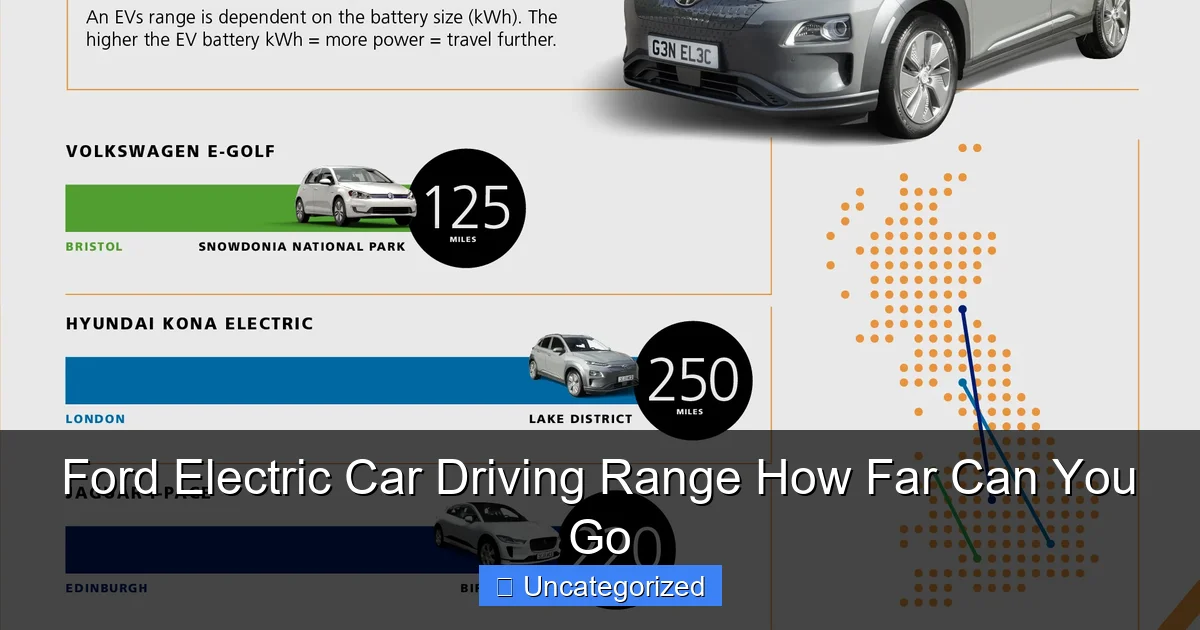
Image source: edfenergy.com
Ford electric cars deliver competitive driving ranges, with models like the Mustang Mach-E offering up to 314 miles and the F-150 Lightning reaching 320 miles on a single charge. Whether you’re commuting or road-tripping, Ford’s EV lineup combines real-world range, fast-charging capability, and smart energy management to keep you moving with confidence.
Key Takeaways
- Maximize range: Use Eco mode to extend battery life on long trips.
- Real-world range: Expect 10-20% less than EPA estimates in daily driving.
- Fast charging: Recharge up to 80% in 30-40 minutes with DC fast chargers.
- Weather impact: Cold weather reduces range; pre-heat while plugged in.
- Model matters: Choose F-150 Lightning for max range (up to 320 miles).
- Route planning: Use FordPass app to locate chargers and optimize trips.
📑 Table of Contents
- The Future is Electric: How Far Can Ford’s EVs Really Take You?
- Ford’s Electric Lineup: Models and Their Official Driving Ranges
- What Affects Real-World Driving Range? Beyond the EPA Numbers
- Maximizing Your Ford EV’s Range: Practical Tips and Tricks
- Charging Infrastructure: How It Impacts Usable Range
- Comparing Ford EVs: Range vs. Competitors
- Conclusion: Range Realism and the Road Ahead
The Future is Electric: How Far Can Ford’s EVs Really Take You?
The automotive world is undergoing a seismic shift, and at the forefront of this revolution is Ford, an American icon reimagining its legacy for the electric era. With the global push toward sustainability, reduced emissions, and smarter technology, Ford has committed to an electrified future with a bold lineup of electric vehicles (EVs) that promise not just environmental benefits but also impressive performance and, most importantly, driving range. But in a market crowded with claims of “up to 300 miles” or “400-mile range,” how much of it is real-world usable distance? That’s the million-dollar question for anyone considering a Ford electric car.
For many drivers, range anxiety remains the top barrier to EV adoption. The fear of running out of battery power before reaching a charging station—or worse, during a road trip—can make even the most eco-conscious consumer hesitate. Ford understands this concern and has responded with a strategic rollout of electric models designed to deliver competitive, reliable, and practical driving ranges. From the sporty Mustang Mach-E to the rugged F-150 Lightning and the upcoming E-Transit, Ford’s electric lineup aims to prove that going electric doesn’t mean sacrificing distance, comfort, or capability. In this comprehensive guide, we’ll dive deep into the Ford electric car driving range—what you can realistically expect, how different models compare, the factors that affect range, and how to maximize every mile on a single charge.
Ford’s Electric Lineup: Models and Their Official Driving Ranges
Ford’s foray into the electric vehicle market began in earnest with the launch of the Mustang Mach-E in 2021, followed swiftly by the groundbreaking F-150 Lightning and the commercial-focused E-Transit. Each of these vehicles targets a different segment of the market, and their driving range varies significantly based on battery size, vehicle weight, aerodynamics, and intended use. Let’s break down the current models and their EPA-estimated ranges to give you a clear picture of what’s available today.

Visual guide about ford electric car driving range
Image source: yps-assets.s3.eu-west-2.amazonaws.com
Mustang Mach-E: The Electric SUV with Muscle Car Soul
The Mustang Mach-E is Ford’s first all-electric SUV and a direct nod to the brand’s performance heritage. It’s available in several trims—Select, Premium, California Route 1, and GT—each offering different battery configurations and drivetrains (RWD or AWD). The driving range varies accordingly:
- Select (RWD, Standard Range): 247 miles
- Select (AWD, Standard Range): 224 miles
- Premium (RWD, Extended Range): 314 miles
- Premium (AWD, Extended Range): 270 miles
- California Route 1 (RWD, Extended Range): 314 miles
- GT (AWD, Extended Range): 270 miles
- GT Performance Edition: 260 miles
The Mach-E’s range is highly dependent on battery size. The standard-range models use a 70 kWh battery, while extended-range versions pack a 91 kWh pack. The California Route 1 trim, optimized for efficiency with low-rolling-resistance tires and aerodynamic enhancements, matches the Premium’s range despite having fewer luxury features—a smart choice for long-distance commuters.
F-150 Lightning: The Electric Pickup That’s Breaking Barriers
When Ford announced the F-150 Lightning, the industry took notice. This isn’t just another EV; it’s a full-size pickup truck with the capability of a workhorse and the efficiency of a modern electric drivetrain. The F-150 Lightning comes in three main trims: Pro, XLT, Lariat, and Platinum, each with optional battery packs.
- Pro, XLT, Lariat (Standard Range, 98 kWh): 240 miles
- XLT, Lariat, Platinum (Extended Range, 131 kWh): 320 miles
The extended-range battery is a game-changer, offering a 320-mile EPA range—comparable to many sedans and SUVs. This is particularly impressive given the F-150 Lightning’s size, weight (over 6,000 lbs), and aerodynamic profile. For contractors, adventurers, and families who need both utility and range, the F-150 Lightning delivers. The Platinum trim with the extended battery even includes features like Pro Power Onboard, which turns the truck into a mobile power station—perfect for tailgating, job sites, or emergencies.
E-Transit: Electrifying the Commercial Van Segment
While not aimed at consumers, the E-Transit is a critical part of Ford’s EV strategy, especially for businesses and fleet operators. This all-electric version of the popular Transit van comes in multiple configurations (cargo, cutaway, and passenger) and wheelbases, with a focus on urban delivery and service routes.
- All E-Transit configurations: 126 miles (EPA estimated)
With a 68 kWh battery, the E-Transit isn’t built for cross-country trips, but it’s perfectly suited for last-mile delivery, shuttle services, and local operations where daily mileage is predictable and charging can be scheduled overnight. For fleet managers, the E-Transit’s range is less about long-distance travel and more about consistent, reliable service within a 100-mile radius.
Upcoming Models: The Next Chapter in Ford’s EV Range
Ford isn’t stopping with these three models. The company has announced plans for several new EVs, including the Explorer Electric and Lincoln Nautilus Electric, both expected to debut by 2025. Early reports suggest these models will target ranges of 300+ miles, leveraging Ford’s next-generation battery technology and modular EV platform (known as GE2). Additionally, Ford is investing heavily in battery innovation through its partnership with SK On, aiming to produce batteries with higher energy density and faster charging capabilities—both of which will directly impact future Ford electric car driving range.
What Affects Real-World Driving Range? Beyond the EPA Numbers
While EPA ratings are a useful starting point, they don’t always reflect real-world conditions. Many Ford EV owners report that their actual range varies significantly from the official numbers—sometimes by as much as 20–30%. So, what factors cause this discrepancy? Understanding them is key to managing your expectations and maximizing your vehicle’s range.
Weather and Temperature: The Biggest Culprit
Temperature has a profound effect on battery performance. Lithium-ion batteries, used in all Ford EVs, operate most efficiently between 68°F and 77°F (20°C–25°C). When temperatures drop below freezing, chemical reactions inside the battery slow down, reducing its ability to store and release energy. This leads to a noticeable drop in range.
- Cold weather (below 32°F): Expect 15–30% range reduction, especially in winter months.
- Extreme heat (above 95°F): Can also reduce efficiency, particularly if the battery overheats and triggers thermal management systems.
Tip: Precondition your Ford EV while it’s still plugged in. Using the FordPass app, you can warm up the cabin and battery before driving, which reduces the load on the battery during operation and helps preserve range.
Driving Habits: Speed, Acceleration, and Braking
Your driving style plays a major role in how far you can go. High speeds, rapid acceleration, and hard braking all consume more energy.
- Speed: Driving at 70 mph uses significantly more energy than 55 mph due to increased aerodynamic drag. At highway speeds, range can drop by 10–20%.
- Acceleration: The F-150 Lightning GT can go 0–60 mph in under 4 seconds—but doing so repeatedly will drain the battery fast.
- Regenerative braking: Ford EVs use strong regenerative braking, which recaptures energy when slowing down. Using one-pedal driving (available in most models) can extend range by up to 10% in stop-and-go traffic.
Tip: Use the “Eco” or “Low” regenerative setting in highway driving to reduce drag and improve efficiency.
Vehicle Load and Terrain
Heavier loads and hilly terrain increase energy consumption. The F-150 Lightning, for example, can tow up to 10,000 lbs—but towing at maximum capacity can reduce range by 40% or more.
- Towing: A 5,000-lb trailer might cut range by 30–35%. Always plan charging stops when towing.
- Hills and elevation changes: Climbing steep grades requires more power, while descending can partially recharge the battery via regenerative braking.
- Roof racks and cargo boxes: These increase drag and can reduce range by 5–10%.
Tip: Remove unnecessary weight and roof-mounted items when not needed. For the Mach-E, using the “Range” drive mode (if available) optimizes power delivery for efficiency.
Use of Climate Control and Accessories
Heating and cooling the cabin is one of the biggest drains on an EV’s battery. Unlike gas cars, which use waste heat from the engine, EVs must generate heat electrically—especially in cold weather.
- Heating: Using the HVAC system on high can reduce range by 10–20% in winter.
- Seat and steering wheel heaters: These are more efficient than cabin heating and can help preserve range.
- Infotainment and lights: Minor, but still contributes to overall energy use.
Tip: Use seat heaters instead of cranking the cabin heat. Precondition the cabin while charging, and use eco-climate settings when possible.
Maximizing Your Ford EV’s Range: Practical Tips and Tricks
Now that you understand the factors affecting range, let’s look at actionable strategies to get the most miles out of every charge. Whether you’re driving a Mach-E to the beach or using the F-150 Lightning for a weekend camping trip, these tips will help you stretch your range.
Optimize Your Driving Style
Smooth, consistent driving is the golden rule of EV efficiency. Avoid jackrabbit starts and sudden stops. Use cruise control on highways to maintain a steady speed. The Mach-E’s “One Pedal Drive” mode (in select trims) allows you to control speed almost entirely with the accelerator, using regenerative braking to slow down—great for city driving and traffic.
Real-world example: A Mach-E Premium driver in Chicago reported a 280-mile range on a 300-mile trip by using cruise control at 65 mph, avoiding hard acceleration, and using regenerative braking effectively. That’s 93% of the EPA estimate—impressive for a winter drive.
Precondition and Preheat
As mentioned earlier, preheating your Ford EV while it’s plugged in is one of the best ways to save range. The FordPass app lets you schedule climate control to start 15–30 minutes before you leave. This warms the battery and cabin using grid power, not battery power.
Tip: Set a departure time in the app even if you’re not sure when you’ll leave. The car will start preconditioning automatically based on your schedule.
Plan Your Route with Charging in Mind
Use navigation systems that factor in charging stops. The Mach-E and F-150 Lightning come with Ford’s SYNC 4A system, which includes built-in route planning with charging station locations, estimated charge times, and range forecasts based on terrain and weather.
Tip: For long trips, aim to charge to 80% rather than 100%. Charging slows significantly after 80%, and the last 20% can take as long as the first 50%. Use the “Trip Planner” feature to find optimal charging points.
Use Eco Modes and Efficiency Features
Most Ford EVs offer drive modes like “Eco,” “Normal,” and “Sport.” Eco mode reduces power output, limits HVAC use, and adjusts regenerative braking for maximum efficiency. The Mach-E also has a “Whisper” mode for quiet, efficient city driving.
Tip: Activate Eco mode for daily commutes and highway driving. Save Sport mode for when you really want to feel the electric torque.
Maintain Your Vehicle and Battery
Regular maintenance helps preserve range over time. Keep tires properly inflated (check monthly), rotate them regularly, and ensure wheel alignment is correct. Underinflated tires increase rolling resistance, reducing range by up to 5%.
Also, avoid keeping your battery at 100% for long periods. For daily use, charge to 80–90% to prolong battery life. Use the FordPass app to set charging limits and schedules.
Charging Infrastructure: How It Impacts Usable Range
Even the best Ford electric car driving range won’t matter if you can’t charge when and where you need to. Ford has taken a proactive approach to charging infrastructure, partnering with major networks and offering solutions for home, public, and on-the-go charging.
Home Charging: Level 1 vs. Level 2
- Level 1 (120V): Adds about 3–5 miles of range per hour. Suitable for overnight charging if you drive less than 40 miles daily.
- Level 2 (240V): Adds 20–30 miles per hour. Highly recommended for all Ford EV owners. The F-150 Lightning comes with an 80-amp Ford Connected Charge Station (Level 2) that can fully charge the extended-range battery in about 10 hours.
Tip: Install a Level 2 charger at home for maximum convenience and range flexibility. Many states offer rebates for EV charger installation.
Public and DC Fast Charging
Ford has partnered with Electrify America to provide free fast charging for new EV buyers (up to 250 kWh for Mach-E and F-150 Lightning). DC fast chargers can add 60–80 miles of range in just 10 minutes, depending on the station and vehicle.
- F-150 Lightning: Charges from 15% to 80% in about 41 minutes (at 150 kW).
- Mustang Mach-E: 10% to 80% in about 45 minutes (at 150 kW).
Tip: Use the FordPass app to locate nearby fast chargers, check availability, and even start a session remotely.
Ford’s BlueOval Charging Network
Ford is expanding the BlueOval Charge Network, which includes over 84,000 charging points across North America—many of which are DC fast chargers. The network integrates with FordPass, allowing seamless access, payment, and real-time status updates.
Comparing Ford EVs: Range vs. Competitors
To truly understand how Ford’s electric car driving range stacks up, let’s compare the Mach-E and F-150 Lightning to key competitors in their segments.
Data Table: Range Comparison (EPA Estimated)
| Model | Trim | Driving Range (Miles) | Battery Size (kWh) | Key Competitors |
|---|---|---|---|---|
| Ford Mustang Mach-E | Premium (RWD, Extended) | 314 | 91 | Chevy Blazer EV (320), Tesla Model Y (330) |
| Ford Mustang Mach-E | GT (AWD, Extended) | 270 | 91 | Kia EV6 GT (310), Hyundai Ioniq 5 (303) |
| Ford F-150 Lightning | Lariat (Extended Range) | 320 | 131 | Rivian R1T (314), Tesla Cybertruck (340 est.) |
| Ford F-150 Lightning | Pro (Standard Range) | 240 | 98 | Chevy Silverado EV (290 est.), GMC Sierra EV (290 est.) |
| Ford E-Transit | All Configurations | 126 | 68 | Ram ProMaster EV (162 est.), Mercedes eSprinter (150) |
As the table shows, Ford’s EVs are competitive, especially in the SUV and pickup segments. The Mach-E’s 314-mile range is on par with top rivals, and the F-150 Lightning’s 320-mile extended-range version outperforms most electric pickups on the market. The E-Transit, while shorter-range, is optimized for its intended use case.
Conclusion: Range Realism and the Road Ahead
When it comes to Ford electric car driving range, the numbers are impressive—but the real story is in the details. Ford has delivered vehicles that offer competitive, practical ranges for their segments, backed by intelligent technology, robust charging partnerships, and a commitment to continuous improvement. Whether you’re a city dweller needing a daily commuter (Mach-E Select at 247 miles), a long-distance traveler (F-150 Lightning Extended at 320 miles), or a business owner with delivery needs (E-Transit at 126 miles), Ford has an EV that can meet your range requirements.
But remember: range isn’t just about the number on the EPA sticker. It’s about understanding how weather, driving habits, load, and charging infrastructure affect your real-world experience. By adopting smart charging practices, optimizing your driving style, and planning ahead, you can consistently achieve 85–95% of the official range—even in challenging conditions.
Ford’s journey into electrification is far from over. With new models on the horizon, advancements in battery technology, and a growing charging network, the future of Ford electric car driving range looks brighter—and longer—than ever. So, how far can you go? With Ford, the answer is: farther than you think.
Frequently Asked Questions
What is the average driving range of a Ford electric car?
The average Ford electric car driving range varies by model but typically falls between 230 and 320 miles on a single charge. For example, the Mustang Mach-E offers up to 314 miles, while the F-150 Lightning ranges from 240 to 320 miles depending on the battery pack.
How does the Ford F-150 Lightning’s range compare to other electric trucks?
The Ford F-150 Lightning delivers competitive range, offering 240 miles (Standard Range) or 320 miles (Extended Range), rivaling rivals like the Rivian R1T and Chevrolet Silverado EV. Real-world range may vary based on payload, terrain, and driving habits.
Does cold weather affect Ford electric car driving range?
Yes, cold temperatures can reduce a Ford EV’s range by 20-30% due to increased energy demands for heating the cabin and battery. Preconditioning while plugged in and using seat heaters can help mitigate range loss in winter.
How far can the Mustang Mach-E go on a full charge?
The Ford electric car driving range for the Mustang Mach-E spans 247 to 314 miles, depending on the trim and battery configuration. The California Route 1 Edition offers the longest range, while performance-focused GT models sacrifice some range for speed.
Can Ford electric cars achieve their advertised range in real-world driving?
Most Ford EVs meet or come close to their EPA-estimated range under optimal conditions, but aggressive driving, hilly terrain, or heavy use of climate control can reduce it. Eco mode and regenerative braking help maximize efficiency for longer trips.
How does battery size impact Ford electric car driving range?
Larger battery packs (e.g., the F-150 Lightning’s Extended Range battery) increase driving range by storing more energy, while smaller packs prioritize affordability. Ford offers multiple battery options across its EV lineup to suit different needs and budgets.