Ford Electric Car Home Charging Station Cost Guide 2024

Featured image for ford electric car home charging station cost
Image source: smartchargeamerica.com
The average cost to install a Ford electric car home charging station in 2024 ranges from $700 to $1,500, depending on the charger model, electrical upgrades, and labor. Ford’s recommended Charge Station Pro qualifies for federal tax credits, slashing up to 30% off installation costs, making home charging more affordable than ever.
Key Takeaways
- Compare charger types: Level 1 is free; Level 2 costs $500–$2,000 installed.
- Installation varies: Hire a pro for safe, code-compliant setup—budget $300–$1,200 extra.
- Leverage incentives: Federal/state rebates may cover 30–50% of total costs.
- Ford offers perks: Some models include free charger or installation credits—check eligibility.
- Future-proof wiring: Upgrade electrical panels during install to avoid later expenses.
- Optimize timing: Use off-peak rates to cut charging costs by up to 50%.
📑 Table of Contents
- The Future Is Electric: Why Home Charging Matters for Ford EV Owners
- Understanding Ford EV Charging Levels and Compatibility
- Breaking Down the Cost: Equipment, Installation, and Extras
- Ford-Specific Incentives and Rebates (2024 Update)
- DIY vs. Professional Installation: Weighing the Options
- Long-Term Savings and Cost-Benefit Analysis
- Comparative Cost Table: Top Ford-Compatible Chargers (2024)
- Final Thoughts: Is a Home Charging Station Worth It?
The Future Is Electric: Why Home Charging Matters for Ford EV Owners
As the electric vehicle (EV) revolution accelerates, Ford has firmly planted its flag in the future of transportation with its expanding lineup of electric cars, including the Mustang Mach-E, F-150 Lightning, and the upcoming Explorer EV. These vehicles offer impressive range, cutting-edge technology, and a driving experience that rivals—and often surpasses—their gas-powered predecessors. But one of the most critical components of owning a Ford EV isn’t under the hood or in the software—it’s right at home. A home charging station isn’t just a convenience; it’s the backbone of your daily EV experience.
For many prospective Ford EV owners, the question isn’t whether to install a home charging station, but how much it will cost. The total expense involves more than just the price of the charger. It includes installation, electrical upgrades, permits, and potential rebates. With so many variables at play, understanding the full scope of Ford electric car home charging station cost is essential for making an informed decision. This comprehensive 2024 guide breaks down every aspect of the investment, from equipment and labor to incentives and long-term savings, so you can power your Ford EV with confidence—without any surprise bills.
Understanding Ford EV Charging Levels and Compatibility
Level 1 vs. Level 2: What’s the Difference?
Before diving into costs, it’s vital to understand the two main types of home charging: Level 1 and Level 2. Level 1 charging uses a standard 120-volt household outlet and comes with every Ford EV. While convenient, it’s slow—adding only 3–5 miles of range per hour. For a Mustang Mach-E with a 68 kWh battery, that means a full charge could take over 24 hours. This makes Level 1 impractical for daily use unless you drive very little or have access to public charging.
Visual guide about ford electric car home charging station cost
Image source: garageliving.com
Level 2 charging, on the other hand, uses a 240-volt circuit—similar to what powers your dryer or oven. It delivers 20–30+ miles of range per hour, depending on the vehicle and charger. For example, the Ford F-150 Lightning can gain up to 21 miles of range per hour with a 48-amp Level 2 charger. This means a full charge in as little as 8–10 hours, making overnight charging efficient and reliable.
Ford Charging Equipment and Smart Features
Ford offers its own branded Level 2 charging station, the Ford Connected Charge Station, which is designed specifically for its EVs. This 48-amp, Wi-Fi-enabled unit supports features like:
- Remote monitoring and control via the FordPass app
- Scheduled charging to take advantage of off-peak electricity rates
- Real-time charging status and energy usage tracking
- Over-the-air firmware updates
While Ford’s charger is optimized for its vehicles, it’s not the only option. Many third-party brands—such as ChargePoint, JuiceBox, and Grizzl-E—are fully compatible with Ford EVs and may offer better pricing or additional features. The key is ensuring the charger meets SAE J1772 standards, which all Ford EVs support.
Future-Proofing with 80-Amp and 11.5 kW Options
Some high-end chargers offer up to 80 amps (11.5 kW), which is overkill for most Ford EVs today—but could be valuable for future upgrades. For instance, if you plan to buy a Ford E-Transit van or a next-gen EV with a larger battery, a higher-capacity charger ensures you’re ready. However, such units require a 100-amp subpanel or major electrical upgrades, which significantly increase upfront costs.
Breaking Down the Cost: Equipment, Installation, and Extras
1. Charger Unit Cost (Hardware)
The price of the charging station itself varies widely based on brand, power output, and features. Here’s a breakdown of average prices in 2024:
- Ford Connected Charge Station (48A, 11.5 kW): $799
- ChargePoint Home Flex (50A, 12 kW): $649
- JuiceBox 40 (40A, 9.6 kW): $549
- Grizzl-E Classic (40A, 9.6 kW): $349 (most budget-friendly)
- Wallbox Pulsar Plus (48A, 11.5 kW): $699
Note: Prices may vary by retailer and region. The Ford charger is often bundled with installation services, which can offset the higher hardware cost.
2. Installation Labor and Electrical Work
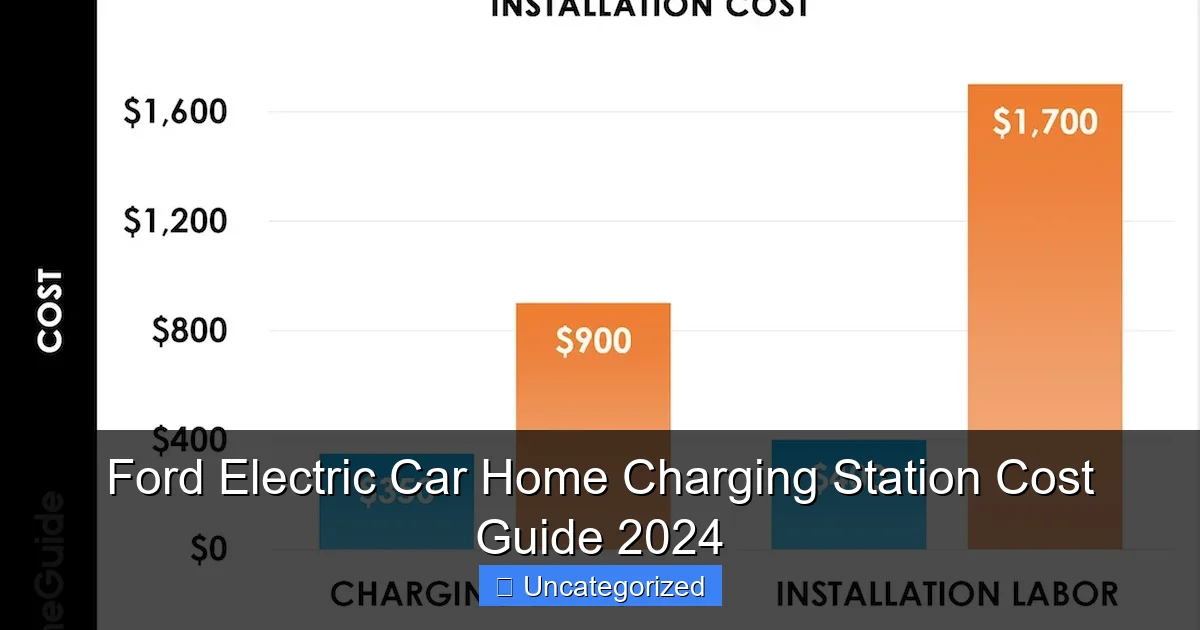
Installation is where costs can escalate quickly. A simple plug-and-play installation (where a 240-volt outlet is already available) may cost $300–$600. But most homes require a dedicated circuit from the main electrical panel, which increases complexity and price.
Average installation costs by scenario:
- Basic installation (existing 240V outlet, <10 ft from panel): $300–$600
- Standard installation (new 240V circuit, 10–30 ft from panel): $600–$1,200
- Complex installation (panel upgrade, >30 ft, conduit in walls): $1,500–$3,000+
- Main panel upgrade (if current panel is full or outdated): $1,000–$2,500
Pro Tip: Get at least three quotes from licensed electricians. Look for those with EVITP (Electric Vehicle Infrastructure Training Program) certification for added expertise.
3. Permits, Inspections, and Local Fees
Most municipalities require a permit for electrical work, especially new circuits. Permit fees range from $50 to $200, and inspections add $100–$300. Some cities, like San Francisco and Seattle, have streamlined EV permitting to encourage adoption. Always check with your local building department before starting work.
4. Additional Costs: Smart Features, Cables, and Accessories
While not mandatory, these extras can enhance convenience and safety:
- Weatherproof enclosure: $100–$200 (if installing outdoors)
- Cable management system: $50–$100
- Wi-Fi extender: $80–$150 (if signal is weak in garage)
- Extended warranty: $100–$200 (some brands offer 3–5 years standard)
Ford-Specific Incentives and Rebates (2024 Update)
Federal Tax Credit: Up to $1,000 for Charger Installation
Under the Inflation Reduction Act (IRA)30% of installation costs, up to $1,000. This applies to both the charger and labor, including permits. The credit is available through 2032 and can be claimed on Form 5695 when filing your annual taxes.
Example: If your total installation cost is $2,500, you’ll receive a $750 tax credit (30% of $2,500, capped at $1,000).
Important: The credit only applies to new installations. Replacing an existing charger doesn’t qualify.
State, Utility, and Local Rebates
Many states and utility companies offer additional incentives. Here are some notable 2024 programs:
- California: The Charge Ready Home program offers up to $2,000 in rebates for single-family homes. Southern California Edison and PG&E provide similar programs.
- New York: NYSERDA’s Charge Ready NY rebates up to $1,000 for Level 2 chargers.
- Texas: Austin Energy offers $500 rebates for residential EV charger installations.
- Colorado: Xcel Energy provides up to $500 for qualifying installations.
Tip: Use the DSIRE database to search for incentives in your area. Enter your ZIP code and filter by “EV Charging Equipment.”
Ford’s Own Programs: Free Installation with F-150 Lightning Purchase
In a major move to boost EV adoption, Ford is offering a free home charging station and installation with the purchase of a new F-150 Lightning (as of Q1 2024). This includes:
- Ford Connected Charge Station (48A)
- Up to $1,200 in installation labor
- Permits and inspections
- One-year FordPass app premium subscription
This program is a game-changer, effectively reducing the Ford electric car home charging station cost to $0 for qualifying buyers. It’s available through participating dealers and is subject to change, so act fast if you’re in the market for an F-150 Lightning.
DIY vs. Professional Installation: Weighing the Options
Can You Install a Charger Yourself?
Technically, yes—if you’re a licensed electrician or have advanced electrical skills. However, DIY installation is strongly discouraged for safety and compliance reasons. Here’s why:
- Electrical code violations: Improper wiring can lead to fines or failed inspections.
- Fire and shock hazards: 240-volt circuits carry significant risk if mishandled.
- Voided warranties: Many charger manufacturers require professional installation to honor warranties.
- Insurance complications: Some insurers may deny claims related to DIY electrical work.
That said, if you’re installing a plug-in charger (using a NEMA 14-50 outlet), you can hire an electrician just to install the outlet and plug in the charger yourself. This hybrid approach saves money while ensuring safety.
When to Hire a Pro: Signs You Need Expert Help
Hire a licensed electrician if:
- Your main panel is full or outdated (needs upgrade)
- The charger location is more than 30 feet from the panel
- You’re installing in a finished basement or wall
- Your home has aluminum wiring (requires special connectors)
- You’re adding a subpanel or load management system
Pro Tip: Ask your electrician to install a load management device (like a DCC or PowerShare) if your home has high electricity demand. This prevents tripped breakers when charging and running appliances like AC or ovens.
Long-Term Savings and Cost-Benefit Analysis
Calculating Your Payback Period
While the upfront cost of a home charger can be $1,000–$3,000+, the long-term savings are substantial. Let’s break it down with a real-world example:
Scenario: You own a Mustang Mach-E (68 kWh battery) and drive 12,000 miles/year. You currently use public Level 2 chargers at $0.30/kWh and plan to switch to home charging at $0.12/kWh (off-peak rate).
- Annual energy use: 12,000 miles ÷ 3 mi/kWh = 4,000 kWh
- Cost with public charging: 4,000 kWh × $0.30 = $1,200/year
- Cost with home charging: 4,000 kWh × $0.12 = $480/year
- Annual savings: $720
Payback period: $1,800 (avg. home charger cost) ÷ $720/year = 2.5 years
After 2.5 years, you’re saving $720 annually—money that stays in your pocket. Over 10 years, that’s $7,200 in savings, not including time saved and convenience gained.
Increased Home Value and Market Appeal
Studies show that homes with EV chargers sell faster and at a premium. According to a 2023 Zillow report, homes with EV chargers sold for 3.6% more on average. For a $400,000 home, that’s a $14,400 increase—more than enough to cover the charging station cost.
Time-of-Use (TOU) Rates: Maximizing Savings
Many utilities offer TOU plans, where electricity is cheaper at night (e.g., 10 PM–6 AM). By scheduling your Ford EV to charge during off-peak hours, you can cut charging costs by 30–50%. The FordPass app makes this easy with its built-in scheduling feature.
Example: Charging a 68 kWh battery during off-peak ($0.08/kWh) costs $5.44. During peak ($0.20/kWh), it costs $13.60. That’s a $8.16 savings per charge!
Comparative Cost Table: Top Ford-Compatible Chargers (2024)
| Charger Model | Max Power (kW) | Amps | Price (USD) | Smart Features | Best For |
|---|---|---|---|---|---|
| Ford Connected Charge Station | 11.5 | 48 | $799 | FordPass app, scheduling, energy tracking | Ford EV owners wanting seamless integration |
| ChargePoint Home Flex | 12.0 | 50 | $649 | Wi-Fi, app control, voice assistant | Tech-savvy users with smart home setups |
| JuiceBox 40 | 9.6 | 40 | $549 | App, Alexa/Google Assistant, energy monitoring | Balanced cost and features |
| Grizzl-E Classic | 9.6 | 40 | $349 | Basic app, weatherproof | Budget-conscious buyers |
| Wallbox Pulsar Plus | 11.5 | 48 | $699 | App, scheduling, load management | Homes with high electricity demand |
Final Thoughts: Is a Home Charging Station Worth It?
For Ford EV owners, a home charging station isn’t just a luxury—it’s a necessity. The Ford electric car home charging station cost may seem high at first glance, but when you factor in long-term savings, convenience, and available incentives, the investment quickly pays for itself. With federal tax credits, state rebates, and Ford’s own free installation program for the F-150 Lightning, 2024 is one of the best years yet to make the switch.
Whether you choose Ford’s branded charger for seamless integration or a third-party model for better value, the key is to plan ahead. Get multiple quotes, check local incentives, and consider your future EV needs. A well-installed Level 2 charger transforms your Ford EV from a novelty into a practical, everyday vehicle—charging overnight, saving money, and reducing your carbon footprint.
In the end, the cost of a home charging station is not just about dollars and cents. It’s about freedom. Freedom from range anxiety. Freedom from crowded public chargers. Freedom to drive cleaner, smarter, and more sustainably. As Ford continues to electrify its fleet, your home charger becomes the gateway to that future—one overnight charge at a time.
Frequently Asked Questions
How much does a Ford electric car home charging station cost in 2024?
The average cost of a Ford home charging station ranges from $500 to $1,200, including equipment and basic installation. Prices vary based on charger level (Level 1 or 2), amperage, and electrical upgrades needed.
Is Ford offering free home charging stations with electric car purchases?
Ford occasionally runs promotional deals, such as covering standard installation costs or offering discounts on the Ford Connected Charge Station. Check with your local dealer for current 2024 incentives and eligibility requirements.
Can I use a standard outlet to charge my Ford electric car at home?
Yes, all Ford EVs come with a portable Level 1 charger that works with a standard 120V outlet. However, this method is slow (3-5 miles per hour), so a Level 2 Ford electric car home charging station is recommended for faster charging.
What factors affect the total Ford home charging station cost?
Key factors include the charger model (80A vs. 48A), distance from your electrical panel, labor rates, and any required electrical upgrades like a dedicated circuit or panel expansion. Permit fees may also apply depending on your location.
Does Ford provide professional installation for home charging stations?
Yes, Ford partners with Qmerit to offer certified electricians for installation. Their network handles permits, inspections, and ensures compliance with local codes, streamlining the setup of your Ford electric car home charging station.
Are there government rebates for Ford home charging station costs?
Many states and utilities offer rebates covering 30-100% of installation costs for EV chargers. The federal tax credit (up to $1,000) may also apply. Visit the U.S. Department of Energy’s website to find current incentives.