Ford Electric Car Investment Driving the Future of Mobility
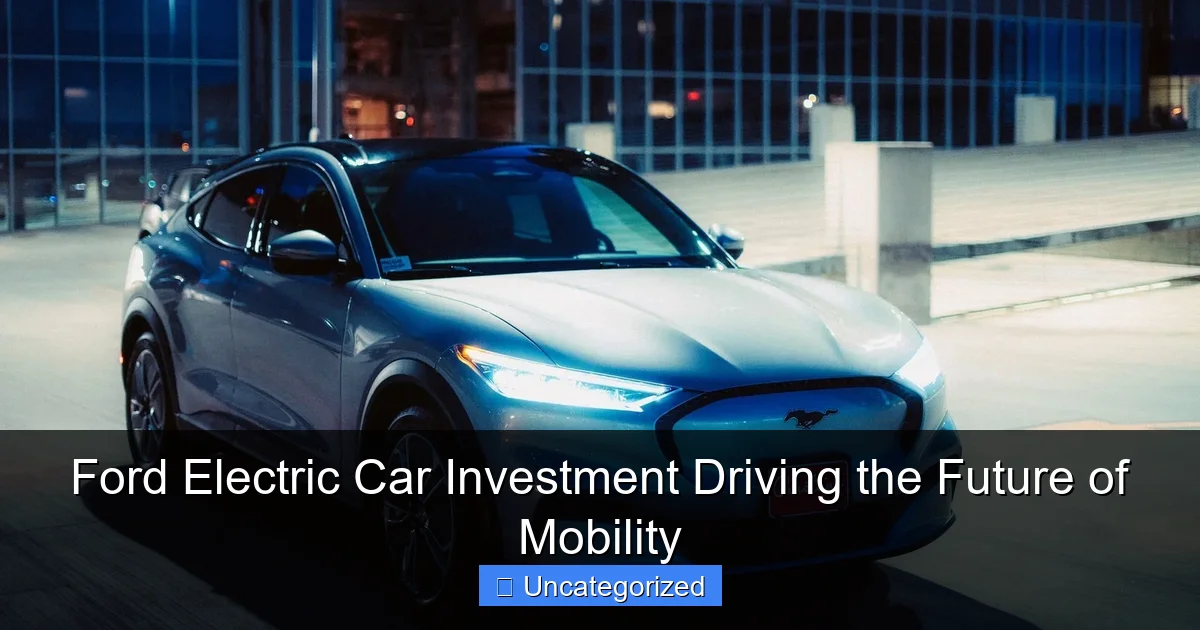
Featured image for ford electric car investment
Image source: sustainablereview.com
Ford is revolutionizing the future of mobility with a massive $50 billion investment in electric vehicles (EVs) by 2026, signaling its bold commitment to an all-electric lineup. This strategic push includes cutting-edge battery plants, next-gen EV platforms, and iconic models like the F-150 Lightning, positioning Ford as a fierce competitor in the global EV race. The investment underscores Ford’s ambition to lead the industry’s shift toward sustainable, high-performance electric transportation.
Key Takeaways
- Ford is investing $50B+ in EVs through 2026 to lead the electric mobility revolution.
- New EV plants in Tennessee and Kentucky will boost production capacity to 2 million units annually.
- Mustang Mach-E and F-150 Lightning are central to Ford’s EV market expansion strategy.
- Battery tech partnerships with SK On and Redwood Materials ensure sustainable supply chains.
- Over-the-air updates will future-proof vehicles with continuous software and feature upgrades.
- Ford Pro offers integrated EV solutions for commercial fleets to drive B2B adoption.
- EV sales targets aim for 50% of global volume by 2030—aggressive but achievable.
📑 Table of Contents
- Ford Electric Car Investment Driving the Future of Mobility
- The Strategic Vision Behind Ford’s Electric Car Investment
- Ford’s Electric Vehicle Lineup: Models That Matter
- Manufacturing and Supply Chain: Building the EV Foundation
- Charging Infrastructure and Customer Experience
- Financial and Market Impact of Ford’s EV Investment
- Conclusion: A Bold Leap into the Electric Future
Ford Electric Car Investment Driving the Future of Mobility
In an era where sustainability and innovation define the automotive industry, Ford electric car investment stands out as a bold declaration of intent. As one of the most iconic names in American automotive history, Ford is no stranger to transformation. From the revolutionary Model T to today’s smart, connected, and electrified vehicles, Ford continues to reinvent itself. The company’s recent shift toward electrification isn’t just a response to market trends—it’s a strategic, long-term commitment to shaping the future of mobility. With billions of dollars allocated to electric vehicle (EV) development, manufacturing, and infrastructure, Ford is positioning itself as a key player in the global race toward a zero-emission transportation future.
The significance of Ford’s electric car investment cannot be overstated. In a world grappling with climate change, rising fuel costs, and evolving consumer preferences, automakers must adapt or risk obsolescence. Ford has chosen the path of innovation, leveraging its century-long engineering expertise, vast manufacturing footprint, and deep supply chain relationships to accelerate the transition to electric vehicles. This blog post explores how Ford’s investment strategy is reshaping its product lineup, redefining its brand identity, and influencing the broader EV ecosystem. Whether you’re an investor, car enthusiast, or environmentally conscious consumer, understanding Ford’s electric journey offers valuable insights into the future of transportation.
The Strategic Vision Behind Ford’s Electric Car Investment
From Legacy to Electrification: A New Era for Ford
Ford’s pivot to electric vehicles marks a fundamental shift in its corporate identity. Historically known for muscle cars, trucks, and internal combustion engines (ICE), the company now embraces a future powered by batteries and renewable energy. The cornerstone of this transformation is the $50 billion investment in EVs and battery technology through 2026, announced as part of its “Ford+” plan. This initiative aims to achieve 8% operating margins in the EV segment by 2026 and deliver 2 million EVs annually by 2026—a massive leap from its current production levels.
Visual guide about ford electric car investment
Image source: cdn.statcdn.com
This vision is not just about building electric cars; it’s about reimagining the entire value chain. Ford is investing in battery R&D, software integration, charging networks, and digital customer experiences. The company’s approach combines vertical integration with strategic partnerships, ensuring it controls key components while remaining agile in a fast-evolving market.
Key Pillars of Ford’s EV Strategy
Ford’s electric car investment rests on three core pillars:
- Product Development: Launching a diverse EV portfolio, including the Mustang Mach-E, F-150 Lightning, and upcoming electric commercial vans and SUVs.
- Manufacturing Transformation: Retrofitting legacy plants and building new gigafactories to support EV production at scale.
- Customer-Centric Ecosystem: Expanding charging access, offering flexible ownership models, and integrating smart technologies like Ford Power-Up over-the-air updates.
For example, the F-150 Lightning—the electric version of America’s best-selling vehicle—has become a symbol of Ford’s ability to electrify its most iconic products. With over 200,000 reservations within months of launch, it demonstrates strong consumer demand for practical, high-performance EVs. Similarly, the Mustang Mach-E has earned critical acclaim for its design, range, and tech features, proving that Ford can compete with Tesla and other EV leaders in the premium segment.
Aligning with Global Sustainability Goals
Ford’s investment aligns with broader environmental and regulatory trends. The company has pledged to achieve carbon neutrality by 2050 across its global operations, with interim targets including a 50% reduction in CO2 emissions by 2035. These goals are supported by the electrification of its fleet, as EVs produce significantly lower lifecycle emissions than ICE vehicles, especially when charged with renewable energy.
Moreover, Ford is responding to tightening emissions standards in the U.S., Europe, and China. By investing heavily in EVs now, Ford avoids future penalties and gains a competitive advantage in regions where ICE vehicles face restrictions. This proactive stance not only future-proofs the company but also strengthens its brand reputation among eco-conscious consumers.
Ford’s Electric Vehicle Lineup: Models That Matter
Mustang Mach-E: Electrifying an Icon
The Mustang Mach-E is Ford’s flagship electric SUV, blending the heritage of the Mustang name with modern EV innovation. Launched in 2020, it quickly became one of the most popular electric SUVs in North America. With a starting price of around $43,000 (before incentives), the Mach-E offers a range of up to 314 miles on a single charge (on the extended-range rear-wheel-drive model).
Key features include:
- SYNC 4A infotainment system with a 15.5-inch touchscreen
- Co-Pilot360 driver-assist suite with BlueCruise hands-free driving
- Over-the-air software updates for continuous improvement
- Performance variants like the Mach-E GT with 480 horsepower and 0-60 mph in 3.5 seconds
The Mach-E has been praised for its spacious interior, smooth ride, and competitive pricing. It’s a prime example of how Ford leverages its brand equity to enter new market segments successfully.
F-150 Lightning: The Electric Workhorse
Perhaps the most transformative model in Ford’s EV lineup is the F-150 Lightning. As the first electric full-size pickup truck from a major automaker, it has disrupted the truck market. With a starting MSRP of $55,974 (before federal tax credits), the Lightning offers up to 320 miles of range and can tow up to 10,000 pounds—comparable to its ICE counterpart.
What sets the F-150 Lightning apart are its innovative features:
- Pro Power Onboard: Up to 9.6 kW of exportable power for tools, appliances, or even home backup during outages.
- Intelligent Backup Power: When connected to a home via Ford Charge Station Pro, the truck can power a house for up to 3 days.
- F-Series Heritage: Retains the ruggedness, towing capacity, and utility of the F-150 while adding instant torque and quiet operation.
Ford has already produced over 150,000 F-150 Lightning units and continues to expand production at its Rouge Electric Vehicle Center. The truck has attracted not just traditional truck buyers but also fleet operators, small businesses, and tech-savvy homeowners.
E-Transit: Electrifying Commercial Fleets
Ford’s E-Transit van targets the growing demand for electric commercial vehicles. With a range of 126 miles (ideal for urban delivery routes) and a payload capacity of up to 3,800 lbs, it’s designed for last-mile logistics, service vehicles, and small businesses. The E-Transit offers multiple configurations, including cargo, passenger, and cutaway models.
Ford has partnered with companies like Amazon, UPS, and Walmart to deploy E-Transit vans in their fleets. For instance, Amazon has ordered 100,000 E-Transit vans as part of its Climate Pledge to achieve net-zero carbon by 2040. This partnership highlights Ford’s ability to scale EV solutions for large enterprises.
Upcoming Models: What’s on the Horizon
Ford has teased several upcoming EVs, including:
- An all-electric Explorer SUV (launching in 2025)
- An electric version of the Bronco (expected in 2026)
- A new electric pickup truck under the “Project T3” codename, promising next-gen battery tech and autonomous features
These models will expand Ford’s EV footprint across key segments, from family SUVs to off-road adventurers, ensuring broad market appeal.
Manufacturing and Supply Chain: Building the EV Foundation
Retrofitting Legacy Plants for the Electric Age
One of Ford’s most innovative strategies is the retrofitting of existing factories to produce EVs. Instead of building entirely new facilities, Ford has upgraded plants like the Cuautitlán Assembly Plant in Mexico (for Mach-E) and the Rouge Center in Michigan (for F-150 Lightning). This approach reduces capital expenditure, speeds up production timelines, and leverages skilled labor and infrastructure already in place.
For example, the Rouge Electric Vehicle Center was converted from a traditional truck plant in just 18 months. It now features advanced robotics, AI-driven quality control, and a dedicated battery pack assembly line. This flexibility allows Ford to scale production rapidly in response to demand.
Building Gigafactories for Battery Independence
To reduce reliance on third-party battery suppliers, Ford is investing in gigafactories through its joint ventures:
- BlueOval SK: A partnership with SK On to build three battery plants in Tennessee and Kentucky, with a combined capacity of 129 GWh/year by 2026.
- BlueOval Battery Park: A $3.5 billion facility in Marshall, Michigan, focused on LFP (lithium iron phosphate) batteries, which are cheaper, safer, and longer-lasting than traditional NMC batteries.
These factories will produce batteries not only for Ford’s EVs but also for commercial vehicles and future energy storage applications. By controlling battery production, Ford can lower costs, ensure supply chain resilience, and accelerate innovation.
Securing Critical Materials and Reducing Costs
Ford is actively securing long-term supply agreements for key materials like lithium, cobalt, and nickel. For instance, it has partnered with mining companies in Australia, Chile, and Canada to source ethically mined lithium. Additionally, Ford is investing in battery recycling programs to recover valuable materials and reduce environmental impact.
The company is also exploring solid-state battery technology through partnerships with startups like QuantumScape. Solid-state batteries promise higher energy density, faster charging, and improved safety—potential game-changers for the EV industry.
Charging Infrastructure and Customer Experience
Expanding Access with the BlueOval Charge Network
One of the biggest barriers to EV adoption is charging infrastructure. To address this, Ford launched the BlueOval Charge Network, a partnership with Electrify America, ChargePoint, and other providers. This network gives Ford EV owners access to over 100,000 charging stations across North America, including more than 1,800 DC fast chargers.
Key features of the network include:
- Seamless integration with FordPass app for navigation, payment, and real-time availability
- Free charging for F-150 Lightning and Mach-E owners (up to 250 kWh annually)
- Prioritized access at Electrify America stations
Ford is also installing home charging stations for customers, with the Ford Connected Charge Station offering Level 2 (240V) charging and smart scheduling features.
Smart Technology and Over-the-Air Updates
Ford EVs are equipped with advanced software that enhances the ownership experience. The Power-Up system delivers over-the-air (OTA) updates, similar to smartphones. These updates can improve battery performance, add new features, and fix bugs—all without visiting a dealership.
For example, Ford recently rolled out an OTA update to the Mach-E that increased range by 10 miles through battery management improvements. Such updates keep vehicles current and reduce long-term maintenance costs.
Flexible Ownership and Subscription Models
Ford is experimenting with new ownership models to attract diverse customers. The Ford Flex Pay program offers flexible lease terms and bundled services (like charging credits and maintenance). Additionally, Ford is exploring subscription services for urban dwellers who don’t need a car full-time.
These initiatives lower the barrier to entry and appeal to younger, tech-savvy buyers who value convenience and sustainability.
Financial and Market Impact of Ford’s EV Investment
Investor Confidence and Stock Performance
Ford’s electric car investment has significantly boosted investor confidence. Since the announcement of its EV strategy in 2021, Ford’s stock price has risen by over 60%, outperforming many legacy automakers. Analysts credit this growth to Ford’s clear roadmap, scalable manufacturing, and strong order books.
However, the EV segment remains a cost center in the short term. In 2023, Ford reported a $4.7 billion loss in its EV division, reflecting high R&D and production costs. Management expects profitability to improve as scale increases and battery costs decline.
Market Share and Competitive Positioning
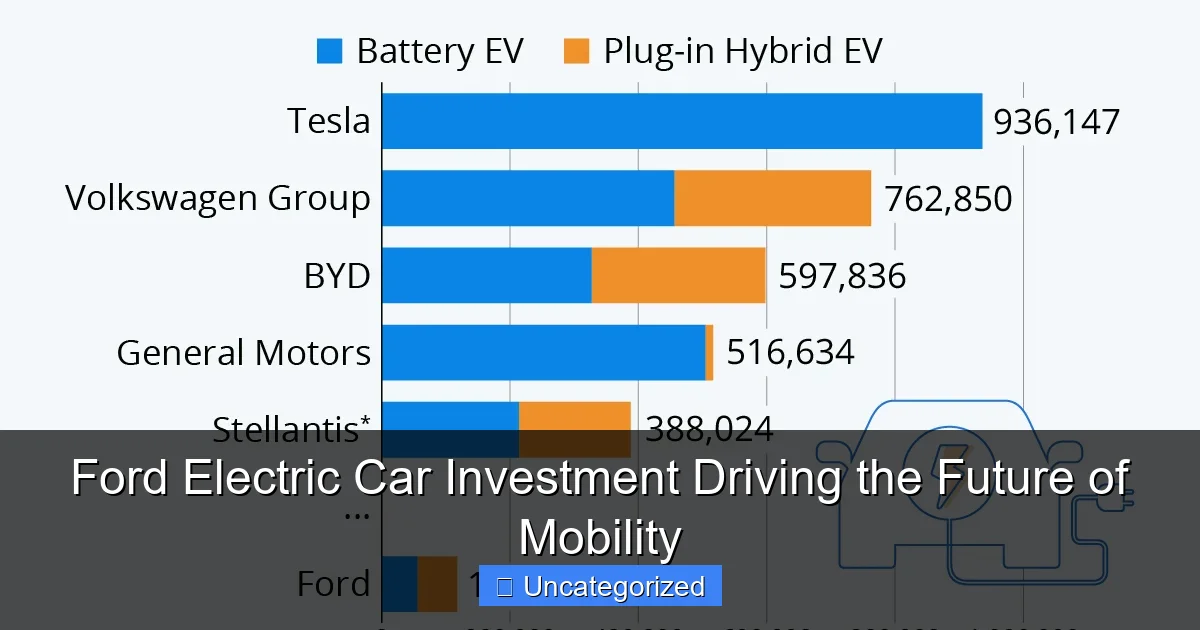
Ford is now the second-largest EV maker in the U.S. (after Tesla), with a market share of around 8% in 2023. The F-150 Lightning and Mach-E are among the top-selling EVs in their segments. Ford’s advantage lies in its ability to electrify high-volume models with strong brand loyalty.
Compared to rivals like GM and Stellantis, Ford has been more aggressive in EV investment and faster to market with compelling products. Its focus on trucks and SUVs—America’s most popular vehicle types—gives it a unique edge.
Data Table: Ford EV Sales and Production (2020–2023)
| Year | EV Models Sold | Total EV Units Sold | Production Capacity (Annual) | Key Milestones |
|---|---|---|---|---|
| 2020 | Mustang Mach-E | 27,140 | 50,000 | Mach-E launch; first OTA update |
| 2021 | Mach-E, E-Transit | 64,392 | 100,000 | E-Transit launch; F-150 Lightning reservations open |
| 2022 | Mach-E, F-150 Lightning, E-Transit | 101,800 | 200,000 | F-150 Lightning production begins; BlueOval Charge Network launch |
| 2023 | All models + Mach-E GT | 150,000+ | 300,000 | First gigafactory opens; 200,000 Lightning reservations |
Conclusion: A Bold Leap into the Electric Future
Ford’s electric car investment is more than a business decision—it’s a transformative journey that redefines what it means to be an automaker in the 21st century. By committing $50 billion to electrification, Ford is not only future-proofing its operations but also playing a pivotal role in the global transition to sustainable mobility. From the groundbreaking F-150 Lightning to the innovative BlueOval Charge Network, Ford is proving that legacy automakers can innovate at speed and scale.
For consumers, Ford’s EVs offer a compelling mix of performance, practicality, and technology—backed by a century of engineering excellence. For investors, the company presents a high-growth opportunity with strong fundamentals and a clear path to profitability. And for the planet, Ford’s shift to zero-emission vehicles contributes to cleaner air and reduced carbon emissions.
As Ford continues to expand its EV lineup, enhance its manufacturing capabilities, and improve the customer experience, one thing is certain: the future of mobility is electric, and Ford is driving it forward. Whether you’re buying your first EV or investing in the next big thing, Ford’s electric revolution is a journey worth watching—and joining.
Frequently Asked Questions
Why is Ford investing heavily in electric cars?
Ford’s electric car investment reflects its commitment to innovation, sustainability, and staying competitive in the rapidly evolving auto industry. The company aims to transition to a carbon-neutral future while meeting growing consumer demand for eco-friendly vehicles.
What are Ford’s top electric car models from this investment?
Ford’s electric car investment has produced standout models like the Mustang Mach-E, F-150 Lightning, and E-Transit van. These vehicles combine performance, range, and smart technology to appeal to diverse drivers.
How does Ford’s electric car investment compare to other automakers?
Ford is among the leaders in electric car investment, with $50 billion allocated through 2026—rivaling industry giants like GM and Volkswagen. Its focus on iconic models and scalable battery tech sets it apart.
When will Ford’s electric car investment start turning a profit?
Ford expects its electric vehicle segment to achieve profitability by late 2024 or early 2025, driven by cost reductions in battery production and rising sales of high-margin models like the F-150 Lightning.
What new technologies is Ford developing through its electric car investment?
Ford’s electric car investment includes advancements in solid-state batteries, over-the-air software updates, and automated driving features. These innovations aim to extend range, improve safety, and enhance user experience.
How is Ford supporting charging infrastructure for its electric cars?
Through its investment, Ford has partnered with charging networks to provide access to over 10,000 public stations via the FordPass app. The company also offers home charging solutions to ensure seamless ownership.