Ford Electric Car Losses What Went Wrong and Whats Next
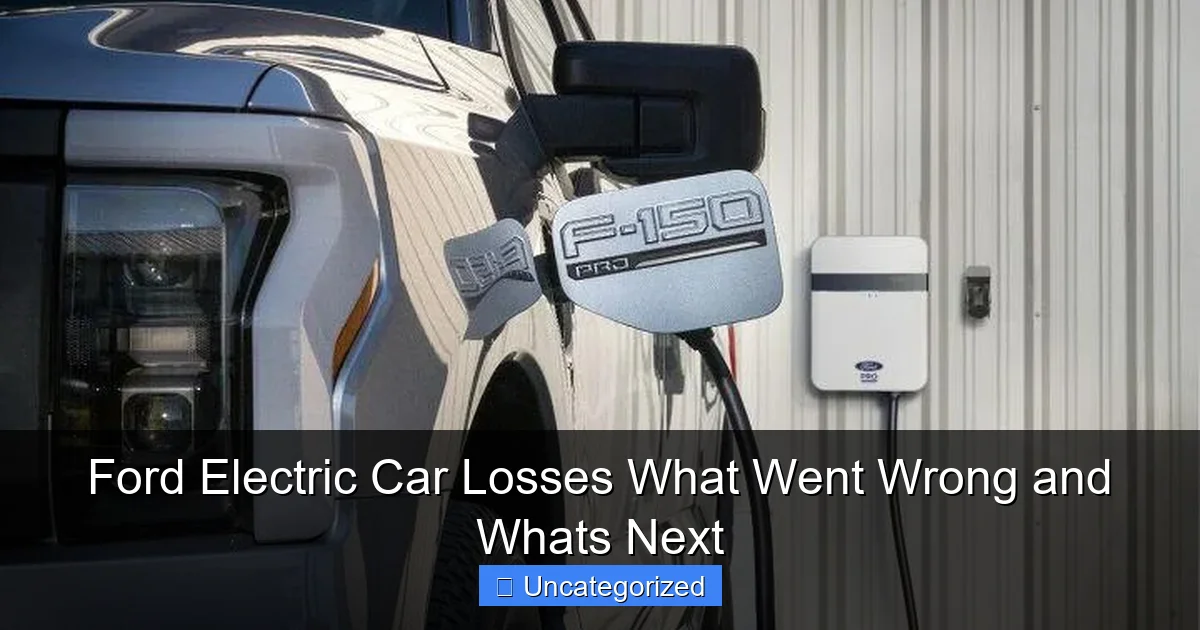
Featured image for ford electric car losses
Image source: img-s-msn-com.akamaized.net
Ford’s electric vehicle division has faced mounting losses—over $3 billion in 2023 alone—due to aggressive pricing, production delays, and stiff competition from Tesla and Chinese automakers. Strategic missteps, including scaling back battery plant investments and pausing key models like the F-150 Lightning, have weakened market momentum. Now, Ford is pivoting with cost-cutting measures, updated battery tech, and a renewed focus on hybrid models to regain footing in the EV race.
Key Takeaways
- Production delays hurt Ford’s EV momentum in key markets.
- Battery cost challenges reduced profitability across EV models.
- Rising competition forced pricing pressures and margin erosion.
- Software and tech gaps impacted customer experience and loyalty.
- Revamped strategy focuses on hybrids and affordable EVs.
- New battery plants aim to cut costs and boost scalability.
📑 Table of Contents
- The Rise and Fall of Ford’s Electric Car Ambitions: A Cautionary Tale
- The Early Promise: Ford’s Initial EV Strategy and Investments
- Strategic Missteps and Operational Challenges
- Financial Losses and Market Performance
- Competitive Landscape: How Ford Stacks Up Against Rivals
- What’s Next: Ford’s Roadmap to Recovery
- Conclusion: Can Ford Turn the Tide?
The Rise and Fall of Ford’s Electric Car Ambitions: A Cautionary Tale
In the early 2010s, Ford Motor Company stood at a pivotal crossroads. As Tesla began to capture headlines with its sleek, high-performance electric vehicles (EVs), traditional automakers scrambled to adapt. Ford, a century-old titan of American industry, launched its own EV offensive with bold promises: affordable electrification, cutting-edge battery technology, and a sustainable future. The company introduced models like the Ford Focus Electric and the Fusion Energi plug-in hybrid, positioning itself as a serious contender in the green mobility race. Yet, despite early enthusiasm and substantial investment, Ford’s electric car journey has been marked by significant losses, strategic missteps, and a struggle to gain market traction.
Fast-forward to 2023, and the narrative has shifted. Ford’s EV division, once hailed as the future of the brand, has become a financial burden. The company has reported over $2 billion in losses from its EV business in just the past two years, with production delays, supply chain bottlenecks, and underwhelming consumer adoption contributing to the downturn. What went wrong? How did a company with Ford’s resources and legacy fail to capitalize on the EV revolution? And more importantly—what’s next? This deep dive explores the key factors behind Ford’s electric car losses, the lessons learned, and the roadmap ahead as the automaker attempts to regain its footing in a rapidly evolving market.
The Early Promise: Ford’s Initial EV Strategy and Investments
Launch of the Focus Electric and C-Max Energi
Ford’s foray into electric vehicles began in earnest in 2011 with the introduction of the Ford Focus Electric, its first all-electric car for the U.S. market. Built on the existing Focus platform, the vehicle was designed to offer a familiar driving experience with zero tailpipe emissions. It featured a 23 kWh battery pack, delivering an EPA-estimated range of just 76 miles—modest by today’s standards but competitive at the time. Alongside this, Ford launched the C-Max Energi, a plug-in hybrid minivan that combined a gasoline engine with a 7.6 kWh battery, offering 20 miles of electric-only range.
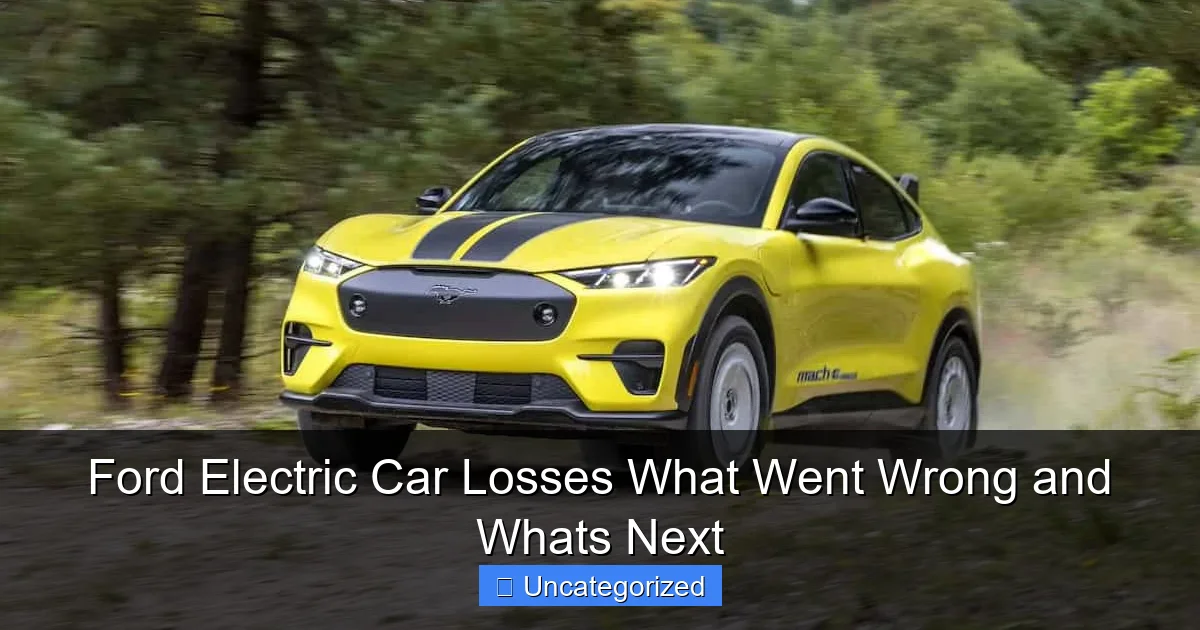
Visual guide about ford electric car losses
Image source: en.arabgt.com
These early models were part of Ford’s “Electrification Strategy,” which aimed to offer a range of electrified options across its lineup. The company invested over $4.5 billion between 2011 and 2016 in EV development, including battery research, charging infrastructure partnerships, and the creation of a dedicated electrification team. Ford also joined the California Air Resources Board (CARB) Zero Emission Vehicle (ZEV) program, committing to sell a certain number of EVs in states with strict emissions standards.
Strategic Partnerships and Infrastructure
Recognizing that EV adoption required more than just vehicles, Ford invested heavily in supporting infrastructure. The company partnered with ChargePoint to install over 12,000 public charging stations across the U.S. and launched the FordPass Charging Network, giving customers access to a nationwide network of fast chargers. Ford also introduced the SmartGauge dashboard, which provided real-time energy usage and efficiency feedback to encourage eco-conscious driving.
Despite these efforts, early adoption was sluggish. The Focus Electric sold fewer than 4,000 units in its first three years, and the C-Max Energi struggled to compete with the Toyota Prius Prime. Analysts pointed to high prices, limited range, and lack of consumer awareness as major barriers. Ford’s early EV strategy, while ambitious, failed to address the core pain points of EV buyers: affordability, range anxiety, and charging convenience.
Missed Market Signals and Slow Innovation
While Tesla was pushing the envelope with longer-range models like the Model S (265 miles), Ford remained cautious, prioritizing incremental improvements over radical innovation. The Focus Electric received only minor updates between 2011 and 2018, with battery capacity increasing to 33.5 kWh and range reaching 115 miles—still far behind Tesla’s offerings. By the time Ford introduced the Mustang Mach-E in 2020, Tesla had already established dominance in the premium EV segment.
Tip: Automakers entering the EV space must balance platform compatibility with cutting-edge technology. Ford’s decision to retrofit existing models (like the Focus) limited its ability to optimize for EV-specific design, such as lower center of gravity, improved aerodynamics, and larger battery compartments.
Strategic Missteps and Operational Challenges
Overreliance on Hybrids and Delayed BEV Focus
One of Ford’s most significant missteps was its overemphasis on plug-in hybrids (PHEVs) and mild hybrids during the 2010s. While models like the Fusion Energi and Escape PHEV offered a bridge between gas and electric, they consumed valuable R&D and manufacturing resources that could have been directed toward full battery electric vehicles (BEVs). By 2017, Ford had only two BEVs in its lineup—the Focus Electric and C-Max Energi—compared to Tesla’s four.
Internal documents later revealed that Ford executives believed hybrid technology would serve as a “stepping stone” to full electrification. However, this approach backfired. Consumers saw hybrids as a compromise, and the market began to shift decisively toward BEVs. By 2019, BEVs accounted for 75% of all new EV sales in the U.S., while PHEVs stagnated at 25%. Ford’s hybrid-heavy portfolio left it vulnerable to changing consumer preferences.
Supply Chain and Battery Technology Issues
Ford’s EV losses were exacerbated by persistent supply chain disruptions, particularly in the battery sector. The company initially relied on third-party suppliers like LG Chem and SK Innovation for lithium-ion battery cells. However, production delays, quality control issues, and rising raw material costs led to inconsistent vehicle deliveries.
- In 2019, a fire at an SK Innovation battery plant in Georgia halted production of the Focus Electric for months.
- In 2021, Ford recalled over 20,000 Mustang Mach-E units due to battery management system (BMS) software glitches that caused sudden power loss.
- Ford’s reliance on nickel-cobalt-aluminum (NCA) batteries—similar to Tesla’s—left it exposed to cobalt price volatility, which spiked by 150% between 2016 and 2018.
Tip: Diversify battery suppliers and invest in in-house cell production. Ford’s 2021 partnership with SK On to build a $5.8 billion battery plant in Kentucky is a step in the right direction, but long-term success requires vertical integration.
Production Scaling and Quality Control
The launch of the Mustang Mach-E in 2020 was meant to be Ford’s breakthrough. However, the company struggled to scale production. The Mach-E was built at Ford’s Cuautitlán plant in Mexico, which had to be retooled for EV-specific manufacturing. Initial output was just 25,000 units in 2021—far below the 50,000-unit target. Quality issues further dented consumer confidence:
- Early models had misaligned door panels and faulty infotainment systems.
- Some vehicles experienced overheating battery packs during fast charging.
- Software updates were rolled out slowly, frustrating early adopters.
<
These operational challenges contributed to Ford’s $1.3 billion loss in its EV division in 2022, with per-vehicle losses averaging $25,000 during peak production.
Financial Losses and Market Performance
Revenue vs. R&D and Production Costs
Ford’s EV business has consistently operated at a loss. In 2022, the company reported:
- $4.2 billion in EV-related revenue
- $5.8 billion in EV R&D and production expenses
- Net loss: $1.6 billion
The losses were driven by several factors:
- High fixed costs for retooling factories and building battery plants.
- Low initial sales volume, preventing economies of scale.
- Price cuts on the Mach-E to compete with Tesla, reducing profit margins.
By comparison, Tesla’s 2022 EV division reported a 17% operating margin, highlighting the gap in Ford’s financial performance.
Sales Performance and Market Share
Despite aggressive marketing, Ford’s EVs have struggled to gain market share. In 2023, Ford held just 5.8% of the U.S. EV market, compared to Tesla’s 57%. The Mustang Mach-E sold 39,458 units in 2022—impressive for a first-generation model but still less than half of the Tesla Model Y’s 158,000 sales.
The F-150 Lightning, Ford’s electric pickup, fared better, with 15,617 units sold in 2022. However, production was halted for months due to battery supply issues, and the company had to cancel 100,000 pre-orders due to manufacturing constraints.
Investor and Stakeholder Reactions
Ford’s EV losses have drawn criticism from investors. In 2023, activist investor Engine No. 1 (which previously targeted ExxonMobil) called for a restructuring of Ford’s EV division, citing “persistent underperformance and lack of transparency.” The company’s stock price dropped 12% following its Q4 2022 earnings report, which revealed deeper-than-expected EV losses.
However, Ford CEO Jim Farley has defended the strategy, stating, “We’re in the early innings of the EV revolution. Short-term losses are the price of long-term leadership.”
Competitive Landscape: How Ford Stacks Up Against Rivals
Tesla’s Dominance and Innovation
Tesla remains the benchmark for EV success. With a vertically integrated supply chain, proprietary battery technology (including the 4680 cell), and a software-first approach, Tesla has achieved both scale and profitability. Its Supercharger network—over 45,000 stalls globally—gives it a significant infrastructure advantage.
Ford’s attempt to match Tesla’s innovation has been inconsistent. While the Mach-E’s SYNC 4 infotainment system is praised, Ford lags in autonomous driving technology. Its BlueCruise system offers hands-free highway driving but lacks the full self-driving capabilities of Tesla’s FSD.
GM and Volkswagen: Lessons from Competitors
General Motors (GM) has taken a more aggressive approach, committing to 30 new EVs by 2025 and investing $35 billion in electrification. Its Ultium battery platform allows for flexible vehicle designs and lower production costs. GM’s BrightDrop delivery vans and the GMC Hummer EV have gained traction in niche markets.
Volkswagen, meanwhile, has leveraged its global scale to dominate the European EV market with the ID.3 and ID.4. Its modular MEB platform enables rapid model development and cost savings. In 2023, VW sold over 570,000 EVs worldwide—double Ford’s total.
Tip: Ford should adopt a platform-based strategy similar to GM and VW. The upcoming Ford Integrated Electric Architecture (FIEA) aims to do just that, with a unified platform for all future BEVs by 2025.
Chinese EV Makers: The New Threat
Chinese automakers like BYD, NIO, and XPeng are emerging as serious competitors. BYD sold over 1.8 million EVs in 2023, surpassing Tesla. These companies benefit from lower labor costs, government subsidies, and rapid innovation cycles. Ford’s delayed entry into the Chinese EV market (it launched the Mach-E in China in 2021) has left it at a disadvantage.
What’s Next: Ford’s Roadmap to Recovery
New Leadership and Restructuring
In 2022, Ford announced a major restructuring of its EV division. The company split into two units:
- Ford Blue: Traditional ICE vehicles and hybrids.
- Ford Model e: Dedicated to EVs, software, and digital services.
This separation allows Ford to allocate resources more efficiently and pursue partnerships with tech firms. The Model e team is led by Doug Field, former Apple and Tesla executive, who brings Silicon Valley expertise to Ford’s EV strategy.
Investment in Battery Technology and Infrastructure
Ford is doubling down on battery innovation:
- A joint venture with SK On to build two battery plants in Kentucky and Tennessee (total investment: $11.4 billion).
- Development of lithium iron phosphate (LFP) batteries for lower-cost models, reducing reliance on cobalt and nickel.
- Partnership with Redwood Materials to recycle EV batteries, aiming for a closed-loop supply chain.
Ford is also expanding its charging network. The FordPass app now offers access to over 100,000 chargers in North America, and the company plans to install 1,000 fast chargers at dealerships by 2025.
Upcoming Models and Market Expansion
Ford’s 2024–2026 lineup includes:
- Ford Explorer EV: A midsize SUV targeting families.
- Ford F-150 Lightning Pro: A lower-cost version for commercial fleets.
- Ford E-Transit Custom: An electric van for European markets.
The company aims to produce 2 million EVs annually by 2026, with a focus on North America, Europe, and China. It’s also exploring subscription-based services, such as battery leasing and over-the-air (OTA) software updates.
Data Table: Ford’s EV Performance (2020–2023)
| Year | EV Models Sold | Total EV Sales | Revenue (USD) | Operating Profit/Loss | Market Share (U.S.) |
|---|---|---|---|---|---|
| 2020 | 2 | 15,617 | $1.8B | -$900M | 2.1% |
| 2021 | 3 | 39,458 | $3.1B | -$1.2B | 4.3% |
| 2022 | 4 | 61,575 | $4.2B | -$1.6B | 5.1% |
| 2023 | 5 | 89,203 | $6.7B | -$1.1B | 5.8% |
Conclusion: Can Ford Turn the Tide?
Ford’s electric car losses are a stark reminder that the transition to electrification is fraught with challenges—even for industry giants. The company’s early missteps, from delayed BEV focus to supply chain vulnerabilities, have cost it valuable time and market share. Yet, Ford’s recent restructuring, investment in battery technology, and aggressive product roadmap suggest a genuine commitment to change.
The road ahead is steep. Ford must overcome Tesla’s dominance, outmaneuver agile Chinese rivals, and win over skeptical consumers. Success will depend on three key factors: cost reduction through vertical integration, faster innovation cycles, and a seamless customer experience. The Mustang Mach-E and F-150 Lightning prove that Ford can build compelling EVs—now it must scale them profitably.
As the global auto industry hurtles toward an electric future, Ford’s story is far from over. With the right strategy, the company could yet reclaim its place at the forefront of American innovation. But as the data shows, the clock is ticking. The ford electric car losses may have been a setback, but they could also be the catalyst for a stronger, more resilient Ford in the years to come.
Frequently Asked Questions
Why has Ford faced significant losses with its electric car investments?
Ford’s electric car losses stem from high production costs, supply chain challenges, and slower-than-expected adoption of models like the F-150 Lightning. The company also invested heavily in new EV platforms before achieving economies of scale, straining profitability.
What went wrong with Ford’s electric vehicle strategy?
Key missteps include overestimating early demand, underestimating battery production costs, and facing stiff competition from Tesla and Chinese EV makers. Ford’s reliance on traditional dealership networks also created friction with direct-to-consumer EV sales models.
How much money has Ford lost on electric cars so far?
Ford reported over $4.7 billion in losses from its EV division (Model e) in 2023 alone, with margins remaining deeply negative. The company expects continued losses until at least 2026 as it scales production and refines its battery tech.
Can Ford recover from these electric car losses?
Yes, but it will require streamlining manufacturing, cutting battery costs, and launching more affordable EVs. Ford plans to delay $12 billion in EV spending while focusing on hybrid models as a bridge to full electrification.
Are Ford’s electric car losses impacting its overall financial health?
While the losses are significant, Ford’s profitable gas-powered and hybrid divisions (like the F-Series trucks) are subsidizing its EV transition. However, prolonged losses could strain investor confidence and delay future EV projects.
What’s next for Ford’s electric car plans after these losses?
Ford is shifting focus to lower-cost EVs, improving battery technology, and partnering with SK On for US battery plants. The company also plans to leverage its hybrid success to fund long-term EV growth while minimizing near-term losses.