Ford Electric Car Range How Far Can You Go on a Single Charge
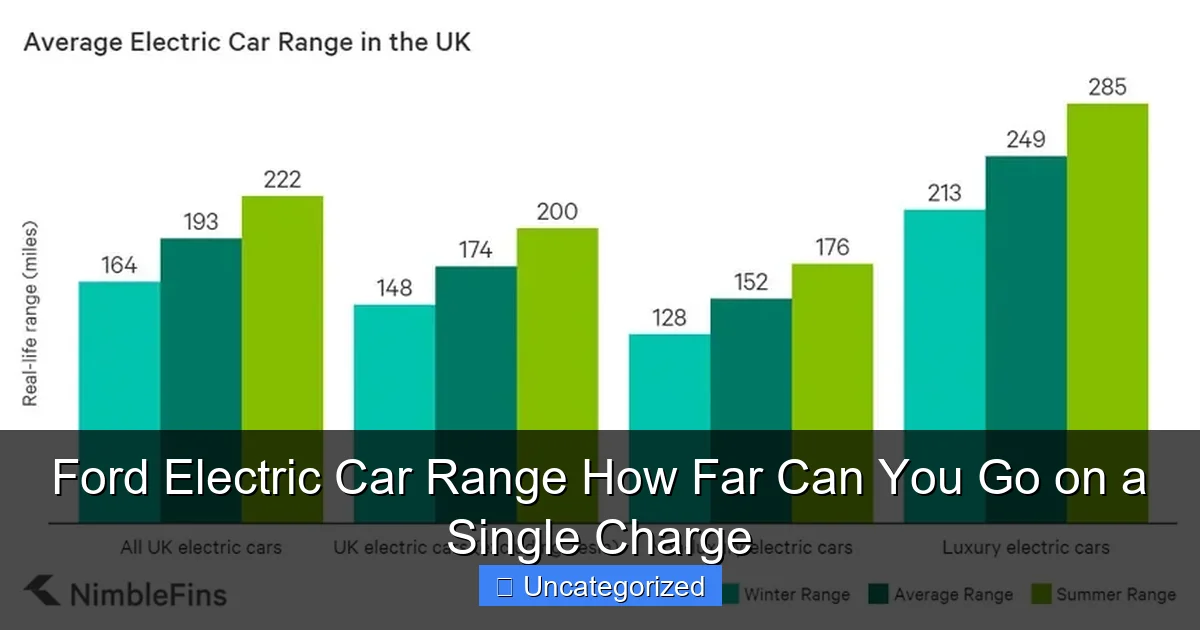
Featured image for ford electric car range
Image source: joosup.com
Ford electric cars offer a competitive range of up to 320 miles on a single charge, making them ideal for daily commutes and long-distance travel alike. With models like the Mustang Mach-E and F-150 Lightning, Ford combines power, efficiency, and cutting-edge battery tech to meet diverse driving needs.
Key Takeaways
- Max range reaches 300+ miles: Select Ford EVs offer over 300 miles on a single charge.
- Real-world range varies: Driving habits and terrain significantly impact actual battery performance.
- Fast charging saves time: DC fast charging restores 80% in under 45 minutes.
- Check EPA estimates: Always review official EPA ratings for accurate range comparisons.
- Climate affects efficiency: Cold weather can reduce range by up to 30%.
- Regen braking helps: Maximize range by using one-pedal driving and regen modes.
📑 Table of Contents
- The Future of Driving: Exploring Ford’s Electric Car Range
- Ford’s Current Electric Vehicle Lineup: Models and EPA Ranges
- Understanding Range: EPA vs. Real-World Performance
- Maximizing Your Ford EV’s Range: Pro Tips and Best Practices
- Charging Infrastructure and How It Impacts Range
- Comparing Ford EVs to Competitors: Range and Value
- Data Table: Ford Electric Car Range Comparison (2024 Models)
- Conclusion: How Far Can You Go on a Single Charge?
The Future of Driving: Exploring Ford’s Electric Car Range
The automotive world is undergoing a seismic shift, and at the forefront of this revolution is Ford Motor Company. Long known for its rugged trucks and iconic muscle cars, Ford is now making bold moves into the electric vehicle (EV) space, redefining what it means to drive an American-made EV. With rising fuel costs, growing environmental awareness, and rapid advancements in battery technology, electric vehicles are no longer a niche curiosity—they’re a practical, high-performance alternative to traditional internal combustion engines. Among the major automakers, Ford has emerged as a serious contender, offering a growing lineup of all-electric vehicles that combine innovation, style, and real-world usability.
One of the most critical factors for any EV buyer is range—how far can you go on a single charge? Range anxiety has long been a psychological barrier to EV adoption, but Ford is tackling this head-on with vehicles designed for both urban commuters and long-distance travelers. From the versatile Ford Mustang Mach-E to the groundbreaking Ford F-150 Lightning and the compact Ford E-Transit, Ford’s electric car range is engineered to meet diverse needs. In this comprehensive guide, we’ll dive deep into Ford’s current electric vehicle lineup, explore how their real-world range compares to EPA estimates, examine the factors that affect driving distance, and provide practical tips to maximize your battery life and efficiency. Whether you’re a first-time EV buyer or a seasoned driver considering a switch, this article will help you answer the essential question: How far can you go on a single charge with a Ford electric car?
Ford’s Current Electric Vehicle Lineup: Models and EPA Ranges
Ford’s electric vehicle portfolio has expanded rapidly in recent years, offering a range of vehicles that cater to different lifestyles, budgets, and driving needs. As of 2024, Ford’s all-electric lineup includes the Mustang Mach-E, F-150 Lightning, and E-Transit—each designed with unique features and range capabilities. Let’s break down each model and examine their official EPA-estimated ranges.
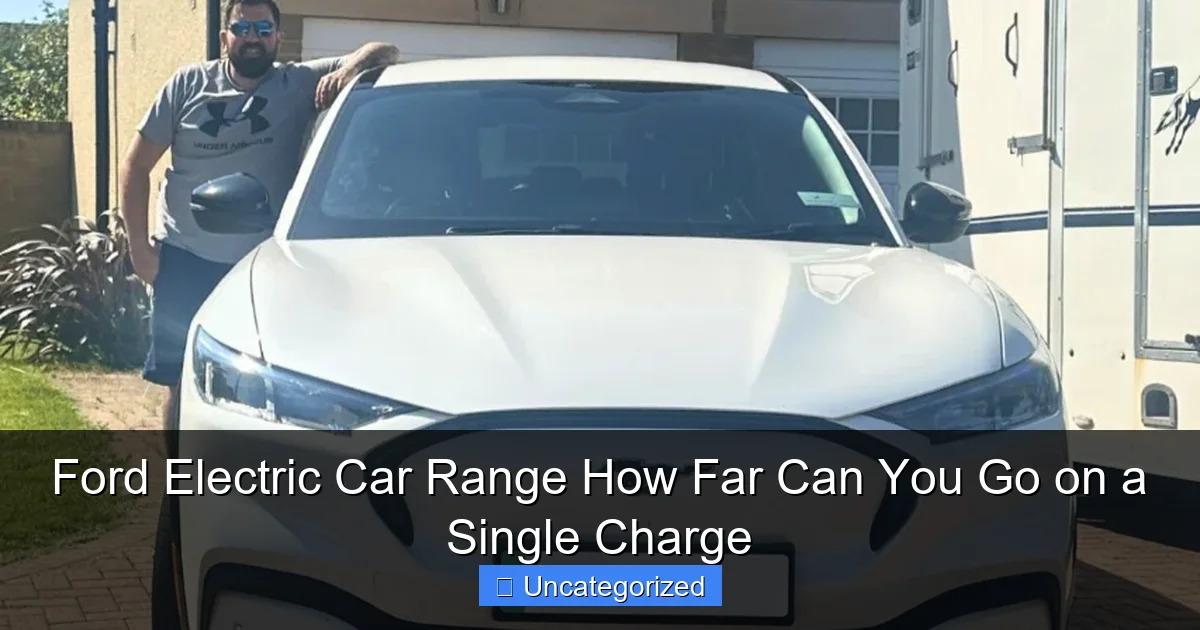
Visual guide about ford electric car range
Image source: images.squarespace-cdn.com
Ford Mustang Mach-E: The Electric SUV with Muscle
The Ford Mustang Mach-E is Ford’s first all-electric SUV and a direct competitor to the Tesla Model Y and Hyundai Ioniq 5. Launched in 2021, it combines the spirit of the Mustang with modern EV performance and practicality. The Mach-E is available in multiple trims and configurations, each offering different battery sizes and drivetrain options.
- Select RWD (Standard Range): 250 miles (EPA)
- Premium RWD (Extended Range): 310 miles (EPA)
- California Route 1 RWD (Extended Range): 314 miles (EPA) – the longest-range Mach-E
- GT AWD (Extended Range): 270 miles (EPA)
- GT Performance Edition: 260 miles (EPA)
For example, the California Route 1 trim is optimized for efficiency with aerodynamic wheels, low-rolling-resistance tires, and a single-speed transmission. This model is ideal for drivers who prioritize range over raw power. Meanwhile, the GT Performance Edition delivers 480 horsepower and 634 lb-ft of torque—perfect for thrill-seekers who still want over 250 miles of range.
Ford F-150 Lightning: The Electric Workhorse
The F-150 Lightning is a game-changer. As the first all-electric version of America’s best-selling vehicle, it brings Ford’s legendary truck durability into the EV era. With a focus on utility, towing, and daily driving, the Lightning offers impressive range and real-world versatility.
- Standard Range (4×4): 240 miles (EPA)
- Extended Range (4×4): 320 miles (EPA) – the longest-range Ford EV available
The Extended Range model uses a 131 kWh battery pack and features dual electric motors for all-wheel drive. It can tow up to 10,000 pounds and accelerate from 0 to 60 mph in under 4.5 seconds—making it both a workhorse and a performance machine. The Lightning also includes innovative features like a “Mega Power Frunk” (front trunk) and the ability to power your home during outages via Ford’s Intelligent Backup Power system.
Ford E-Transit: The Electric Van for Business and Delivery
Designed for commercial use, the E-Transit is Ford’s all-electric cargo van, aimed at fleets, delivery services, and small businesses. While not a consumer vehicle in the traditional sense, it’s a critical part of Ford’s electrification strategy.
- Low Roof (Standard Range): 126 miles (EPA)
- Medium Roof (Standard Range): 116 miles (EPA)
- High Roof (Standard Range): 108 miles (EPA)
Although the range is lower than passenger EVs, the E-Transit is optimized for urban delivery routes, where daily mileage is typically under 100 miles. Its 67 kWh battery supports 115 miles of real-world driving in city conditions, making it highly efficient for stop-and-go traffic.
Upcoming Models: What’s on the Horizon?
Ford has announced plans to expand its EV lineup with new models by 2025, including a three-row electric SUV (codenamed “Project T3”) and a smaller, more affordable EV platform. These future vehicles are expected to offer even greater range and charging speeds, leveraging next-gen battery technologies like lithium iron phosphate (LFP) and solid-state cells. Ford aims for 600,000 EVs annually by 2023 and 2 million by 2026, signaling a long-term commitment to electrification.
Understanding Range: EPA vs. Real-World Performance
When evaluating Ford electric car range, it’s crucial to understand the difference between official EPA estimates and real-world driving conditions. The EPA (Environmental Protection Agency) tests vehicles under controlled laboratory conditions, including city, highway, and combined cycles. While these figures provide a standardized benchmark, actual range can vary significantly based on driving habits, climate, terrain, and vehicle usage.
What Affects Real-World Range?
Several factors can reduce or enhance your Ford EV’s range. Here are the most significant:
- Temperature: Cold weather (< 32°F) can reduce battery efficiency by 20–40%. Lithium-ion batteries perform best at 60–80°F. Using climate control (heating or AC) draws power from the battery, further reducing range. For example, a Mustang Mach-E with a 314-mile EPA rating might deliver only 220 miles in winter with cabin heating.
- Driving Style: Aggressive acceleration and high speeds (above 70 mph) increase energy consumption. Smooth, moderate driving can extend range by 15–20%. Using regenerative braking effectively (e.g., “one-pedal driving”) also helps recover energy.
- Terrain and Elevation: Driving uphill requires more power, while downhill driving allows for energy regeneration. A route with 500 feet of elevation gain could reduce range by 5–10%.
- Vehicle Load: Carrying heavy cargo or towing trailers significantly impacts range. The F-150 Lightning loses about 20–25% of its range when towing a 5,000-pound trailer.
- Accessories: Using features like seat heaters, heated steering wheels, and infotainment systems consumes additional power. However, Ford’s heat pump (available on Mach-E and Lightning) is 3–5x more efficient than traditional electric heaters.
Real-World Range Examples
Let’s look at practical scenarios:
- Urban Commuter (Mach-E Premium, 310-mile EPA): Daily 30-mile round trip in moderate weather. With moderate AC use and regenerative braking, expect ~280–290 miles of real-world range.
- Highway Road Trip (F-150 Lightning Extended Range, 320-mile EPA): Driving 70 mph in 40°F weather with cabin heating. Range drops to ~240–260 miles due to cold and high speed.
- Winter Driving (E-Transit, 126-mile EPA): In 20°F conditions with frequent stops, range may fall to 90–100 miles. Preconditioning the battery while charging can mitigate this.
Tip: Use Ford’s SYNC 4A navigation system, which includes a “Charge Point” feature. It calculates range based on your route, weather, and driving history, providing accurate arrival charge predictions.
Maximizing Your Ford EV’s Range: Pro Tips and Best Practices
Getting the most out of your Ford electric car range isn’t just about driving slowly—it’s about smart, efficient habits. Here are proven strategies to extend your battery life and driving distance.
1. Leverage Regenerative Braking
All Ford EVs feature regenerative braking, which converts kinetic energy back into stored electricity when decelerating. The Mach-E and Lightning offer multiple regen modes:
- Low: Gentle deceleration, ideal for highway driving.
- Medium/High: Stronger regen, enabling “one-pedal driving” in city traffic. This can recover up to 15% of energy.
Example: In stop-and-go traffic, using high regen can add 20–30 miles to your daily range.
2. Optimize Climate Control
Heating and cooling are the biggest energy drains after driving. Use these tips:
- Precondition the cabin while charging: Heat or cool the car while plugged in—this uses grid power, not battery.
- Use seat and steering wheel heaters: These use 5–10% less energy than full cabin heating.
- Activate the heat pump (if equipped): Found on Mach-E and Lightning, it’s far more efficient than resistive heating.
3. Maintain Proper Tire Pressure
Underinflated tires increase rolling resistance, reducing range. Check tire pressure monthly. Ford recommends 35–38 PSI for Mach-E and 45 PSI for F-150 Lightning. Proper inflation can improve range by 3–5%.
4. Plan Routes with FordPass and Navigation
The FordPass app and SYNC 4A navigation system help you plan trips with charging stops. Features include:
- Real-time battery level and charging station availability
- Route optimization based on terrain and weather
- Remote start and preconditioning
Pro Tip: Set your navigation to “Eco Route” for the most efficient path.
5. Avoid Extreme Charging States
While modern Ford EVs have battery management systems (BMS), it’s best to:
- Keep battery between 20% and 80% for daily use (maximizes lifespan)
- Only charge to 100% before long trips
- Avoid frequent DC fast charging (can degrade battery over time)
Charging Infrastructure and How It Impacts Range
Even with a high Ford electric car range, access to reliable charging is essential. Ford is investing heavily in charging solutions to support its EV customers.
Home Charging: Level 1 vs. Level 2
- Level 1 (120V): Adds 3–5 miles of range per hour. Suitable for overnight charging of low-mileage drivers (e.g., E-Transit users).
- Level 2 (240V): Adds 20–30 miles per hour. Ford recommends installing a Level 2 charger (Ford Connected Charge Station) for all EV owners. It takes 8–10 hours to fully charge a Mach-E or 10–12 hours for an F-150 Lightning.
Tip: Schedule charging during off-peak hours (e.g., midnight to 6 AM) to save on electricity costs.
Public and DC Fast Charging
Ford EVs support DC fast charging (CCS1 connector) and can charge at rates up to:
- Mustang Mach-E: 150 kW (10–80% in ~45 minutes)
- F-150 Lightning: 150 kW (10–80% in ~41 minutes)
- E-Transit: 115 kW (10–80% in ~34 minutes)
Ford has partnered with BlueOval Charge Network, which includes over 10,000 fast chargers across North America. FordPass users get access to discounted rates and real-time station availability.
Charging on Road Trips: A Practical Example
Planning a 400-mile trip in a Lightning Extended Range (320-mile EPA):
- Start with 95% charge (304 miles range)
- Drive 250 miles, arrive with 54 miles remaining
- Stop at a BlueOval fast charger (150 kW), charge to 80% (~256 miles range)
- Complete the remaining 150 miles
Total charging time: ~30 minutes. Use FordPass to locate chargers and monitor battery.
Comparing Ford EVs to Competitors: Range and Value
How does Ford electric car range stack up against key competitors? Let’s compare top models in each category.
SUVs: Ford Mustang Mach-E vs. Tesla Model Y, Hyundai Ioniq 5
- Ford Mustang Mach-E (California Route 1): 314 miles (EPA)
- Tesla Model Y Long Range: 330 miles (EPA)
- Hyundai Ioniq 5 Long Range RWD: 303 miles (EPA)
While the Model Y leads in range, the Mach-E offers more cargo space (34.4 cu ft vs. 30.2 cu ft) and a lower starting price ($42,895 vs. $47,740). The Ioniq 5 has faster 800V charging (10–80% in 18 minutes), but the Mach-E’s 4G/5G connectivity and SYNC 4A system provide superior infotainment.
Trucks: Ford F-150 Lightning vs. Rivian R1T, Chevrolet Silverado EV
- Ford F-150 Lightning (Extended Range): 320 miles (EPA)
- Rivian R1T (Large Pack): 314 miles (EPA)
- Chevrolet Silverado EV (WT): 400 miles (EPA) – but only for fleet models; retail models start at 350 miles
The Lightning offers the best value: starting at $49,995 (after tax credit), it’s $15,000 cheaper than the R1T and includes Ford’s Pro Power Onboard (9.6 kW of exportable power). The Silverado EV has higher range but limited availability and higher pricing.
Commercial Vans: Ford E-Transit vs. Mercedes eSprinter, Ram ProMaster EV
- Ford E-Transit (Low Roof): 126 miles (EPA)
- Mercedes eSprinter (Standard Roof): 105 miles (EPA)
- Ram ProMaster EV (Coming 2024): Estimated 162 miles (EPA)
The E-Transit leads in payload capacity (3,800 lbs) and has the most established service network. Its range is sufficient for 90% of urban delivery routes.
Data Table: Ford Electric Car Range Comparison (2024 Models)
| Model | Trim | Battery Size (kWh) | EPA Range (Miles) | DC Fast Charging (10–80%) | Starting MSRP |
|---|---|---|---|---|---|
| Mustang Mach-E | California Route 1 (RWD) | 91 | 314 | ~45 min (150 kW) | $51,500 |
| Mustang Mach-E | GT (AWD) | 91 | 270 | ~45 min (150 kW) | $61,500 |
| F-150 Lightning | Extended Range (4×4) | 131 | 320 | ~41 min (150 kW) | $69,995 |
| F-150 Lightning | Standard Range (4×4) | 98 | 240 | ~40 min (150 kW) | $49,995 |
| E-Transit | Low Roof (Standard Range) | 67 | 126 | ~34 min (115 kW) | $51,985 |
Conclusion: How Far Can You Go on a Single Charge?
Ford’s electric car range is no longer a compromise—it’s a competitive advantage. With the F-150 Lightning offering 320 miles of EPA-estimated range, the Mustang Mach-E reaching 314 miles, and the E-Transit delivering over 100 miles for urban fleets, Ford has built a lineup that meets real-world needs. These vehicles aren’t just about distance; they’re about freedom—the freedom to commute, explore, work, and adventure without the limitations of range anxiety.
But as we’ve seen, Ford electric car range is influenced by more than just battery size. Weather, driving habits, terrain, and charging habits all play a role. By leveraging regenerative braking, preconditioning, smart route planning, and efficient climate control, you can maximize every mile. Ford’s investment in charging infrastructure—through the BlueOval Network and home charging solutions—ensures that range is only as limited as your journey demands.
Looking ahead, Ford’s commitment to electrification promises even greater range, faster charging, and more affordable options. The future of driving is electric, and Ford is leading the charge. So, how far can you go on a single charge? With Ford, the answer is: farther than you think. Whether you’re navigating city streets, towing a trailer to the mountains, or delivering packages downtown, Ford’s EVs are built to go the distance—and then some. The road ahead is electric, and Ford is paving the way.
Frequently Asked Questions
What is the average Ford electric car range on a single charge?
The average Ford electric car range varies by model but typically spans 230–320 miles. For example, the Mustang Mach-E offers up to 314 miles, while the F-150 Lightning ranges up to 320 miles in its extended-range version.
Which Ford electric car has the longest range?
The Ford F-150 Lightning with the extended-range battery currently leads with a maximum range of 320 miles. The Mustang Mach-E follows closely with a 314-mile range in its California Route 1 trim.
How does Ford electric car range compare to competitors like Tesla?
Ford’s range competes well with Tesla’s entry-level models, offering comparable or slightly lower numbers. For instance, the Mustang Mach-E matches the Tesla Model Y’s range, while the F-150 Lightning outperforms the Cybertruck’s base range.
Does driving style affect Ford electric car range?
Yes, aggressive acceleration, high speeds, and frequent use of climate control can reduce range by up to 20%. Smooth driving and using regenerative braking can help maximize your Ford’s electric car range.
Can cold weather reduce Ford electric car range?
Yes, extreme cold can reduce range by 20–30% due to battery efficiency loss and cabin heating demands. Preconditioning the battery while plugged in helps mitigate this impact.
How do I check the real-time range of my Ford electric car?
Your Ford’s touchscreen displays real-time range estimates, factoring in terrain, speed, and climate settings. The FordPass app also provides range tracking and charging station locations.