Ford Electric Car Warranty What You Need to Know Before Buying
Featured image for ford electric car warranty
Image source: res.cloudinary.com
Ford’s electric car warranty offers 8 years/100,000 miles of coverage on the battery and electric components, giving buyers long-term peace of mind. This comprehensive protection surpasses many competitors, making it a standout choice for EV shoppers prioritizing reliability and value. Always check for model-specific terms and available extensions before purchasing.
Key Takeaways
- Check coverage duration: Ford offers 8-year/100,000-mile battery warranty—verify remaining term before buying used.
- Understand exclusions: Normal wear and cosmetic damage aren’t covered under the EV warranty.
- Transferability matters: Warranty transfers to new owners, boosting resale value—confirm with Ford.
- Track software updates: Ford includes complimentary updates—ask about update scheduling and benefits.
- Review roadside assistance: Free 24/7 support for EVs—know what’s covered during emergencies.
- Document maintenance: Keep records to avoid voiding warranty—use certified Ford service centers.
📑 Table of Contents
- Understanding the Ford Electric Car Warranty: A Smart Buyer’s Guide
- 1. Ford’s Standard Electric Vehicle Warranty Coverage
- 2. The High-Voltage Battery Warranty: What’s Covered and What’s Not
- 3. Additional Warranties and Roadside Assistance
- 4. How Ford’s EV Warranty Compares to Competitors
- 5. Maximizing Your Warranty: Tips for Long-Term EV Ownership
- 6. The Bottom Line: Is Ford’s EV Warranty Worth It?
Understanding the Ford Electric Car Warranty: A Smart Buyer’s Guide
The electric vehicle (EV) revolution is no longer a distant future—it’s here, and Ford is leading the charge with its bold commitment to an all-electric lineup by 2030. With models like the Ford F-150 Lightning, Mustang Mach-E, and the upcoming E-Transit van, Ford is proving that American automakers can deliver high-performance, reliable electric vehicles. But as exciting as these innovations are, one critical question remains for prospective buyers: What does the Ford electric car warranty cover, and how does it compare to traditional vehicle warranties?
When investing in an electric car, especially one with advanced battery technology and software-driven systems, understanding the warranty isn’t just a formality—it’s a necessity. Unlike internal combustion engine (ICE) vehicles, EVs have unique components like high-voltage battery packs, electric motors, and regenerative braking systems, all of which require specialized coverage. Ford’s warranty structure reflects this shift, offering a mix of traditional and EV-specific protections. This guide will walk you through everything you need to know about the Ford electric car warranty, from battery longevity to roadside assistance, so you can make a confident, informed purchase decision.
1. Ford’s Standard Electric Vehicle Warranty Coverage
Ford’s warranty for its electric vehicles is designed to provide peace of mind across multiple systems, combining traditional mechanical protection with specialized coverage for electric components. The warranty is structured into distinct categories, each with its own duration and scope. Here’s a breakdown of the core protections included in the Ford electric car warranty.
Visual guide about ford electric car warranty
Image source: imgv2-1-f.scribdassets.com
Basic Limited Warranty (Bumper-to-Bumper)
All new Ford EVs come with a 3-year/36,000-mile basic limited warranty, also known as the bumper-to-bumper warranty. This coverage applies to nearly every component of the vehicle, excluding wear-and-tear items like brake pads, wiper blades, and tires. It protects against defects in materials or workmanship, including the electric motor, power electronics, charging port, HVAC system, and infotainment hardware.
For example, if your Mustang Mach-E’s touchscreen freezes due to a manufacturing flaw, or the E-Transit’s electric motor fails prematurely, this warranty will cover the repair or replacement. However, it’s important to note that this warranty does not cover damage from misuse, accidents, or improper maintenance.
Tip: Always keep service records and avoid aftermarket modifications during the first three years to maintain full coverage eligibility.
Powertrain Limited Warranty
While EVs don’t have traditional engines or transmissions, Ford still offers a 5-year/60,000-mile powertrain warranty that covers the electric motor, power electronics (inverter, DC-DC converter), and the battery management system (BMS). This is a critical layer of protection, as these components are expensive to replace—often costing thousands of dollars out of pocket.
For instance, if your F-150 Lightning’s inverter fails at 40,000 miles due to a defect, Ford will repair or replace it at no cost. This warranty is transferable to subsequent owners, which can enhance resale value.
Corrosion and Paint Warranty
Ford provides a 5-year/unlimited-mileage corrosion warranty for perforation rust (holes through the metal body panels) and a 5-year/100,000-mile paint warranty for defects like peeling, cracking, or blistering. While these may seem less relevant to EVs, they’re still important—especially if you live in coastal or high-humidity areas where salt and moisture accelerate corrosion.
Practical Tip: Regularly wash and wax your EV, especially during winter months, to prevent surface rust and maintain warranty compliance.
2. The High-Voltage Battery Warranty: What’s Covered and What’s Not
The high-voltage battery is the heart of any electric car, and Ford recognizes its importance by offering one of the most comprehensive battery warranties in the industry. This is arguably the most critical aspect of the Ford electric car warranty for long-term ownership.
8-Year/100,000-Mile Battery Warranty
All Ford EVs come with a 8-year/100,000-mile warranty on the high-voltage battery pack. This warranty covers defects in materials or workmanship, including cell failure, module degradation, and BMS malfunctions. Crucially, it also includes capacity loss protection—if the battery’s usable capacity drops below 70% within the warranty period, Ford will repair or replace it.
For example, if your 2023 Mustang Mach-E’s battery degrades to 65% capacity after 7 years and 90,000 miles, Ford will intervene. This is a significant advantage over some competitors, who only cover capacity loss if it’s due to a specific defect, not normal aging.
Note: The 70% threshold is based on Ford’s internal testing and is verified using a diagnostic scan at a Ford-certified service center.
What’s Excluded from Battery Coverage
While the battery warranty is robust, it’s not all-encompassing. Ford excludes coverage for:
- Damage from accidents or misuse (e.g., deep discharges, overheating due to faulty charging).
- Improper charging habits such as consistently charging to 100% or leaving the vehicle at 0% for extended periods (though Ford’s battery management system mitigates these risks).
- Aftermarket modifications that affect battery performance (e.g., third-party charging hardware).
- Normal wear and tear beyond the 70% capacity threshold after the warranty expires.
Pro Tip: Use Ford’s “Daily” charging mode (80% max) for everyday use and reserve 100% charges for road trips. This helps preserve battery health and avoids unnecessary stress.
Extended Battery Warranty Options
Ford offers Ford Protect Extended Service Plans that can extend battery coverage up to 10 years/150,000 miles. These plans are optional but highly recommended for buyers planning to keep their EV beyond the standard warranty period. Pricing varies by model and coverage level, but a typical battery extension costs between $1,500 and $3,000.
Example: A 2024 F-150 Lightning owner could purchase a 10-year/120,000-mile battery extension for $2,200, ensuring coverage until the vehicle is over a decade old.
3. Additional Warranties and Roadside Assistance
Beyond the core mechanical and battery warranties, Ford provides several supplementary protections that enhance the ownership experience of its electric vehicles.
Federal Emissions Warranty (EV-Specific)
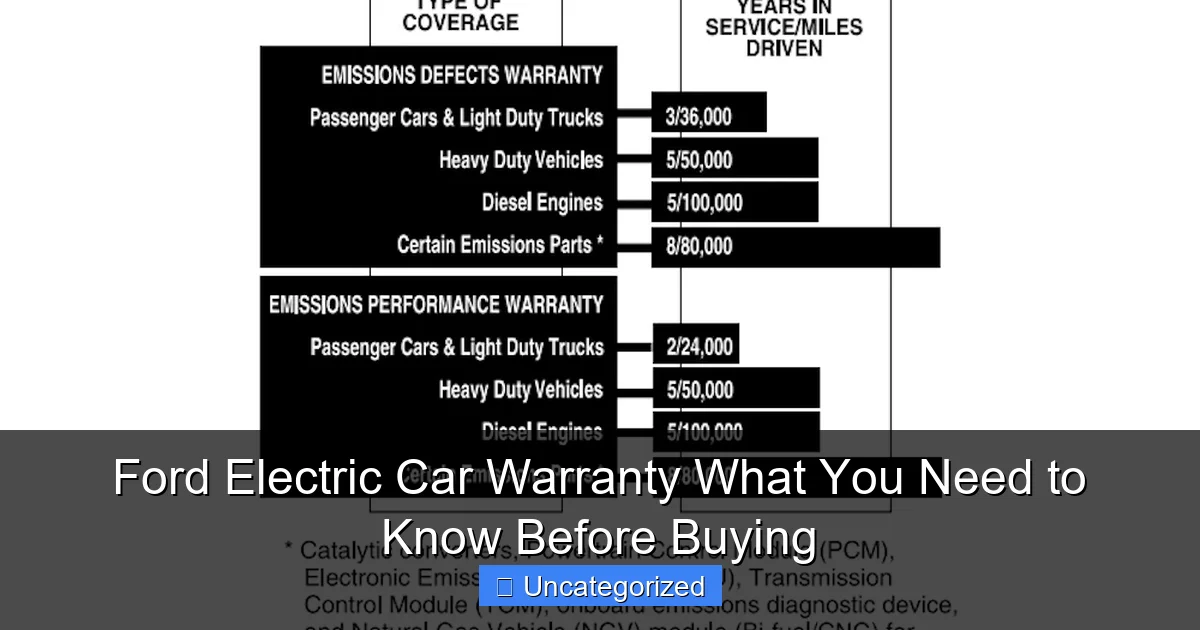
Under the Clean Air Act, Ford must provide an 8-year/80,000-mile warranty on emissions-related components, including the catalytic converter (though less relevant for EVs) and EV-specific systems like the electric drive unit and battery cooling system. This warranty is federally mandated and applies in all 50 states.
For example, if the battery cooling pump fails at 50,000 miles, causing overheating, this warranty covers the repair—even if it’s outside the basic warranty period.
Roadside Assistance: 24/7 EV Support
Ford offers 5 years of complimentary roadside assistance for all new EVs, which is especially valuable for electric vehicles. Services include:
- EV-specific towing to the nearest Ford dealer or charging station (not just any repair shop).
- Mobile charging assistance if your vehicle runs out of charge (Ford partners with third-party services to deliver portable chargers).
- Jump-starting (12V battery), tire changes, lockout assistance, and fuel delivery (for hybrid models).
Real-World Scenario: If your E-Transit van is stranded at a job site with a dead 12V battery, Ford will dispatch a technician with a mobile charger to get you back on the road.
Software and Over-the-Air (OTA) Updates
Ford EVs receive regular OTA updates to improve performance, fix bugs, and add new features. While not a traditional “warranty,” Ford guarantees that these updates will not degrade core vehicle functions. If an update causes a malfunction (e.g., a bug that disables regenerative braking), Ford will roll back the update or issue a patch at no cost.
Tip: Keep your vehicle connected to Wi-Fi to ensure timely updates and maintain warranty compliance.
4. How Ford’s EV Warranty Compares to Competitors
When shopping for an electric car, comparing warranties is essential. Ford’s offerings stack up favorably against key competitors like Tesla, Chevrolet, and Hyundai. Below is a detailed comparison of warranty terms across major EV brands.
Warranty Comparison Table
| Brand & Model | Battery Warranty | Basic Warranty | Powertrain Warranty | Roadside Assistance | Capacity Loss Coverage |
|---|---|---|---|---|---|
| Ford Mustang Mach-E | 8 years/100,000 miles (70% min. capacity) | 3 years/36,000 miles | 5 years/60,000 miles | 5 years (EV-specific) | Yes (70% threshold) |
| Tesla Model Y | 8 years/120,000 miles (70% for Long Range) | 4 years/50,000 miles | 4 years/50,000 miles | 4 years/50,000 miles | Yes (model-dependent) |
| Chevrolet Bolt EV | 8 years/100,000 miles (60% min. capacity) | 3 years/36,000 miles | 5 years/60,000 miles | 5 years | Yes (60% threshold) |
| Hyundai Ioniq 5 | 10 years/100,000 miles (70% min. capacity) | 5 years/60,000 miles | 10 years/100,000 miles | 5 years | Yes (70% threshold) |
| Toyota bZ4X | 8 years/100,000 miles (70% min. capacity) | 3 years/36,000 miles | 5 years/60,000 miles | 3 years | Yes (70% threshold) |
Key Takeaways from the Comparison
- Hyundai and Kia lead with 10-year/100,000-mile warranties, but Ford’s 8-year coverage is still competitive.
- Tesla offers longer basic and powertrain warranties (4 years), but Ford provides better roadside assistance duration.
- Chevrolet has a lower capacity threshold (60%), making Ford’s 70% standard more generous.
- Ford’s EV-specific roadside assistance is a standout feature, especially for commercial users.
Insight: While Ford doesn’t have the longest warranty in every category, its balanced approach—combining strong battery protection, EV-focused roadside help, and transferable coverage—makes it a top choice for most buyers.
5. Maximizing Your Warranty: Tips for Long-Term EV Ownership
Getting the most out of your Ford electric car warranty requires proactive maintenance and smart ownership habits. Here are actionable tips to ensure your EV stays protected and performs at its best.
Follow the Maintenance Schedule
Ford EVs require less maintenance than ICE vehicles, but they still need regular checkups. Refer to your owner’s manual for a maintenance schedule that includes:
- Every 10,000 miles: Tire rotation, cabin air filter inspection.
- Every 20,000 miles: Brake system check, battery coolant inspection.
- Every 60,000 miles: High-voltage battery system inspection, brake fluid replacement.
Why It Matters: Skipping inspections can void warranty coverage for related components. For example, failing to check brake fluid could lead to corrosion in the regenerative braking system.
Use FordPass and Connected Services
The FordPass app provides real-time diagnostics, charging station navigation, and remote climate control. It also logs your vehicle’s health data, which can help prove warranty claims. Enable connected vehicle services to receive proactive alerts (e.g., low battery coolant level).
Charge Smartly
While Ford’s battery warranty is generous, poor charging habits can still lead to premature degradation. Follow these best practices:
- Use 80% as your daily charging limit (set in the app or vehicle settings).
- Avoid frequent DC fast charging (use Level 2 charging at home/work).
- Don’t leave the battery at 0% or 100% for extended periods (e.g., overnight).
Document Everything
Keep records of all services, repairs, and charging habits. Save receipts for Ford-certified parts and services. This documentation is crucial if you need to file a warranty claim later.
Example: If you replace a charging port at a third-party shop, Ford may deny a related warranty claim due to non-compliance with OEM parts.
Consider an Extended Service Plan
If you plan to keep your EV beyond 8 years, explore Ford Protect Extended Service Plans. These can cover battery replacements, power electronics, and even software issues. Compare costs with the potential repair expenses to determine if it’s worth the investment.
6. The Bottom Line: Is Ford’s EV Warranty Worth It?
Ford’s electric car warranty is a well-rounded package that addresses the unique needs of EV owners. With 8 years/100,000 miles of battery coverage, EV-specific roadside assistance, and capacity loss protection, Ford provides robust safeguards against the biggest concerns of electric vehicle ownership: battery degradation, high repair costs, and roadside emergencies.
Compared to competitors, Ford strikes a balance between length of coverage and real-world usability. While Hyundai offers longer warranties, Ford’s EV-focused features—like mobile charging assistance and OTA update guarantees—make it a more practical choice for everyday drivers. The ability to extend battery coverage and the transferability of warranties also add significant long-term value.
Ultimately, the Ford electric car warranty is not just a safety net—it’s a strategic advantage. By understanding what’s covered, following maintenance best practices, and leveraging Ford’s connected services, you can drive with confidence, knowing that your investment is protected. Whether you’re buying a Mustang Mach-E for daily commutes or an F-150 Lightning for heavy-duty work, Ford’s warranty gives you the peace of mind to embrace the electric future without compromise.
Frequently Asked Questions
What does the Ford electric car warranty cover?
The Ford electric car warranty includes an 8-year/100,000-mile battery and electric component warranty, covering defects in materials and workmanship. It also includes roadside assistance and a standard 3-year/36,000-mile bumper-to-bumper warranty for other vehicle parts.
How long is the battery warranty on a Ford electric car?
Ford offers an 8-year or 100,000-mile warranty on the high-voltage battery and related electric components, whichever comes first. This ensures peace of mind for long-term ownership of your Ford EV.
Does the Ford electric car warranty transfer to a new owner?
Yes, the Ford electric car warranty is transferable to subsequent owners within the warranty period, which can increase resale value. Be sure to provide proper documentation when transferring ownership.
Are there any limitations to the Ford EV warranty?
The warranty does not cover damage from accidents, misuse, or normal wear and tear. Always review the full terms of the Ford electric car warranty to understand what is excluded.
Does Ford offer an extended warranty for electric cars?
Yes, Ford provides optional extended service plans for electric vehicles, which can extend coverage beyond the standard warranty. These plans can be customized to fit your driving habits and needs.
Is regular maintenance covered under the Ford electric car warranty?
Routine maintenance like tire rotations and brake inspections are not included in the warranty but are recommended to keep your vehicle in top condition. However, warranty-covered repairs for defective parts are fully handled by Ford.