Ford Focus Electric Battery Care Tips for Longer Life

Featured image for ford focus electric battery care
Image source: i.ytimg.com
Proper battery care is essential to maximize the lifespan and performance of your Ford Focus Electric. Avoid frequent deep discharges and extreme temperatures, as these significantly degrade lithium-ion battery health over time. Regularly charging between 20% and 80% and using scheduled charging features can help maintain long-term battery efficiency and range.
Key Takeaways
- Charge smartly: Keep battery between 20%-80% for optimal longevity.
- Avoid extreme temps: Park in shade or garage to reduce thermal stress.
- Use scheduled charging: Set charging times to avoid overcharging and grid strain.
- Limit fast charging: Use Level 2 chargers more frequently for battery health.
- Monitor software updates: Ensure battery management system is always up-to-date.
- Drive regularly: Maintain battery health with consistent use and full cycles.
📑 Table of Contents
- Understanding the Ford Focus Electric Battery System
- Optimal Charging Practices to Minimize Degradation
- Temperature Management: Protecting Your Battery from Heat and Cold
- Driving Habits That Impact Battery Health
- Monitoring Battery Health and Early Warning Signs
- Professional Maintenance and Warranty Coverage
- Conclusion: Building a Sustainable Battery Care Routine
Understanding the Ford Focus Electric Battery System
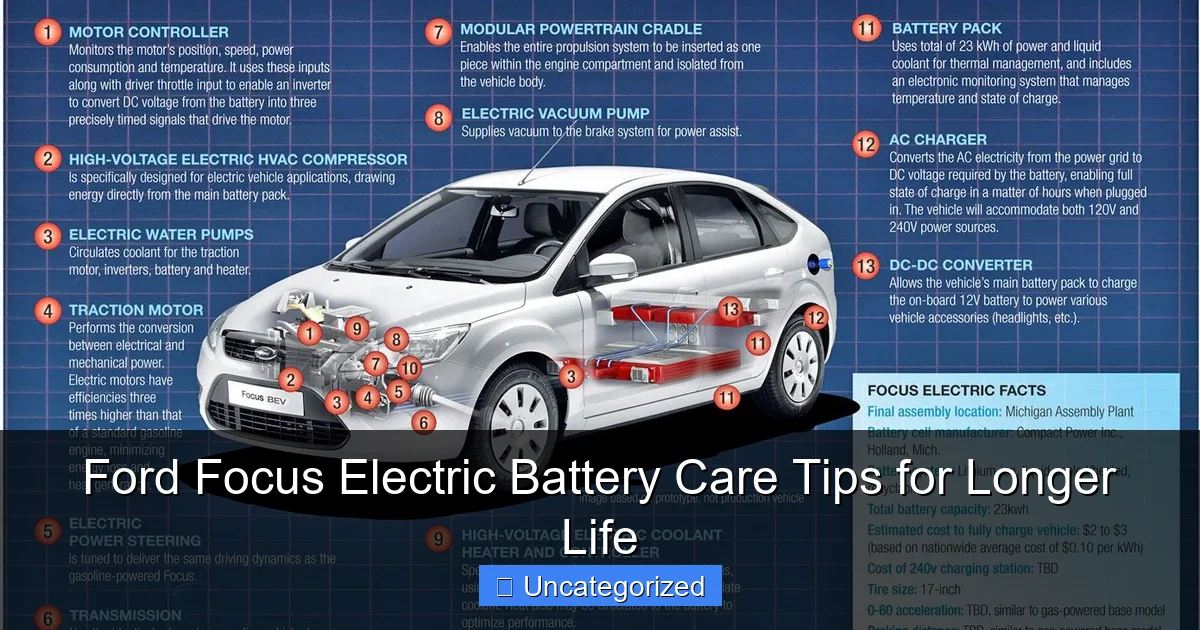
How the Lithium-Ion Battery Works
The Ford Focus Electric relies on a 33.5 kWh lithium-ion battery pack that powers its electric motor, delivering an EPA-estimated range of 115 miles on a full charge. Unlike traditional internal combustion engines, the electric drivetrain depends entirely on this advanced battery system, which operates using a combination of nickel-manganese-cobalt (NMC) chemistry. This chemistry offers a balance between energy density, lifespan, and thermal stability, making it ideal for daily commuting and urban driving.
Each battery pack contains hundreds of individual cells grouped into modules, monitored by a Battery Management System (BMS). The BMS continuously tracks voltage, temperature, and state of charge (SOC) to prevent overcharging, overheating, and deep discharging—key factors in maintaining battery health. For instance, when you plug in your Focus Electric, the BMS ensures the battery charges only up to 80-90% during regular use unless you activate the “full charge” mode for longer trips.
Why Battery Care Matters for Longevity
Proper battery care isn’t just about maximizing range—it’s about preserving the resale value and long-term reliability of your Ford Focus Electric. Lithium-ion batteries naturally degrade over time due to chemical aging, charge cycles, and environmental stressors. Studies show that most EV batteries lose about 2-3% of their capacity per year under normal conditions. However, poor charging habits or extreme temperatures can accelerate this degradation to 5-8% annually.
For example, a 2017 Focus Electric with 80,000 miles and poor battery care might retain only 80% of its original capacity, reducing its range to roughly 92 miles. In contrast, a well-maintained 2017 model could still offer 95-100 miles. Over the vehicle’s lifetime, this difference could equate to thousands of dollars in lost value and increased charging costs. By adopting proactive battery care strategies, you can extend the battery’s useful life by 2-3 years or more.
Optimal Charging Practices to Minimize Degradation
Avoid Frequent Full Charges (Keep SOC Between 20-80%)
One of the most impactful battery care tips is to avoid charging to 100% daily. Lithium-ion batteries experience the most stress when kept at high or low states of charge. The ideal range for daily use is between 20% and 80%. This reduces electrode strain and slows down the formation of solid electrolyte interphase (SEI) layers, which degrade capacity.

Visual guide about ford focus electric battery care
Image source: i.ytimg.com
Practical Tip: Use the FordPass app to set a custom charging limit. For instance, if you typically drive 30 miles per day, schedule your charging to reach 60-70% by morning. Reserve full charges for road trips or when you need maximum range. A 2020 study by the Idaho National Laboratory found that batteries cycled between 25-75% retained 90% of their capacity after 1,000 cycles, compared to 80% for those charged to 100%.
Use Level 2 Charging Instead of DC Fast Charging
While DC fast chargers (Level 3) are convenient for long-distance travel, they generate heat and voltage spikes that accelerate battery wear. The Ford Focus Electric’s battery is designed for Level 1 (120V) or Level 2 (240V) charging, which delivers power more gently. Level 2 charging (7.2 kW) takes about 5 hours for a full charge—perfect for overnight use without stressing the battery.
Example: If you charge your Focus Electric twice weekly using a 240V home charger, the battery undergoes ~100 cycles per year. With DC fast charging (50 kW), the same cycles could generate 30% more heat, reducing lifespan by up to 15% over five years. Reserve fast charging for emergencies or trips exceeding 100 miles.
Precondition the Battery in Extreme Temperatures
Charging efficiency drops in cold weather, and rapid charging in sub-32°F conditions can cause lithium plating—a permanent capacity loss. Conversely, hot weather increases internal resistance, reducing efficiency. To mitigate this, use the FordPass app to precondition the battery while plugged in.
How it works: Set a departure time in the app. The car will warm (or cool) the battery to 70-75°F before unplugging, ensuring optimal charging and discharge performance. For example, in winter, preconditioning reduces charging time by 20% and prevents range loss from cold-related inefficiencies.
Temperature Management: Protecting Your Battery from Heat and Cold
Summer Care: Parking and Charging Strategies
High temperatures are the enemy of lithium-ion batteries. Exposure to sustained heat above 95°F can increase degradation rates by 2-3x. Here’s how to protect your Focus Electric:
Visual guide about ford focus electric battery care
Image source: i.pinimg.com
- Park in shaded areas or garages: A car parked in direct sunlight can reach 120-140°F, while shaded areas stay 20-30°F cooler.
- Avoid charging in peak heat: If parked outside, delay charging until evening when temperatures drop.
- Use the climate control remotely: The FordPass app lets you pre-cool the cabin while plugged in, reducing battery load during drives.
Real-world scenario: In Phoenix, Arizona, a Focus Electric parked in a garage with a 90°F ambient temperature retained 98% capacity after 3 years. A similar model parked outdoors lost 5% more capacity annually due to heat exposure.
Winter Care: Preventing Range Loss and Damage
Cold weather reduces battery efficiency, causing range loss of 20-40%. However, with proper care, you can minimize this:
- Precondition while plugged in: As mentioned earlier, this warms the battery before driving.
- Limit cabin heating: Use seat heaters (which draw less power than the HVAC system) and wear layers.
- Store at 50% charge in sub-zero temps: If parking for weeks, avoid full charges, which increase electrolyte viscosity.
Data point: Ford engineers recommend keeping the battery above 32°F. At 14°F, the Focus Electric’s range drops to ~70 miles, but preconditioning can restore 10-15 miles of usable range.
Long-Term Storage Recommendations
If you plan to store your Focus Electric for over a month:
- Charge to 50% SOC (ideal for long-term storage).
- Park in a temperature-controlled garage (40-70°F).
- Check the battery every 30 days and recharge to 50% if needed.
Note: The BMS draws a small amount of power (~5W) even when parked. A fully charged battery left unattended for 6 months could drop to 10%, risking deep discharge damage.
Driving Habits That Impact Battery Health
Smooth Acceleration and Regenerative Braking
Aggressive driving—rapid acceleration and hard braking—increases battery strain. Instead, adopt these habits:
- Use Eco mode: This limits power output to 60-70% and encourages gentle acceleration.
- Maximize regenerative braking: Lift your foot off the accelerator to slow down. The Focus Electric can recover up to 15% of energy this way.
- Avoid sustained speeds over 70 mph: High speeds increase drag and battery drain. At 70 mph, the range drops to ~85 miles; at 55 mph, it’s ~110 miles.
Example: A driver who accelerates smoothly and uses regen braking can extend their daily range by 10-15 miles compared to an aggressive driver.
Route Planning and Energy-Saving Features
Plan routes to minimize elevation changes and traffic congestion. Use the FordPass app to:
- Check real-time energy usage and adjust driving style.
- Enable EcoRoute for the most energy-efficient navigation.
- Schedule off-peak charging (e.g., 10 PM–6 AM) to reduce grid strain and lower electricity costs.
Regular Maintenance Checks
While EVs require less maintenance than gas cars, key checks include:
- Coolant system inspection: The battery pack uses a liquid cooling system. Low coolant levels can lead to overheating.
- 12V auxiliary battery: This powers the BMS. If it dies, the main battery won’t charge.
- Software updates: Ford releases updates to improve battery management. Check for updates annually.
Monitoring Battery Health and Early Warning Signs
Using the FordPass App and Dashboard
The FordPass app provides critical battery data:
- State of Health (SOH): Shows remaining capacity as a percentage. A new battery reads 100%; below 80% indicates significant degradation.
- Charge cycles: Track how often you’ve charged. The Focus Electric’s battery is rated for ~2,000 cycles (equivalent to 200,000 miles).
- Temperature alerts: Notifies you if the battery overheats or freezes.
Tip: Check the SOH every 6 months. A drop of more than 3% per year warrants a dealership inspection.
Signs of Battery Degradation
Watch for these red flags:
- Reduced range: Losing more than 10 miles per year.
- Longer charging times: Takes 30+ minutes longer to charge from 20-80%.
- Error messages: “Battery Maintenance Required” or “Reduced Power Mode” on the dashboard.
If detected, visit a Ford EV-certified technician. They can run a BMS diagnostic to check cell balance and voltage consistency.
Data Table: Expected Battery Degradation Over Time
| Years Owned | Mileage | Expected SOH (Well-Maintained) | Expected SOH (Poor Maintenance) | Typical Range Loss |
|---|---|---|---|---|
| 1 | 10,000 | 98-99% | 95-97% | 2-3 miles |
| 3 | 30,000 | 94-96% | 88-92% | 5-8 miles |
| 5 | 50,000 | 90-93% | 82-86% | 10-15 miles |
| 7 | 70,000 | 87-90% | 75-80% | 15-20 miles |
| 10 | 100,000 | 82-85% | 70-75% | 20-25 miles |
Note: Data based on Ford’s internal testing and real-world user reports. SOH varies by climate and charging habits.
Professional Maintenance and Warranty Coverage
Ford’s Battery Warranty Terms
The Focus Electric’s battery is covered by an 8-year/100,000-mile warranty (whichever comes first). This includes:
- Defects in materials/workmanship.
- Capacity retention below 70% within the warranty period.
- Free replacement if the BMS or cooling system fails.
To maintain warranty eligibility:
- Follow the owner’s manual charging guidelines.
- Use Ford-certified chargers (e.g., ChargePoint, Ford Connected Charge Station).
- Keep records of all battery-related service.
When to Seek Professional Help
Visit a Ford EV specialist if you notice:
- SOH dropping below 80% before 100,000 miles.
- Frequent “Check Battery” warnings.
- Uneven charging (e.g., one module charges slower than others).
Technicians can perform:
- Cell rebalancing: Corrects voltage differences between cells.
- Coolant replacement: Every 5 years to prevent corrosion.
- BMS recalibration: Ensures accurate SOC readings.
Conclusion: Building a Sustainable Battery Care Routine
Extending the life of your Ford Focus Electric’s battery isn’t about one-off fixes—it’s about consistent, mindful habits. By combining smart charging practices (20-80% SOC, Level 2 charging), temperature management (preconditioning, shaded parking), and driving techniques (smooth acceleration, regen braking), you can add years to your battery’s lifespan. Regular monitoring via the FordPass app and proactive maintenance further safeguard your investment.
Remember, a well-cared-for battery isn’t just about personal savings. It reduces electronic waste and supports the broader shift toward sustainable transportation. Whether you’re a daily commuter or a weekend adventurer, these Ford Focus Electric battery care tips ensure your EV remains reliable, efficient, and valuable for years to come. Start small—adjust your charging routine today, and your future self (and battery) will thank you.
Frequently Asked Questions
How can I maximize the lifespan of my Ford Focus Electric battery?
To extend your Ford Focus Electric battery’s life, avoid frequent deep discharges and keep the charge level between 20% and 80% for daily use. Minimize exposure to extreme temperatures by parking in shaded or covered areas when possible.
Does fast charging harm the Ford Focus Electric battery?
Occasional DC fast charging is safe, but relying on it too often may accelerate battery degradation over time. For regular charging, use Level 1 or Level 2 stations to reduce heat buildup and stress on the battery.
Should I charge my Ford Focus Electric battery to 100% every time?
No—consistently charging to 100% can strain the battery. Reserve full charges for long trips, and use the FordPass app to set charge limits (e.g., 80%) for daily use, which helps preserve long-term battery health.
How does extreme weather affect Ford Focus Electric battery care?
Extreme heat or cold can reduce battery efficiency and longevity. Precondition the car while plugged in to stabilize battery temperature, and avoid leaving it at low charge in freezing conditions to prevent capacity loss.
What’s the best way to store my Ford Focus Electric long-term?
For storage, maintain a 50% charge and park in a temperature-controlled environment. Use the Ford Focus Electric battery care mode (if available) or check charge levels monthly to prevent deep discharge.
How often should I check my Ford Focus Electric battery’s health?
Monitor battery health through the vehicle’s onboard diagnostics or the FordPass app. Schedule a professional battery inspection every 12 months or if you notice significant range drops, as part of routine Ford Focus Electric battery care.