Ford Focus Electric Car Review Top Features and Performance Insights
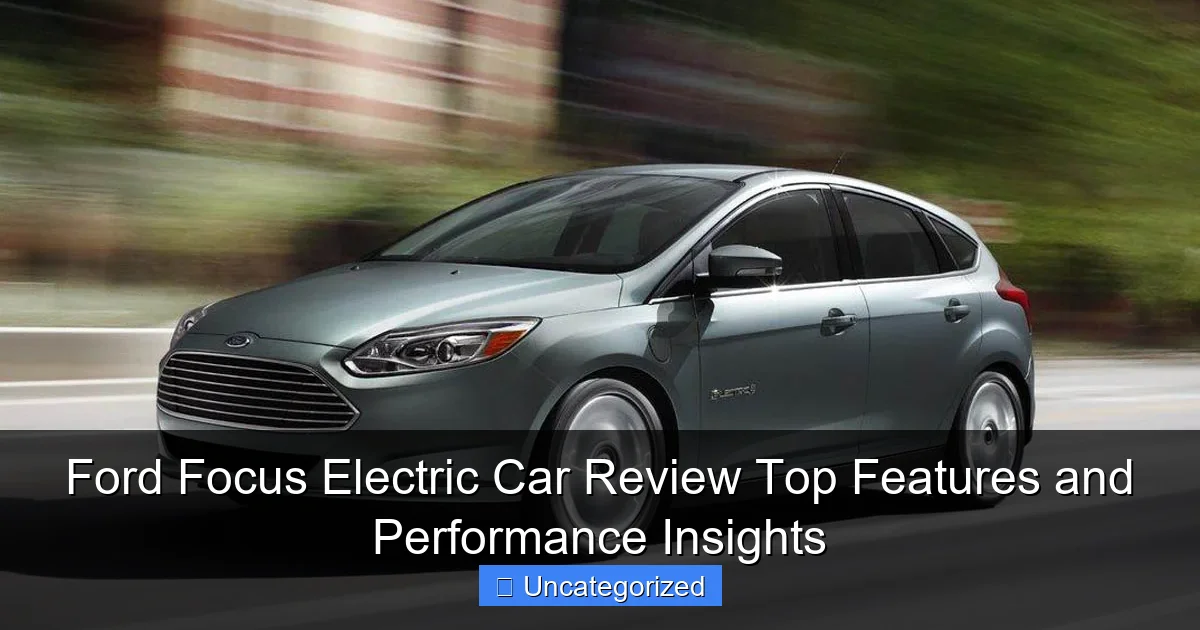
Featured image for ford focus electric car
Image source: media.evo.co.uk
The Ford Focus Electric delivers a smooth, zero-emission ride with an EPA-estimated 115 MPGe, making it a standout in efficiency for urban commuters. Quick acceleration and responsive handling pair with a tech-rich interior featuring SYNC 3 infotainment and available driver-assist features, offering strong value in the compact EV segment.
Key Takeaways
- Efficient performance: Delivers 115 MPGe with smooth, instant torque.
- Spacious interior: Roomy cabin and cargo space outshine rivals.
- Regen braking: One-pedal driving boosts battery efficiency.
- Smart tech: SYNC 3 infotainment ensures seamless connectivity.
- Affordable range: 115-mile range suits daily commutes affordably.
- Home charging: Level 2 charger fully recharges in 3.6 hours.
📑 Table of Contents
- Ford Focus Electric Car Review: Top Features and Performance Insights
- 1. Powertrain and Performance: How the Focus Electric Drives
- 2. Charging Infrastructure and Efficiency
- 3. Interior, Technology, and Safety Features
- 4. Design and Practicality: Everyday Usability
- 5. Cost, Depreciation, and Long-Term Value
- 6. How the Focus Electric Stacks Up Against Competitors
- Conclusion: A Pioneering EV with Lasting Value
Ford Focus Electric Car Review: Top Features and Performance Insights
Introduction: The Evolution of Ford’s Electric Vision
The automotive industry is undergoing a seismic shift toward electrification, and Ford—once synonymous with gas-guzzling muscle cars—has emerged as a serious contender in the electric vehicle (EV) space. Among its early forays into the EV market, the Ford Focus Electric stands as a pivotal model that helped shape the company’s electrified future. Launched in 2011 and produced until 2018, the Focus Electric was Ford’s first mass-market all-electric vehicle, offering a glimpse into what a mainstream automaker could achieve in the EV realm. While it didn’t dominate sales like Tesla’s models, it played a crucial role in normalizing electric mobility for everyday drivers.
Unlike its hybrid sibling, the C-Max Energi, the Focus Electric was built from the ground up as a zero-emission vehicle, leveraging a full battery-electric drivetrain. It was designed to appeal to urban commuters, eco-conscious families, and tech-savvy drivers seeking a practical, affordable EV with Ford’s trusted build quality. Though production has ceased, the Focus Electric remains a relevant benchmark for understanding the progression of Ford’s EV strategy—especially as the company now pushes forward with the Mustang Mach-E and F-150 Lightning. In this comprehensive review, we’ll explore the Ford Focus Electric’s top features, real-world performance, charging capabilities, interior comfort, and long-term value to help you determine whether it’s still a viable option in today’s used EV market.
1. Powertrain and Performance: How the Focus Electric Drives
Electric Motor and Battery Specifications
At the heart of the Ford Focus Electric lies a 107-kilowatt (143 horsepower) electric motor, paired with a 23 kWh liquid-cooled lithium-ion battery pack. This setup delivers 184 lb-ft of torque, which is available instantly—a hallmark of electric vehicles. Unlike internal combustion engines that require revving to reach peak torque, the Focus Electric provides immediate responsiveness, making city driving a breeze. The motor is mounted transversely up front, powering the front wheels through a single-speed reduction gear transmission.

Visual guide about ford focus electric car
Image source: imageonthefly.autodatadirect.com
The battery pack, located beneath the floor, is designed to optimize weight distribution and lower the center of gravity. This contributes to improved handling and stability, especially during cornering. The 23 kWh capacity was modest by today’s standards (modern EVs often exceed 60 kWh), but it was competitive during the Focus Electric’s production years. Ford used a modular design that allowed for easier serviceability and thermal management, with coolant lines circulating around each battery cell to prevent overheating during fast charging or high-load driving.
Real-World Driving Experience
On the road, the Focus Electric delivers a smooth, quiet ride typical of EVs. Acceleration is brisk off the line—0 to 60 mph takes around 9.9 seconds, which is adequate for city driving but not sporty. However, the car feels more agile than its acceleration time suggests, thanks to the low center of gravity and responsive steering. Drivers often praise the “one-pedal driving” capability enabled by aggressive regenerative braking. When you lift off the accelerator, the car slows significantly, converting kinetic energy back into stored electricity. This feature reduces brake wear and increases efficiency, especially in stop-and-go traffic.
Tip: To maximize range, use the “L” (Low) mode on the gear selector. This increases regenerative braking, allowing you to coast less and recover more energy. For highway driving, “D” mode is more efficient, as it reduces drag from regen at higher speeds.
Handling is competent but not exceptional. The suspension is tuned for comfort, with MacPherson struts up front and a twist-beam rear axle. While this setup is cost-effective, it can lead to a slightly bouncy ride over rough pavement. However, the electric power steering is well-calibrated, offering good feedback and light effort at low speeds—ideal for parking and tight maneuvers.
Top Speed and Range
The Focus Electric has a governed top speed of 84 mph, which is lower than most gasoline-powered cars but sufficient for U.S. and European highways. Its EPA-estimated range was 76 miles per full charge (2017–2018 model year), a figure that drops to around 65 miles in cold weather or when using climate control aggressively. In real-world conditions, drivers typically report 60–70 miles of usable range, depending on driving habits and terrain.
For example, a driver commuting 30 miles round-trip in a moderate climate with moderate use of HVAC systems can complete the trip with 50–60% battery remaining. However, longer highway stretches at 70+ mph can reduce range by up to 20% due to increased aerodynamic drag. This makes the Focus Electric best suited for urban and suburban use, rather than cross-country road trips.
2. Charging Infrastructure and Efficiency
Charging Options and Times
One of the Ford Focus Electric’s strengths is its flexibility in charging. It supports three charging levels:
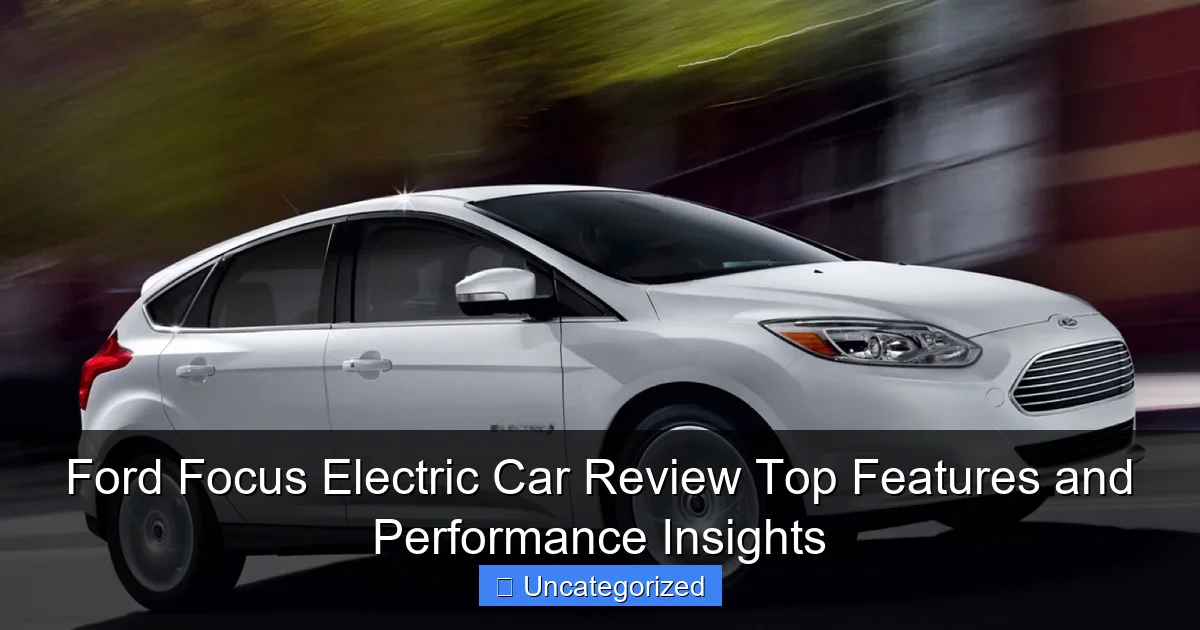
Visual guide about ford focus electric car
Image source: ev-database.org
- Level 1 (120V): Uses a standard household outlet. Fully charging the 23 kWh battery takes approximately 20 hours. Ideal for overnight charging or emergency top-ups.
- Level 2 (240V): Requires a home charging station (e.g., Ford’s 240V home charger). Charging time drops to 3.5–4 hours. Most owners install Level 2 stations for daily use.
- DC Fast Charging (CHAdeMO): Available on 2017–2018 models only. Can replenish 80% of the battery in about 30 minutes. Compatible with public fast-charging networks like ChargePoint and EVgo.
Tip: If you’re considering a used Focus Electric, verify whether it has the optional DC fast-charging port. Earlier models (2011–2016) lack this feature, which limits long-distance usability. The DC port uses the CHAdeMO standard, which is less common than CCS in North America but still widely available in urban areas.
Energy Efficiency and Cost of Ownership
The Focus Electric has an EPA-rated efficiency of 105 MPGe (combined), meaning it uses energy equivalent to 105 miles per gallon of gasoline. In practical terms, this translates to about 32 kWh per 100 miles. At an average U.S. electricity rate of $0.14/kWh, a full charge costs roughly $3.22, or about $0.043 per mile.
Compare this to a gasoline-powered Focus (30 mpg, $3.50/gallon): fuel cost is about $0.117 per mile. Over 15,000 miles per year, the electric version saves over $1,100 annually on fuel alone. Additionally, EVs require less maintenance—no oil changes, fewer brake replacements (thanks to regen), and fewer moving parts. Ford offered an 8-year/100,000-mile battery warranty, which is transferable, adding long-term peace of mind.
Smart Charging and Remote Control
Ford equipped the Focus Electric with the MyFord Mobile app, which allows owners to:
- Remotely start/stop charging
- Precondition the cabin (heat or cool the interior while plugged in)
- Check battery status and range
- Locate nearby charging stations
This feature is especially useful for cold climates. For example, if you schedule your departure for 8:00 AM, the car can begin heating the cabin at 7:30 AM while still plugged in, preserving battery for driving. The app also sends alerts if charging is interrupted or if the battery reaches 80% (to encourage unplugging and reduce grid strain).
3. Interior, Technology, and Safety Features
Cabin Design and Comfort
The Focus Electric’s interior is nearly identical to the gasoline-powered Focus, with minor EV-specific changes. The cabin is well-built, using soft-touch materials on the dashboard and door panels. Front seats are supportive, with 8-way power adjustment for the driver (standard on all trims). Rear legroom is adequate for two adults, though taller passengers may find headroom tight due to the sloping roofline.
Unique to the EV model is a digital instrument cluster with an “Efficiency Leaves” display. This eco-meter rewards smooth acceleration and braking with growing leaves, encouraging energy-conscious driving. While it may seem gimmicky, studies show such feedback systems can improve driving efficiency by up to 15%.
Infotainment and Connectivity
The Focus Electric comes standard with Ford’s SYNC 3 infotainment system (2017–2018 models), featuring:
- 8-inch touchscreen
- Apple CarPlay and Android Auto
- Voice-controlled navigation
- Wi-Fi hotspot (via AT&T)
- USB and auxiliary inputs
SYNC 3 is a significant upgrade over earlier versions, with faster response times and intuitive menu layouts. For example, you can use voice commands to set a destination: “Navigate to the nearest EV charging station.” The system also integrates with the MyFord Mobile app, enabling remote climate control and vehicle status checks.
Safety Systems and Ratings
The Focus Electric earned a 5-star overall rating from the National Highway Traffic Safety Administration (NHTSA) and was named a Top Safety Pick by the Insurance Institute for Highway Safety (IIHS) for several model years. Standard safety features include:
- AdvanceTrac with Roll Stability Control
- Six airbags (dual front, side, and side-curtain)
- Rearview camera
- Parking sensors (rear only)
- Blind-spot monitoring (optional)
Advanced driver-assistance systems (ADAS) like adaptive cruise control and lane-keeping assist were not available, as the Focus Electric predated Ford’s Co-Pilot360 suite. However, its solid structure and responsive brakes (with regen assist) provide strong crash protection.
4. Design and Practicality: Everyday Usability
Exterior Styling and Aerodynamics
The Focus Electric features subtle EV-specific styling cues to distinguish it from the gasoline model. These include:
- Closed-off grille (no radiator needed)
- Unique 17-inch alloy wheels with low-rolling-resistance tires
- Blue accent trim on the front bumper and fenders
- “ELECTRIC” badging on the liftgate
Aerodynamics are optimized for efficiency, with a drag coefficient of 0.29 Cd. The front fascia is smoothed, and the underbody is partially covered to reduce turbulence. The low-rolling-resistance tires (205/55R17) improve range by 3–5% but may sacrifice some grip in wet conditions.
Cargo Space and Storage
Despite the underfloor battery, the Focus Electric retains the same 13.2 cubic feet of trunk space as the gasoline model. The rear seats fold 60/40, expanding cargo capacity to 43.9 cubic feet—enough for groceries, strollers, or a weekend’s worth of luggage. A small storage compartment under the cargo floor holds the Level 1 charging cord.
Tip: Use the “EV+” mode (available via the center console) to extend range by slightly limiting HVAC output and reducing motor power. This is useful when you’re low on charge and need to reach a charging station.
Daily Practicality
For urban drivers, the Focus Electric excels. Its compact size (171.7 inches long) makes parking and maneuvering in tight spaces easy. The quiet cabin reduces noise pollution, and the instant torque makes merging and passing effortless. However, its 76-mile range limits spontaneity for long trips. Families with two cars (one electric, one gasoline) find it ideal for school runs, errands, and work commutes.
5. Cost, Depreciation, and Long-Term Value
Pricing and Incentives (Historical Context)
When new, the Focus Electric had a starting MSRP of $39,200 (2018 model). Federal tax credits of up to $7,500 and state incentives (e.g., California’s $2,000 rebate) brought the effective price down to around $29,700. Some dealers offered additional discounts to move inventory, especially after the 2018 discontinuation.
Today, used Focus Electrics (2017–2018) typically sell for $8,000–$12,000, depending on mileage, condition, and charging capabilities. This makes it one of the most affordable used EVs on the market.
Battery Longevity and Maintenance
Ford’s 8-year/100,000-mile battery warranty covers capacity loss below 70% of original. Real-world data suggests most Focus Electric batteries retain 80–90% capacity after 100,000 miles, assuming proper care. To maximize battery life:
- Avoid frequent DC fast charging (use Level 2 when possible)
- Keep the battery between 20% and 80% for daily use
- Store the car plugged in during extreme temperatures
Annual maintenance costs average $300–$500, compared to $500–$800 for gasoline models. No oil changes, spark plugs, or exhaust system repairs are needed.
Resale Value and Market Demand
The Focus Electric has depreciated significantly—a common trend for early EVs. However, demand is rising as buyers seek affordable, reliable electric options. Its low operating costs and proven reliability make it attractive to budget-conscious EV adopters. Unlike some EVs with complex software issues, the Focus Electric’s systems are straightforward and well-documented, easing repairs for independent shops.
6. How the Focus Electric Stacks Up Against Competitors
Comparison Table: Focus Electric vs. Key Rivals
| Feature | Ford Focus Electric (2018) | Nissan Leaf (2018) | Chevrolet Spark EV (2016) | BMW i3 (2018) |
|---|---|---|---|---|
| Range (EPA) | 76 miles | 150 miles (Leaf SV) | 82 miles | 114 miles |
| Charging (DC Fast) | Yes (30 min to 80%) | Yes (30 min to 80%) | No | Yes (40 min to 80%) |
| Starting Price (Used) | $8,000–$12,000 | $10,000–$14,000 | $6,000–$9,000 | $15,000–$20,000 |
| Infotainment | SYNC 3 (Apple CarPlay) | NissanConnect (Apple CarPlay) | MyLink (No CarPlay) | iDrive (CarPlay) |
| Warranty (Battery) | 8 yr/100,000 mi | 8 yr/100,000 mi | 8 yr/100,000 mi | 8 yr/100,000 mi |
The Focus Electric holds its own against rivals in key areas. While it trails the Leaf in range, it matches the Spark EV and i3 in charging capability and offers superior infotainment. Its lower used price makes it a compelling value, especially for first-time EV buyers.
Who Should Buy a Focus Electric?
The Ford Focus Electric is ideal for:
- Urban commuters with short daily drives
- Families seeking a second car for errands
- Eco-conscious buyers on a budget
- Those with home Level 2 charging
It’s less suitable for drivers needing 200+ miles of range or frequent highway trips. However, for its intended use case, it delivers reliable, efficient, and enjoyable electric mobility.
Conclusion: A Pioneering EV with Lasting Value
The Ford Focus Electric may no longer be in production, but its legacy endures. As Ford’s first serious electric car, it demonstrated that a mainstream automaker could build a practical, affordable EV without sacrificing quality or safety. While newer models offer longer range and faster charging, the Focus Electric remains a smart choice for budget-minded buyers entering the EV world.
Its strengths—low operating costs, user-friendly technology, and proven reliability—make it a standout in the used EV market. Whether you’re charging at home or leveraging public fast chargers, the Focus Electric proves that electric driving can be simple, affordable, and enjoyable. As Ford continues to electrify its lineup, the Focus Electric serves as a reminder of how far EV technology has come—and how accessible it has become.
If you’re considering a used EV, don’t overlook this underdog. With proper care, the Ford Focus Electric can deliver years of quiet, emission-free driving—proving that sometimes, the best innovations are the ones that quietly get the job done.
Frequently Asked Questions
What is the range of the Ford Focus Electric car?
The Ford Focus Electric offers an EPA-estimated range of 115 miles on a full charge, making it ideal for daily commutes and city driving. Real-world range may vary based on driving habits, terrain, and climate conditions.
How long does it take to charge the Ford Focus Electric?
Using a standard 240V Level 2 charger, the Ford Focus Electric can be fully charged in about 3.5 to 4 hours. With a 120V household outlet, charging takes significantly longer—up to 20 hours for a full charge.
What are the standout features of the Ford Focus Electric car?
The Ford Focus Electric comes equipped with SYNC 3 infotainment, regenerative braking, and a quiet, smooth electric drivetrain. It also includes smartphone integration, heated seats, and advanced driver aids like rearview camera and blind-spot monitoring.
Is the Ford Focus Electric eligible for federal tax credits?
Yes, the Ford Focus Electric qualifies for a federal tax credit of up to $7,500, depending on your tax liability. Additional state and local incentives may also be available, further reducing ownership costs.
How does the Ford Focus Electric compare to gas-powered Focus models?
The Focus Electric delivers instant torque and a quieter ride than gas-powered versions, with lower maintenance costs due to fewer moving parts. However, it has a shorter range and longer refueling time compared to traditional gasoline models.
Can the Ford Focus Electric handle highway speeds and long-distance travel?
Yes, the Ford Focus Electric can reach highway speeds and is capable of short road trips. However, its limited range and sparse fast-charging infrastructure make it less ideal for frequent long-distance travel compared to newer EVs with extended ranges.