Ford Focus Electric Car Charging Requirement Explained Simply
Featured image for ford focus electric car charging requirement
Image source: images.hgmsites.net
The Ford Focus Electric requires a standard 240-volt Level 2 charger for optimal home charging, delivering a full charge in about 3–4 hours. It also supports DC fast charging, enabling an 80% charge in just 30 minutes at public stations, making long trips more practical. Always use a compatible charging station to ensure safety and battery longevity.
Key Takeaways
- Use Level 2 charging: Optimal for daily charging; delivers 25 miles per hour.
- Install a home charger: Saves time and ensures consistent overnight charging.
- Plan trips with DC fast charging: Adds 75 miles in 30 minutes on road trips.
- Check connector compatibility: Focus Electric uses J1772 for Level 1/2 and CCS for DC fast charging.
- Monitor battery health: Avoid frequent 100% charges to prolong battery lifespan.
- Leverage off-peak rates: Schedule charging during low-rate hours to save money.
📑 Table of Contents
- Understanding the Basics of Ford Focus Electric Car Charging
- Ford Focus Electric Charging Specifications and Battery Overview
- Types of Charging: Level 1 vs. Level 2 and What They Mean for You
- Home Charging Installation: What You Need to Know
- Public Charging: Where, How, and What to Expect
- Maximizing Charging Efficiency and Battery Health
- Data Table: Ford Focus Electric Charging Comparison
- Final Thoughts: Making the Most of Your Ford Focus Electric Charging
Understanding the Basics of Ford Focus Electric Car Charging
Electric vehicles (EVs) are revolutionizing the way we think about transportation, and the Ford Focus Electric stands as a compelling example of this shift. As one of the early entrants into the mass-market EV segment, the Focus Electric offers a practical, eco-friendly alternative to traditional gasoline-powered vehicles. However, owning an EV isn’t just about driving a car—it’s about understanding how to keep it powered, especially when it comes to charging requirements. If you’re considering purchasing a Ford Focus Electric or already own one, knowing how, when, and where to charge your vehicle is essential for a seamless ownership experience.
Charging an EV like the Ford Focus Electric might seem daunting at first, especially if you’re new to the world of electric mobility. But fear not—modern EV charging systems are designed with convenience and efficiency in mind. From plug types and charging speeds to home installations and public networks, the charging landscape is more accessible than ever. This guide breaks down everything you need to know about the Ford Focus Electric car charging requirement in simple, practical terms. Whether you’re charging overnight at home or topping up during a road trip, you’ll learn how to optimize your charging routine, save time and money, and avoid common pitfalls.
Ford Focus Electric Charging Specifications and Battery Overview
Battery Capacity and Range
The Ford Focus Electric is equipped with a lithium-ion battery pack that powers an electric motor, delivering a smooth and quiet driving experience. Depending on the model year (2012–2018), the battery capacity varies slightly:
Visual guide about ford focus electric car charging requirement
Image source: union-power.com
- 2012–2014 models: 23 kWh battery pack, offering an EPA-estimated range of approximately 76 miles (122 km) on a full charge.
- 2015–2018 models: Upgraded 33.5 kWh battery pack, increasing the range to about 115 miles (185 km) per charge.
This range is ideal for urban commuting and daily errands, but understanding how charging impacts your available range is crucial. Unlike gas stations, where refueling takes just minutes, EV charging is a longer process—though with smart planning, it can easily fit into your daily routine.
Charging Connector Type: The SAE J1772 Standard
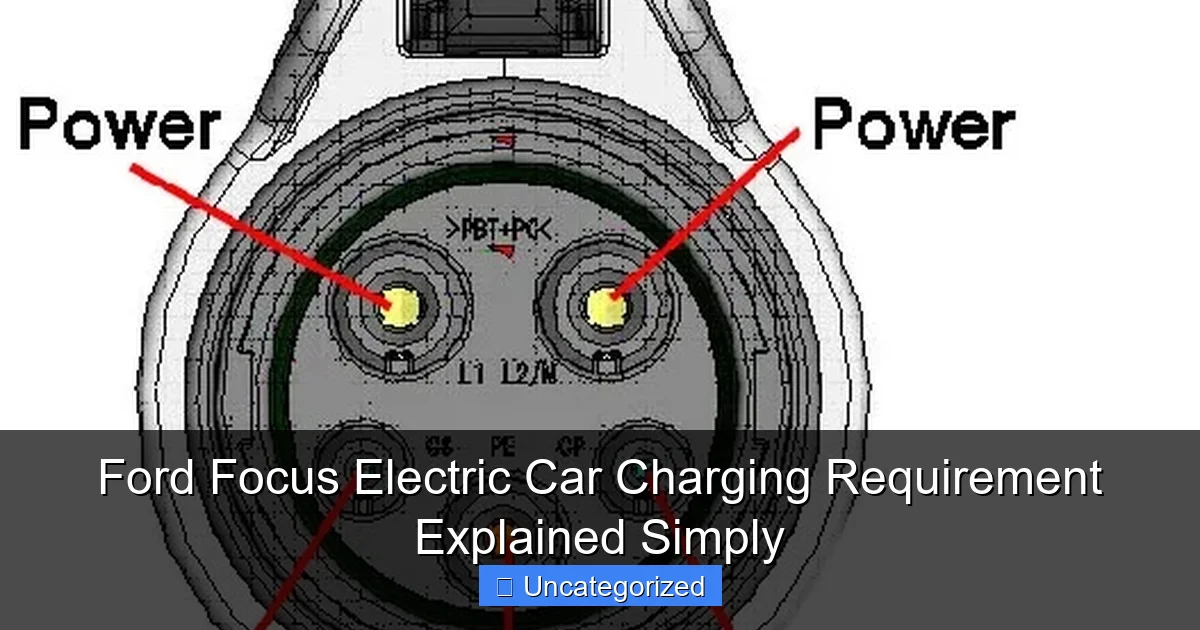
All Ford Focus Electric models use the SAE J1772 (commonly called “J-Plug” or “Type 1”) connector for Level 1 and Level 2 charging. This is the North American standard for EV charging and ensures compatibility with nearly all public charging stations and home charging equipment. The J1772 plug features five pins: two for AC power, one for ground, one for proximity detection (to ensure the plug is fully inserted), and one for pilot communication (to negotiate charging rate).
It’s important to note that the Focus Electric does not support DC fast charging (DCFC) via the CCS (Combined Charging System) or CHAdeMO standards. This means it cannot use high-speed public fast chargers, which can be a limitation for long-distance travel. However, for most drivers—especially those with predictable commutes—this isn’t a major drawback.
Onboard Charger and Power Acceptance
The Ford Focus Electric includes a 6.6 kW onboard charger, which determines the maximum rate at which the car can accept AC power from Level 2 chargers. This means:
- At a 240-volt Level 2 station, the car can charge at up to 6.6 kW.
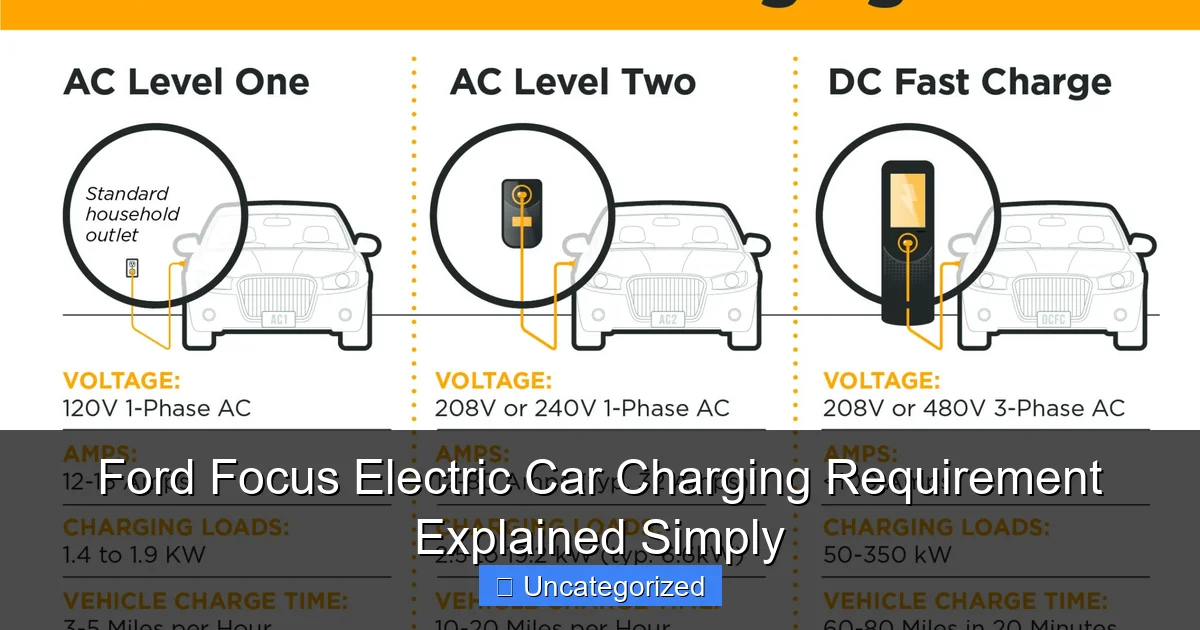
- At a 120-volt Level 1 outlet, the charging rate is limited to about 1.4 kW (12 amps).
While 6.6 kW is standard for many EVs of its era, newer models often feature 7.2 kW or even 11 kW chargers. Still, the Focus Electric’s charging capability strikes a good balance between speed and cost-effectiveness for typical use cases.
Types of Charging: Level 1 vs. Level 2 and What They Mean for You
Level 1 Charging: The Standard Household Outlet
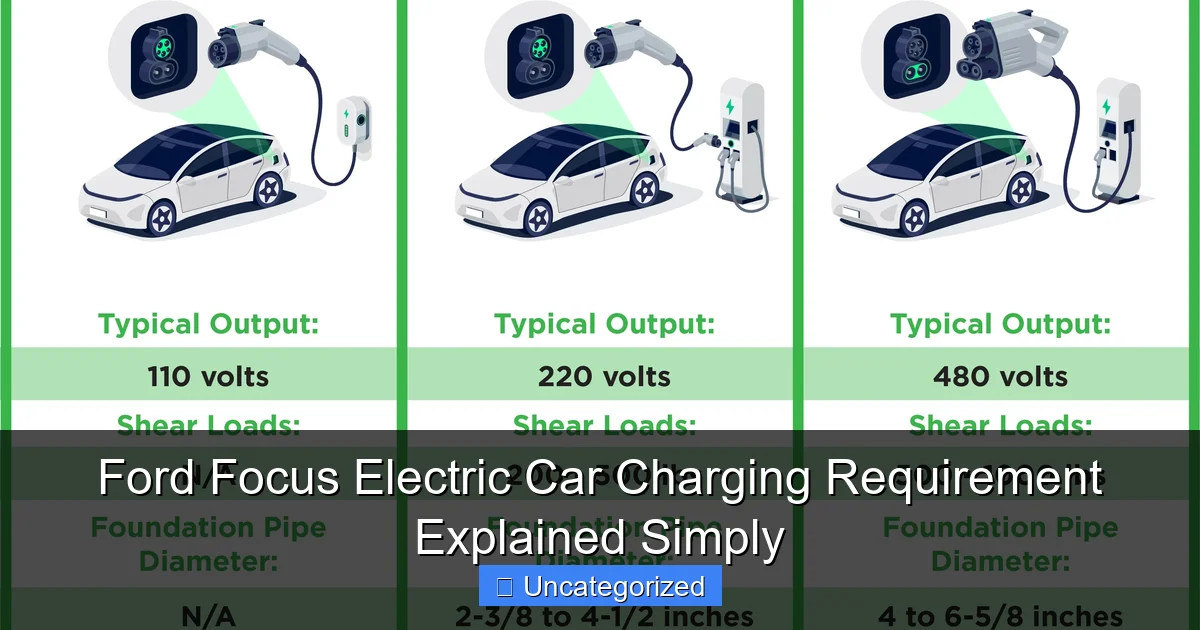
Level 1 charging uses a standard 120-volt AC outlet—the same kind you use for lamps, phone chargers, and kitchen appliances. Every Ford Focus Electric comes with a portable Level 1 charging cord (often called the “trickle charger” or “granny cord”) that plugs directly into a household outlet.
Visual guide about ford focus electric car charging requirement
Image source: blog.hubbell.com
Charging Speed: Approximately 1.4 kW (12 amps), adding about 4 miles of range per hour.
Full Charge Time: Around 20–24 hours for a completely depleted battery (2012–2014 models), or 26–30 hours for 2015–2018 models.
While Level 1 is convenient—no installation required—it’s best suited for:
- Overnight charging with low daily mileage (under 40 miles).
- Emergency or backup charging when no other options are available.
- Owners who park in public garages or shared spaces without 240V access.
Tip: Always use a dedicated outlet for your EV charger. Avoid extension cords, especially those not rated for continuous high load, as they can overheat and pose a fire hazard.
Level 2 Charging: The Recommended Option for Daily Use
Level 2 charging uses 240-volt AC power—similar to what powers your clothes dryer or electric oven. It requires a dedicated circuit and a wall-mounted or portable Level 2 charging station (EVSE—Electric Vehicle Supply Equipment).
Charging Speed: Up to 6.6 kW (27.5 amps on a 240V circuit), adding about 25–30 miles of range per hour.
Full Charge Time: 4–5 hours for a full charge from empty.
For most Ford Focus Electric owners, Level 2 is the ideal charging method because:
- It fully charges the car overnight.
- It’s faster and more efficient than Level 1.
- It enables you to start each day with maximum range.
Example: If you drive 30 miles daily, a Level 2 charger can replenish your battery in about 1.5 hours. This means you could charge during dinner or while watching TV—no need to leave it plugged in all night.
Portable vs. Wall-Mounted Level 2 Chargers
You have two main options for Level 2 charging:
- Portable Level 2 EVSE: Plugs into a NEMA 14-50 outlet (common in RV parks, workshops, or garages). Offers flexibility but requires you to plug/unplug each time.
- Wall-mounted EVSE: Permanently installed in your garage or driveway. Often includes features like Wi-Fi connectivity, scheduling, and usage tracking. Brands like ChargePoint, ClipperCreek, and JuiceBox offer reliable models compatible with the Focus Electric.
<
Tip: Look for an EVSE with a 25-foot cable for maximum flexibility. Also, choose one with a NEMA 6-50 or 14-50 plug if you plan to use it in multiple locations.
Home Charging Installation: What You Need to Know
Assessing Your Home Electrical System
Before installing a Level 2 charger, it’s essential to evaluate your home’s electrical infrastructure. Most homes have a 100-amp or 200-amp main service panel. Adding a Level 2 charger requires a dedicated 240-volt circuit, typically rated at 40 or 50 amps (to support 32 or 40 amps of continuous load, following the 80% rule for safety).
Key considerations:
- Panel capacity: If your panel is near capacity, you may need a service upgrade or load management device.
- Distance from panel to parking spot: Longer runs require thicker (lower gauge) wires to prevent voltage drop.
- Existing outlets: A NEMA 14-50 outlet (used for electric stoves or RVs) can be repurposed for a portable EVSE.
Tip: Hire a licensed electrician to perform a load calculation and install the circuit. DIY electrical work can void warranties and pose safety risks.
Cost of Installation
The cost of a home Level 2 charger setup varies widely based on location, electrical complexity, and equipment choice:
- EVSE unit: $400–$800 (e.g., ChargePoint Home Flex, JuiceBox 40).
- Installation labor: $500–$1,500, depending on panel access and wire length.
- Permits and inspections: $50–$200 (required in most jurisdictions).
Total cost: $1,000–$2,500. However, many states and utility companies offer rebates and incentives that can reduce the cost by 50% or more. For example, California’s Clean Vehicle Rebate Project and New York’s Drive Clean Rebate have funded thousands of home charger installations.
Smart Charging and Scheduling Features
Modern Level 2 chargers often include smart features that enhance convenience and savings:
- Wi-Fi connectivity: Monitor charging status remotely via smartphone app.
- Scheduled charging: Set the charger to operate during off-peak hours (e.g., 10 PM–6 AM) to take advantage of lower electricity rates.
- Energy tracking: View monthly kWh usage and cost estimates.
- Load balancing: Some systems can share power with other circuits to avoid tripping breakers.
Example: If your utility charges $0.10/kWh during off-peak hours and $0.25/kWh during peak, scheduling your Focus Electric to charge from midnight to 6 AM saves you over 50% per charge.
Public Charging: Where, How, and What to Expect
Finding Public Level 2 Charging Stations
While the Ford Focus Electric doesn’t support DC fast charging, it can use any public Level 2 (240V) J1772 station. These are widely available at:
- Shopping malls and retail centers
- Workplaces and corporate campuses
- Public parking garages and municipal lots
- Universities and hospitals
- Restaurants and hotels
Use apps like PlugShare, ChargeHub, or Google Maps to locate nearby stations. Filter by “J1772” to ensure compatibility. Many stations are free or low-cost, while others require a membership or per-use fee.
Charging Networks: Blink, ChargePoint, EVgo, and More
Different networks operate public chargers, each with its own pricing and access model:
- ChargePoint: Largest network in the U.S. Offers free, paid, and subscription-based options. App integration allows easy payment and station status checks.
- Blink: Common in urban areas. Pay-per-use or membership plans available.
- EVgo: While primarily focused on DC fast charging, many EVgo stations also have Level 2 J1772 ports.
- Greenlots and Flo: Regional networks in the Midwest and Canada.
Tip: Download multiple charging apps and consider signing up for a universal access card (like the ChargePoint RFID tag) to avoid app switching.
Charging Etiquette and Best Practices
When using public chargers, follow these unwritten rules to be a considerate EV owner:
- Don’t hog the charger: Once your battery is sufficiently charged (e.g., 80–90%), move your car to allow others to use the station.
- Park properly: Align your car so the charging port is close to the station to prevent tripping hazards.
- Report issues: If a station is broken or damaged, report it via the app so it can be repaired quickly.
- Be mindful of time limits: Some workplaces or malls restrict charging to 2–4 hours.
Example: If you’re at a mall for 3 hours, charge for 2 hours, then move your car to a regular parking spot. This keeps the charger available for others and avoids potential fines.
Maximizing Charging Efficiency and Battery Health
Optimal Charging Habits for Longevity
While lithium-ion batteries are durable, certain charging habits can extend their lifespan:
- Avoid frequent full charges: Charging to 100% daily stresses the battery. For daily use, aim for 80–90%.
- Don’t deep discharge: Try not to let the battery drop below 10–20%. Deep discharges reduce cycle life.
- Use scheduled charging: Prevents unnecessary charging and reduces grid strain.
- Minimize high-temperature exposure: Park in the shade or a garage during hot days to reduce battery cooling load.
The Ford Focus Electric includes battery thermal management, but keeping the car in moderate temperatures (60–80°F) is still ideal.
Regenerative Braking and Its Role in Charging
The Focus Electric features regenerative braking, which converts kinetic energy back into electricity when you decelerate or brake. This system:
- Recharges the battery slightly during normal driving (up to 10–15% of daily range).
- Reduces brake wear by minimizing friction brake usage.
- Can be adjusted via the “L” (Low) gear mode for stronger regeneration.
Tip: Use “One-Pedal Driving” techniques—lift off the accelerator early to coast and regenerate, reducing the need to use the brake pedal.
Seasonal Charging Considerations
Cold weather (<32°F) can reduce battery efficiency and charging speed. In winter:
- Precondition the cabin while plugged in (using the FordPass app or in-car timer). This warms the battery and cabin using grid power, not battery power.
- Charge more frequently, as cold reduces range by 20–30%.
- Park in a garage to keep the battery warmer.
In summer, avoid charging during the hottest part of the day (12 PM–4 PM) to prevent thermal stress on the battery.
Data Table: Ford Focus Electric Charging Comparison
| Charging Type | Voltage | Power (kW) | Miles of Range per Hour | Full Charge Time (Empty to 100%) | Best For |
|---|---|---|---|---|---|
| Level 1 | 120V | 1.4 kW | 4 mph | 20–30 hours | Low-mileage drivers, backup charging |
| Level 2 | 240V | 6.6 kW | 25–30 mph | 4–5 hours | Daily use, overnight charging |
| Regenerative Braking | N/A | Variable | 1–3 mph (average) | Continuous during driving | Energy recovery, brake wear reduction |
Final Thoughts: Making the Most of Your Ford Focus Electric Charging
Charging your Ford Focus Electric doesn’t have to be complicated. By understanding the Ford Focus Electric car charging requirement—from battery specs and connector types to home installation and public network usage—you can enjoy a reliable, cost-effective, and eco-friendly driving experience. The key is to match your charging method to your lifestyle: Level 1 for occasional use, Level 2 for daily convenience, and smart scheduling to save money.
Remember, every EV owner’s journey is unique. Whether you’re charging in your suburban garage, at a downtown parking garage, or during a weekend getaway, the flexibility and growing infrastructure of EV charging make ownership easier than ever. With proper habits, your Focus Electric’s battery will remain healthy for years, and you’ll spend less time “refueling” and more time enjoying the quiet, smooth ride of electric mobility.
Embrace the change. Plug in. Drive on.
Frequently Asked Questions
What type of charging does the Ford Focus Electric car require?
The Ford Focus Electric uses a standard Level 1 (120V) or Level 2 (240V) charging system. A Level 2 charger is recommended for faster charging and better efficiency.
How long does it take to fully charge a Ford Focus Electric car?
With a Level 2 (240V) charger, the Ford Focus Electric takes about 3–4 hours for a full charge. Using a standard Level 1 (120V) outlet can take up to 18–20 hours.
Can I use public charging stations for the Ford Focus Electric car charging requirement?
Yes, the Ford Focus Electric is compatible with most public Level 2 charging stations. Simply use the included J1772 connector, which is standard across North America.
Do I need a special charger installed at home for the Ford Focus Electric?
While the car can charge using a regular household outlet (Level 1), installing a Level 2 (240V) charger greatly reduces charging time and is ideal for daily use.
What is the Ford Focus Electric car charging requirement for battery health?
The Ford Focus Electric is designed to maintain battery health with regular charging. Avoid frequent deep discharges, and keep the battery between 20%–80% for optimal longevity.
Can I charge my Ford Focus Electric in the rain or snow?
Yes, the charging system is weatherproof and safe to use in rain or snow. The car and charger are designed with safety mechanisms to prevent electrical hazards.