Ford Focus Electric Car Driving Range How Far Can It Go

Featured image for ford focus electric car driving range
Image source: teslarati.com
The Ford Focus Electric delivers an EPA-estimated 115 miles of driving range on a full charge, making it a solid choice for daily commutes and city driving. While not the longest-range EV on the market, its efficient performance and practical design cater well to urban drivers seeking reliability and low operating costs.
Key Takeaways
- Max range: Ford Focus Electric offers 115 miles on a full charge.
- Real-world use: Expect 80–90 miles daily with mixed driving conditions.
- Charging time: Full recharge in 4–5 hours with Level 2 charger.
- Regen braking: Use low-speed regen to extend range in traffic.
- Climate impact: Cold weather can reduce range by 30%; preheat garage.
- Efficiency tip: Maintain steady speed to maximize battery life.
📑 Table of Contents
- Ford Focus Electric Car Driving Range: How Far Can It Go?
- Understanding the Ford Focus Electric: A Brief Overview
- Real-World Driving Range: What to Expect Beyond EPA Numbers
- Comparing the Focus Electric to Competitors and Newer EVs
- Maximizing Your Focus Electric’s Driving Range
- Long-Term Ownership: Battery Degradation and Range Over Time
- Conclusion: Is the Ford Focus Electric Right for You?
Ford Focus Electric Car Driving Range: How Far Can It Go?
The electric vehicle (EV) revolution is in full swing, and automakers are racing to deliver practical, affordable, and efficient solutions for eco-conscious drivers. Among the pioneers in this shift is Ford, a brand historically known for its gas-powered trucks and muscle cars, now embracing the future with the Ford Focus Electric. While the Focus Electric may not be the newest EV on the block—having been discontinued in 2018—it remains a relevant and often-overlooked gem for those seeking a compact, zero-emission vehicle with real-world usability. One of the most critical factors for any EV buyer is driving range: how far can it go on a single charge? This question isn’t just about numbers—it’s about peace of mind, daily usability, and long-term value.
For drivers considering the Ford Focus Electric, whether as a used purchase or a nostalgic nod to Ford’s early EV efforts, understanding its driving range is essential. Unlike newer EVs with 300+ mile ranges, the Focus Electric operates in a different league—compact, efficient, and designed for urban and suburban lifestyles. But don’t let its modest specs fool you. With careful planning, smart charging habits, and an awareness of environmental variables, the Focus Electric can deliver surprising range performance. In this comprehensive guide, we’ll explore the real-world driving range of the Ford Focus Electric, analyze factors that affect it, compare it to competitors, and provide practical tips to help you get the most out of every charge. Whether you’re commuting to work, running errands, or planning a weekend trip, this article will help you answer the all-important question: How far can the Ford Focus Electric go?
Understanding the Ford Focus Electric: A Brief Overview
Model Years and Key Specifications
The Ford Focus Electric was produced from 2012 to 2018, with incremental updates over the years. It was Ford’s first mass-market all-electric vehicle, built on the same platform as the gasoline-powered Focus but with a fully electric powertrain. The vehicle was designed to compete with early EVs like the Nissan Leaf and Chevrolet Spark EV, offering a blend of affordability, reliability, and Ford’s signature driving dynamics.
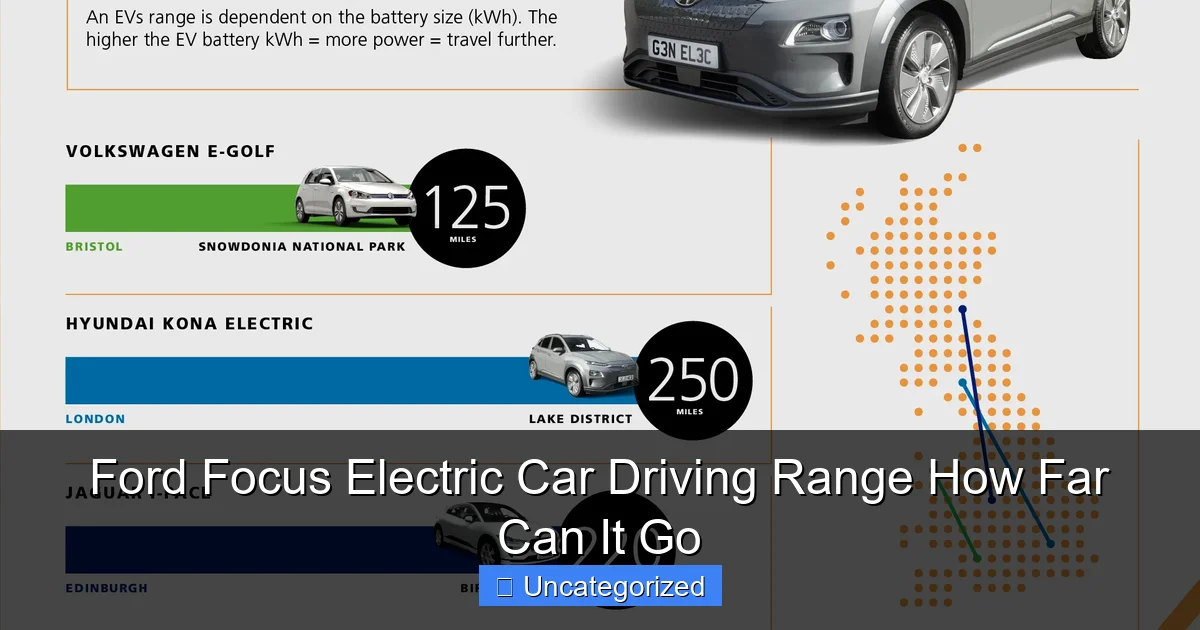
Visual guide about ford focus electric car driving range
Image source: edfenergy.com
- Model Years: 2012–2018
- Battery Capacity: 23 kWh (early models) to 33.5 kWh (2017–2018)
- Motor Output: 143 horsepower, 184 lb-ft of torque
- Top Speed: 84 mph (electronically limited)
- Charging: Standard Level 1 (120V), Level 2 (240V) compatible, DC fast charging (2017+ models)
- EPA-Estimated Range: 76 miles (2012–2016), 115 miles (2017–2018)
How the Battery and Powertrain Work
The heart of the Focus Electric is its lithium-ion battery pack, which powers a permanent magnet electric motor. The battery is liquid-cooled for thermal management, a feature that helps maintain consistent performance and longevity. The 2017 and 2018 models received a significant upgrade with a larger 33.5 kWh battery, nearly 50% more capacity than earlier versions. This increase directly translated into a higher EPA-estimated range, jumping from 76 to 115 miles.
The electric motor delivers instant torque, giving the Focus Electric a peppy, responsive feel in city driving. Unlike internal combustion engines, EVs don’t need gears—power is delivered smoothly and silently. Regenerative braking also plays a key role: when you lift off the accelerator, the motor acts as a generator, capturing kinetic energy and feeding it back into the battery. This system not only extends range but also reduces brake wear over time.
Target Market and Use Case
The Focus Electric was designed for drivers with short to medium commutes, typically under 50 miles per day. Its compact size, hatchback design, and quiet operation make it ideal for urban environments, school runs, and daily errands. While it’s not built for cross-country road trips, it excels in stop-and-go traffic and city driving, where regenerative braking and instant torque shine.
For example, a driver in Portland, Oregon, with a 20-mile round-trip commute, could easily complete a full workweek on a single charge (assuming no additional trips). Even with weekend use, the 115-mile range (2017–2018) offers flexibility for light weekend getaways—especially if charging is available at a destination.
Real-World Driving Range: What to Expect Beyond EPA Numbers
EPA Ratings vs. Real-World Performance
The EPA-estimated range for the 2017–2018 Ford Focus Electric is 115 miles, while earlier models (2012–2016) are rated at 76 miles. However, real-world driving often deviates from these figures due to various factors. The EPA test is conducted under controlled conditions: ideal temperatures, flat terrain, no HVAC use, and a standardized driving cycle. In reality, your experience may vary.
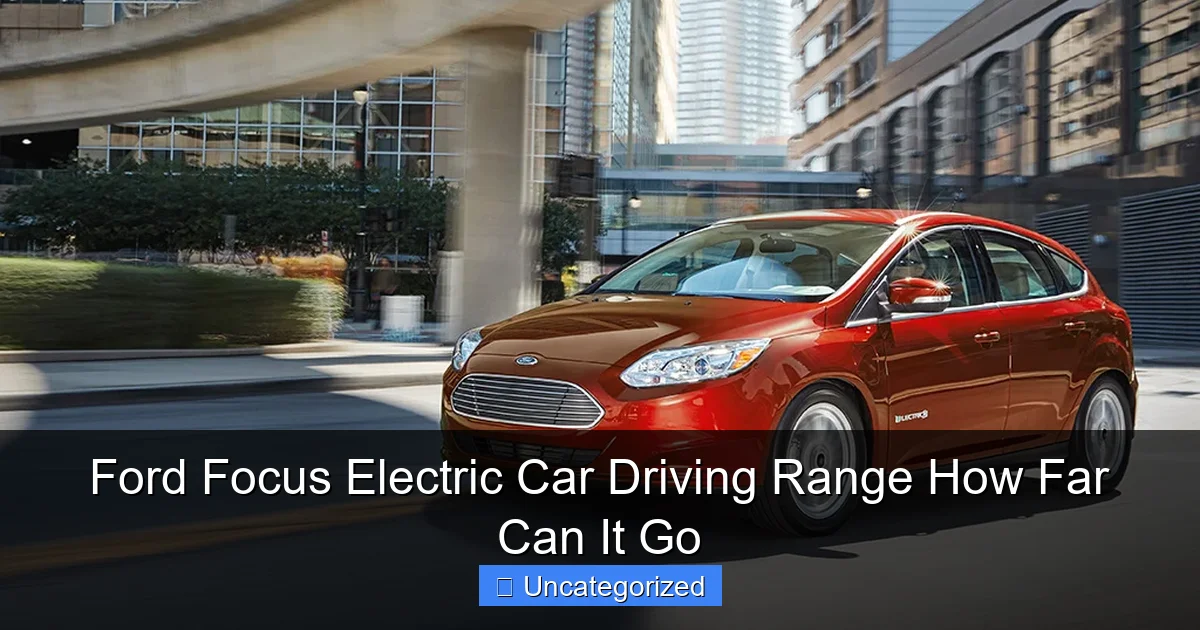
Visual guide about ford focus electric car driving range
Image source: cleanchargenetwork.com
Based on data from owners, forums (like Focus Electric Forum and Reddit’s r/electricvehicles), and third-party testing, the average real-world range is:
- 2017–2018 models: 90–110 miles (80–95% of EPA)
- 2012–2016 models: 60–70 miles (75–90% of EPA)
For instance, a 2018 Focus Electric driven in mild spring weather (60°F), with moderate HVAC use and city/highway mix, typically achieves around 100 miles. In contrast, the same car in winter conditions might only deliver 80–85 miles due to increased energy demands.
Factors That Reduce Range
Several variables can impact how far your Focus Electric can go:
- Temperature: Cold weather (below 40°F) can reduce range by 20–30%. The battery’s chemical efficiency drops, and cabin heating (which uses resistive elements) draws significant power. Preconditioning while plugged in helps mitigate this.
- Speed and Driving Style: Driving at highway speeds (65+ mph) increases aerodynamic drag and energy consumption. Aggressive acceleration and braking also reduce efficiency. Smooth, steady driving maximizes range.
- HVAC Use: Heating the cabin in winter or running the AC in summer can cut range by 10–20%. Using seat heaters (which use less power) instead of full cabin heat helps.
- Terrain: Hilly or mountainous routes require more energy to climb, and regenerative braking can only recover a portion on the way down.
- Accessories: Lights, infotainment, and phone charging add small but cumulative loads.
Real-World Examples from Owners
Let’s look at two real-world scenarios:
Case 1: Sarah, a teacher in Austin, TX, owns a 2018 Focus Electric. Her daily commute is 35 miles round-trip. She drives in mild Texas weather, uses AC sparingly, and charges at home each night. She consistently gets 105 miles of range—slightly above her average needs. She rarely uses DC fast charging and relies on her 240V Level 2 home charger.
Case 2: Mark, a delivery driver in Chicago, uses his 2015 Focus Electric for light courier work. He drives about 60 miles per day in mixed conditions, including stop-and-go traffic and short highway stretches. In winter, he sees range drop to 55–60 miles, requiring midday charging. He uses a public Level 2 station at his office and preconditioning to stay efficient.
These examples show that range is highly personal and depends on your driving habits, environment, and charging access.
Comparing the Focus Electric to Competitors and Newer EVs
How It Stacks Up Against Its Peers (2012–2018)
During its production run, the Focus Electric faced stiff competition from other compact EVs. Here’s how it compares in terms of driving range:
Data Table: 2017–2018 Compact EV Driving Range Comparison
| Vehicle | EPA Range (miles) | Battery Size (kWh) | DC Fast Charging | Price (MSRP, 2018) |
|---|---|---|---|---|
| Ford Focus Electric (2018) | 115 | 33.5 | Yes (24 kW) | $29,120 |
| Nissan Leaf (2018) | 150 | 40.0 | Yes (50 kW) | $29,990 |
| Chevrolet Bolt EV (2018) | 238 | 60.0 | Yes (55 kW) | $36,620 |
| BMW i3 (2018) | 153 | 33.2 | Yes (50 kW) | $44,450 |
| Volkswagen e-Golf (2018) | 125 | 35.8 | Yes (40 kW) | $30,495 |
As the table shows, the Focus Electric lagged behind the Nissan Leaf and Chevrolet Bolt EV in range, but it was competitive with the BMW i3 and Volkswagen e-Golf. Its 24 kW DC fast charging capability (available from 2017) was slower than the Leaf and Bolt but sufficient for 80% charge in about 30 minutes.
Comparison to Modern EVs (2020+)
Today’s EVs have made significant leaps in range and efficiency. For example:
- Chevrolet Bolt EV (2023): 259 miles
- Nissan Leaf Plus: 226 miles
- Hyundai Kona Electric: 258 miles
- Ford Mustang Mach-E (Standard Range): 230 miles
While the Focus Electric’s 115-mile range seems modest today, it was a solid offering for its time. For drivers with shorter commutes or secondary vehicles, it remains a viable option—especially in the used market, where prices are often under $15,000.
Value Proposition: Cost vs. Range
The Focus Electric’s value lies not in its range alone, but in its total cost of ownership. Lower purchase price (used), minimal maintenance (no oil changes, fewer moving parts), and lower fuel costs (electricity vs. gasoline) make it economical. For a driver who only needs 80–100 miles per day, the Focus Electric is more than sufficient—and far cheaper than a new EV with 300-mile range.
Maximizing Your Focus Electric’s Driving Range
Smart Driving Techniques
You can extend your Focus Electric’s range with simple, effective driving habits:
- Smooth Acceleration: Avoid rapid starts. Use the “Eco” mode (if available) to limit throttle response.
- Coast When Possible: Lift off the accelerator early when approaching stops to maximize regenerative braking.
- Maintain Steady Speeds: Use cruise control on highways to reduce speed fluctuations.
- Limit High Speeds: Driving at 55 mph uses less energy than 70 mph. Every 5 mph over 50 increases energy use by 8–10%.
- Use One-Pedal Driving (Regen Mode): The Focus Electric has strong regenerative braking. With practice, you can drive using mostly the accelerator, reducing brake wear and increasing energy recovery.
HVAC and Climate Control Tips
Heating and cooling are the biggest energy drains. Try these strategies:
- Precondition While Plugged In: Use the FordPass app to heat or cool the cabin while the car is still charging. This uses grid power, not battery.
- Use Seat Heaters Instead of Cabin Heat: Seat heaters use ~10% of the energy of the cabin heater.
- Park in the Shade or Use a Sunshade: Reduces cabin heat buildup, minimizing AC load.
- Recirculate Air: Once the cabin reaches desired temperature, switch to recirculate mode to reduce energy use.
Battery and Charging Best Practices
To maintain battery health and range over time:
- Charge to 80% Daily: Frequent full charges (100%) can degrade lithium-ion batteries. For daily use, 80% is ideal.
- Use Level 2 Charging When Possible: Level 1 (120V) takes 20+ hours for a full charge. A 240V Level 2 charger cuts this to 5–6 hours.
- Limit DC Fast Charging: While convenient, frequent fast charging generates heat and accelerates battery wear. Use it for long trips, not daily charging.
- Store at 50% Charge if Unused: If parking the car for weeks, charge to ~50% to reduce battery stress.
Route Planning and Navigation
Use apps like PlugShare or A Better Routeplanner (ABRP) to plan trips with charging stops. The Focus Electric’s navigation system (in later models) includes EV-specific routing, showing nearby chargers and estimated range at arrival.
For example, a 100-mile trip with a 2018 Focus Electric might include a 15-minute DC fast charge at a midpoint to ensure a safe buffer. Always plan with a 20–30% range cushion to account for unexpected detours or weather.
Long-Term Ownership: Battery Degradation and Range Over Time
How Battery Health Affects Range
All lithium-ion batteries degrade over time. For the Focus Electric, battery degradation typically results in a 1–3% annual range loss under normal conditions. After 5–7 years, a 2018 model might retain 85–90% of its original range (98–103 miles), while a 2012 model could drop to 50–60 miles.
Factors that accelerate degradation:
- Frequent DC fast charging
- Consistently charging to 100%
- Exposure to extreme temperatures (hot climates)
- Long periods of inactivity without proper charge levels
Monitoring Battery Health
Ford provides a battery health indicator in the instrument cluster. Owners can also use third-party tools like LeafSpy (with OBD-II adapter) to monitor battery state of health (SOH) and individual cell voltages. A significant drop in SOH (below 80%) may indicate the need for battery service or replacement.
Cost of Battery Replacement
While rare, battery replacements can be expensive. A new 33.5 kWh pack for a 2018 Focus Electric costs $8,000–$12,000 from Ford, though refurbished or aftermarket options may be cheaper. However, most owners never need a full replacement—regular maintenance and smart charging extend battery life.
Resale Value and Market Trends
Used Focus Electric prices have stabilized. As of 2024, a well-maintained 2017–2018 model with 60,000 miles sells for $12,000–$15,000. Early models (2012–2014) go for $5,000–$8,000. The car’s reliability, low maintenance, and zero emissions make it attractive to budget-conscious EV buyers.
Conclusion: Is the Ford Focus Electric Right for You?
The Ford Focus Electric driving range—whether 76 miles or 115 miles—may not impress compared to today’s 300-mile EVs, but it was a solid, practical choice for its time and remains so for the right driver. For urban commuters, secondary households, or eco-conscious drivers with modest daily needs, the Focus Electric delivers reliable, efficient, and affordable electric transportation.
Its real-world range of 90–110 miles (2017–2018) covers most daily driving scenarios, especially when paired with home charging. With smart driving habits, climate management, and proper battery care, you can maximize every charge and extend the car’s lifespan. While it lacks the range of newer EVs, its lower price, proven reliability, and Ford’s service network make it a compelling option in the used EV market.
Ultimately, the question isn’t just “How far can it go?” but “How far do you need to go?” If your daily drive fits within 100 miles and you have access to charging, the Ford Focus Electric is more than capable. It may not be the fastest or flashiest EV, but it’s a dependable, no-frills workhorse that proves electric driving can be practical, accessible, and even fun. As the EV landscape evolves, the Focus Electric stands as a testament to Ford’s early commitment to electrification—and a reminder that sometimes, less range can mean more value.
Frequently Asked Questions
What is the driving range of the Ford Focus Electric car?
The Ford Focus Electric has an EPA-estimated driving range of 115 miles on a full charge, making it suitable for daily commutes and urban driving. Actual range may vary based on driving habits, terrain, and climate conditions.
How does the Ford Focus Electric’s range compare to other EVs?
With a 115-mile range, the Focus Electric falls behind newer long-range EVs like the Tesla Model 3 or Chevrolet Bolt but remains competitive among older or budget-friendly electric models. It’s ideal for drivers with predictable, shorter-distance needs.
Can the Ford Focus Electric driving range be extended?
Yes, you can maximize the Ford Focus Electric’s driving range by using eco-driving techniques like gentle acceleration, regenerative braking, and pre-conditioning the cabin while plugged in. Avoiding extreme temperatures also helps preserve battery efficiency.
How long does it take to recharge the Ford Focus Electric?
Using a Level 2 (240V) charger, the Focus Electric recharges in about 3.6 hours for a full charge. With a standard 120V outlet, it takes roughly 20 hours, so a home charging station is recommended for convenience.
Does cold weather reduce the Ford Focus Electric’s range?
Yes, cold weather can reduce the Focus Electric’s driving range by up to 30-40% due to battery chemistry and increased energy use for heating. Pre-heating the car while still plugged in helps mitigate this issue.
Is the 115-mile range enough for most drivers?
For many daily commuters and urban drivers, the Ford Focus Electric’s 115-mile range is sufficient, especially with access to home charging. However, frequent long-distance travelers may find it limiting without careful route planning.