Ford Focus Electric Cars 2012 A Complete Review and Guide

Featured image for ford focus electric cars 2012
Image source: live.staticflickr.com
The 2012 Ford Focus Electric stands out as a pioneering all-electric compact car, offering an EPA-estimated 76-mile range and smooth, quiet performance powered by a 107-kW electric motor. With fast 30-minute DC fast charging (optional), advanced tech like SYNC, and a spacious interior, it delivers practicality and innovation—though limited availability and modest range may challenge long-distance drivers.
Key Takeaways
- Efficient Performance: Delivers 110 MPGe with a 76-mile range per charge.
- Charging Flexibility: Fully charges in 3-4 hours using a 240V Level 2 charger.
- Regenerative Braking: Maximizes energy recovery and boosts overall efficiency.
- Limited Range: Best suited for urban commutes, not long-distance travel.
- Spacious Interior: Offers practical cargo space despite compact EV design.
- Early Tech: Pioneered Ford’s EV features but lacks modern infotainment updates.
📑 Table of Contents
- Introduction: The Dawn of a New Electric Era
- Design and Exterior: Subtle Sophistication with a Futuristic Twist
- Performance and Driving Experience: Silent Power and Urban Agility
- Technology and Interior Features: A Tech-Forward Cabin
- Charging Infrastructure and Battery Management
- Ownership Costs, Incentives, and Reliability
- Legacy and Impact: Paving the Way for the Future
Introduction: The Dawn of a New Electric Era
The early 2010s marked a pivotal shift in the automotive industry, as electric vehicles (EVs) began transitioning from niche novelties to serious contenders in the mainstream market. Among the pioneers was the Ford Focus Electric 2012, Ford’s first all-electric production vehicle in decades. Launched as a direct response to the growing demand for sustainable transportation, this compact hatchback aimed to prove that electric mobility could be practical, efficient, and even fun—without compromising the brand’s reputation for reliability and innovation.
With rising fuel prices, increasing environmental awareness, and government incentives for EV adoption, the 2012 Ford Focus Electric entered the market at a critical moment. It wasn’t just about replacing gasoline with electrons; it was about reimagining the driving experience. From its zero-emission powertrain to its futuristic tech features, the Focus Electric promised a glimpse into the future of urban mobility. In this comprehensive review and guide, we’ll dive deep into every aspect of the 2012 Ford Focus Electric, exploring its design, performance, technology, ownership experience, and legacy in the EV landscape.
Design and Exterior: Subtle Sophistication with a Futuristic Twist
Exterior Styling: A Familiar Face with Electric Cues
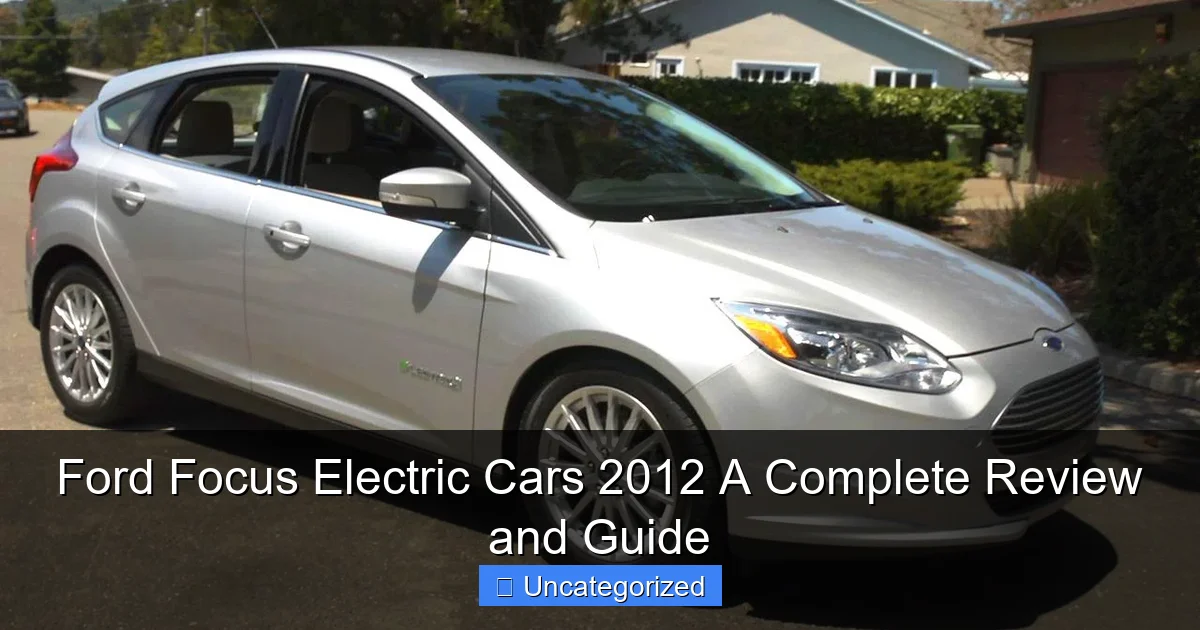
The 2012 Ford Focus Electric shares much of its exterior design with the gasoline-powered Focus, a strategic move to maintain brand familiarity while introducing electric-specific elements. The most noticeable change is the redesigned front fascia, which eliminates the traditional grille—since electric motors don’t require air intake—and replaces it with a smooth, gloss-black panel. This gives the car a sleek, modern appearance that sets it apart from its combustion-engine siblings.

Visual guide about ford focus electric cars 2012
Image source: carsuk.net
- LED Lighting: The Focus Electric features LED daytime running lights and taillights, enhancing visibility and contributing to its futuristic aesthetic.
- Aerodynamic Tweaks: The front bumper and underbody were optimized for reduced drag, with a coefficient of 0.29 Cd—slightly better than the standard Focus.
- Distinctive Badging: The “Focus Electric” badge on the rear and “ELECTRIC” decals on the side windows clearly identify the vehicle as an EV.
One practical example of its design philosophy is the charging port, cleverly integrated into the front driver-side fender. This placement allows for convenient access in parking spaces and aligns with the standard charging port location in many public EV stations.
Color and Trim Options: Limited but Purposeful
Ford offered the 2012 Focus Electric in three exterior colors: Ingot Silver, White Platinum, and Tuxedo Black. While the palette was limited compared to other trims, it emphasized the car’s premium, eco-conscious identity. The 17-inch aluminum wheels were unique to the electric model, featuring a turbine-inspired design that improved aerodynamics.
Interior materials were upgraded over base Focus models, with standard cloth upholstery (leather was optional), soft-touch dashboard surfaces, and piano-black trim accents. The cabin felt more upscale than many EVs of its era, a testament to Ford’s focus on quality.
Size and Practicality: Compact but Spacious
Measuring 172 inches in length and 72 inches in width, the Focus Electric is a true compact car—ideal for city driving and tight parking spaces. Despite its size, the hatchback design provides 14.5 cubic feet of cargo space behind the rear seats (expandable to 39.5 cubic feet with seats folded), making it competitive with rivals like the Nissan Leaf and Chevrolet Volt.
Pro Tip: The rear hatch opens wide, and the low load floor makes loading groceries or luggage a breeze. For urban dwellers, this practicality is a major selling point.
Performance and Driving Experience: Silent Power and Urban Agility
Electric Powertrain: The Heart of the Machine
The 2012 Ford Focus Electric is powered by a permanent-magnet electric motor producing 123 horsepower and 184 lb-ft of torque. Unlike gasoline engines, which build torque gradually, electric motors deliver 100% of torque instantly—resulting in brisk acceleration from a standstill. The 0-60 mph time is approximately 9.6 seconds, which is adequate for city driving but not sporty by modern standards.
Visual guide about ford focus electric cars 2012
Image source: i.ytimg.com
The motor draws energy from a 23 kWh liquid-cooled lithium-ion battery pack, mounted under the floor for optimal weight distribution. This placement lowers the car’s center of gravity, enhancing handling and stability.
Range and Efficiency: Real-World Expectations
The EPA-rated range for the 2012 Focus Electric is 76 miles on a full charge. While this was competitive for its time (the 2012 Nissan Leaf had 73 miles), it pales in comparison to today’s 250+ mile EVs. However, for urban commuters with daily drives under 50 miles, the range was sufficient—especially with the ability to recharge overnight.
Energy consumption is rated at 32 kWh per 100 miles, translating to an equivalent of 110 MPGe (miles per gallon equivalent) in the city and 99 MPGe on the highway. This efficiency made it one of the most economical vehicles on the market.
Real-World Example: A driver commuting 30 miles round-trip daily would need to charge only 3-4 times per week, depending on auxiliary loads like heating or air conditioning.
Driving Modes and Regenerative Braking
The Focus Electric features three selectable driving modes:
- Normal: Balanced performance and efficiency.
- Econ: Limits throttle response and HVAC output to maximize range.
- Low: Enhances regenerative braking, allowing one-pedal driving in stop-and-go traffic.
The regenerative braking system captures energy during deceleration, feeding it back into the battery. In “Low” mode, lifting off the accelerator slows the car significantly—reducing brake wear and increasing efficiency. For city drivers, this feature is a game-changer.
Handling and Ride Quality
Thanks to the low-mounted battery and well-tuned suspension, the Focus Electric handles with surprising agility. The steering is light and responsive, ideal for zipping through traffic. The ride is firm but compliant, absorbing bumps better than many compact EVs.
Tip: Use the “Econ” mode for longer trips and “Low” mode in heavy traffic to maximize range and minimize brake usage.
Technology and Interior Features: A Tech-Forward Cabin
SYNC with MyFord Touch: The Infotainment Hub
The 2012 Focus Electric was one of the first Ford vehicles to feature the SYNC with MyFord Touch system. This touchscreen-based infotainment platform included:
- 8-inch color touchscreen
- Voice-activated controls
- Bluetooth connectivity
- Navigation with EV-specific routing
- Real-time energy monitoring
One standout feature was the EV-specific navigation system, which could plot routes based on remaining battery range and locate nearby charging stations. It even displayed the estimated charge level upon arrival—a rare and useful tool in 2012.
Energy Management and Driver Feedback
The instrument cluster was redesigned for EV use, featuring a large digital speedometer flanked by energy flow indicators. Drivers could monitor:
- Battery state of charge
- Instantaneous and average energy consumption
- Regenerative braking efficiency
- Estimated range
A “Power Meter” on the left side of the cluster showed how much power was being drawn or regenerated in real time. This gamified energy usage, encouraging eco-friendly driving habits.
Climate Control and Pre-Conditioning
The Focus Electric includes a pre-conditioning feature accessible via the MyFord Mobile app or the in-car menu. This allows drivers to heat or cool the cabin while the car is still plugged in—using grid power instead of draining the battery. For example, on a cold winter morning, you could set the cabin to 72°F while charging overnight, arriving to a warm, fully charged car.
The HVAC system is electric, eliminating the need for engine heat. It’s efficient but can reduce range in extreme temperatures—by up to 30% in sub-zero conditions.
Connectivity and Charging Apps
The MyFord Mobile app (available for iOS and Android) enables remote monitoring and control:
- Start/stop charging
- Check battery status
- Locate the vehicle
- Schedule charging during off-peak hours
Practical Tip: Schedule charging between 11 PM and 7 AM to take advantage of lower electricity rates—saving money and reducing grid strain.
Charging Infrastructure and Battery Management
Charging Options: Level 1 vs. Level 2
The 2012 Focus Electric supports two charging levels:
- Level 1 (120V AC): Uses a standard household outlet. Adds about 4 miles of range per hour. Full charge: ~20 hours.
- Level 2 (240V AC): Requires a dedicated EVSE (Electric Vehicle Supply Equipment). Adds about 20 miles per hour. Full charge: ~3.5 hours.
Ford offered a free 240V charging station (via partnerships with companies like Best Buy) for early buyers—a significant incentive.
Charging Port and Cable
The car uses a standard J1772 connector, compatible with most public charging stations in North America. The included portable charging cord (Level 1) can be stored in the cargo area. A Level 2 charger is highly recommended for daily use.
Installation Tip: Hire a licensed electrician to install a 240V outlet (NEMA 14-50) in your garage. Most installations cost $500–$1,000 but pay for themselves in convenience and time savings.
Battery Degradation and Longevity
Early lithium-ion batteries were prone to degradation, but Ford designed the Focus Electric’s pack with thermal management (liquid cooling) to extend lifespan. Real-world data shows most 2012 models retain 70–80% of original capacity after 8–10 years.
Factors affecting battery health:
- Frequent deep discharges
- High ambient temperatures
- Use of DC fast charging (not available on the 2012 model)
Maintenance Tip: Avoid keeping the battery at 100% charge for long periods. Aim to charge to 80–90% for daily use and only 100% for long trips.
Public Charging and Network Compatibility
While the 2012 Focus Electric lacks DC fast charging (a limitation of its era), it works seamlessly with Level 2 stations from networks like ChargePoint, EVgo, and Blink. Many public stations offer free or low-cost charging for early adopters.
Example: A 2012 Focus Electric driver in California could use the state’s “EV Everywhere” network, which provided free Level 2 charging at shopping centers and workplaces.
Ownership Costs, Incentives, and Reliability
Pricing and Incentives: Making EVs Affordable
The 2012 Ford Focus Electric had a starting MSRP of $39,200—higher than the gasoline Focus ($17,000) but competitive with other EVs. However, federal and state incentives significantly reduced the cost:
- Federal Tax Credit: $7,500 (available at tax time)
- California HOV Sticker: Allowed solo drivers in carpool lanes (value: $1,000–$2,000 in time savings)
- State Rebates: Up to $2,500 in states like Colorado and Georgia
After incentives, the effective price could drop to $29,200 or lower—making it more accessible than many buyers expected.
Fuel and Maintenance Savings
Electricity is cheaper than gasoline. At $0.12/kWh, a full charge costs about $2.76 (23 kWh × $0.12). Over 15,000 miles/year, that’s $552 in energy costs—vs. $1,800 for a 25 MPG gasoline car at $3.00/gallon.
Maintenance is also simplified:
- No oil changes
- No exhaust system
- No spark plugs or timing belts
- Regenerative braking reduces brake pad wear by 50–70%
Annual maintenance costs average $500–$700, compared to $900+ for ICE vehicles.
Reliability and Common Issues
The 2012 Focus Electric has a solid reliability record. According to Consumer Reports, it scores 4/5 for reliability. Known issues include:
- MyFord Touch system glitches (fixed via software updates)
- 12V battery drain (common in all EVs)
- Heater core failure in cold climates (rare but costly to repair)
Pro Tip: Replace the 12V battery every 3–4 years and keep the car plugged in during long storage periods to avoid deep discharge.
Warranty and Battery Coverage
Ford offered an 8-year/100,000-mile warranty on the battery and electric drivetrain—longer than the standard 3-year/36,000-mile bumper-to-bumper coverage. This provided peace of mind for early adopters.
Legacy and Impact: Paving the Way for the Future
A Trailblazer in Ford’s EV Journey
The 2012 Focus Electric was Ford’s bold entry into the EV market. While it didn’t outsell the Nissan Leaf, it played a crucial role in proving that American automakers could compete in the electric space. It laid the groundwork for future models like the Ford Escape Hybrid, Fusion Energi, and the Ford Mustang Mach-E.
Lessons Learned and Industry Influence
The Focus Electric highlighted the importance of:
- User-friendly charging integration
- Real-time energy feedback
- Smart climate control
- Public-private partnerships for charging infrastructure
Many of these features are now standard in modern EVs.
Resale Value and Collector Status
As of 2023, 2012 Focus Electrics sell for $6,000–$10,000 on the used market. While not a collector’s item yet, well-maintained examples are becoming sought after by EV enthusiasts and sustainability advocates.
| Feature | 2012 Ford Focus Electric | 2012 Nissan Leaf | 2012 Chevrolet Volt |
|---|---|---|---|
| Range (EPA) | 76 miles | 73 miles | 38 miles (EV) + 340 miles (gas) |
| Horsepower | 123 hp | 107 hp | 149 hp (combined) |
| Battery Capacity | 23 kWh | 24 kWh | 16.5 kWh |
| Charging Time (Level 2) | 3.5 hours | 4 hours | 4 hours (EV mode) |
| MSRP (Base) | $39,200 | $35,200 | $39,145 |
| MPGe (City/Highway) | 110/99 | 106/92 | 94/90 (EV mode) |
Final Thoughts: A Worthy Pioneer
The 2012 Ford Focus Electric was more than just a car—it was a statement. It proved that electric mobility could be practical, affordable, and enjoyable. While its range and charging speed seem modest by today’s standards, it set a high bar for usability, technology, and driver engagement. For early adopters, it offered a glimpse into a cleaner, quieter future. For the industry, it was a catalyst for innovation.
Today, the Focus Electric stands as a testament to Ford’s forward-thinking vision. Whether you’re considering a used model for city driving or simply interested in the history of EVs, this car deserves recognition as a true pioneer. As the world accelerates toward electrification, the 2012 Ford Focus Electric remains a milestone—a small car with a big impact.
Frequently Asked Questions
What is the range of the 2012 Ford Focus Electric car?
The 2012 Ford Focus Electric offers an EPA-estimated range of 76 miles (122 km) on a full charge, making it ideal for daily commutes. Actual range may vary based on driving habits, terrain, and climate conditions.
How long does it take to charge the Ford Focus Electric 2012?
Using a 240V Level 2 charger, the 2012 Ford Focus Electric takes about 3–4 hours to fully charge. With a standard 120V household outlet, charging can take up to 20 hours for a full battery.
Does the 2012 Ford Focus Electric have fast-charging capabilities?
No, the 2012 Ford Focus Electric does not support DC fast charging. It is limited to Level 1 (120V) and Level 2 (240V) charging, which may affect convenience for long-distance travel.
What are the key features of the Ford Focus Electric 2012?
The 2012 Ford Focus Electric includes SYNC infotainment, heated front seats, a rearview camera, and regenerative braking. It also features smartphone integration for monitoring charging status and battery life remotely.
How does the 2012 Ford Focus Electric compare to gas-powered Focus models?
The Ford Focus Electric 2012 trades the gas engine for a 143-hp electric motor, offering quieter acceleration and zero tailpipe emissions. However, cargo space is slightly reduced due to the battery pack placement.
Is the 2012 Ford Focus Electric a good used EV buy today?
The 2012 Ford Focus Electric can be a budget-friendly entry into EV ownership, but its limited range and older tech may not suit everyone. Always check battery health and available incentives when buying used.