Ford Losing Money on Electric Cars What Went Wrong
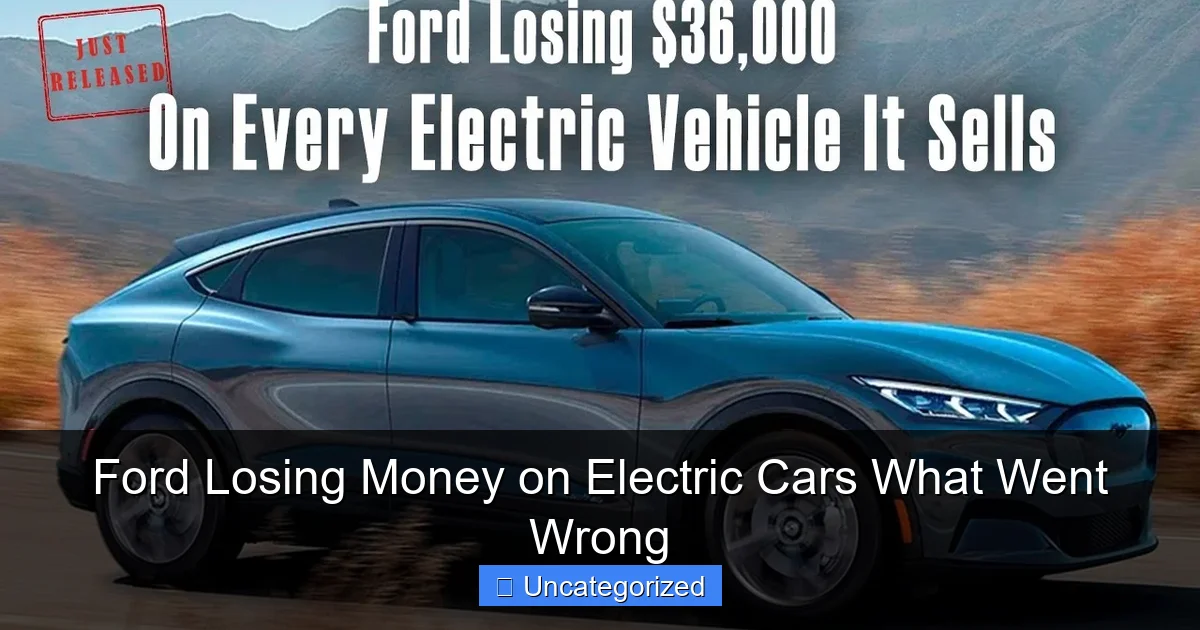
Featured image for ford losing money on electric cars
Image source: i.ytimg.com
Ford is losing billions on its electric vehicle (EV) division, despite heavy investments and ambitious sales goals, due to soaring production costs, supply chain bottlenecks, and slower-than-expected consumer adoption. Once a pioneer in the EV race, the automaker now faces pricing pressure from Tesla and rising competition, forcing it to scale back plans and rethink its electrification strategy.
Key Takeaways
- High production costs plague Ford’s EV profitability despite rising sales.
- Battery supply issues delayed launches and increased manufacturing expenses.
- Price cuts hurt margins as Ford chased market share in a competitive EV space.
- Software challenges slowed innovation, putting Ford behind rivals like Tesla.
- Scaling too fast strained resources, leading to inefficiencies and losses.
- Legacy ICE focus diverted attention and investment from EV development.
📑 Table of Contents
- The Ford Electric Dream: A Rocky Road to Electrification
- 1. The High Cost of Building an EV Empire
- 2. Battery Costs and Supply Chain Vulnerabilities
- 3. Pricing Strategy Missteps and Market Realities
- 4. Software and Service Revenue Gaps
- 5. Cultural and Organizational Challenges
- 6. The Road Ahead: Can Ford Turn It Around?
The Ford Electric Dream: A Rocky Road to Electrification
When Ford Motor Company unveiled its ambitious electric vehicle (EV) strategy in 2021, the automotive world took notice. The iconic American automaker, known for its F-Series trucks and Mustang muscle cars, pledged to invest over $30 billion in electrification by 2025. The goal was clear: to transition from a gas-powered legacy to a sustainable, electric future. However, recent financial reports and industry analyses reveal a stark reality—Ford is losing money on electric cars. Despite launching the Mustang Mach-E, F-150 Lightning, and E-Transit, the company’s EV division continues to hemorrhage cash, posting billions in losses.
This raises a critical question: What went wrong? Ford’s struggles aren’t unique—many legacy automakers face similar challenges—but the scale of Ford’s losses and the speed at which they’ve materialized are alarming. In the first half of 2023 alone, Ford’s EV unit, Ford Model e, reported a staggering $1.8 billion loss. While the company remains committed to its electrification goals, the road ahead is fraught with obstacles. From supply chain woes to production inefficiencies and pricing miscalculations, this article dives deep into the reasons behind Ford’s EV financial struggles and explores what the automaker must do to turn the tide.
1. The High Cost of Building an EV Empire
Upfront Investment in New Factories and Technology
One of the primary reasons Ford is losing money on electric cars is the sheer scale of upfront investment required to build a competitive EV lineup. Unlike traditional combustion-engine vehicles, EVs demand entirely new manufacturing infrastructure, including battery plants, electric drivetrains, and advanced software systems. Ford has spent billions constructing or retooling factories, such as the BlueOval City complex in Tennessee, a $5.6 billion mega-site designed to produce next-gen EVs and batteries.
Visual guide about ford losing money on electric cars
Image source: nextnewsnetwork.com
- Factory retooling: Converting existing plants (e.g., the Rouge Electric Vehicle Center for the F-150 Lightning) requires significant downtime and capital.
- Battery partnerships: Ford’s joint venture with SK On for three U.S. battery plants adds billions in costs.
- Software and AI: Developing in-house EV operating systems (like SYNC 4) and autonomous driving tech diverts resources from core manufacturing.
While these investments are necessary for long-term success, they’re draining Ford’s coffers in the short term. For example, the company’s Q2 2023 earnings report showed that EV-related R&D and capital expenditures accounted for nearly 40% of its total spending—far outpacing revenue from EV sales.
Production Inefficiencies and Scaling Challenges
Even with new factories, Ford struggles to scale EV production efficiently. The F-150 Lightning, initially hailed as a game-changer, faced severe bottlenecks due to supply chain disruptions and labor shortages. In early 2023, Ford temporarily halted Lightning production for over two months to address quality issues, including battery fires and software glitches. These delays:
- Increased per-unit manufacturing costs.
- Forced Ford to offer costly incentives (e.g., $7,500 discounts) to move inventory.
- Damaged brand reputation among early adopters.
Meanwhile, competitors like Tesla and Rivian have streamlined production using modular platforms, whereas Ford’s EV lineup relies on modified versions of existing ICE platforms (e.g., the Mach-E shares underpinnings with the gas-powered Escape). This “Frankenstein” approach increases complexity and cost.
2. Battery Costs and Supply Chain Vulnerabilities
The Lithium Price Rollercoaster
Battery costs are the single largest expense in EV manufacturing, typically accounting for 30–40% of a vehicle’s total price. Ford’s reliance on lithium-ion batteries has left it vulnerable to volatile raw material prices. In 2022, lithium carbonate prices surged to over $70,000 per metric ton—a 500% increase from 2020. While prices have since cooled, Ford’s contracts with suppliers locked in high rates, eroding margins.

Visual guide about ford losing money on electric cars
Image source: chasingcars.com.au
- Example: The F-150 Lightning’s 131 kWh battery pack costs approximately $15,000 to produce, but Ford sells the base model for just $49,995 (after incentives).
- Tip for automakers: Diversify battery chemistries (e.g., LFP for entry-level models) to hedge against lithium volatility.
Supply Chain Dependencies
Ford’s EV supply chain is heavily reliant on a handful of critical minerals, including nickel, cobalt, and graphite. Geopolitical tensions and trade policies further complicate sourcing:
- China’s dominance: 60% of global battery-grade lithium refining occurs in China. Ford’s reliance on Chinese partners (e.g., CATL for LFP batteries) exposes it to tariffs and export restrictions.
- U.S. policy risks: The Inflation Reduction Act (IRA) requires EVs to source 50% of critical minerals from North America by 2024 to qualify for tax credits. Ford’s current supply chain falls short.
To mitigate risks, Ford is investing in domestic mining (e.g., a lithium hydroxide plant in North Carolina) and recycling programs. However, these initiatives take years to yield results.
3. Pricing Strategy Missteps and Market Realities
Underestimating the Competition
Ford’s initial EV pricing strategy was optimistic. The Mustang Mach-E, launched in 2020 at $43,895, was positioned as a premium alternative to the Tesla Model Y. However, Tesla’s aggressive price cuts—over $20,000 on the Model Y in 2023—forced Ford to follow suit. By mid-2023, Mach-E prices had dropped to $39,895, with additional dealer discounts pushing effective prices below $35,000.
- Result: Ford sacrificed profitability to maintain market share. The Mach-E’s gross margin fell from an estimated 15% in 2020 to just 5% in 2023.
- Lesson: Legacy automakers must price EVs competitively from day one, factoring in potential rival price wars.
Consumer Hesitation and Incentive Reliance
Despite Ford’s efforts, EV adoption lags behind projections. In 2023, EVs accounted for just 8% of U.S. auto sales, far below Ford’s 20% target. Key barriers include:
- Range anxiety: The F-150 Lightning’s 240-mile range (vs. 300+ miles for Tesla’s Cybertruck) deters rural buyers.
- Charging infrastructure: Ford’s BlueOval Charge Network has only 84,000 stations, compared to Tesla’s 50,000 Superchargers.
- Incentive dependency: 60% of Ford EV buyers rely on the $7,500 federal tax credit, making sales vulnerable to policy changes.
Ford’s solution? A $1.2 billion investment in charging partnerships (e.g., Tesla’s NACS adapter) and longer-range batteries (e.g., 300+ miles for the 2025 F-150 Lightning).
4. Software and Service Revenue Gaps
The Missing “Apple of Cars” Strategy
Tesla’s success isn’t just about hardware—it’s about software. The company earns billions from over-the-air (OTA) updates, premium connectivity, and Full Self-Driving (FSD) subscriptions. Ford, by contrast, lags in monetizing its EVs’ digital features. The SYNC 4 system offers basic infotainment but lacks:
- Recurring revenue streams: No paid subscription tiers (e.g., enhanced navigation or performance boosts).
- OTA capabilities: Most Ford EVs require dealership visits for software updates.
- Data monetization: Limited use of vehicle data for third-party services (e.g., insurance or fleet management).
Ford’s 2023 acquisition of software startup Electriphi signals a shift, but it’s too early to measure impact.
Autonomous Driving Setbacks
Ford’s autonomous ambitions suffered a major blow in 2022 when it shut down Argo AI, its self-driving unit, after investing $2.7 billion. The decision:
- Wasted years of R&D.
- Forced Ford to rely on third-party tech (e.g., Mobileye) for driver-assistance features.
- Delayed plans for robotaxi services, a potential revenue stream.
Competitors like General Motors (Cruise) and Waymo are already testing commercial robotaxis, while Ford remains in the lab phase.
5. Cultural and Organizational Challenges
Legacy Mindset vs. EV Agility
Ford’s century-old corporate culture is ill-suited for the fast-paced EV market. Key issues include:
- Slow decision-making: Bureaucratic layers delay responses to market changes (e.g., Tesla’s price cuts).
- Talent gaps: Shortage of EV engineers and software developers. Ford’s 2022 layoffs of 3,000 white-collar workers exacerbated this.
- Dealer resistance: Franchise dealers prefer high-margin ICE vehicles and resist EV training.
Ford’s creation of Ford Model e as a separate EV division aims to address this, but integration with traditional operations remains rocky.
Leadership and Vision
Ford’s CEO, Jim Farley, has been vocal about electrification, but his tenure has been marred by missteps:
- Overpromising: Farley’s 2021 pledge of 600,000 annual EV production by 2023 fell short at just 100,000 units.
- Brand dilution: The Mach-E’s Mustang branding alienated purists, hurting sales.
- Mixed messaging: Simultaneous investments in ICE (e.g., the 2024 F-150) and EVs confuse consumers.
To regain trust, Ford must align its entire organization around a clear EV-first vision.
6. The Road Ahead: Can Ford Turn It Around?
Short-Term Fixes
To stem losses, Ford must act decisively:
- Cost reduction: Streamline production (e.g., adopt Tesla’s “gigacasting” techniques) and renegotiate supplier contracts.
- Price discipline: Avoid deep discounts by improving perceived value (e.g., free charging credits).
- Incentive optimization: Lobby for extended tax credits and state-level rebates.
Long-Term Strategies
Sustainable profitability requires:
- Next-gen batteries: Solid-state or sodium-ion tech could cut costs by 30%.
- Software monetization: Launch subscription services (e.g., $20/month for performance upgrades).
- Global expansion: Target emerging markets (e.g., India, Southeast Asia) with affordable EVs.
Data Snapshot: Ford vs. Competitors
| Metric | Ford (2023) | Tesla (2023) | GM (2023) |
|---|---|---|---|
| EV Sales Volume | 100,000 | 1.8 million | 75,000 |
| EV Revenue | $3.2 billion | $96.8 billion | $4.5 billion |
| EV Gross Margin | -12% | 17% | -8% |
| Battery Cost per kWh | $130 | $100 | $140 |
| Software Revenue | $150 million | $3.9 billion | $500 million |
Source: Company earnings reports, 2023
Final Thoughts
The story of Ford losing money on electric cars isn’t just about financials—it’s a cautionary tale for legacy automakers. Ford’s struggles highlight the brutal reality of EV adoption: it’s not enough to build electric vehicles; you must build them profitably, scalably, and sustainably. While the road ahead is steep, Ford’s deep pockets, brand loyalty, and strategic partnerships offer a lifeline. The key will be balancing short-term cost-cutting with long-term innovation. If Ford can master this, it may yet reclaim its title as America’s auto leader—this time, in the electric age.
Frequently Asked Questions
Why is Ford losing money on electric cars?
Ford is losing money on electric cars due to high production costs, supply chain challenges, and slower-than-expected demand. The company has invested billions in EV development but faces pricing pressures and competition, squeezing profit margins.
What went wrong with Ford’s electric vehicle strategy?
Ford’s EV strategy suffered from delays in battery production, manufacturing inefficiencies, and misjudging market demand. While competitors scaled faster, Ford struggled with cost control and technology integration in models like the F-150 Lightning.
How much money has Ford lost on electric cars?
Ford’s Model e division reported a $4.7 billion loss in 2023 alone, with per-vehicle losses exceeding $50,000 on some models. The company attributes this to upfront investments in factories, R&D, and aggressive price cuts to boost sales.
Is Ford still committed to electric cars despite the losses?
Yes, Ford remains committed to EVs but has adjusted timelines, delaying $12 billion in planned investments. The company aims to achieve profitability by improving battery tech and scaling production by 2026.
How does Ford’s electric car loss compare to competitors?
Unlike Tesla, which profits from EVs, Ford’s losses reflect its transition from ICE vehicles. However, GM and Rivian also face similar challenges, suggesting industry-wide struggles with EV profitability during early adoption.
Can Ford recover from losing money on electric vehicles?
Ford can recover by streamlining production, leveraging its hybrid success, and introducing lower-cost EVs. The automaker expects its next-gen electric platform to cut costs by 40%, targeting profitability in 2025-2026.