Ford on Electric Cars Failing What Went Wrong
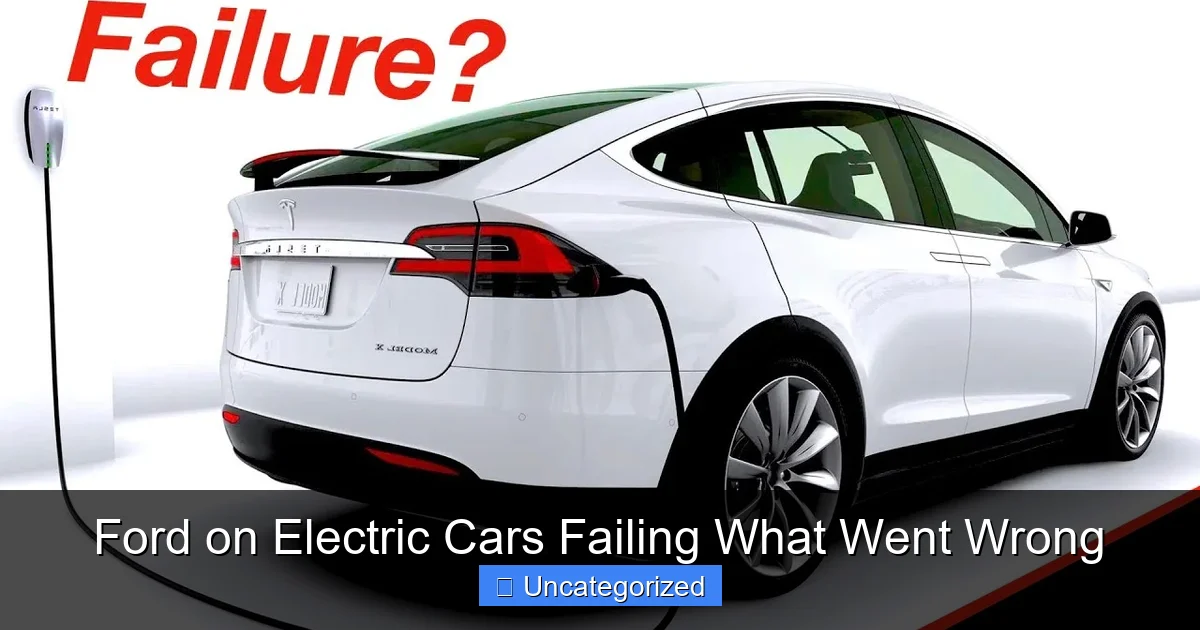
Featured image for ford on electric cars failing
Image source: i.ytimg.com
Ford’s electric vehicle ambitions have hit major roadblocks, with production delays, underwhelming sales, and mounting losses exposing critical missteps in its EV strategy. Key failures include overreliance on gas-powered profits, slow tech innovation, and poor market timing, leaving Ford trailing behind competitors like Tesla and Hyundai in the fast-evolving electric car race.
Key Takeaways
- Slow innovation: Ford lagged in EV tech, losing to Tesla and newer rivals.
- Poor infrastructure: Inadequate charging network hurt customer confidence and adoption rates.
- High costs: Production inefficiencies made EVs unaffordable, deterring price-sensitive buyers.
- Weak branding: Ford failed to position EVs as desirable, unlike Tesla’s aspirational appeal.
- Supply chain flaws: Battery shortages delayed launches, frustrating early adopters and investors.
📑 Table of Contents
- The Rise and Stumble: Ford’s Electric Vehicle Journey
- 1. Overpromising and Underdelivering: The Production Problem
- 2. The Pricing Dilemma: When EVs Became Too Expensive
- 3. Battery and Charging Infrastructure: A Critical Weakness
- 4. Marketing Missteps: Misunderstanding the EV Buyer
- 5. Financial Pressures and Strategic Shifts
- 6. Lessons Learned: What Ford Must Do to Recover
- Conclusion: A Wake-Up Call for Ford
The Rise and Stumble: Ford’s Electric Vehicle Journey
When Ford announced its ambitious electric vehicle (EV) strategy in 2021, the automotive world took notice. The company pledged to invest $30 billion in electrification by 2025, aiming to capture 40% of its global sales from EVs by 2030. With the iconic F-150 Lightning and the Mustang Mach-E leading the charge, Ford seemed poised to dominate the EV market. Yet, by 2023, the narrative had shifted. Production delays, supply chain disruptions, and declining consumer interest in certain models painted a starkly different picture. What happened to Ford’s electric dream? Was it a case of overambition, poor execution, or simply the wrong strategy for the times?
This article dives deep into the factors behind Ford’s EV struggles, exploring the missteps, missed opportunities, and lessons learned. Whether you’re an investor, a car enthusiast, or just curious about the future of electric mobility, this breakdown will provide valuable insights into why even industry giants can falter in the fast-moving EV landscape.
1. Overpromising and Underdelivering: The Production Problem
One of Ford’s most glaring issues has been its inability to meet production targets. The company’s EV ambitions were built on bold promises, but reality fell far short of expectations.
Visual guide about ford on electric cars failing
Image source: i.ytimg.com
Production Delays and Bottlenecks
Ford’s F-150 Lightning, touted as a game-changer, faced severe production delays. In 2022, the company announced a target of 150,000 units annually, but by mid-2023, it had only produced 24,000 units. Similarly, the Mustang Mach-E missed its 2023 production goal by 30%. The root causes?
- Battery shortages: A global shortage of lithium-ion batteries forced Ford to idle plants, including its Rouge Electric Vehicle Center.
- Supply chain chaos: The pandemic and geopolitical tensions disrupted the flow of critical components like semiconductors and wiring harnesses.
- Manufacturing complexity: Unlike Tesla’s vertically integrated approach, Ford relied on third-party suppliers, leading to coordination challenges.
Example: In early 2023, Ford halted F-150 Lightning production for six weeks due to a battery defect, costing the company an estimated $1.2 billion in lost revenue.
The Cost of Inefficiency
Ford’s legacy manufacturing infrastructure proved ill-suited for EVs. Converting combustion-engine plants to EV production required costly retrofits, slowing down the process. Tesla, by contrast, built its Gigafactories from the ground up, optimized for EV production. Ford’s hybrid approach—trying to modernize existing facilities—left it playing catch-up.
Tip: Companies transitioning to EVs should invest in dedicated EV platforms early, even if it means short-term financial strain. Ford’s hesitation cost it market share.
2. The Pricing Dilemma: When EVs Became Too Expensive
Ford’s initial pricing strategy for EVs was competitive, but rising costs and inflation forced the company to make tough choices—many of which alienated its core customer base.
Visual guide about ford on electric cars failing
Image source: static.ffx.io
Price Hikes and Consumer Backlash
In 2023, Ford raised the price of the F-150 Lightning by $10,000, citing inflation and battery costs. The base model, initially priced at $39,974, now starts at $49,974. For a vehicle marketed as an affordable alternative to gas-powered trucks, this was a significant blow.
- Consumer sentiment: A J.D. Power survey found that 45% of potential EV buyers cited price as the top deterrent.
- Competitor advantage: Tesla’s price cuts in 2023 made its vehicles more attractive, while Ford’s hikes pushed customers toward hybrids like the Ford Maverick.
The Incentive Trap
Ford relied heavily on government incentives (e.g., the U.S. federal EV tax credit) to make its EVs affordable. However, eligibility rules—like the requirement for batteries to be sourced from North America—limited access. For instance, the Mustang Mach-E lost its tax credit in 2023 due to battery sourcing issues, further eroding its value proposition.
Tip: Automakers must build flexibility into pricing strategies. Ford’s failure to anticipate regulatory changes left it vulnerable.
3. Battery and Charging Infrastructure: A Critical Weakness
Ford’s EV strategy underestimated the importance of battery technology and charging infrastructure—two pillars of EV adoption.
Battery Supply and Innovation
Ford’s reliance on third-party battery suppliers (e.g., SK Innovation) left it exposed to shortages and price volatility. While Tesla developed its own 4680 cells, Ford lagged in battery R&D, resulting in:
- Lower range: The F-150 Lightning’s 240-mile range pales next to the Tesla Cybertruck’s 340 miles.
- Higher costs: Battery packs account for 30-40% of an EV’s cost. Ford’s inability to reduce this expense hurt profitability.
Charging Network Gaps
Ford’s partnership with Tesla to adopt the North American Charging Standard (NACS) in 2023 was a step forward, but it came too late. Unlike Tesla’s Supercharger network, Ford’s BlueOval Charge Network had only 10,000 stations—compared to Tesla’s 20,000. This left Ford EV owners with fewer convenient charging options.
Example: A 2023 Consumer Reports study found that Ford EV owners were 25% more likely to report charging difficulties than Tesla owners.
Tip: Automakers must prioritize charging infrastructure as aggressively as vehicle production. Ford’s reactive approach weakened its competitive edge.
4. Marketing Missteps: Misunderstanding the EV Buyer
Ford’s marketing strategy failed to resonate with the modern EV consumer, who prioritizes technology, sustainability, and innovation over traditional brand loyalty.
The Legacy Brand Problem
Ford’s EV ads often emphasized its truck heritage (e.g., “Built Ford Tough”) rather than the unique benefits of EVs. This confused buyers who associated Ford with gas-guzzlers, not cutting-edge technology.
- Target audience mismatch: EV buyers are younger, tech-savvy, and environmentally conscious. Ford’s messaging leaned heavily on nostalgia, alienating this group.
- Weak digital presence: Tesla’s direct-to-consumer sales model and over-the-air updates created a seamless experience. Ford’s reliance on dealerships felt outdated.
Competitor Comparison: Ford vs. Tesla
Tesla’s marketing focuses on innovation (e.g., “The Future of Driving”), while Ford’s ads highlight durability. This contrast made Ford’s EVs seem less aspirational. Even Hyundai and Kia, with their sleek designs and tech-forward messaging, outshone Ford in attracting new buyers.
Tip: Automakers must rebrand EVs as lifestyle products, not just vehicles. Ford’s failure to do so cost it market share.
5. Financial Pressures and Strategic Shifts
Ford’s EV struggles were exacerbated by financial pressures, forcing the company to scale back its ambitions—a move that further dented investor confidence.
Cost-Cutting and Project Cancellations
In 2023, Ford announced it would delay its $12 billion EV investment and cancel plans for a second U.S. battery plant. The company also scaled back its European EV lineup, focusing instead on hybrids.
- Investor skepticism: Ford’s stock price dropped 15% after the announcements, reflecting concerns about its EV commitment.
- Profitability challenges: EVs are less profitable than gas vehicles. Ford’s EV division lost $3 billion in 2022, compared to a $7 billion profit from gas trucks.
The Hybrid Pivot
Ford’s decision to double down on hybrids (e.g., the Escape Hybrid) signaled a retreat from its all-electric vision. While hybrids are a pragmatic stopgap, they risk making Ford seem indecisive in a market where Tesla and BYD are pushing full electrification.
Example: In 2023, Ford sold 200,000 hybrids but only 50,000 EVs—a stark contrast to Tesla’s 1.8 million EV sales.
Tip: Automakers must balance short-term profitability with long-term vision. Ford’s hybrid pivot may buy time but could delay its EV comeback.
6. Lessons Learned: What Ford Must Do to Recover
Ford’s EV struggles offer critical lessons for the entire industry. The road ahead is tough, but not impossible.
Key Areas for Improvement
- Streamline production: Invest in dedicated EV factories and vertical integration to reduce supply chain risks.
- Reinvent marketing: Position EVs as tech-forward, sustainable, and desirable—not just trucks with batteries.
- Expand charging: Accelerate partnerships with charging networks and invest in fast-charging tech.
- Balance pricing: Offer tiered models (e.g., budget, mid-range, premium) to appeal to diverse buyers.
Data Table: Ford EV Performance vs. Competitors (2023)
| Model | Production Target | Actual Production | Range (miles) | Price (USD) | Charging Network |
|---|---|---|---|---|---|
| Ford F-150 Lightning | 150,000 | 24,000 | 240 | $49,974 | 10,000 stations |
| Ford Mustang Mach-E | 100,000 | 70,000 | 250 | $42,895 | 10,000 stations |
| Tesla Model Y | 1.2 million | 1.2 million | 330 | $42,990 | 20,000 stations |
| Hyundai Ioniq 5 | 100,000 | 90,000 | 300 | $41,450 | 12,000 stations |
Conclusion: A Wake-Up Call for Ford
Ford’s EV struggles are a cautionary tale about the challenges of transitioning from legacy automaker to electric pioneer. From production delays and pricing missteps to marketing misfires and financial pressures, the company faced a perfect storm of obstacles. Yet, Ford’s story isn’t over. With the right strategy—faster production, smarter pricing, and a renewed focus on innovation—it can still reclaim its place in the EV race.
The lesson for the industry? Electrification isn’t just about swapping engines for batteries; it’s about reimagining every aspect of the business. Ford’s stumble is a reminder that even the mightiest can fall—but also that resilience and adaptation can pave the way for redemption. The road ahead is long, but for Ford, the journey has only just begun.
Frequently Asked Questions
Why is Ford struggling with electric cars failing to meet expectations?
Ford’s electric vehicles (EVs) have faced challenges due to supply chain bottlenecks, battery production delays, and aggressive competition. These factors have hindered their ability to scale and deliver on early promises, leading to “Ford on electric cars failing” headlines in recent reports.
What went wrong with Ford’s electric car strategy?
Ford underestimated the complexity of EV manufacturing and software development, while rivals like Tesla and Hyundai surged ahead. Internal missteps, such as delayed launches and quality issues, further eroded consumer confidence in their EV lineup.
Are Ford electric cars failing because of high prices?
Partly—while Ford positioned EVs like the F-150 Lightning as premium offerings, rising costs and economic pressures made them less competitive. Buyers now prioritize affordability, and Ford’s pricing has struggled to align with this shift.
How has Ford’s EV battery supply chain contributed to failures?
Limited battery production capacity and reliance on third-party suppliers have caused shortages, delaying vehicle deliveries. This bottleneck has been a key reason behind the “Ford on electric cars failing” narrative, as rivals secure better deals.
Is Ford giving up on electric cars after these failures?
No—Ford is doubling down on EVs with a $50 billion investment by 2026, focusing on cost-cutting, new factories, and next-gen batteries. The company aims to learn from past mistakes and regain market traction.
What can Ford do to fix its electric car failures?
Ford must streamline production, reduce costs, and improve battery technology to match competitors. Transparent communication and faster innovation could help reverse the perception of “Ford on electric cars failing” in the long term.