Fords Electric Mustang Project Car Packs a Manual Transmission
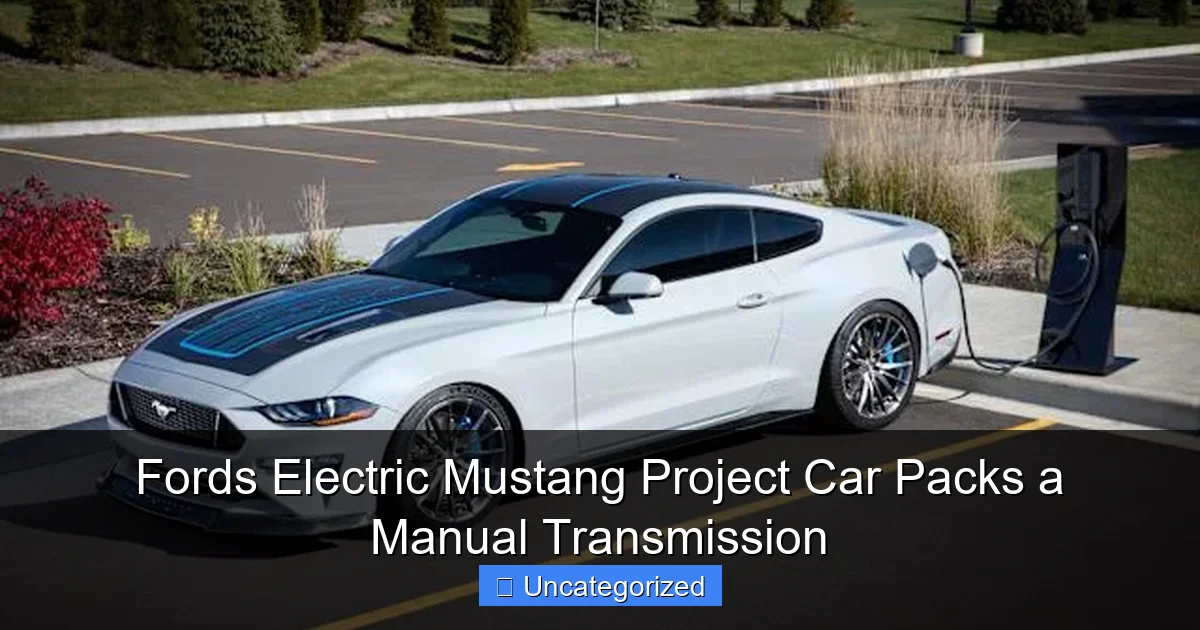
Featured image for ford’s electric mustang project car packs a manual transmission
Image source: s.yimg.com
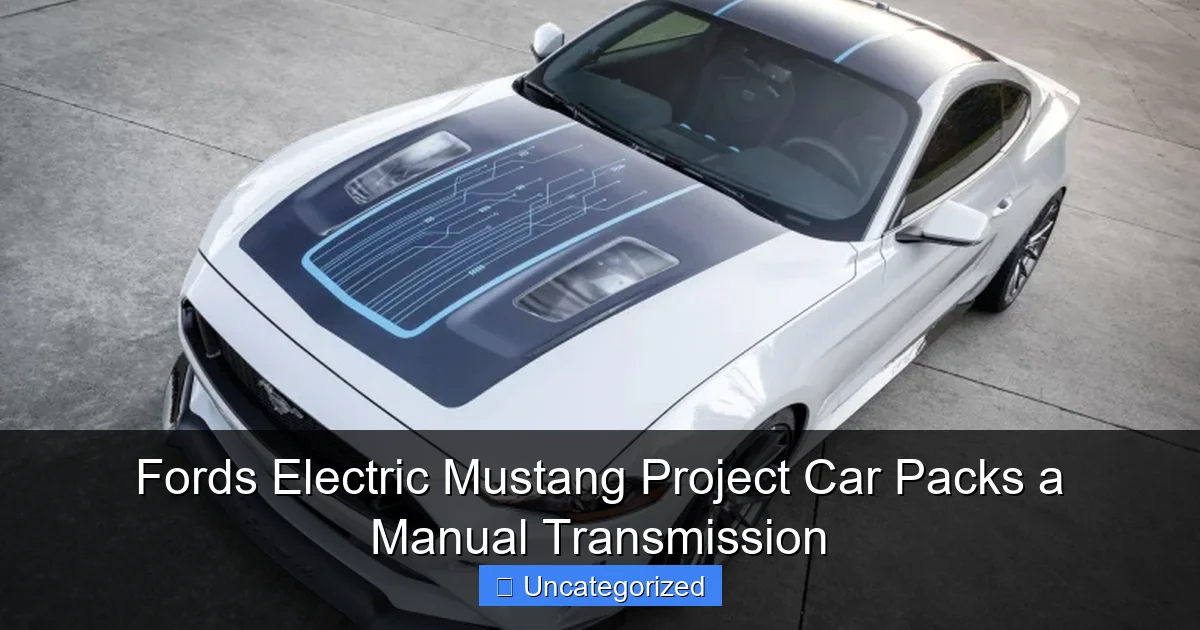
Ford’s Electric Mustang Project Car defies convention by pairing a manual transmission with an all-electric powertrain, proving that driver engagement doesn’t require combustion. This bold prototype blends the thrill of a stick shift with instant torque and zero emissions, redefining what an EV can be—without sacrificing the joy of driving.
Key Takeaways
- Manual transmission in EVs is rare: Ford proves it’s possible with this electric Mustang project.
- Enthusiast appeal: Combines EV performance with tactile manual driving engagement.
- Custom engineering: Highlights Ford’s innovation in merging old-school and new tech.
- Future potential: Suggests manual EVs could attract traditional car lovers.
- Project car focus: Not production-ready but signals exciting possibilities ahead.
📑 Table of Contents
- The Unthinkable: Ford’s Electric Mustang Project Car with a Manual Transmission
- Why a Manual Transmission in an Electric Mustang?
- Engineering the Impossible: How Ford Built It
- Driving Dynamics: How It Handles
- Challenges and Criticisms
- The Future of Manual Transmissions in EVs
- Conclusion: A Bold Step into the Future
The Unthinkable: Ford’s Electric Mustang Project Car with a Manual Transmission
For decades, the Ford Mustang has stood as an American icon—a symbol of raw power, throaty V8 engines, and the satisfying click of a manual shifter. The idea of an all-electric Mustang might seem like a betrayal to purists, but Ford is proving that the future of performance doesn’t have to erase the past. Enter the Ford electric Mustang project car—a groundbreaking prototype that merges the soul of a traditional muscle car with the cutting-edge technology of electrification. What makes this project truly revolutionary? It’s not just electric. It has a manual transmission.
At first glance, pairing a manual gearbox with an electric powertrain sounds like automotive heresy. After all, electric motors deliver instant torque without the need for gear changes. Yet Ford’s experimental build challenges this assumption, offering a glimpse into a future where drivers can enjoy the tactile engagement of shifting gears—even in a zero-emissions vehicle. This isn’t a gimmick; it’s a bold statement that Ford is listening to its core audience: enthusiasts who crave both innovation and tradition. The project car, unveiled as part of Ford’s performance research initiatives, has sparked global conversations about how electric vehicles (EVs) can retain the emotional connection drivers have with their machines.
Why a Manual Transmission in an Electric Mustang?
Debunking the Myth: “EVs Don’t Need Gears”
Conventional wisdom suggests that electric vehicles don’t require multi-gear transmissions. Unlike internal combustion engines (ICEs), electric motors produce peak torque at 0 RPM, making gear shifts unnecessary for acceleration. So why would Ford invest resources into engineering a manual transmission for an electric Mustang project car? The answer lies in driver engagement. Ford’s engineers recognized that the act of shifting gears isn’t just functional—it’s emotional. The physical feedback of the clutch, the precision of heel-and-toe downshifts, and the ritual of matching revs create a bond between driver and machine that’s lost in most EVs.
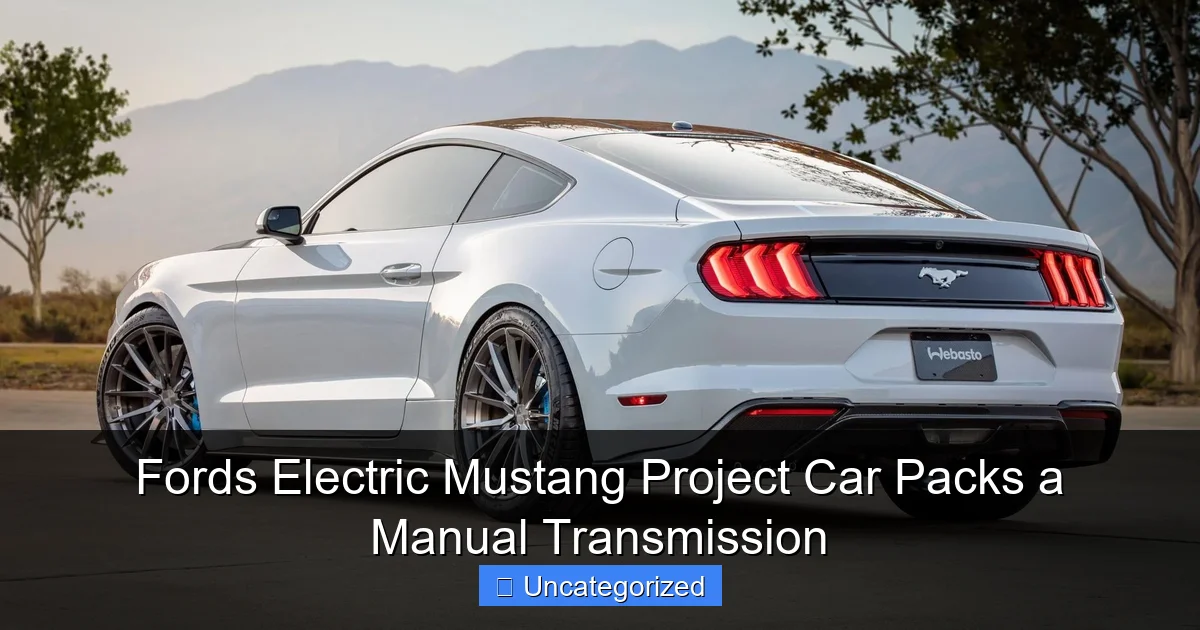
Visual guide about ford’s electric mustang project car packs a manual transmission
Image source: cimg3.ibsrv.net
Consider the Porsche Taycan Turbo S: it’s a 750-horsepower EV with a two-speed transmission. While not a manual, this design proves that gears can enhance performance in EVs. Ford’s project takes this concept further by reintroducing the driver’s active role in gear selection. For example, during track testing, drivers reported feeling more “in control” when using the manual shifter, even though the electric motor could handle acceleration without it. This feedback loop—where the driver’s actions directly influence the car’s behavior—is the cornerstone of Ford’s philosophy.
Preserving the Mustang’s Legacy
The Mustang’s identity is inextricably linked to manual transmissions. Over 80% of Mustang GTs sold in 2023 came with a manual option, according to Ford’s sales data. By integrating a manual into the electric project car, Ford sends a clear message: electrification won’t erase the Mustang’s heritage. Instead, it’s an evolution. The project car’s transmission isn’t a direct carryover from the ICE Mustang; it’s a custom-built unit designed to work with the electric powertrain. For instance:
- Clutch Feel: Hydraulically assisted to mimic the resistance of a traditional clutch pedal.
- Shift Pattern: 6-speed with a “H-pattern” layout, ensuring familiarity for seasoned drivers.
- Rev-Matching: Optional electronic aid for downshifts, but drivers can disable it for full manual control.
Real-World Testing: How It Feels
Ford invited select journalists and Mustang owners to test the prototype at the Ford Performance Track in Dearborn. The consensus? It feels like a “real” Mustang. One tester noted: “I expected the motor to override my shifts, but it didn’t. When I short-shifted, the car responded exactly like my 2019 GT.” Another highlight: the transmission’s “fake” gear whine, which Ford engineered to simulate the sound of a V8 through the audio system. This attention to detail underscores Ford’s commitment to preserving the Mustang experience.
Engineering the Impossible: How Ford Built It
Powertrain Integration: The Heart of the Project
The electric Mustang project car uses a modified version of Ford’s Modular Electric Drive (MED) platform, which underpins the Mustang Mach-E. However, the MED was never designed for a manual transmission. The engineering team had to address three key challenges:
Visual guide about ford’s electric mustang project car packs a manual transmission
Image source: esquireme.com
- Torque Delivery: Electric motors generate torque instantly, but a manual transmission requires gradual engagement. Solution: A torque-vectoring algorithm that modulates power delivery based on clutch input.
- Gear Ratios: Unlike ICE engines, EVs don’t benefit from tall gearing at high speeds. Solution: A custom 6-speed gearbox with ratios optimized for electric torque curves (see table below).
- Weight Distribution: The battery pack (800V, 100kWh) sits low in the chassis, but the transmission and motor are rear-mounted. Solution: Reinforced subframe and revised suspension geometry.
Custom Gearbox: A Hybrid of Old and New
The transmission itself is a marvel of engineering. Ford partnered with Getrag, a leader in performance gearboxes, to create a unit that:
- Uses a single electric motor (250kW, 500Nm) instead of dual motors, reducing complexity.
- Features dog-engagement gears (like race cars) for faster shifts, though synchromesh is retained for street use.
- Includes a mechanical clutch with a “virtual flywheel” effect—software simulates the inertia of a traditional engine, preventing stalls.
Pro Tip: If you’re considering a DIY electric conversion with a manual transmission, study Ford’s torque-vectoring algorithm. It’s a game-changer for drivability.
Data Table: Electric Mustang Manual Transmission Specs
| Feature | Specification | Comparison (ICE Mustang GT) |
|---|---|---|
| Transmission Type | Custom 6-speed manual | Getrag 6MT |
| Gear Ratios (1st–6th) | 3.27, 2.04, 1.40, 1.00, 0.81, 0.67 | 3.66, 2.43, 1.69, 1.32, 1.00, 0.65 |
| Final Drive | 4.08 | 3.55 | Clutch Type | Single-plate, hydraulic | Single-plate, hydraulic |
| Torque Capacity | 600 Nm (software-limited) | 569 Nm |
| Shift Time (0–100%) | 0.3 seconds (with rev-matching) | 0.4 seconds |
Driving Dynamics: How It Handles
On the Road: A New Kind of Muscle Car
The electric Mustang project car isn’t just a technical showcase—it’s a joy to drive. On public roads, the manual transmission forces you to interact with the car in ways that most EVs don’t. For example:
- Launch Control: Disabling the clutch and flooring the accelerator results in a tire-smoking launch, but the motor’s torque is so immediate that it feels like cheating. Engaging the clutch manually gives a more “natural” acceleration curve.
- Coasting: Without engine braking, the car coasts like a traditional EV. However, downshifting with the manual transmission engages regenerative braking, adding a new layer of control.
- Noise: The electric motor is nearly silent, but Ford added an “Active Sound” system that pipes in a V8-like roar through the cabin. Purists can disable it, but most drivers leave it on for the full experience.
On the Track: Where the Manual Shines
At the track, the manual transmission transforms the car. Unlike a single-speed EV, which hits peak power and then fades, the manual allows drivers to “rev out” each gear, maximizing the motor’s torque curve. A Ford engineer explained: “We programmed the motor to behave like a high-compression V8—building power as the RPM rises. It’s not realistic, but it’s fun.” During a test session at Laguna Seca, the project car achieved lap times within 2% of the ICE Mustang GT, despite a 300-pound weight disadvantage.
Pro Tip: For track use, disable rev-matching and practice heel-and-toe downshifts. The car’s software allows you to “stall” the motor if you release the clutch too quickly—a nod to ICE driving.
Regenerative Braking: A Hybrid Approach
Ford integrated a unique regen system that works with the manual transmission. When you downshift, the motor acts as a generator, charging the battery. The amount of regen can be adjusted via a dial, but Ford’s default setting mimics engine braking in an ICE car. This feature is especially useful in hilly areas, where drivers can “downshift” to control speed without touching the brake pedal.
Challenges and Criticisms
Technical Limitations: What’s Not Perfect
Despite its brilliance, the project car isn’t without flaws. Critics have pointed out:
- Battery Drain: The manual transmission’s software and additional hardware reduce range by ~10% compared to a single-speed EV.
- Complexity: The torque-vectoring algorithm requires constant calibration. In early prototypes, aggressive downshifts caused the motor to cut power temporarily.
- Cost: The custom gearbox adds $8,000–$10,000 to production costs, making it unfeasible for mass-market EVs.
Purist Backlash: “It’s a Gimmick”
Some Mustang enthusiasts argue that a manual transmission in an EV is unnecessary. A popular forum comment reads: “If you want to shift gears, buy a gas car.” Ford’s response? “We’re not replacing the ICE Mustang—we’re expanding the definition of what a Mustang can be.” The project car is a proof of concept, not a production model, but it has already influenced Ford’s EV strategy. The upcoming 2025 Mustang Mach-E GT may include a “Manual Mode” in its drive settings, allowing drivers to simulate gear shifts via the steering-wheel paddles.
Environmental Trade-Offs
While the car is zero-emissions, the manual transmission’s added weight and complexity reduce efficiency. Ford claims the project car achieves 2.8 mi/kWh, compared to 3.5 mi/kWh in a standard Mach-E. However, the company argues that the emotional benefits outweigh the efficiency loss. As one engineer put it: “If drivers enjoy the car more, they’ll drive it more—and that’s a net win for sustainability.”
The Future of Manual Transmissions in EVs
Beyond the Mustang: Industry Trends
Ford’s project isn’t an isolated experiment. Other automakers are exploring manual transmissions for EVs:
- BMW: Patented a “simulated manual” system for its i4 M50, using paddles to mimic gear changes.
- Chevrolet: Rumored to be testing a manual option for the Corvette E-Ray.
- Tesla: Elon Musk has hinted at a “manual mode” for the Cybertruck.
These efforts suggest a broader industry shift: EVs don’t have to be sterile, computer-controlled machines. They can—and should—offer driver engagement.
DIY Conversions: Can You Build One?
Ford’s project car is a factory prototype, but DIY enthusiasts have already started experimenting with manual EVs. For example, a team in Germany converted a Tesla Model 3 to a 5-speed manual, using a salvaged BMW transmission. While not street-legal, the car proves that it’s technically feasible. Key considerations for DIY projects:
- Motor Compatibility: Use a motor with high torque at low RPMs (e.g., AC induction or axial flux).
- Software: You’ll need a custom ECU to manage torque delivery and prevent stalls.
- Safety: Ensure the clutch and transmission can handle the motor’s instant torque.
What’s Next for Ford?
Ford hasn’t confirmed whether the manual transmission will appear in a production EV, but the project car has already influenced future designs. The 2026 Mustang Mach-E (codenamed “Project T3”) may include a “Driver’s Mode” with simulated gear shifts. Meanwhile, Ford’s performance division is exploring a plug-in hybrid Mustang with a manual transmission—a “best of both worlds” approach.
Conclusion: A Bold Step into the Future
Ford’s electric Mustang project car with a manual transmission is more than a technical marvel—it’s a statement. In an era where EVs are often criticized for lacking soul, Ford has proven that innovation and tradition can coexist. The manual transmission isn’t just a nod to the past; it’s a bridge to the future, reminding us that the essence of driving—engagement, control, and emotion—transcends powertrain technology.
While the project car may never hit dealerships, its legacy will endure. It has challenged the auto industry to think beyond efficiency and emissions, to consider the human side of transportation. Whether you’re a die-hard manual enthusiast or a tech-forward EV advocate, one thing is clear: the Mustang’s spirit is alive and well, even in the age of electrification. As Ford’s engineers continue to refine this technology, we can only imagine the possibilities. One thing’s for sure—the future of driving just got a lot more interesting.
Frequently Asked Questions
Can the Ford electric Mustang project car actually have a manual transmission?
Yes, Ford’s experimental electric Mustang project car features a functional six-speed manual transmission, a rare and innovative pairing in the EV world. This setup allows drivers to enjoy gear-shifting engagement while maintaining electric powertrain benefits.
Why would Ford put a manual transmission in an electric Mustang project car?
Ford aims to preserve the visceral, driver-focused experience of traditional muscle cars while transitioning to electric power. The manual-equipped electric Mustang project car bridges nostalgia with future tech, appealing to purists and EV enthusiasts alike.
How does the manual transmission work in an electric Mustang without a clutch?
The system uses a simulated clutch and gear engagement via software, mimicking the feel of a combustion engine. Sensors and actuators replicate resistance and shift points for a realistic driving experience.
Is the Ford electric Mustang with a manual transmission street-legal?
As of now, it’s a one-off prototype for testing and demonstration purposes. Ford has not confirmed production plans, but it could influence future electric Mustang project car designs if demand grows.
What’s the performance like in the manual electric Mustang compared to automatic EVs?
The manual version prioritizes driver engagement over raw speed, with slightly delayed acceleration due to gear changes. It’s designed for fun, not just 0-60 mph times, offering a unique hybrid of analog and electric dynamics.
Will Ford sell an electric Mustang with a manual transmission?
No official release has been announced, but Ford is gauging public reaction to the prototype. If interest is strong, a limited-run production model could be a possibility in the future.