Ford SUV Electric Cars The Future of OffRoad Power and Efficiency
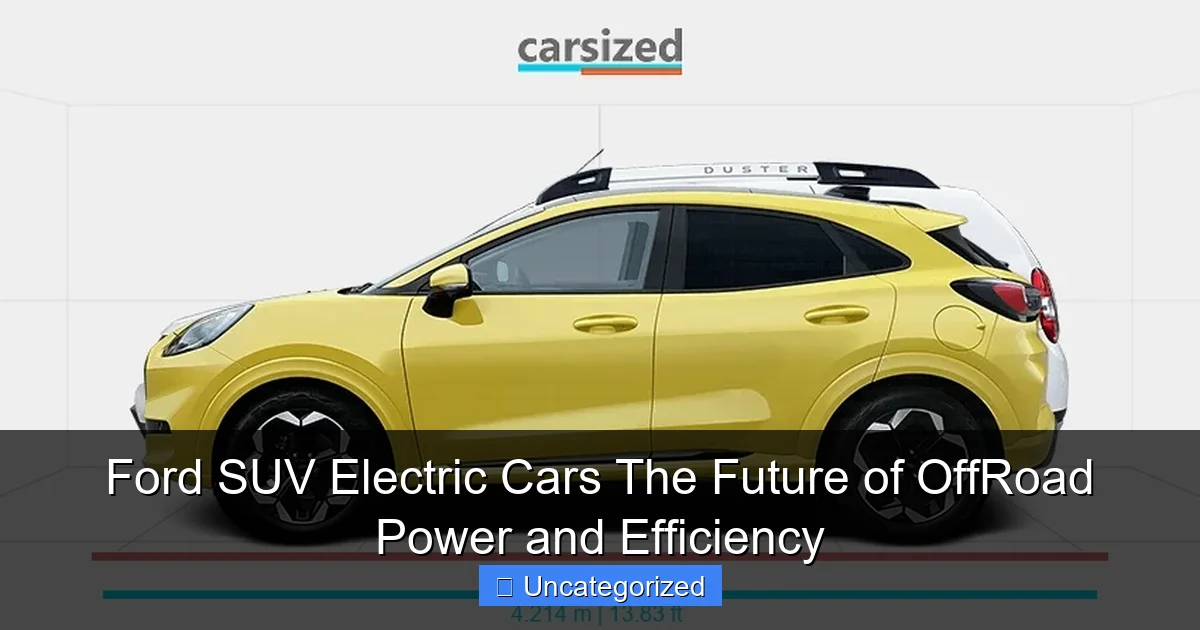
Featured image for ford suv electric cars
Image source: carsized.com
Ford SUV electric cars are redefining off-road performance by merging rugged capability with zero-emission efficiency. With advanced electric powertrains, extended range, and innovative features like Pro Power Onboard, models like the Mustang Mach-E and upcoming electric Explorer deliver uncompromising power and sustainability for adventure seekers—proving Ford is leading the charge in electrified SUV innovation.
Key Takeaways
- Electric power: Ford SUVs deliver instant torque for superior off-road performance.
- Extended range: New models offer 300+ miles, ideal for long adventures.
- Fast charging: Recharge 80% in 45 minutes with DC fast charging.
- Advanced tech: SYNC 4A and over-the-air updates keep systems cutting-edge.
- Sustainable design: Eco-conscious materials reduce environmental impact without sacrificing durability.
- Smart towing: Electric drivetrains enable efficient, high-capacity towing for outdoor gear.
📑 Table of Contents
- The Rise of Electric SUVs: Ford’s Bold Leap Into the Future
- Why Ford Is Leading the Charge in Electric SUV Innovation
- Top Ford SUV Electric Models: Performance, Range, and Features
- Off-Road Capabilities: How Ford Electric SUVs Conquer Tough Terrain
- Efficiency and Cost of Ownership: The Hidden Benefits
- The Future of Ford SUV Electric Cars: What’s Next?
The Rise of Electric SUVs: Ford’s Bold Leap Into the Future
The automotive world is undergoing a seismic shift, and at the heart of this transformation is the rise of electric SUVs. As consumers demand vehicles that combine sustainability, power, and versatility, automakers are racing to meet the challenge. Among them, Ford has emerged as a trailblazer, redefining what an electric SUV can be. With decades of experience building rugged, capable SUVs like the Explorer, Expedition, and Bronco, Ford is now channeling its legacy into a new era of electric off-road performance and efficiency.
Ford’s electric SUV lineup is not just about replacing internal combustion engines with batteries—it’s about reimagining the entire driving experience. These vehicles are engineered to conquer trails, deliver cutting-edge technology, and offer uncompromised efficiency, all while reducing carbon footprints. Whether you’re an off-road enthusiast, a family seeking adventure, or an eco-conscious commuter, Ford’s electric SUVs promise to deliver. This blog post dives deep into how Ford is shaping the future of off-road power and efficiency, exploring the innovations, models, and real-world benefits that set these vehicles apart.
Why Ford Is Leading the Charge in Electric SUV Innovation
Ford’s commitment to electrification isn’t a recent pivot—it’s a strategic, long-term vision. With the launch of the Ford F-150 Lightning (an electric pickup) and the Mustang Mach-E (a sporty crossover), the company has proven its ability to blend performance, practicality, and sustainability. Now, Ford is expanding its electric SUV portfolio with models specifically designed for off-road capability and long-range efficiency.
Legacy Meets Electrification: Ford’s SUV Heritage
Ford’s SUV roots run deep. From the rugged Bronco of the 1960s to the modern Expedition, the brand has mastered the art of building vehicles that thrive in challenging environments. This heritage is now being electrified. The upcoming Ford Explorer EV and the highly anticipated Bronco EV are testaments to Ford’s ability to merge its off-road expertise with electric powertrains. These models retain the iconic design cues and trail-ready features of their gas-powered counterparts while introducing instant torque, whisper-quiet operation, and zero tailpipe emissions.
For example, the Bronco EV is expected to feature a dual-motor all-wheel-drive (AWD) system, adaptive suspension, and advanced terrain management—all powered by a high-capacity battery. This means drivers can tackle rocky trails or deep mud without sacrificing efficiency or comfort.
Cutting-Edge Battery and Motor Technology
At the core of Ford’s electric SUVs is its proprietary Extended-Range Battery and Dual-Motor AWD system. The batteries, developed in partnership with SK Innovation, offer ranges of up to 300+ miles on a single charge (varies by model and configuration). The dual-motor setup ensures maximum traction and power distribution, making these SUVs ideal for off-road adventures.
Ford also prioritizes fast-charging capabilities. Using DC fast chargers, most Ford electric SUVs can achieve 80% charge in under 45 minutes. For home charging, Ford offers the Ford Connected Charge Station, a Level 2 charger that replenishes the battery overnight. Additionally, Ford’s BlueOval Charge Network provides access to over 100,000 charging stations across North America, easing range anxiety for long-distance travelers.
Smart Features for Off-Road and Everyday Use
Ford’s electric SUVs aren’t just about raw power—they’re packed with intelligent features to enhance both off-road and urban driving. Key innovations include:
- Trail Turn Assist: Reduces turning radius on tight trails by braking the inner rear wheel.
- One-Pedal Driving: Regenerative braking lets drivers accelerate and decelerate using only the accelerator pedal, improving control on descents.
- Ford Co-Pilot360: A suite of driver-assistance features like adaptive cruise control, lane-keeping, and blind-spot monitoring.
- Over-the-Air Updates: Keeps the vehicle’s software current with new features and optimizations.
These technologies make Ford’s electric SUVs as capable in the city as they are on a mountain trail.
Top Ford SUV Electric Models: Performance, Range, and Features
Ford’s electric SUV lineup is growing rapidly, with several models catering to different needs—from family haulers to hardcore off-roaders. Here’s a breakdown of the most notable options:
1. Ford Mustang Mach-E: The Sporty Crossover
The Mustang Mach-E was Ford’s first foray into the electric SUV market, and it’s a game-changer. While it shares the Mustang name, this is a spacious, practical SUV with a sporty edge. Key specs:
- Range: Up to 314 miles (California Route 1 trim).
- Power: Up to 480 horsepower (GT Performance Edition).
- 0-60 mph: As low as 3.5 seconds (GT).
- Off-Road Capability: Available AWD, adaptive suspension, and selectable drive modes (Whisper, Engage, Unbridled).
The Mach-E is perfect for drivers who want a balance of performance, tech, and daily usability. It’s also one of the few electric SUVs with a front trunk (frunk)—a handy 4.8 cubic feet of storage space.
2. Ford Explorer EV: The Family-Friendly Electric SUV
Set to debut in 2025, the Explorer EV is Ford’s answer to the growing demand for electric family SUVs. Based on the same platform as the Mach-E, it will offer:
- Three-Row Seating: Accommodates up to 7 passengers.
- Range: Estimated 300+ miles.
- Off-Road Features: Trail Control, terrain modes, and available AWD.
- Tech: SYNC 4 infotainment, 15.5-inch touchscreen, and wireless Apple CarPlay/Android Auto.
Unlike its gas-powered sibling, the Explorer EV will prioritize efficiency without sacrificing space or versatility. It’s ideal for road trips, camping, and daily commutes.
3. Ford Bronco EV: The Ultimate Off-Road Electric SUV
The Bronco EV is perhaps Ford’s most anticipated electric SUV. Expected to launch in 2026, it’s designed to be a direct competitor to the Jeep Wrangler 4xe. Highlights include:
- Body-on-Frame Design: For maximum durability on rough terrain.
- Removable Roof and Doors: Just like the gas-powered Bronco.
- Range: Targeted 300+ miles.
- Off-Road Tech: Trail Turn Assist, G.O.A.T. (Goes Over Any Terrain) modes, and a 360-degree camera system.
Ford is even teasing a “Bronco Raptor EV” variant, which would feature extreme off-road upgrades like 35-inch all-terrain tires and a lifted suspension.
4. Ford Expedition EV: The Luxury Electric SUV
While details are still under wraps, the Expedition EV is expected to be Ford’s flagship electric SUV. It will likely offer:
- Three-Row Luxury: Premium materials, reclining seats, and advanced climate control.
- Towing Capacity: Up to 10,000 lbs (similar to the gas model).
- Range: 350+ miles (estimated).
- Tech: BlueCruise hands-free driving, augmented reality navigation, and a 20-speaker B&O sound system.
This model will target buyers who want a large, luxurious SUV without the environmental guilt.
Off-Road Capabilities: How Ford Electric SUVs Conquer Tough Terrain
One of the biggest misconceptions about electric vehicles is that they’re only suited for city driving. Ford’s electric SUVs shatter this myth with their off-road prowess. Here’s how they’re designed to handle the toughest trails:
Instant Torque and Low-End Power
Electric motors deliver instant torque—100% of it at 0 RPM. This means Ford’s electric SUVs can climb steep inclines, crawl over rocks, and power through deep sand without lag. For example, the Mach-E GT’s dual motors generate 634 lb-ft of torque, giving it a significant advantage over gas-powered SUVs in low-speed off-road scenarios.
Pro Tip: Use the “Unbridled” drive mode for maximum torque delivery on trails.
Advanced Suspension and Terrain Management
Ford’s electric SUVs feature adaptive suspension systems that adjust damping rates based on terrain. The Bronco EV, for instance, will have a high-clearance suspension and locking differentials** to tackle uneven ground. The Mach-E’s available MagneRide suspension uses magnetorheological fluid to adjust firmness in real-time.
Additionally, Ford’s G.O.A.T. (Goes Over Any Terrain) Modes optimize traction for different surfaces:
- Normal: For paved roads.
- Eco: Maximizes efficiency.
- Sport: Sharpens throttle response.
- Off-Road: Balances power and traction for trails.
- Rock Crawl: Slows throttle input for precise control.
Water Fording and Durability
Ford’s electric SUVs are built to handle water crossings. The Mach-E, for example, has a water fording depth of 18 inches, while the Bronco EV is expected to exceed 30 inches. All high-voltage components are sealed to IP67 standards, protecting them from dust and water.
Tip: Always check the water depth before crossing—even electric SUVs have limits.
Regenerative Braking for Trail Control
Regenerative braking isn’t just for efficiency—it’s a trail tool. By adjusting the regen level, drivers can control descent speed without using the friction brakes. This is especially useful on steep, rocky trails where brake fade is a concern.
Efficiency and Cost of Ownership: The Hidden Benefits
Beyond performance, Ford’s electric SUVs offer significant advantages in efficiency and cost of ownership. Here’s what buyers can expect:
Lower Fuel and Maintenance Costs
Electric SUVs have fewer moving parts than gas vehicles, reducing maintenance needs. For example:
- No oil changes, spark plugs, or exhaust systems.
- Regenerative braking extends brake pad life.
- Fewer fluid changes (no transmission fluid or coolant for the engine).
Ford estimates that the Mach-E costs 40% less to maintain over 5 years compared to a gas-powered SUV. Electricity is also cheaper than gas—driving 15,000 miles/year costs about $500 in electricity vs. $1,500 in gas (assuming $0.13/kWh and $3.50/gallon).
Tax Incentives and Rebates
Buyers of Ford electric SUVs may qualify for federal and state incentives. As of 2024, the federal tax credit offers up to $7,500 for eligible vehicles. Some states (e.g., California, Colorado) provide additional rebates of up to $2,000. Ford’s website has a tool to check local incentives.
Long-Term Resale Value
Electric SUVs are holding their value better than gas vehicles. According to Kelley Blue Book, the Mach-E retains 58% of its value after 3 years, compared to 52% for the gas-powered Explorer. This is due to high demand, low depreciation, and Ford’s strong brand loyalty.
Data Table: Ford Electric SUV Efficiency Comparison
| Model | Range (EPA est.) | MPGe (City/Highway) | Charging Time (DC Fast, 10-80%) | Estimated 5-Year Fuel Cost* |
|---|---|---|---|---|
| Mustang Mach-E (Extended Range) | 314 miles | 100/93 MPGe | 45 minutes | $2,500 |
| Explorer EV (Estimated) | 300+ miles | 95/88 MPGe | 40 minutes | $2,400 |
| Bronco EV (Estimated) | 300+ miles | 90/85 MPGe | 50 minutes | $2,600 |
| Expedition EV (Estimated) | 350+ miles | 85/80 MPGe | 55 minutes | $2,800 |
*Based on 15,000 miles/year and $0.13/kWh electricity.
The Future of Ford SUV Electric Cars: What’s Next?
Ford’s electric SUV journey is just beginning. The company has pledged to invest $50 billion in electrification by 2026, with plans to launch 16 electric vehicles by then. Here’s what’s on the horizon:
New Platforms and Battery Tech
Ford is developing the Next-Gen Electric SUV Platform, which will underpin future models like the Explorer EV and Expedition EV. This platform will support:
- Solid-State Batteries: Expected to offer 50% more range and faster charging (2027+).
- 800-Volt Architecture: Enables ultra-fast charging (10-80% in 15 minutes).
- Vehicle-to-Grid (V2G) Technology: Lets SUVs power homes during outages.
Expansion of Off-Road Lineup
Ford plans to electrify its entire off-road lineup, including the Ranger EV (a midsize pickup) and the Everglades EV (a specialized overlanding SUV). These models will feature:
- Winches and Recovery Gear: Built-in electric winches and recovery points.
- Extended-Range Batteries: For multi-day off-grid adventures.
- Modular Roof Racks: For carrying gear.
Autonomous Driving and Connectivity
Ford’s electric SUVs will soon integrate BlueCruise 2.0, a hands-free driving system for highways and off-road trails. Future models may also offer AI-powered navigation that suggests trails based on driver preferences and battery levels.
Ford’s electric SUVs represent the perfect fusion of off-road power, efficiency, and innovation. From the sporty Mach-E to the rugged Bronco EV, these vehicles prove that electrification doesn’t mean sacrificing capability. With lower costs, advanced tech, and a commitment to sustainability, Ford is setting a new standard for what an electric SUV can be. Whether you’re exploring the backcountry or commuting to work, a Ford electric SUV delivers the future—today.
Frequently Asked Questions
What are the best Ford SUV electric cars available today?
The Ford Mustang Mach-E and the upcoming Ford Explorer EV are the top Ford SUV electric cars, offering a blend of performance, range, and advanced tech. Both models cater to different needs, from sporty driving to family-friendly versatility.
How does the off-road capability of Ford’s electric SUVs compare to gas models?
Ford’s electric SUVs, like the rugged F-150 Lightning-based SUVs, deliver instant torque and adaptive suspension for superior off-road control. Their low center of gravity and advanced AWD systems often outperform traditional gas-powered SUVs on tough terrain.
What is the driving range of Ford SUV electric cars?
The Mustang Mach-E offers up to 314 miles on a single charge (Extended Range RWD), while the F-150 Lightning SUV variants provide 240–320 miles, depending on battery configuration. Real-world range may vary based on terrain and driving habits.
Do Ford electric SUVs have fast charging capabilities?
Yes, Ford SUV electric cars support DC fast charging, adding 59–61 miles in just 10 minutes (Mach-E) or up to 54 miles in 15 minutes (F-150 Lightning). Their 150kW+ charging capability ensures quick stops during long off-road adventures.
Can Ford electric SUVs tow heavy loads without losing efficiency?
Ford’s electric SUVs, like the F-150 Lightning, can tow up to 10,000 lbs while maintaining competitive efficiency. Pro Power Onboard and smart energy management systems optimize power distribution for both towing and off-grid use.
Are there any upcoming Ford SUV electric cars with advanced off-road features?
Ford is developing the Bronco EV, an SUV electric car with removable doors, off-road drive modes, and a 300+ mile range. It promises terrain management tech and underbody protection for serious off-roading enthusiasts.