Ford Think Electric Car Manual Essential Guide for Owners
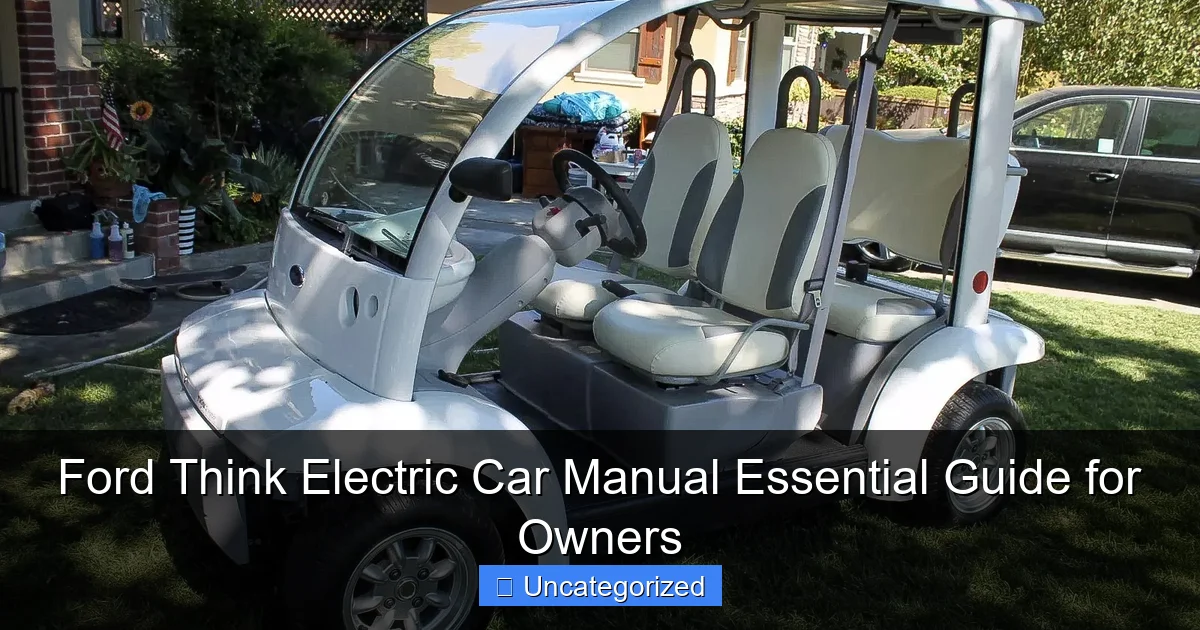
Featured image for ford think electric car manual
Image source: ebaymotorsblog.com
The Ford Think Electric Car Manual is your essential, all-in-one resource for maximizing performance, safety, and efficiency in your Ford Think EV. Packed with expert guidance on battery care, charging protocols, and troubleshooting, this manual empowers owners to confidently maintain and enjoy their electric vehicle for years to come.
Key Takeaways
- Master your Ford Think: Always keep the manual handy for troubleshooting and features.
- Optimize battery life: Follow charging guidelines to extend battery longevity.
- Understand error codes: Quickly diagnose issues using the manual’s error code list.
- Schedule maintenance: Adhere to service intervals to prevent costly repairs.
- Use eco-driving tips: Maximize range with efficient driving techniques from the guide.
- Access safety protocols: Review emergency procedures for breakdowns or accidents.
📑 Table of Contents
- The Rise of the Ford Think: A Pioneering Electric Vehicle
- Understanding the Ford Think: Model Variants and Specifications
- Charging Your Ford Think: Best Practices and Infrastructure
- Daily Operation and Driving Tips
- Maintenance and Troubleshooting: Keeping Your Think Running
- Long-Term Ownership: Upgrades, Community, and Legacy
- Conclusion: Embracing the Ford Think Experience
The Rise of the Ford Think: A Pioneering Electric Vehicle
The Ford Think electric car, though no longer in production, remains a fascinating chapter in the history of electric mobility. Introduced in the late 1990s as part of Ford’s response to California’s Zero Emission Vehicle (ZEV) mandate, the Think (originally developed by Norwegian company Pivco and later acquired by Ford) was one of the first mass-produced electric vehicles (EVs) from a major American automaker. With its compact design, city-friendly dimensions, and zero tailpipe emissions, the Think aimed to redefine urban transportation. While it was eventually discontinued due to financial and technological challenges, the Think’s legacy lives on—especially among vintage EV enthusiasts, sustainability advocates, and those curious about the early days of electric mobility.
For current and prospective owners of a Ford Think electric car, understanding the vehicle’s unique mechanics, charging requirements, and maintenance needs is essential. Unlike modern EVs with advanced software, regenerative braking, and smartphone integration, the Think relies on analog systems, lead-acid or NiMH batteries, and a simplified control interface. This means that owners must become familiar with a different kind of EV ownership—one rooted in hands-on care, mechanical intuition, and a deep respect for the vehicle’s limitations and strengths. Whether you’ve inherited a Think, purchased one from a collector, or are simply fascinated by its retro-futuristic charm, this Ford Think electric car manual essential guide for owners will equip you with the knowledge to keep your vehicle running smoothly, safely, and efficiently.
Understanding the Ford Think: Model Variants and Specifications
Model Generations and Key Differences
The Ford Think was produced in two main generations: the Think City (1999–2002) and the Think Neighbor (2000–2002). The City was the primary passenger model, designed for urban commuters, while the Neighbor was a low-speed utility vehicle (LSV) used in campuses, resorts, and gated communities. Both were based on the Pivco City Bee platform but adapted for American regulations and Ford’s branding.

Visual guide about ford think electric car manual
Image source: images.hgmsites.net
- Think City (Passenger Model): Seated two adults, reached speeds up to 50 mph (80 km/h), and had a range of 50–70 miles (80–113 km) on a full charge, depending on battery type and driving conditions.
- Think Neighbor (Utility Model): Limited to 25 mph (40 km/h), ideal for short-distance use. Often used in retirement communities or industrial parks.
- Battery Options: Early models used lead-acid batteries, which were cheaper but heavier and less efficient. Later models (2001–2002) featured nickel-metal hydride (NiMH) packs, offering better range, longevity, and charging cycles.
Understanding which model you own is crucial for sourcing parts, estimating range, and planning maintenance. For example, lead-acid batteries require more frequent water topping, while NiMH packs are sealed and maintenance-free (though still sensitive to deep discharges).
Core Specifications at a Glance
The Think’s mechanical simplicity is both a blessing and a challenge. Here are the key specs every owner should know:
- Motor: 27 kW (36 hp) AC induction motor
- Battery Pack: 24–36 kWh (lead-acid) or 24 kWh (NiMH), 120–156 volts
- Charging Time: 6–10 hours via standard 120V Level 1 charger; 3–5 hours with 240V Level 2 (if equipped)
- Transmission: Single-speed direct drive (no clutch or gears)
- Weight: ~2,700 lbs (1,225 kg) with lead-acid; ~2,500 lbs (1,134 kg) with NiMH
- Dimensions: 128” L x 65” W x 60” H — compact and agile in city traffic
One unique feature is the regenerative braking system, which recaptures energy during deceleration. However, unlike modern EVs, the Think’s regen is modest—owners should not rely on it to extend range significantly. Instead, it’s best used to reduce wear on mechanical brakes.
Charging Your Ford Think: Best Practices and Infrastructure
Charging Options: Level 1 vs. Level 2
The Ford Think electric car was designed with simplicity in mind, and its charging system reflects that. Most models come with a built-in onboard charger and a J1772-compliant charging port (standard for EVs), allowing compatibility with most public and home charging stations.

Visual guide about ford think electric car manual
Image source: topworldauto.com
- Level 1 Charging (120V): Uses a standard household outlet. Charges at ~1.4 kW. A full charge takes 8–10 hours. Ideal for overnight charging if you drive less than 30 miles daily.
- Level 2 Charging (240V): Requires a dedicated circuit and a Level 2 charger (sold separately). Delivers ~3.3–6.6 kW. Cuts charging time to 3–5 hours. Highly recommended for owners who drive frequently.
Pro Tip: If your Think has a 120V-only charger, consider upgrading to a 240V onboard charger (available from third-party suppliers like EVSE or Zivan). This is a cost-effective way to reduce charging time without replacing the entire battery system.
Charging Tips to Maximize Battery Life
Whether you have lead-acid or NiMH batteries, proper charging habits are critical for longevity:
- Avoid Deep Discharges: Never let the battery drop below 20%. Deep discharges (especially with lead-acid) cause sulfation, reducing capacity.
- Use a Timer or Smart Plug: Set charging to complete by morning to prevent overcharging. The Think’s basic charger doesn’t have sophisticated charge management.
- Charge in Moderate Temperatures: Extreme heat or cold slows charging and stresses batteries. Ideal charging temp: 50–80°F (10–27°C).
- Equalize Lead-Acid Batteries: Every 1–2 months, perform an equalization charge (higher voltage for a short period) to balance cell voltages. Use a charger with this feature.
- Monitor Charging Cycles: Keep a log of charge times and range to detect early signs of battery degradation.
Example: If your Think’s range drops from 60 to 45 miles over six months, it may indicate battery wear. Test individual cell voltages with a multimeter to identify weak cells.
Public Charging and Road Trips
While the Think isn’t built for long-distance travel, you can use public Level 2 chargers at shopping malls, workplaces, or EV charging networks like ChargePoint or Blink. Always carry your J1772 cable and a portable 120V charger as a backup. For road trips, plan routes with charging stops every 40–50 miles—apps like PlugShare help locate compatible stations.
Daily Operation and Driving Tips
Starting and Driving the Think
Operating the Ford Think electric car is straightforward but different from gas vehicles:
- Insert the key and turn to “ON.” The dashboard will display battery level, speed, and error codes.
- Press the brake pedal and shift into “D” (Drive) or “R” (Reverse). The motor engages silently.
- Accelerate gently. The Think’s torque is immediate but limited—rapid acceleration drains the battery quickly.
- Use regenerative braking by lifting off the accelerator. The car slows gradually, and energy is fed back into the battery.
- To stop, press the brake pedal firmly. The mechanical brakes handle final deceleration.
Tip: The Think has no traditional “engine noise,” so be extra cautious at intersections and when backing up. Consider installing a rearview camera or backup sensor for safety.
Optimizing Range and Efficiency
Maximizing your Think’s range requires smart driving habits:
- Drive Smoothly: Avoid hard acceleration and braking. Use cruise control on highways (if equipped).
- Reduce Weight: Remove unnecessary items from the trunk. Every extra 100 lbs reduces range by ~1–2%.
- Maintain Tire Pressure: Underinflated tires increase rolling resistance. Check pressure monthly (recommended: 40–45 PSI).
- Minimize HVAC Use: Heating and AC drain the battery. Use seat warmers (if available) instead of cabin heat. In summer, park in shade and ventilate the cabin before driving.
- Use Eco Mode (if equipped): Some models have a “Power Save” mode that limits top speed and motor output to extend range.
Real-World Example: A Think owner in Seattle reported a 20% range increase by combining smooth driving, tire inflation, and avoiding HVAC—extending range from 50 to 60 miles on a single charge.
Handling and Safety Features
The Think’s lightweight chassis and low center of gravity make it agile in city traffic, but it’s not designed for high-speed stability. Key safety features include:
- Dual front airbags
- Anti-lock Braking System (ABS) on later models
- Three-point seatbelts
- LED brake lights
Note: The Think lacks modern safety tech like lane departure warnings or automatic emergency braking. Always drive defensively, especially in heavy traffic.
Maintenance and Troubleshooting: Keeping Your Think Running
Routine Maintenance Schedule
Unlike gas cars, the Think has fewer moving parts—but it still requires regular care. Follow this maintenance checklist:
| Interval | Task | Details |
|---|---|---|
| Monthly | Check tire pressure | Adjust to 40–45 PSI |
| Monthly | Inspect battery terminals | Clean corrosion with baking soda/water |
| Every 3 Months | Top off lead-acid battery water | Use distilled water only |
| Every 6 Months | Lubricate door hinges, latches | Use silicone spray |
| Every 12 Months | Check brake fluid level | Top off if below MIN line |
| Every 12 Months | Inspect suspension and steering | Look for loose bolts, worn bushings |
| Every 2 Years | Replace 12V auxiliary battery | Standard car battery (Group 24) |
Common Issues and Fixes
The Think’s simplicity means fewer complex failures, but common problems include:
- Battery Degradation: Most Thinks have 15–20+ years on their original packs. Symptoms: reduced range, slow charging. Solution: Replace with refurbished NiMH packs (~$3,000–$5,000) or consider lithium-ion conversion (advanced).
- Charging Failure: If the car won’t charge, check the J1772 port for debris, test the charging cable, and verify outlet voltage. A faulty onboard charger is a common culprit.
- Motor Controller Errors: Error codes like “E1” or “E3” indicate controller issues. Often caused by overheating or voltage spikes. Tip: Let the controller cool for 30 minutes and restart.
- 12V Battery Drain: The Think’s auxiliary battery powers lights, locks, and the main contactor. If the car won’t start, jump the 12V battery (standard jumper cables).
DIY Repair Tip: Keep a multimeter and basic toolkit in the car. Test battery voltages monthly—lead-acid cells should read 2.1–2.2V when charged.
Parts and Service Resources
Since Ford discontinued the Think in 2002, OEM parts are rare. However, these resources can help:
- EV Parts Suppliers: EV West, Current EV, and Think Motor Company (UK-based) sell refurbished controllers, chargers, and battery packs.
- Online Forums: ThinkOwners.com and ElectricVehicleForums.com have active communities sharing repair guides and part sources.
- Local EV Shops: Many specialize in vintage EVs and can source or fabricate parts.
Long-Term Ownership: Upgrades, Community, and Legacy
Performance and Range Upgrades
Enthusiasts have developed several upgrades to enhance the Think’s performance:
- Lithium-Ion Battery Conversion: Replacing lead-acid/NiMH with lithium packs (e.g., LiFePO4) can double range, reduce weight, and extend lifespan. Cost: $4,000–$8,000.
- Upgraded Charger: High-output 240V chargers (e.g., 10 kW) cut charge time to 2–3 hours.
- Regen Enhancement: Aftermarket controllers can increase regen braking for better efficiency.
- Interior Upgrades: Modern infotainment, backup cameras, and heated seats improve comfort.
Example: A Think owner in Oregon converted their car to lithium-ion, achieving 100+ miles per charge—nearly double the original range.
Joining the Think Community
The Think has a passionate, global community. Benefits of joining include:
- Access to rare parts and repair advice
- Group buys for batteries and upgrades
- Local meetups and EV events
- Shared knowledge on retrofitting and customization
Popular groups: Think Owners International, EV1 Club (includes Think members), and Facebook groups like “Ford Think Electric Car Owners.”
Preserving the Think’s Legacy
As a pioneering EV, the Think deserves preservation. Consider:
- Documenting your car’s history (e.g., original purchase date, battery swaps)
- Restoring the exterior to factory specs
- Displaying the car at vintage EV shows
- Donating to museums (e.g., Petersen Automotive Museum)
Your Think isn’t just a car—it’s a piece of automotive history.
Conclusion: Embracing the Ford Think Experience
The Ford Think electric car manual essential guide for owners underscores a truth: owning a vintage EV is a labor of love. From understanding its quirky charging habits to troubleshooting a 20-year-old motor controller, the Think demands patience, curiosity, and hands-on engagement. Yet, for those willing to embrace its quirks, the rewards are profound. You’re not just driving a car—you’re participating in a legacy of innovation, sustainability, and automotive history.
Whether you’re using your Think for daily errands, weekend joyrides, or as a rolling conversation piece, this guide equips you with the tools to keep it running for years to come. Stay informed, connect with the community, and never stop exploring. The future of electric mobility began with pioneers like the Ford Think—and with your care, its story continues.
Frequently Asked Questions
What is the Ford Think Electric Car Manual and why do I need it?
The Ford Think Electric Car Manual is your go-to resource for understanding your vehicle’s features, maintenance, and troubleshooting. It helps owners maximize efficiency, safety, and longevity of their Ford Think electric car. Whether you’re a new or experienced EV driver, this guide simplifies complex systems.
How do I charge my Ford Think using the manual’s guidelines?
The manual outlines step-by-step charging instructions, including compatible chargers, optimal charging times, and battery care tips. Follow its recommendations to preserve battery health and avoid overcharging. It also covers public charging station protocols and home setup best practices.
Where can I find the Ford Think Electric Car Manual online?
You can download the official Ford Think Electric Car Manual from Ford’s website or third-party auto resources. Ensure you get the correct version matching your model year. Some forums also offer user-uploaded copies with added owner tips.
What maintenance tasks does the manual recommend for my electric car?
The manual details routine checks like tire pressure, brake fluid, and coolant levels, tailored for EVs. It also highlights battery inspections and software updates critical for performance. Sticking to its schedule helps prevent costly repairs.
Can the manual help me troubleshoot common Ford Think issues?
Yes, it includes a troubleshooting section for problems like slow charging, error codes, or power loss. Each issue has clear solutions, from resetting systems to contacting service centers. Always refer to it before calling support.
Does the Ford Think Electric Car Manual cover safety features?
Absolutely. The guide explains safety systems like regenerative braking, emergency shutoffs, and collision alerts. It also provides protocols for accidents or electrical malfunctions. Familiarizing yourself with these can prevent hazards.