Ford Think Electric Car Parts Guide for DIY Enthusiasts
Featured image for ford think electric car parts
Image source: imagehost.vendio.com
Discover essential Ford Think electric car parts to keep your eco-friendly ride running smoothly and efficiently. From high-voltage battery packs and regenerative braking systems to electric motors and onboard chargers, this guide breaks down the must-know components for DIY repairs and upgrades—helping enthusiasts save time, money, and maximize performance.
Key Takeaways
- Source OEM parts: Ensure compatibility and reliability with Ford-certified components.
- Prioritize battery care: Regularly inspect and maintain the Think battery system.
- Use torque specs: Follow manufacturer guidelines to avoid damaging electric drivetrains.
- Upgrade cooling systems: Enhance thermal management for peak performance and longevity.
- Verify software updates: Keep firmware current for optimal functionality and safety.
- Inspect wiring harnesses: Prevent faults by checking for wear or corrosion early.
📑 Table of Contents
- The Rise of the Ford Think and Why DIY Enthusiasts Love It
- Understanding the Ford Think’s Core Electric Drivetrain
- Essential Ford Think Electric Car Parts for Maintenance and Repair
- Upgrading Ford Think Electric Car Parts for Performance and Range
- Where to Source Ford Think Electric Car Parts
- Common Ford Think Electric Car Parts Failures and How to Fix Them
- Conclusion: The Ford Think Lives On Through DIY Innovation
The Rise of the Ford Think and Why DIY Enthusiasts Love It
The Ford Think electric car, though short-lived in its original production run (1999–2002), has become a cult favorite among DIY enthusiasts and electric vehicle (EV) hobbyists. Originally developed as Ford’s answer to California’s zero-emission vehicle mandate, the Think (originally named TH!NK) was one of the first mass-produced EVs from a major automaker. Despite being discontinued due to limited market appeal at the time, the car’s simple design, modular construction, and accessible electric drivetrain have made it a prime candidate for restoration, modification, and DIY upgrades.
For today’s DIY mechanics, the Ford Think electric car parts ecosystem is a goldmine. Whether you’re restoring a barn-find Think, converting a gas-powered car to electric using Think components, or simply replacing worn-out parts, understanding the vehicle’s unique architecture is essential. Unlike modern EVs with complex software and proprietary components, the Think’s analog systems and open-sourced design allow for easier tinkering, troubleshooting, and customization. This guide dives deep into the key Ford Think electric car parts, offering practical advice, sourcing tips, and real-world examples to help you keep your Think running—or turn it into your next EV project.
Understanding the Ford Think’s Core Electric Drivetrain
The heart of any electric vehicle is its drivetrain, and the Ford Think is no exception. Unlike combustion engines, the Think’s electric system is simpler in some ways but requires a different mindset when diagnosing or replacing components. The drivetrain consists of several interdependent parts that work together to convert electrical energy into motion. Understanding each part’s role is crucial for DIY repairs and upgrades.

Visual guide about ford think electric car parts
Image source: i.ebayimg.com
Electric Motor and Gearbox
The Ford Think is powered by a 36 kW (48 hp) DC brush motor developed by Advanced DC Motors. This motor is air-cooled and mounted transversely at the front, driving the front wheels through a single-speed reduction gearbox. The motor is robust, with a peak torque of 150 Nm, giving the Think decent acceleration for a city EV of its era.
DIY Tip: If your Think struggles to accelerate or makes grinding noises, the motor or gearbox may be the culprit. Inspect for oil leaks (the gearbox uses standard gear oil), check motor brushes for wear (replaceable), and use a multimeter to test motor resistance. A common issue is worn brushes, which can be replaced with aftermarket kits available from EV specialty suppliers like EV Source or Electric Motorsport.
Battery Pack and Configuration
The original Ford Think uses a 28.8 kWh lead-acid battery pack, composed of 24 individual 12V flooded lead-acid batteries arranged in series. The pack is mounted in the floor, giving the car a low center of gravity and improved handling. However, lead-acid batteries degrade faster than modern lithium-ion packs, and most surviving Think models have either been upgraded or need replacement.
Replacement Options:
- Refurbished Lead-Acid Packs: Still available through niche suppliers, but expensive and heavy.
- Lithium-Ion Conversion: The most popular DIY upgrade. Using LiFePO4 (lithium iron phosphate) cells, owners can achieve 60–80 miles of range, faster charging, and 40% weight reduction. Companies like Thunderstruck EV and ReVolt Systems offer drop-in battery modules compatible with the Think’s battery trays.
- Custom Battery Build: Advanced DIYers can build their own pack using 3.2V LiFePO4 prismatic cells (e.g., CALB or Winston) in a 96V configuration (30S), matching the original voltage.
Example: A 2001 Think converted with a 30S1P LiFePO4 pack (200Ah) achieves 75 miles of range and recharges in 4 hours on a Level 2 charger—far surpassing the original 50-mile range.
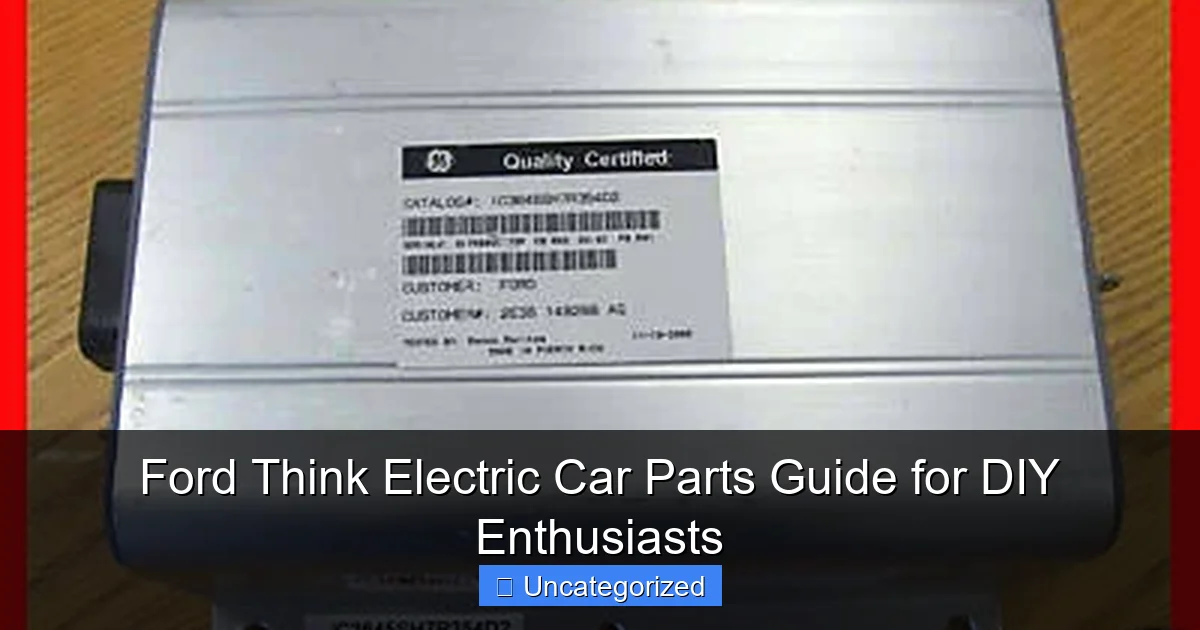
Motor Controller (Inverter)
The motor controller (also called the inverter) is the brain of the drivetrain. In the Ford Think, it’s a Curtis Instruments 1221C-7601 DC controller, capable of handling up to 500A. It regulates power flow from the battery to the motor based on pedal input and system feedback.
DIY Tip: A failing controller often causes jerky acceleration, error codes (if equipped), or complete loss of power. Test the controller using a Curtis programmer (available on eBay) to check error logs. If replacement is needed, consider upgrading to a modern Curtis 1239E or a Sevcon Gen4, which offer regenerative braking and better efficiency.
Essential Ford Think Electric Car Parts for Maintenance and Repair
While the drivetrain gets the most attention, the Think’s supporting systems—charging, cooling, and auxiliary components—are equally important for reliable operation. Neglecting these parts can lead to premature failure or safety hazards.

Visual guide about ford think electric car parts
Image source: i.ebayimg.com
Charging System and Onboard Charger
The Ford Think uses a Delta-Q QuiQ 1200 onboard charger, which converts 120/240V AC to 96V DC to charge the battery pack. The charger is mounted under the hood and connects to the J1772 charge port (standard in North America).
Common Issues:
- Charger Failure: Often due to capacitor degradation or MOSFET failure. Symptoms include no charging, intermittent charging, or error lights.
- Charge Port Corrosion: Common in older models due to moisture exposure. Clean contacts with contact cleaner and apply dielectric grease.
- Charging Cable Damage: Inspect the 15A/20A cable for fraying or overheating. Replace with a UL-listed J1772 cable if needed.
DIY Tip: If the charger fails, consider a drop-in replacement like the Elcon PFC-2500, which offers higher efficiency (93% vs. 85%) and faster charging. It’s compatible with the Think’s charge port and requires only minor wiring adjustments.
DC-DC Converter and 12V System
The Think uses a DC-DC converter to step down the 96V pack voltage to 12V, powering lights, wipers, and the 12V auxiliary battery. The original converter is prone to overheating and failure, especially in hot climates.
Solutions:
- Upgrade to a High-Efficiency Converter: The Mean Well HLG-480H-12B is a popular choice, offering 480W output, active cooling, and 94% efficiency.
- Install a Redundant 12V Battery: Use a lithium or AGM battery to ensure critical systems (e.g., power steering) remain functional if the converter fails.
Example: A DIYer in Arizona replaced the stock converter with a Mean Well unit and added a 30Ah lithium auxiliary battery. Result: No more 12V system failures during summer months.
Thermal Management and Cooling
The Ford Think lacks active cooling for the motor and controller, relying on passive airflow. In stop-and-go traffic or hot weather, this can lead to thermal shutdowns.
DIY Upgrades:
- Add Forced Air Cooling: Install a 12V fan (e.g., SPAL 30100401) near the motor and controller. Wire it to a temperature sensor (e.g., LM35) for automatic activation.
- Improve Ventilation: Cut vents in the front hood or install louvers to increase airflow to the motor bay.
Tip: Monitor temperatures with an OBD2-style EV monitor (e.g., CANview) to detect overheating early.
Upgrading Ford Think Electric Car Parts for Performance and Range
While the stock Ford Think is adequate for city driving, many DIYers aim to boost performance, range, or reliability. Upgrades range from simple bolt-ons to full drivetrain swaps.
Lithium Battery Conversions: A Game-Changer
As mentioned earlier, lithium battery upgrades are the most impactful modification. Here’s a step-by-step guide:
- Remove Lead-Acid Batteries: Drain and disconnect the old pack. Dispose of batteries properly at a recycling center.
- Prepare the Battery Tray: Clean and reinforce the tray with aluminum or fiberglass to support lithium’s weight distribution.
- Install LiFePO4 Cells: Use 30S configuration (30 cells in series) for 96V. Secure cells with foam or custom brackets to prevent vibration damage.
- Add a BMS: A Battery Management System (e.g., Daly or Orion) is essential for cell balancing, overcharge protection, and thermal monitoring.
- Test and Calibrate: Perform a full charge/discharge cycle and verify voltage and temperature readings.
Cost Estimate: $3,000–$5,000 for a 200Ah LiFePO4 pack, including BMS and labor.
Regenerative Braking System
The stock Think has no regenerative braking, wasting kinetic energy during deceleration. Adding regen improves efficiency by 10–15%.
How to Add Regen:
- Upgrade the Controller: Install a Curtis 1239E or Sevcon Gen4, which supports regen.
- Modify the Throttle Signal: Use a regen controller (e.g., EV West’s Regen Kit) to blend regen with friction brakes.
- Install a Regen Switch: Let the driver choose between regen and coasting.
Example: A Think with regen achieves 68 miles of range in mixed driving, up from 50 miles with stock settings.
High-Voltage Wiring and Connectors
Stock HV wiring (e.g., battery-to-controller cables) is often undersized for lithium packs or high-current controllers. Upgrade to:
- 6 AWG or 4 AWG Copper Wire: For reduced resistance and heat.
- Anderson SB50 or SB175 Connectors: For easy disconnection during maintenance.
- High-Temperature Insulation: Use silicone-coated wire (e.g., Ancor Marine) for durability.
Where to Source Ford Think Electric Car Parts
Finding OEM or aftermarket parts for a 20-year-old EV can be challenging, but a robust community and specialty suppliers keep the Think alive.
OEM and Salvage Parts
Original Ford Think parts are rare but not extinct. Try:
- eBay and Craigslist: Search for “Ford Think parts” or “TH!NK City parts.” Look for complete cars being parted out.
- Junkyards: Some salvage yards specialize in EVs. Call ahead to check inventory.
- Ford Dealerships: A few dealers still stock obsolete parts (e.g., charge ports, HVAC units).
Tip: Join the Think Owner’s Forum (forum.thinkowners.com) to buy/sell parts and get advice.
Aftermarket and Universal Parts
Many components have modern equivalents:
- Controllers: Curtis, Sevcon, and Kelly Controllers offer compatible units.
- Chargers: Elcon, Zivan, and Brusa provide drop-in replacements.
- Batteries: Thunderstruck EV, ReVolt Systems, and DIY suppliers like Battery Hookup sell lithium kits.
- HV Components: EV West, Electric Motorsport, and EV Source offer cables, fuses, and contactors.
3D Printing and Custom Fabrication
For hard-to-find parts (e.g., interior trim, motor mounts), use:
- 3D Printing: Design parts using CAD software (e.g., Fusion 360) and print with ABS or PETG.
- Local Machine Shops: Fabricate custom brackets, battery trays, or cooling ducts.
Example: A DIYer 3D-printed a replacement dashboard bezel after the original cracked. Cost: $15 vs. $200 for a used OEM part.
Common Ford Think Electric Car Parts Failures and How to Fix Them
Even with upgrades, the Think has known weak points. Here’s how to address them.
Battery Management System (BMS) Errors
After a lithium conversion, BMS errors (e.g., “Cell Imbalance”) are common.
Fix:
- Balance cells manually with a cell balancer.
- Check BMS wiring for loose connections.
- Upgrade to a BMS with active balancing (e.g., Orion Jr).
Motor Brush Wear
The DC motor’s brushes last 50,000–80,000 miles. Symptoms: Reduced power, sparking, or motor noise.
DIY Replacement:
- Remove motor cover.
- Extract worn brushes (usually 4 per motor).
- Install new brushes (available from EV Source).
- Break in the motor with 10 miles of gentle driving.
HV Contactor Failure
The high-voltage contactor (a relay that connects the battery to the controller) can fail, causing a “no power” condition.
Diagnosis: Use a multimeter to check for continuity. If open, the contactor is faulty.
Replacement: Install a 12V coil contactor (e.g., Gigavac GX11) with a pre-charge resistor to prevent arcing.
Data Table: Common Ford Think Electric Car Parts and Alternatives
| Original Part | Issue | Aftermarket Alternative | Cost (USD) |
|---|---|---|---|
| Lead-Acid Battery Pack (24x12V) | Low range, heavy | LiFePO4 30S2P (200Ah) | $3,500 |
| Curtis 1221C-7601 Controller | No regen, limited diagnostics | Curtis 1239E-7601 | $1,200 |
| Delta-Q QuiQ 1200 Charger | Low efficiency, prone to failure | Elcon PFC-2500 | $800 |
| DC-DC Converter (OEM) | Overheats, low output | Mean Well HLG-480H-12B | $120 |
| HV Contactor (OEM) | Sticks, fails to close | Gigavac GX11 | $180 |
Conclusion: The Ford Think Lives On Through DIY Innovation
The Ford Think electric car parts ecosystem is a testament to the vehicle’s enduring appeal. While Ford may have abandoned the Think in the early 2000s, DIY enthusiasts have kept it alive—and even improved upon it. From lithium battery conversions to regen braking and custom cooling systems, the Think has become a platform for innovation, not just a relic of EV history.
Whether you’re a first-time EV tinkerer or a seasoned mechanic, the Think offers a unique blend of simplicity and potential. Its modular design, accessible drivetrain, and passionate community make it the perfect canvas for your next project. So grab your tools, source those Ford Think electric car parts, and join the movement of DIY EV pioneers who are proving that the future of transportation isn’t just about new cars—it’s about reimagining the old ones.
Frequently Asked Questions
What are the most common Ford Think electric car parts that need replacement?
The most frequently replaced parts include the battery pack, DC-DC converter, and electric motor brushes. These components wear out over time due to high usage and thermal stress. Regular maintenance can extend their lifespan.
Where can I buy genuine Ford Think electric car parts for a DIY repair?
OEM Ford Think electric car parts are available through Ford dealerships, online marketplaces like RockAuto, and specialty EV parts suppliers. Always verify part compatibility with your specific model year before purchasing.
Can I upgrade the battery in my Ford Think for longer range?
While possible, battery upgrades require significant electrical expertise and custom fabrication. Most enthusiasts opt for refurbished OEM battery packs instead, as full upgrades may void remaining warranties or cause system errors.
How do I troubleshoot a failing DC-DC converter in my Ford Think?
Signs of a failing converter include flickering dashboard lights and 12V battery drain. Use a multimeter to test output voltage (should be 13.5-14.5V); inconsistent readings confirm the need for replacement.
Are there aftermarket Ford Think electric car parts available for performance upgrades?
Limited aftermarket options exist, mostly for cooling systems and regenerative braking controllers. Most upgrades focus on efficiency rather than power, as the Think’s original design prioritizes urban commuting over performance.
What safety precautions should I take when working on Ford Think electric car parts?
Always disconnect the high-voltage battery using insulated tools and wear Class 0 rubber gloves. The system retains lethal voltages even when powered off—wait 10 minutes after shutdown before servicing.