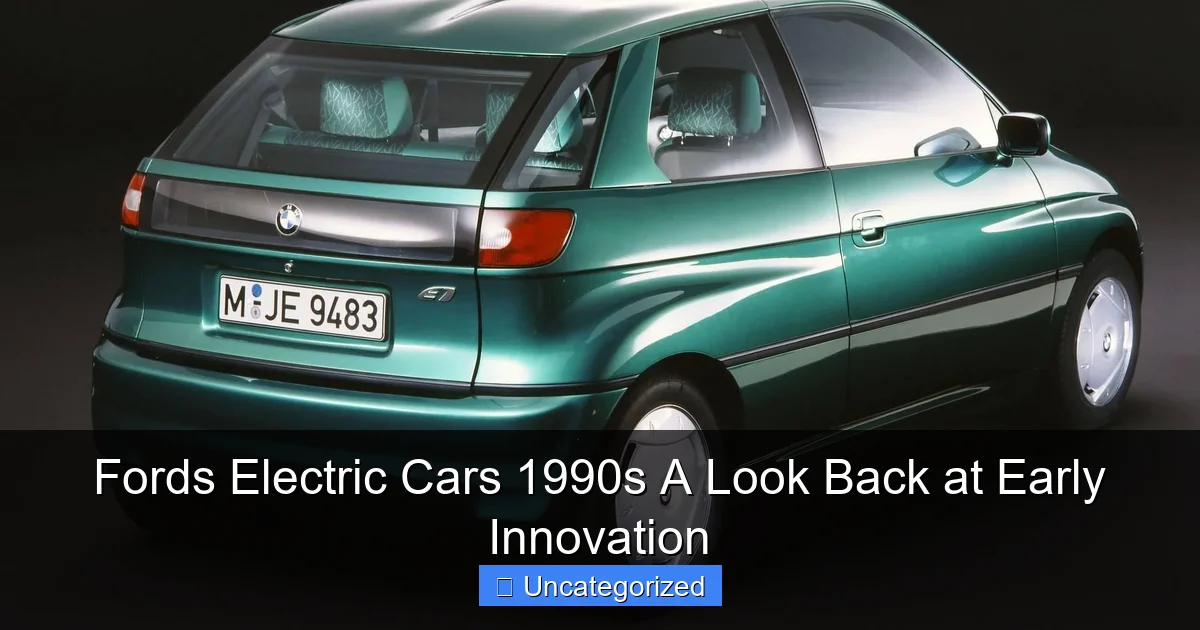
Fords Electric Cars 1990s A Look Back at Early Innovation

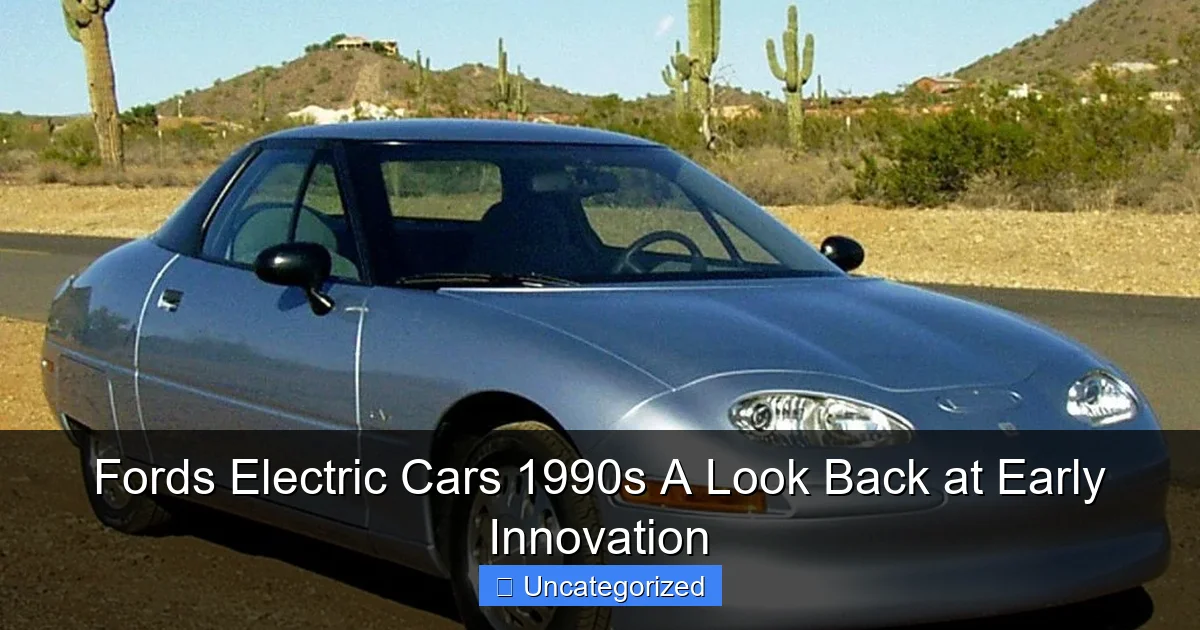
Featured image for fords electric cars 1990s
Image source: images.carexpert.com.au
Ford’s electric cars in the 1990s, like the groundbreaking Ranger EV and Ecostar, showcased the automaker’s early commitment to sustainable innovation. These vehicles, though limited in range and infrastructure, laid the foundation for modern EVs with advanced battery tech and real-world testing. Decades before the Mustang Mach-E, Ford was quietly shaping the future of electric mobility.
Key Takeaways
- Ford pioneered EV innovation in the 1990s with limited but impactful models.
- Early EVs faced battery limits, driving later advancements in energy density.
- Regulatory pressure fueled development, shaping Ford’s long-term electrification strategy.
- Customer feedback was critical, highlighting range and charging as key concerns.
- Legacy models inspired today’s EVs, proving early risks paved the way forward.
- Lessons from the 1990s remain relevant for overcoming modern EV adoption barriers.
📑 Table of Contents
- The Dawn of a Green Revolution: Ford’s Electric Cars in the 1990s
- Why Ford Entered the Electric Vehicle Market in the 1990s
- Ford’s Key Electric Models of the 1990s
- Challenges and Limitations of Ford’s 1990s EVs
- Legacy and Influence on Modern Ford EVs
- Data Table: Ford’s 1990s Electric Vehicles at a Glance
- Conclusion: The Forgotten Pioneers of Ford’s Electric Future
The Dawn of a Green Revolution: Ford’s Electric Cars in the 1990s
In the 1990s, the automotive world stood at a crossroads. Gasoline-powered vehicles dominated the roads, but growing concerns about air pollution, oil dependence, and environmental degradation began to shift public consciousness. Amid this changing landscape, Ford Motor Company took a bold step into the future by launching a series of electric vehicles (EVs) that would lay the groundwork for the electrified future we see today. While Tesla and other modern EV pioneers often steal the spotlight, Ford’s foray into electric mobility in the 1990s was a pioneering effort that deserves recognition. These early innovations were not just experiments—they were serious attempts to redefine personal transportation, driven by regulatory pressure, technological curiosity, and a vision for a cleaner world.
During this decade, Ford introduced several electric models, including the Ranger EV pickup truck, the Ecostar delivery van, and the ill-fated but ambitious Think City. These vehicles were born from a mix of necessity and innovation: California’s stringent Zero Emission Vehicle (ZEV) mandate pushed automakers to explore alternatives to internal combustion engines, while Ford’s engineers sought to harness emerging battery and electric motor technologies. Though many of these vehicles were short-lived, they played a crucial role in shaping Ford’s long-term strategy, influencing future models like the Focus Electric, Mustang Mach-E, and F-150 Lightning. By revisiting Ford’s electric cars of the 1990s, we uncover a story of early innovation, regulatory challenges, and the seeds of a revolution that would take decades to fully bloom.
Why Ford Entered the Electric Vehicle Market in the 1990s
Regulatory Pressure and the California ZEV Mandate
The primary catalyst behind Ford’s entry into the electric vehicle market was the California Air Resources Board (CARB) and its Zero Emission Vehicle (ZEV) mandate, introduced in 1990. This groundbreaking regulation required major automakers to ensure that a certain percentage of their vehicles sold in California emitted zero tailpipe pollutants—effectively mandating the production of electric vehicles. Initially, CARB set a target of 2% ZEVs by 1998, increasing to 10% by 2003. For Ford, this was not just a compliance issue; it was a strategic imperative.
Visual guide about fords electric cars 1990s
Image source: images.carexpert.com.au
At the time, Ford was one of the largest automakers in the U.S., and California was its largest single market. Failing to meet the ZEV requirements would have resulted in substantial fines and reputational damage. As a result, Ford accelerated its research and development in electric propulsion, investing heavily in battery technology, electric motors, and vehicle integration. The mandate forced Ford to think beyond traditional engineering paradigms and embrace a new era of clean transportation.
Technological Curiosity and Competitive Edge
Beyond regulatory compliance, Ford saw an opportunity to gain a first-mover advantage in a potentially transformative market. The 1990s were a period of rapid technological change—microprocessors, advanced materials, and new battery chemistries were emerging. Ford’s engineers were intrigued by the potential of electric vehicles to deliver quiet, smooth, and responsive performance. Unlike gasoline engines, electric motors offered instant torque, minimal maintenance, and zero emissions during operation.
Ford also recognized that early investment in EV technology could position the company as a leader in sustainable mobility. By developing expertise in battery management, regenerative braking, and energy-efficient design, Ford aimed to create a competitive edge. The company partnered with academic institutions, battery manufacturers, and government agencies to accelerate innovation. For example, Ford collaborated with General Electric and Exide to develop lead-acid and nickel-metal hydride (NiMH) battery packs, which were the most advanced available at the time.
Corporate Social Responsibility and Public Image
In the 1990s, public awareness of environmental issues was growing. Events like the 1992 Earth Summit in Rio de Janeiro and the rise of environmental NGOs put pressure on corporations to adopt more sustainable practices. Ford, as a global brand, sought to enhance its public image by demonstrating environmental stewardship.
Launching electric vehicles allowed Ford to position itself as a forward-thinking, eco-conscious company. The company launched marketing campaigns highlighting the zero-emission benefits of its EVs, targeting environmentally aware consumers and fleet operators. While the sales numbers were modest, the symbolic impact was significant. Ford’s electric vehicles became ambassadors of a cleaner future, helping to shift public perception and build brand loyalty among green-minded customers.
Ford’s Key Electric Models of the 1990s
The Ford Ecostar: A Delivery Van for the Future
Launched in 1992, the Ford Ecostar was Ford’s first mass-produced electric vehicle. Based on the Ford Cargo van platform, the Ecostar was designed for commercial fleet use, particularly in urban delivery services where short-range, stop-and-go driving was common. With a top speed of 65 mph and a range of approximately 60–80 miles on a single charge, the Ecostar was well-suited for city logistics.
Visual guide about fords electric cars 1990s
Image source: supercars.net
Power came from a 39 kWh lead-acid battery pack, which was heavy and limited in energy density, but reliable and cost-effective at the time. The vehicle featured regenerative braking, which helped extend range by recovering energy during deceleration. Ford deployed the Ecostar in several U.S. cities, including Los Angeles, New York, and Chicago, where it was used by utility companies, mail services, and delivery fleets.
Tip for fleet operators today: The Ecostar’s success in urban delivery highlights the importance of right-sizing electric vehicles for specific use cases. Modern fleets can learn from Ford’s early strategy—deploying EVs in predictable, short-range operations maximizes efficiency and reduces charging downtime.
The Ford Ranger EV: America’s First Electric Pickup Truck
In 1998, Ford introduced the Ranger EV, the first electric pickup truck offered by a major U.S. automaker. Based on the popular Ford Ranger compact pickup, the EV version featured a 90 hp electric motor and a 26 kWh lead-acid battery pack. It offered a range of 60–90 miles and could tow up to 1,500 pounds—impressive for an electric vehicle of its era.
The Ranger EV was available in both two-wheel and four-wheel drive configurations, with a payload capacity of around 1,000 pounds. It was marketed primarily to fleet customers, including utility companies, municipalities, and government agencies. Ford produced approximately 1,500 units between 1998 and 2002, making it one of the most successful early EVs in terms of volume.
Despite its limitations—such as long charging times (8–10 hours on a standard 110V outlet) and the eventual phase-out of the battery supplier—the Ranger EV proved that electric trucks could be practical and reliable. Today’s F-150 Lightning owes a debt to this pioneering model, proving that Ford’s vision for electric trucks was decades ahead of its time.
The Ford Think City: A European Venture with American Roots
One of Ford’s most ambitious EV projects was the Think City, a compact electric car developed through Ford’s acquisition of the Norwegian company Think Global in 1999. Unlike the Ranger EV and Ecostar, the Think City was designed as a consumer-oriented city car, with a sleek, modern design and a focus on urban mobility.
The Think City featured a 28 kWh NiMH battery pack (later upgraded to lithium-ion in later models), offering a range of 80–110 miles and a top speed of 60 mph. It had seating for two (later expanded to four) and a modular design that allowed for easy maintenance and upgrades. Ford marketed the Think City in Europe, particularly in Norway, where high gasoline prices and strong environmental policies created favorable conditions for EVs.
Although the Think City was discontinued in 2002 due to financial challenges and limited demand, it demonstrated Ford’s willingness to experiment with new vehicle architectures and business models. The car’s lightweight composite body and energy-efficient systems were ahead of their time, influencing future EV designs.
Other Prototypes and Concepts
In addition to production models, Ford developed several electric prototypes during the 1990s. These included:
- Ford P2000: A lightweight concept car designed to showcase fuel efficiency and alternative powertrains, including electric and hybrid versions.
- Ford E-Ka: A small electric city car developed in collaboration with the UK’s GKN, aimed at European urban markets.
- Ford Electric Explorer: A prototype electric SUV that tested the feasibility of electrifying larger vehicles—predating the Mach-E by over 20 years.
These prototypes helped Ford refine its EV engineering expertise and gather valuable data on consumer preferences and real-world performance.
Challenges and Limitations of Ford’s 1990s EVs
Battery Technology: The Achilles’ Heel
The biggest obstacle facing Ford’s 1990s electric vehicles was battery technology. At the time, the most viable options were lead-acid and early nickel-metal hydride (NiMH) batteries, both of which had significant drawbacks. Lead-acid batteries were heavy, had low energy density (typically 30–40 Wh/kg), and degraded quickly after 2–3 years of use. NiMH batteries were better but still limited in range and expensive to produce.
For example, the Ranger EV’s 26 kWh battery pack weighed over 1,000 pounds—nearly a third of the vehicle’s total weight. This reduced payload capacity and increased energy consumption. Charging times were also a major issue; most vehicles required 8–12 hours to fully charge using standard household outlets, making them impractical for many users.
Tip: Today’s EV owners benefit from lithium-ion batteries, which offer higher energy density, longer lifespans, and faster charging. But the lessons from Ford’s early struggles underscore the importance of battery R&D—a lesson that continues to drive innovation in the industry.
High Production Costs and Limited Market Demand
Ford’s EVs were significantly more expensive to produce than their gasoline counterparts. The electric drivetrain, battery pack, and specialized components added thousands of dollars to the manufacturing cost. For instance, the Ranger EV sold for around $45,000—nearly double the price of a standard Ranger.
Consumer demand was also limited. In the 1990s, most drivers were accustomed to long-range, fast-refueling gasoline vehicles. The idea of a 60-mile range and 10-hour charge time was a hard sell, especially in rural areas with sparse charging infrastructure. Additionally, the performance of EVs—while smooth and quiet—was often perceived as underwhelming compared to V6 or V8 engines.
Fleet operators showed more interest, but even they were hesitant due to the high upfront cost and uncertain resale value. As a result, Ford struggled to achieve economies of scale, further driving up per-unit costs.
Infrastructure and Charging Challenges
Unlike today’s growing network of public charging stations, the 1990s offered almost no EV charging infrastructure. Most Ford EVs were charged at home or at fleet depots using standard 110V or 220V outlets. This meant that:
- Charging was slow (8–12 hours)
- Public charging was nearly nonexistent
- Workplace charging was rare
Ford attempted to address this by developing its own charging solutions, including Level 2 chargers (240V, 40A), but adoption was slow. The lack of infrastructure made long-distance travel impossible and limited the appeal of EVs to urban dwellers and fleet users.
Regulatory Reversals and Market Shifts
Another challenge was the rollback of the ZEV mandate. In the early 2000s, CARB revised its regulations, allowing automakers to meet ZEV requirements through hybrid vehicles or other alternative fuels. This reduced the urgency for pure electric vehicles and led many companies—including Ford—to shift focus to hybrids and fuel-efficient gasoline cars.
Additionally, the discovery of vast natural gas reserves and the rise of fuel-efficient internal combustion engines made gasoline vehicles more competitive. With oil prices relatively low and environmental concerns not yet at the forefront of mainstream discourse, automakers saw little incentive to continue heavy investment in EVs.
Legacy and Influence on Modern Ford EVs
Technological Foundations for Future Models
Despite their commercial shortcomings, Ford’s 1990s EVs laid the technological groundwork for its modern electric lineup. The Ranger EV, for example, demonstrated that electric powertrains could be integrated into pickup trucks—a concept that culminated in the 2022 F-150 Lightning, which offers over 300 miles of range, 563 horsepower, and a 10,000-pound towing capacity.
Similarly, the Think City’s modular design and lightweight construction influenced the development of the Ford E-Transit and Mustang Mach-E, both of which emphasize energy efficiency and smart packaging. Ford’s early work on battery management systems, regenerative braking, and thermal management also contributed to the advanced systems used in today’s EVs.
Lessons in Consumer Behavior and Market Strategy
The 1990s taught Ford valuable lessons about consumer expectations and market readiness. The failure of the Think City and the limited adoption of the Ranger EV showed that:
- Range anxiety is real and must be addressed
- Charging infrastructure is critical
- Price parity with gasoline vehicles is essential
- Consumer education is needed to build trust in new technology
These insights directly shaped Ford’s modern EV strategy. The company now offers longer-range batteries (up to 320 miles), fast-charging capabilities, and competitive pricing. It has also invested heavily in charging networks and consumer outreach programs.
Environmental and Brand Impact
Ford’s early EVs helped establish the company as a leader in sustainable mobility. Even though the vehicles were discontinued, the effort enhanced Ford’s reputation for innovation and environmental responsibility. This goodwill paid off in the 2020s, when Ford launched its “Ford BlueOval Charge Network” and committed to carbon neutrality by 2050.
Moreover, the 1990s EVs served as a proof of concept that electric vehicles could be practical, reliable, and desirable. They paved the way for a cultural shift that made the Mustang Mach-E and F-150 Lightning not just accepted, but celebrated by consumers and critics alike.
Data Table: Ford’s 1990s Electric Vehicles at a Glance
| Model | Year | Battery Type | Range (miles) | Top Speed (mph) | Units Produced | Primary Use Case |
|---|---|---|---|---|---|---|
| Ford Ecostar | 1992–1997 | Lead-acid | 60–80 | 65 | ~500 | Urban delivery |
| Ford Ranger EV | 1998–2002 | Lead-acid / NiMH | 60–90 | 75 | ~1,500 | Fleet / utility |
| Ford Think City | 1999–2002 | NiMH / Lithium-ion | 80–110 | 60 | ~1,000 | Urban commuting |
| Ford P2000 (Concept) | 1997 | Various | 100+ (est.) | 85 | Prototype | Technology showcase |
Conclusion: The Forgotten Pioneers of Ford’s Electric Future
Ford’s electric vehicles of the 1990s may not have achieved commercial success, but their legacy is undeniable. These early innovations were not mere compliance exercises—they were bold experiments that pushed the boundaries of automotive engineering and sustainability. From the utilitarian Ecostar to the futuristic Think City, Ford’s 1990s EVs demonstrated that electric mobility was not just possible, but practical in certain applications.
The challenges they faced—battery limitations, high costs, and lack of infrastructure—were not unique to Ford, but the company’s willingness to confront them head-on helped shape the EV landscape we see today. The lessons learned during this era directly influenced the development of modern electric models like the Mustang Mach-E, F-150 Lightning, and E-Transit, which are now driving Ford’s resurgence in the global EV market.
As we look back at Ford’s electric cars of the 1990s, we see more than just prototypes and discontinued models. We see the foundation of a revolution—one that was delayed by decades but never truly abandoned. These vehicles remind us that innovation is a journey, not a destination. And in the case of Ford, the seeds planted in the 1990s are now blossoming into a sustainable, electric future for millions of drivers around the world.
Frequently Asked Questions
What electric cars did Ford produce in the 1990s?
Ford’s electric cars in the 1990s included the Ford Ranger EV (1998-2002), a battery-powered pickup, and the Ford Ecostar (1992-1993), a compact delivery van. These models marked Ford’s early efforts to explore zero-emission vehicles.
Why did Ford stop making electric cars in the 1990s?
Limited battery technology, high production costs, and low consumer demand led Ford to discontinue its 1990s electric car lineup. The company shifted focus to hybrid and fuel-efficient gasoline models instead.
How far could Ford’s 1990s electric cars travel on a single charge?
The Ford Ranger EV offered a range of 50-80 miles, while the Ecostar achieved up to 60 miles. Both vehicles were hampered by the era’s lead-acid batteries, which limited their practicality.
Were Ford’s 1990s electric cars successful?
Ford’s electric cars in the 1990s were niche products with limited commercial success, but they provided valuable R&D insights. Their failure paved the way for future EV advancements like the Mustang Mach-E.
What battery technology did Ford use in its 1990s electric cars?
The Ranger EV and Ecostar used lead-acid batteries, which were heavy and inefficient compared to modern lithium-ion packs. Later prototypes experimented with sodium-sulfur batteries for better performance.
How many Ford Ranger EVs were made in the 1990s?
Ford built fewer than 1,500 Ranger EVs between 1998 and 2002, mostly for fleet customers. Their rarity makes them a sought-after collectible among vintage EV enthusiasts today.