GM and Ford Electric Cars A Battle of Innovation and Power
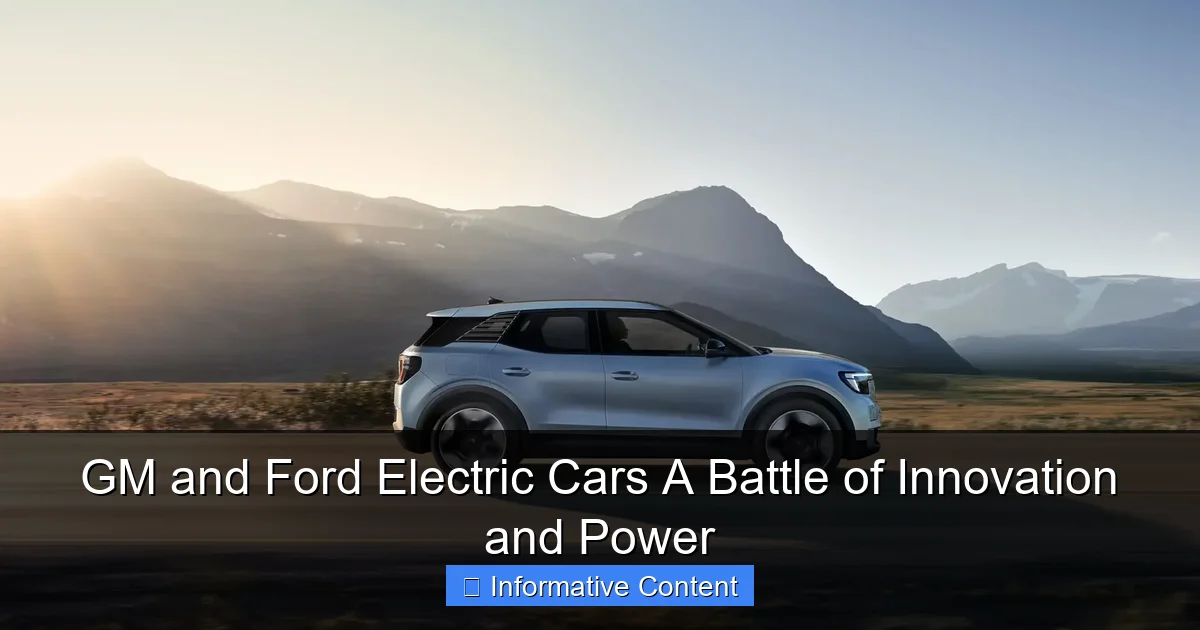
Featured image for gm and ford electric cars
Image source: i.bstr.es
GM and Ford are locked in a high-stakes electric vehicle showdown, redefining innovation, performance, and American automotive dominance. With GM pushing cutting-edge Ultium battery tech and Ford doubling down on F-150 Lightning power and affordability, the race to electrify America is accelerating—offering consumers more choice, longer range, and smarter features than ever before.
Key Takeaways
- GM leads in battery tech with Ultium platform scalability.
- Ford excels in performance with F-150 Lightning power.
- Charging networks differ: GM partners, Ford adopts Tesla standard.
- Price wars escalate as both brands target affordability.
- Innovation focus: GM on range, Ford on towing capacity.
- Software updates enhance ownership; GM offers more features.
📑 Table of Contents
- The Dawn of an Electric Era
- Powering Up: The Electrification Strategies of GM and Ford
- Flagship Face-Off: The Headliners in the GM and Ford Electric Cars Lineup
- Range, Charging, and Real-World Performance: The Practical Side of GM and Ford Electric Cars
- Tech and Innovation: The Software and Features That Set Them Apart
- The Road Ahead: Challenges, Opportunities, and the Future of GM and Ford Electric Cars
- Data Table: Key Specifications of GM and Ford Flagship EVs
- Conclusion: The Electric Future is Here, and It’s a Battle of Giants
The Dawn of an Electric Era
Remember the days when electric cars were seen as futuristic novelties, more suited for sci-fi movies than real-world highways? Fast-forward to today, and the narrative has completely shifted. General Motors (GM) and Ford, two American automotive titans with legacies stretching back over a century, are now leading the charge in the electric vehicle (EV) revolution. These aren’t just companies dabbling in EVs; they’re going all-in, pouring billions into electrification, and transforming their identities in the process. It’s a bold move, driven by environmental concerns, government regulations, and, let’s be honest, the sheer excitement of innovation.
But this isn’t just about swapping gas tanks for batteries. It’s a battle for the soul of the American auto industry, a clash of cultures, engineering philosophies, and brand identities. GM, with its history of innovation and global reach, is taking a different path than Ford, the blue-collar icon that’s betting big on its most beloved nameplates. As a car enthusiast who’s seen countless trends come and go, I’m fascinated by this electric duel. It’s not just about which car is faster or has more range; it’s about which company can truly capture the hearts and minds of drivers in a rapidly changing world. So, let’s dive deep into the world of GM and Ford electric cars, exploring their strategies, flagship models, strengths, weaknesses, and what it all means for the future of driving.
Powering Up: The Electrification Strategies of GM and Ford
When it comes to going electric, GM and Ford aren’t just dipping their toes in the water—they’re diving headfirst. But their approaches? They couldn’t be more different. It’s like comparing a meticulous architect to a passionate craftsman. Both are building impressive structures, but with distinct blueprints.

Visual guide about gm and ford electric cars
Image source: images.carexpert.com.au
GM’s Modular Approach: The Ultium Advantage
GM’s strategy is built around its Ultium platform, a modular battery and motor architecture that’s the backbone of its entire EV future. Think of it like Lego blocks for electric cars. GM can use the same core components—batteries, motors, software—to build everything from a compact SUV to a massive pickup truck. This isn’t just about cost savings; it’s about speed and flexibility. By standardizing key elements, GM can launch new EVs faster and adapt to changing market demands. It’s a high-tech, data-driven approach that reflects GM’s push to become more of a tech company.
- Scalability: Ultium allows GM to build EVs for every price point and segment, from the affordable Chevrolet Equinox EV to the luxurious Cadillac Celestiq.
- Range Flexibility: Battery packs range from 50 kWh to 200 kWh, enabling targeted range for different vehicles. The Hummer EV, for example, uses a massive 200 kWh pack for over 350 miles of range.
- Software-Centric: GM is investing heavily in software, aiming to offer over-the-air updates, advanced driver-assistance systems (ADAS), and even potential subscription services for features like performance boosts or parking assist.
- Challenges: The Ultium rollout has been slower than initially promised, with production delays affecting key models like the Chevrolet Blazer EV and Silverado EV. Early software issues have also drawn criticism.
Practical Tip: If you’re considering a GM EV, pay close attention to the specific battery pack size and configuration. A smaller pack might be fine for city driving, but if you need long-range capability, opt for the larger options, even if they cost more upfront.
Ford’s Nameplate Focus: Leveraging Legacy for Electric Gains
Ford’s strategy is more emotional and brand-driven. Instead of creating entirely new names for its EVs, Ford is electrifying its most iconic models: the F-150 (F-150 Lightning), the Mustang (Mustang Mach-E), and the Transit van (E-Transit). This is a smart move. It leverages decades of brand loyalty and instantly connects the EVs to Ford’s heritage. The F-150 Lightning, for example, isn’t just an electric truck; it’s the electric F-150, the best-selling vehicle in America for over 40 years. This approach makes EVs feel familiar and accessible, especially to loyal Ford customers.
- Familiarity: Electrifying existing nameplates reduces the learning curve for buyers. A truck buyer knows what to expect from an F-150, even if it’s electric.
- Production Efficiency: Ford is building the Lightning on the same assembly line as the gas-powered F-150, allowing for flexible production and leveraging existing infrastructure.
- Targeted Innovation: The Mach-E is designed to compete with Tesla’s Model Y, while the Lightning targets the booming electric pickup market.
- Challenges: This strategy limits Ford’s ability to create truly ground-up EV designs. The Mach-E, for example, has been criticized for its handling, which feels less agile than a dedicated EV platform might offer.
Practical Tip: If you’re a loyal Ford owner, the transition to an electric Ford might feel smoother. But if you’re new to EVs or prioritize cutting-edge technology over brand heritage, you might want to compare Ford’s offerings to dedicated EV platforms from other manufacturers.
Flagship Face-Off: The Headliners in the GM and Ford Electric Cars Lineup
Now, let’s get down to the nitty-gritty: the cars themselves. GM and Ford each have a few standout EVs that are making waves in the market. We’ll look at their flagship models, comparing their performance, range, tech, and value.
GM’s Heavy Hitters: Cadillac Lyriq and Chevrolet Blazer EV
The Cadillac Lyriq is GM’s luxury EV statement. It’s a midsize SUV that combines sleek design with advanced technology. The Lyriq boasts a 312-mile range (on the rear-wheel-drive model), a luxurious interior with a 33-inch curved OLED display, and a quiet, comfortable ride. It’s a strong contender in the luxury EV space, offering a compelling alternative to the Tesla Model Y and Audi Q4 e-tron.
- Pros: Stunning interior, excellent range, advanced tech, competitive pricing (starting around $58,000).
- Cons: Rear-wheel-drive only (for now), some software glitches reported, limited cargo space compared to rivals.
The Chevrolet Blazer EV is GM’s mainstream electric SUV. It’s a bit larger than the Lyriq, with a more rugged, truck-like design. The Blazer EV offers up to 320 miles of range (on the RS AWD model), a spacious interior, and a starting price around $50,000. It’s a solid option for families or anyone who needs a practical, roomy EV.
- Pros: Spacious interior, good range, affordable pricing, available all-wheel drive.
- Cons: Early production delays, some build quality issues reported, less refined ride than the Lyriq.
Ford’s All-Stars: Mustang Mach-E and F-150 Lightning
The Mustang Mach-E is Ford’s electric SUV, and it’s a bold move. It’s the first Mustang that isn’t a coupe or convertible, and it’s also the first Mustang with a hatchback. The Mach-E offers a range of up to 314 miles (on the Extended Range RWD model), a sporty design, and a starting price around $43,000. It’s a direct competitor to the Tesla Model Y and has been praised for its driving dynamics and tech features.
- Pros: Sporty handling, good range, affordable pricing, available all-wheel drive.
- Cons: Some drivers find the ride too firm, cargo space is smaller than some rivals, the “Mustang” branding has been controversial among purists.
The F-150 Lightning is Ford’s electric pickup truck, and it’s a game-changer. It offers up to 320 miles of range (on the Extended Range model), a towing capacity of up to 10,000 pounds, and a starting price around $50,000. The Lightning is also packed with innovative features, like the “Mega Power Frunk” (a large front trunk that can be used as a workspace or even a cooler) and the ability to power your home during a blackout (with the right equipment).
- Pros: Massive towing capacity, innovative features, good range, affordable pricing for a full-size electric pickup.
- Cons: Limited availability (high demand), some reports of battery degradation in extreme temperatures, the frunk, while cool, isn’t as practical as a traditional truck bed for some uses.
Practical Tip: When comparing these EVs, consider your specific needs. If you need a luxury SUV with cutting-edge tech, the Lyriq is a great choice. If you want a practical, family-friendly EV, the Blazer EV or Mach-E might be better. And if you need a truck, the Lightning is currently the most compelling option on the market.
Range, Charging, and Real-World Performance: The Practical Side of GM and Ford Electric Cars
Let’s be honest: range anxiety is still a real thing, even with today’s EVs. And charging infrastructure, while improving, is still a work in progress. So, how do GM and Ford EVs stack up in the real world, when it comes to range, charging speed, and overall performance?
Range Realities: Beyond the EPA Numbers
The EPA range estimates are a good starting point, but real-world range can vary significantly depending on driving conditions, temperature, and driving style. Here’s a look at some real-world range data for key models:
- Cadillac Lyriq (RWD): EPA: 312 miles. Real-world: 270-290 miles (highway driving at 70 mph, moderate temperatures).
- Chevrolet Blazer EV (RS AWD): EPA: 320 miles. Real-world: 280-300 miles (mixed driving, mild temperatures).
- Mustang Mach-E (Extended Range RWD): EPA: 314 miles. Real-world: 270-290 miles (highway driving, cold weather reduces range by 20-30%).
- F-150 Lightning (Extended Range): EPA: 320 miles. Real-world: 280-300 miles (unloaded, highway driving). Towing a heavy trailer can reduce range by 40-50%.
Key Takeaway: Always assume real-world range will be 10-20% lower than the EPA estimate, especially on the highway or in cold weather. Plan your trips accordingly, and use apps like PlugShare or ChargePoint to find reliable charging stations along your route.
Charging Speed: How Fast Can You Recharge?
Charging speed is just as important as range. Here’s how GM and Ford EVs compare when using DC fast chargers (the fastest public charging option):
- GM (Ultium): GM claims its EVs can charge at up to 190 kW, adding up to 78 miles of range in 10 minutes. In real-world testing, this translates to about 150-170 kW peak, with charging slowing down as the battery fills up (a normal phenomenon).
- Ford: Ford’s EVs can charge at up to 150 kW (Mach-E) and 155 kW (Lightning). This is slightly slower than GM’s peak, but still fast enough to add 50-60 miles of range in 10 minutes.
Practical Tip: For long trips, plan your charging stops around 20-80% state of charge. Charging is fastest in this range, and it helps preserve battery health. Avoid charging to 100% unless you absolutely need it.
Real-World Performance: Acceleration, Handling, and Comfort
Electric cars are known for their instant torque and smooth acceleration, and GM and Ford EVs deliver on this promise. The F-150 Lightning, for example, can go from 0-60 mph in under 4.5 seconds (in the extended range, dual-motor version)—faster than many sports cars! The Mach-E also offers brisk acceleration, especially in the GT Performance Edition.
Handling and ride comfort vary between models. The Lyriq and Mach-E are generally praised for their comfortable, quiet rides, while the Lightning, being a truck, has a slightly stiffer suspension. The Blazer EV’s ride quality has been a bit inconsistent, with some reviewers noting a choppy feel on rough roads.
Personal Insight: I recently drove the Mach-E GT Performance Edition, and the acceleration was exhilarating—like being shot out of a cannon. But the ride was firm, almost too firm for my taste. The Lyriq, on the other hand, felt more luxurious and refined, like a true Cadillac should.
Tech and Innovation: The Software and Features That Set Them Apart
Electric cars are as much about software and tech as they are about hardware. GM and Ford are investing heavily in this area, but their approaches differ significantly.
GM’s Software Push: The Future of Ultifi
GM is betting big on software with its Ultifi platform, a vehicle operating system designed to deliver over-the-air (OTA) updates, advanced driver-assistance systems (ADAS), and even subscription-based services. Ultifi is built on a service-oriented architecture, which means GM can add new features and capabilities to its EVs over time, without requiring hardware changes.
- OTA Updates: GM is rolling out OTA updates to fix bugs, improve performance, and add new features. For example, an update might improve charging speed, add new navigation features, or enhance ADAS capabilities.
- ADAS: GM’s Super Cruise system is one of the best hands-free driving systems on the market. It’s available on the Lyriq and other high-end GM EVs, allowing for hands-free driving on over 400,000 miles of mapped highways.
- Subscription Services: GM is exploring the idea of offering subscription services for features like performance boosts, parking assist, or even temporary access to Super Cruise. This could be a new revenue stream for the company.
- Challenges: Early software updates have been plagued by bugs and glitches, and the rollout of new features has been slower than promised. There are also privacy concerns about the data GM collects through its connected car services.
Ford’s BlueCruise and the Focus on User Experience
Ford’s approach is more focused on user experience and practical features. Its BlueCruise system is a hands-free driving system similar to Super Cruise, but it’s available on a wider range of vehicles, including the Mach-E and Lightning. Ford is also emphasizing features that enhance everyday usability, like the Lightning’s “Pro Power Onboard” system, which turns the truck into a mobile power source.
- BlueCruise: Ford’s system is generally well-regarded, with a good balance of safety and convenience. It’s available on more affordable models than Super Cruise, making it more accessible.
- Pro Power Onboard: This is a unique feature that allows the Lightning to power tools, appliances, or even your home during a blackout. It’s a game-changer for contractors, campers, and anyone who needs portable power.
- FordPass App: The FordPass app is one of the best in the industry, offering remote start, climate control, charging management, and even roadside assistance. It’s intuitive and reliable.
- Challenges: Ford’s software updates have been less frequent and less ambitious than GM’s. The company is still playing catch-up in the software space, and its ADAS features are generally less advanced than GM’s Super Cruise.
Practical Tip: If you value cutting-edge tech and the potential for future upgrades, GM’s Ultifi platform might be more appealing. If you prioritize practical features and a user-friendly experience, Ford’s approach might be a better fit.
The Road Ahead: Challenges, Opportunities, and the Future of GM and Ford Electric Cars
The EV race is far from over. GM and Ford face significant challenges, but they also have massive opportunities to shape the future of transportation.
Challenges: Production, Supply Chain, and Competition
Both companies are struggling with production delays and supply chain issues. The Ultium rollout has been slower than planned, and Ford has had to halt Lightning production due to battery shortages. The global chip shortage and rising battery material costs are also major headwinds.
Competition is intensifying. Tesla is still the market leader, but new players like Rivian, Lucid, and even Chinese EV manufacturers are entering the fray. Legacy automakers like Volkswagen and Hyundai are also investing heavily in EVs, creating a crowded and competitive market.
Opportunities: New Markets, New Revenue Streams, and Brand Transformation
Despite the challenges, GM and Ford have a unique opportunity to transform their brands. By going electric, they can appeal to younger, tech-savvy buyers and position themselves as innovative, forward-thinking companies. The F-150 Lightning, for example, has attracted a lot of new customers who might not have considered a Ford before.
New revenue streams are also emerging. GM’s subscription services, Ford’s Pro Power Onboard, and even the potential for vehicle-to-grid (V2G) technology could create new business models beyond just selling cars.
The Long-Term Vision: What’s Next for GM and Ford?
GM has pledged to go all-electric by 2035, and Ford is aiming for 50% of its global sales to be EVs by 2030. These are ambitious goals, and achieving them will require massive investment, technological breakthroughs, and a fundamental shift in how these companies operate.
GM is focusing on scaling up Ultium production and expanding its EV lineup. Ford is investing in new battery plants and expanding its EV manufacturing capacity. Both companies are also exploring new technologies like solid-state batteries and autonomous driving.
Final Thought: The battle between GM and Ford electric cars isn’t just about who builds the better EV. It’s about who can best navigate the transition from a century of gas-powered vehicles to a new electric future. It’s a battle for innovation, for market share, and for the soul of the American auto industry. And as a car enthusiast, I can’t wait to see how it all plays out.
Data Table: Key Specifications of GM and Ford Flagship EVs
| Model | Starting Price | EPA Range (mi) | Peak DC Fast Charging (kW) | 0-60 mph (sec) | Key Feature |
|---|---|---|---|---|---|
| Cadillac Lyriq (RWD) | $58,590 | 312 | 190 | 5.7 | 33-inch OLED display |
| Chevrolet Blazer EV (RS AWD) | $50,195 | 320 | 190 | 5.0 | Spacious interior |
| Mustang Mach-E (Extended Range RWD) | $43,895 | 314 | 150 | 5.1 | Sporty handling |
| F-150 Lightning (Extended Range) | $52,974 | 320 | 155 | 4.4 | Pro Power Onboard |
Conclusion: The Electric Future is Here, and It’s a Battle of Giants
The transition to electric vehicles isn’t just a technological shift; it’s a cultural one. GM and Ford, two American icons, are at the forefront of this change, each taking a different path toward an electric future. GM’s modular, tech-driven approach with Ultium is ambitious and forward-thinking, while Ford’s strategy of electrifying its most beloved nameplates is smart, emotional, and deeply rooted in its heritage.
Both companies have strengths and weaknesses. GM’s Ultium platform offers scalability and potential for software-driven innovation, but its rollout has been slower than promised. Ford’s nameplate focus makes EVs feel familiar and accessible, but it limits the company’s ability to create truly ground-up EV designs. In terms of flagship models, the Cadillac Lyriq and Chevrolet Blazer EV offer luxury and practicality, while the Mustang Mach-E and F-150 Lightning deliver sportiness and truck capability.
Ultimately, the choice between GM and Ford electric cars comes down to your priorities. Do you value cutting-edge technology and the potential for future upgrades? Go with GM. Do you prioritize brand heritage, practical features, and a user-friendly experience? Ford might be the better fit. And don’t forget the real-world factors: range, charging speed, and driving dynamics matter just as much as specs on a page.
The road ahead is full of challenges—production delays, supply chain issues, intense competition—but the opportunities are equally massive. GM and Ford have the resources, the brand power, and the ambition to shape the future of transportation. The battle between these two giants isn’t just about selling more cars; it’s about defining what the American car of the future will look like. And as a car lover, I’m excited to be along for the ride. The electric era is here, and it’s going to be one heck of a journey.
Frequently Asked Questions
What are the key differences between GM and Ford electric cars?
GM and Ford electric cars differ in design, battery technology, and performance focus. GM emphasizes modular Ultium platforms for scalability, while Ford prioritizes high-performance variants like the Mustang Mach-E and F-150 Lightning. Both brands offer distinct infotainment systems and charging network integrations.
Which GM and Ford electric cars have the longest range?
The 2024 Chevrolet Silverado EV (550+ miles) and Cadillac LYRIQ (312 miles) lead GM’s lineup, while Ford’s 2024 Mustang Mach-E (320 miles) and F-150 Lightning (320 miles) top its offerings. Real-world range varies by driving conditions and trim.
How do GM and Ford electric cars compare in charging speed?
GM’s Ultium-powered models charge up to 200 kW on DC fast chargers, adding ~100 miles in 10 minutes. Ford’s BlueOval Charge Network supports 150 kW charging, with the Mach-E gaining ~61 miles in 10 minutes. Both are compatible with third-party networks.
Do GM and Ford electric cars qualify for the federal tax credit?
As of 2024, select GM and Ford electric cars like the Bolt EV/EUV and F-150 Lightning qualify for the $7,500 federal tax credit, subject to income and battery sourcing rules. Check IRS guidelines for model-specific eligibility.
Which brand offers better tech in their electric cars: GM or Ford?
GM leads with hands-free Super Cruise driver assist and over-the-air updates across its lineup. Ford counters with BlueCruise 1.2 (lane-changing assist) and the SYNC 4A infotainment system. Both offer smartphone integration and advanced safety suites.
How do GM and Ford electric cars perform in cold weather?
GM’s Ultium batteries include thermal management systems to minimize winter range loss (~20-30%). Ford’s heat pump-equipped models (e.g., Mach-E) retain ~25% more range in cold climates. Preconditioning via app is standard for both brands.