Henry Ford and Thomas Edison Electric Car Revolution Explored
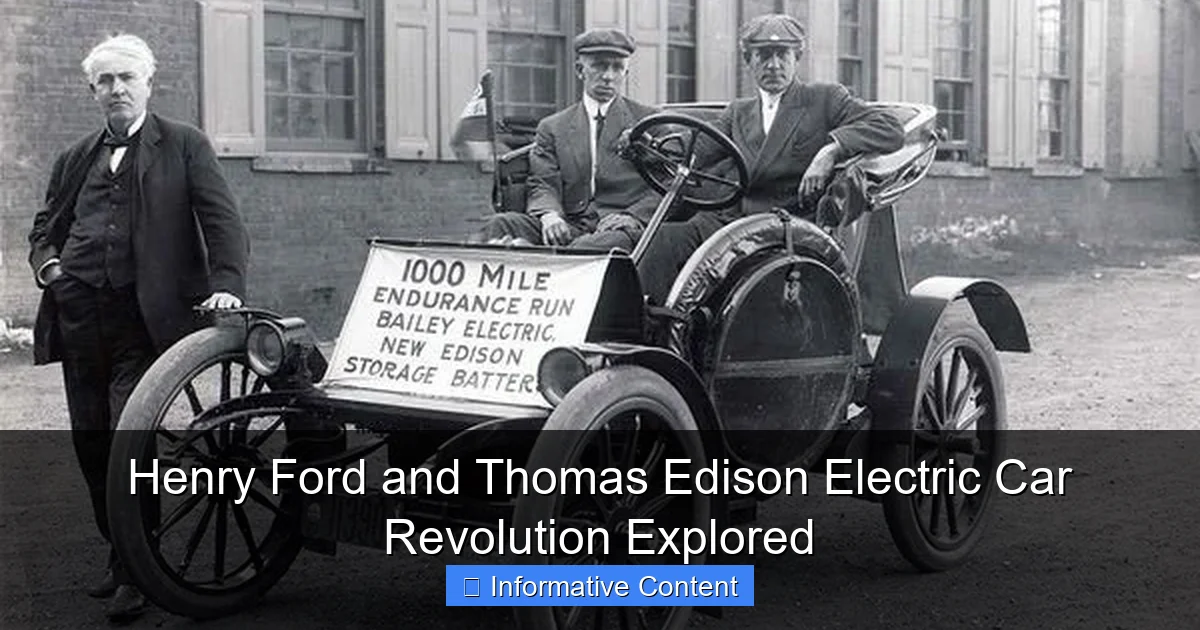
Featured image for henry ford and thomas edison electric car
Image source: leftfieldbikes.com
Henry Ford and Thomas Edison once teamed up to revolutionize transportation with an affordable, mass-produced electric car—nearly a century before Tesla. Their 1914 collaboration aimed to combine Ford’s manufacturing prowess with Edison’s battery innovations, envisioning a clean, quiet alternative to gas-powered vehicles. Though the project ultimately stalled due to technical limitations and market forces, their bold vision foreshadowed today’s electric vehicle revolution.
Key Takeaways
- Ford and Edison partnered to revolutionize electric cars in the early 1900s.
- Affordable EV vision aimed to make electric vehicles accessible to the masses.
- Battery tech limitations hindered progress despite their ambitious collaboration.
- Gasoline dominance outpaced electric cars due to infrastructure and range advantages.
- Legacy inspires innovation as modern EVs revive their original vision.
📑 Table of Contents
- Henry Ford and Thomas Edison Electric Car Revolution Explored
- The Early Days of Electric Vehicles
- The Ford-Edison Partnership: A Vision for the Future
- Challenges and Roadblocks
- The Legacy of Ford and Edison’s Electric Car
- Comparing Ford and Edison’s Electric Car to Today’s EVs
- Conclusion: A Revolution Revisited
Henry Ford and Thomas Edison Electric Car Revolution Explored
Imagine a world where electric cars were the norm over a century ago. It’s a fascinating thought, especially when you consider that today, we’re just catching up to that vision. The idea isn’t a modern invention—it was once the brainchild of two of the most influential innovators in history: Henry Ford and Thomas Edison. These two visionaries, friends and collaborators, once set out to revolutionize the automobile industry with an electric car. While their dream didn’t fully materialize at the time, their efforts laid the foundation for the electric vehicles (EVs) we know today.
Back in the early 1900s, when gas-powered cars were loud, unreliable, and hard to start, the electric car was a sleek, quiet, and efficient alternative. Ford and Edison saw the potential. Ford, already famous for the Model T, believed in making cars accessible to the masses. Edison, the prolific inventor, brought his genius to the table—especially in battery technology. Together, they aimed to create an affordable, long-range electric car. Though their collaboration didn’t achieve the success they hoped for, their story is a compelling chapter in the history of innovation, perseverance, and the early push toward sustainable transportation. Let’s dive into their electric car revolution and explore what happened, why it stalled, and how their legacy still resonates today.
The Early Days of Electric Vehicles
The Rise of Electric Cars Before the Gas Engine
Before Henry Ford and Thomas Edison’s collaboration, electric vehicles were already making waves. In the late 1800s and early 1900s, EVs were a luxury—quiet, clean, and easy to operate. They were especially popular among urban elites and women, who found them more convenient than the hand-cranked, smoke-belching gasoline cars of the era. By 1900, about one-third of all vehicles in the U.S. were electric, and companies like Baker Electric and Detroit Electric were leading the market.
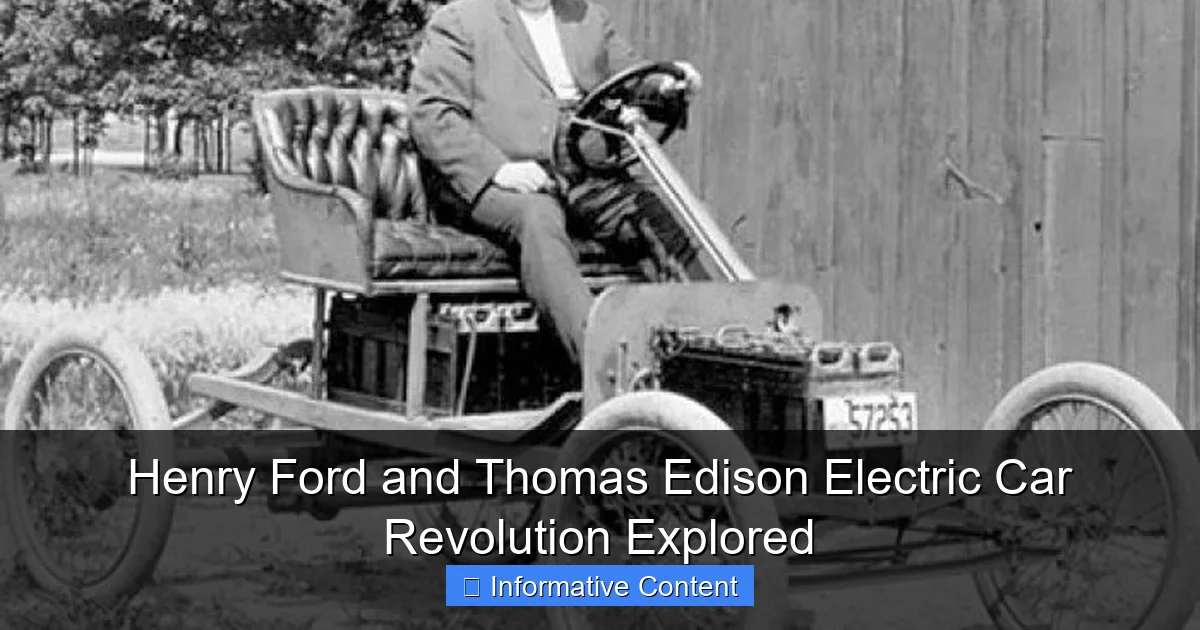
Visual guide about henry ford and thomas edison electric car
Image source: prestigeelectriccar.com
Electric cars had a few key advantages. They didn’t require strenuous cranking to start, emitted no exhaust fumes, and were ideal for short urban trips—perfect for the city dwellers of the time. But they also had limitations: limited range (often under 50 miles), slow charging times, and expensive batteries. These drawbacks made them less practical for long-distance travel, which was becoming increasingly important as road networks expanded.
Why Gasoline Cars Gained an Edge
The turning point came with the introduction of the electric starter by Charles Kettering in 1912. This innovation eliminated the need for hand cranking, making gasoline cars much more user-friendly. Suddenly, gas-powered vehicles—like Ford’s Model T, which debuted in 1908—became the go-to choice for the average American. The Model T was affordable, reliable, and could travel longer distances without refueling. Plus, gas stations began to pop up, making fueling more convenient.
By the 1920s, the electric car market had largely faded. Gasoline cars dominated, and the infrastructure for EVs—like charging stations and battery technology—didn’t keep pace. But the dream of an electric future didn’t die. It was just waiting for the right minds to revive it. Enter Ford and Edison, who believed the electric car could still have its moment—if they could solve its biggest problem: the battery.
The Ford-Edison Partnership: A Vision for the Future
How the Collaboration Began
Henry Ford and Thomas Edison’s friendship began in the 1890s, when Ford worked as an engineer at Edison’s company in Detroit. Their bond grew over shared interests in innovation, efficiency, and making technology accessible. By the 1910s, they were close friends, often vacationing together and brainstorming new ideas. It was during one of these getaways—on a camping trip in 1912—that the idea of an electric car partnership was born.
Ford was already revolutionizing the auto industry with the Model T, but he saw a gap. The Model T was great, but it wasn’t ideal for short, urban trips where EVs excelled. Edison, meanwhile, was obsessed with batteries. He had developed the nickel-iron (NiFe) battery, which was more durable and longer-lasting than the lead-acid batteries used in early EVs. Together, they envisioned an affordable electric car powered by Edison’s battery—a vehicle that could combine the best of both worlds: Ford’s mass production and Edison’s advanced battery tech.
The Plan: Affordable, Long-Range Electric Cars
Their goal was ambitious: create an electric car that could travel 100 miles on a single charge and cost around $500—roughly the price of a Model T. Edison would develop the battery, while Ford would handle the car’s design and production. They even set up a lab at Edison’s winter home in Fort Myers, Florida, to test prototypes. By 1914, they had a working model: a modified Ford Model T chassis fitted with Edison’s NiFe battery.
The car was impressive for its time. It had a top speed of about 25 mph and a range of 30–40 miles—not quite the 100-mile target, but a significant improvement over other EVs. The NiFe battery was more durable and could withstand deep discharges, but it was still heavy and expensive. Ford and Edison believed they could refine it further, but they faced a major hurdle: the market wasn’t ready. Gasoline cars were cheaper to produce, and the infrastructure for EVs simply didn’t exist.
Challenges and Roadblocks
Battery Technology Limitations
The biggest challenge Ford and Edison faced was battery technology. Edison’s NiFe battery was a step forward, but it had drawbacks. It was heavier and less energy-dense than lead-acid batteries, which limited the car’s range and performance. The battery also took up a lot of space—often half the car’s interior—making it impractical for mass adoption. Plus, the NiFe battery was expensive to produce, which drove up the car’s price.
Edison spent years trying to improve the battery. He tested thousands of materials, from nickel to iron to even coconut shells, in search of a breakthrough. By 1914, he claimed to have a prototype that could last 10 years and charge in 30 minutes. But the battery still couldn’t deliver the range or cost-efficiency needed for a mass-market car. As Edison himself admitted, “The problem is not the car, but the battery.”
Market Forces and Infrastructure Gaps
Beyond the technical hurdles, Ford and Edison faced market challenges. Gasoline cars were already dominating, and the infrastructure for EVs was nonexistent. Gas stations were popping up everywhere, while charging stations were rare. Consumers also preferred the longer range and faster refueling of gasoline cars—even if they were noisier and harder to start.
Ford, ever the pragmatist, began to question the project’s viability. The Model T was a massive success, and Ford’s focus shifted to scaling production and cutting costs. By 1914, he reportedly told Edison, “The electric car is not the car for the masses.” The collaboration stalled, and Ford eventually pulled back from the project. Edison continued working on the battery until his death in 1931, but the dream of an affordable, long-range electric car remained out of reach.
The Legacy of Ford and Edison’s Electric Car
Why Their Vision Matters Today
Though Ford and Edison’s electric car never took off, their vision was remarkably prescient. Today, as we face climate change and a global push toward sustainable transportation, their collaboration feels like a missed opportunity—and a lesson in perseverance. They identified the core challenges of EVs a century ago: battery technology, range, and infrastructure. And they were right: solving these problems is key to making electric cars viable for the masses.
Their work also highlighted the importance of collaboration. Ford brought mass production and affordability; Edison brought innovation and battery expertise. Together, they proved that combining strengths can lead to groundbreaking ideas—even if the timing isn’t right. Their partnership is a reminder that innovation isn’t just about technology; it’s about timing, market readiness, and persistence.
Lessons for Modern EV Development
Modern EV developers can learn a lot from Ford and Edison’s story. Here are a few key takeaways:
- Focus on the battery first: The battery is the heart of an EV. Without a breakthrough in energy density, cost, and charging speed, EVs won’t succeed. Edison’s obsession with battery technology was spot on.
- Infrastructure is critical: Just as gas stations were essential for the rise of gasoline cars, charging stations are vital for EVs. Ford and Edison underestimated this, but today’s EV leaders—like Tesla and ChargePoint—know better.
- Collaboration drives innovation: The best ideas come from teamwork. Ford and Edison’s partnership shows how combining expertise can lead to breakthroughs.
- Timing matters: Even the best ideas can fail if the market isn’t ready. Today, with growing concerns about emissions and fossil fuels, the timing for EVs is finally right.
Comparing Ford and Edison’s Electric Car to Today’s EVs
How Far We’ve Come in a Century
The electric car has come a long way since Ford and Edison’s time. Today’s EVs are faster, more efficient, and packed with cutting-edge technology. Let’s compare their 1914 prototype to a modern EV like the Tesla Model 3:
| Feature | Ford-Edison Prototype (1914) | Tesla Model 3 (2024) |
|---|---|---|
| Range | 30–40 miles | 272–333 miles |
| Top Speed | 25 mph | 162 mph |
| Battery Type | Nickel-iron (NiFe) | Lithium-ion (Li-ion) |
| Charging Time | Hours (no fast charging) | 15–30 minutes (superchargers) |
| Price | ~$500 (goal, never achieved) | $38,990+ |
| Infrastructure | None | Thousands of charging stations |
The progress is staggering. Modern EVs offer ranges that Ford and Edison could only dream of, and battery technology has improved exponentially. Lithium-ion batteries are lighter, more energy-dense, and cheaper than NiFe batteries, making EVs more practical for everyday use. Plus, the infrastructure is finally catching up, with charging networks expanding globally.
The Unfinished Business
Despite the advances, some challenges remain. Battery production is still resource-intensive, and charging infrastructure isn’t evenly distributed. But the momentum is undeniable. In 2023, EVs made up nearly 18% of new car sales worldwide—a far cry from the 1% in 2017. Governments are offering incentives, automakers are investing billions, and consumers are embracing the shift.
Ford and Edison’s vision is finally becoming a reality. And while their electric car never made it to the streets, their legacy lives on in every Tesla, Nissan Leaf, and Ford Mustang Mach-E. They were pioneers—ahead of their time, but not wrong.
Conclusion: A Revolution Revisited
The story of Henry Ford and Thomas Edison’s electric car is more than a historical footnote. It’s a reminder that innovation often takes time—and that even the greatest minds can face setbacks. Their collaboration was a bold attempt to solve the challenges of their era, and while they didn’t succeed, their work planted the seeds for the EV revolution we’re seeing today.
As we look to the future, their story offers hope. The problems they grappled with—battery technology, range, infrastructure—are the same ones we’re solving now. But today, with better tools, more knowledge, and a global push for sustainability, we’re closer than ever to making their vision a reality. The electric car revolution isn’t just about technology; it’s about persistence, collaboration, and the belief that a better future is possible.
So the next time you see a sleek Tesla or a quiet Nissan Leaf on the road, remember: it’s not just a car. It’s the culmination of a dream—one that began over a century ago with two friends, a camping trip, and a shared belief in the power of innovation. Ford and Edison may not have seen their electric car hit the streets, but their legacy is driving us forward—one mile at a time.
Frequently Asked Questions
Did Henry Ford and Thomas Edison really collaborate on an electric car?
Yes, in the 1910s, Henry Ford and Thomas Edison partnered to develop an affordable electric car, aiming to combine Ford’s mass-production expertise with Edison’s battery innovations. While they built prototypes, the project was shelved due to limitations in battery technology and the rise of cheaper gasoline vehicles.
What happened to the Henry Ford and Thomas Edison electric car project?
The collaboration stalled because Edison’s nickel-iron batteries couldn’t deliver the range or speed consumers wanted. Despite Ford’s enthusiasm, the Henry Ford and Thomas Edison electric car never entered mass production, as the 1920s oil boom made gasoline cars more practical.
Why didn’t Edison’s battery technology succeed in early electric cars?
Edison’s nickel-iron batteries were durable but heavy and energy-inefficient, limiting driving range. Compared to modern lithium-ion batteries, they couldn’t compete with gasoline engines in performance or cost, dooming the project.
How close was the Ford-Edison electric car to being released?
Ford and Edison built several prototypes, including a modified Model T with electric components. However, technical hurdles and shifting market preferences prevented commercialization, leaving the car as a historical “what-if.”
Could the Ford-Edison electric car have changed automotive history?
If successful, the Henry Ford and Thomas Edison electric car might have accelerated EV adoption, reducing reliance on fossil fuels decades earlier. However, early 20th-century infrastructure favored gasoline, making this outcome unlikely.
Where can I learn more about Ford and Edison’s electric car experiments?
Archival photos, patents, and historical records are available through the Edison Innovation Foundation and The Henry Ford Museum. These highlight their ambitious but ultimately unrealized vision for electrified transport.