Hov Sticker Electric Cars Florida Everything You Need to Know
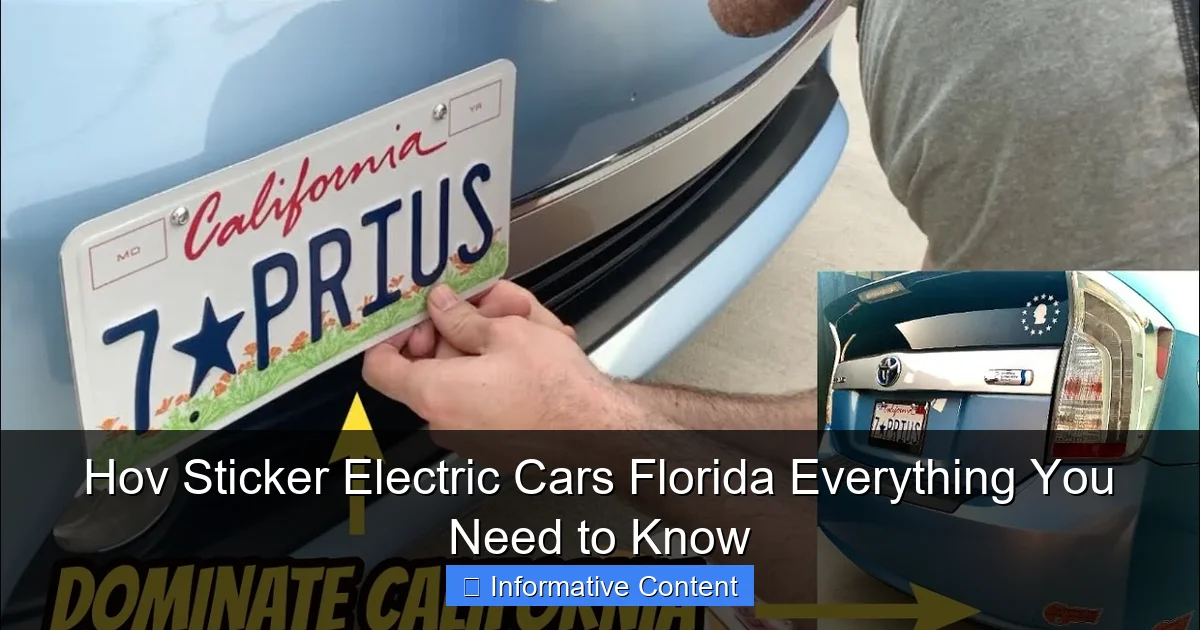
Featured image for hov sticker electric cars florida
Image source: i.ytimg.com
Florida’s HOV sticker program allows electric car owners to use high-occupancy vehicle lanes solo—even with just one person in the car. These special decals, issued by the Florida Department of Highway Safety and Motor Vehicles (FLHSMV), promote EV adoption by offering a major commuting perk on busy highways like I-95 and I-75. Apply online with proof of EV registration and enjoy faster, toll-free travel in designated lanes.
Key Takeaways
- HOV stickers in Florida grant solo electric drivers access to carpool lanes.
- Apply via FLHSMV with proof of EV registration and $54.50 fee.
- Stickers are valid for 3 years, tied to your EV model.
- Non-transferable—sticker stays with the vehicle, not the owner.
- Check eligibility—only battery EVs and PHEVs qualify, not hybrids.
- Save time and fuel using HOV lanes during rush hour.
📑 Table of Contents
- What Is an HOV Sticker for Electric Cars in Florida?
- How the HOV Sticker Program Works in Florida
- Who Qualifies for the HOV Sticker in Florida?
- How to Apply for the HOV Sticker (Step-by-Step)
- Benefits and Drawbacks of the HOV Sticker
- Future of the HOV Sticker Program in Florida
- The Bottom Line: Is the HOV Sticker Worth It?
What Is an HOV Sticker for Electric Cars in Florida?
If you’ve ever been stuck in traffic on I-95 or I-75 during rush hour, you’ve probably noticed those sleek, quiet electric cars zipping past you in the High Occupancy Vehicle (HOV) lane. And no, it’s not because they’re breaking the rules. These drivers are using a special permit—the HOV sticker for electric cars in Florida—that grants them solo access to carpool lanes, even if they’re driving alone.
For many Floridians, especially in busy urban areas like Miami, Orlando, or Tampa, the HOV sticker is more than just a convenience—it’s a game-changer. It can save you 20, 30, even 45 minutes on a single commute. But how does it work? Who qualifies? And what does it mean for the future of driving in the Sunshine State? In this guide, we’ll break down everything you need to know about HOV sticker electric cars Florida—from eligibility and application to real-world benefits and potential drawbacks.
How the HOV Sticker Program Works in Florida
The HOV sticker program in Florida was created to encourage eco-friendly transportation by rewarding drivers who choose electric vehicles (EVs) with faster commutes. Unlike traditional carpool lanes that require two or more people in a vehicle, the HOV sticker allows solo EV drivers to bypass the rules—thanks to the state’s push to reduce emissions and traffic congestion.
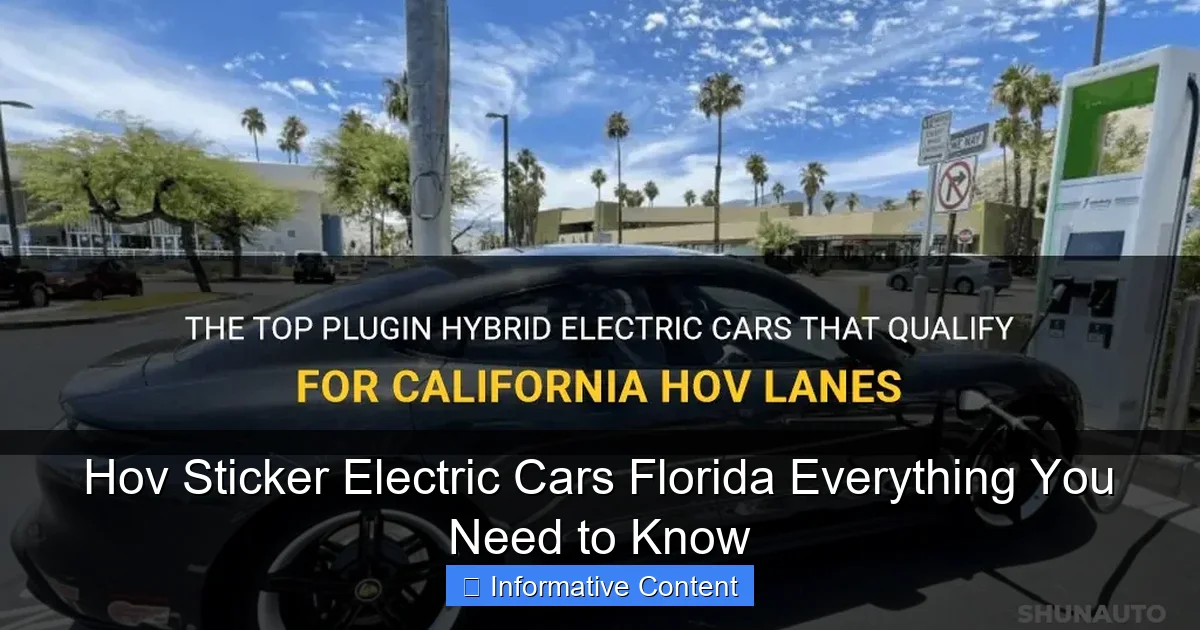
Visual guide about hov sticker electric cars florida
Image source: shunauto.com
What Is an HOV Lane?
An HOV lane (also called a carpool or diamond lane) is a designated lane on highways meant for vehicles with multiple passengers. In Florida, most HOV lanes require at least two people (driver + one passenger) to use them during peak hours (typically 6–9 AM and 4–7 PM). But with the HOV sticker, electric car owners can use these lanes even if they’re driving solo.
These lanes are often less congested, meaning faster travel times. For example, during a typical morning rush on I-75 near Fort Lauderdale, HOV lane traffic might move at 60 mph, while general lanes crawl at 15 mph. That’s a huge difference—especially if you’re commuting 20+ miles.
How the HOV Sticker Grants Access
The HOV sticker is a decal issued by the Florida Department of Highway Safety and Motor Vehicles (FLHSMV). It’s placed on the rear window of your electric vehicle and acts as a permit. Law enforcement officers use it to verify your eligibility to use HOV lanes.
Here’s how it works in practice:
- You apply for the sticker through the FLHSMV website or at a local tax collector’s office.
- Once approved, you receive a red, white, and blue decal with a unique number.
- You affix it to the lower left corner of your rear windshield.
- When you drive alone in an HOV lane, police can check the sticker and confirm you’re compliant.
It’s important to note: The sticker does not give you unlimited access. You can only use it during HOV lane hours. Outside those times, the lanes are open to all traffic.
Real-Life Example: Miami Commuter Saves 30 Minutes
Take Maria, a graphic designer in downtown Miami. Before switching to a Tesla Model 3, her 18-mile commute took 50 minutes in the general lanes. After getting her HOV sticker electric car Florida, she now uses the I-95 HOV lane solo. Her commute dropped to just 20 minutes. “It’s like having a secret lane,” she laughs. “I get home in time to cook dinner instead of eating takeout.”
Who Qualifies for the HOV Sticker in Florida?
Not every electric car gets an HOV sticker. Florida has specific rules to ensure the program benefits truly low-emission vehicles. Let’s break down the eligibility requirements—and what might disqualify you.
Vehicle Type and Emissions
To qualify, your vehicle must be:
- Electric (BEV): Battery-electric vehicles like the Tesla Model Y, Nissan Leaf, or Ford Mustang Mach-E.
- Plug-in Hybrid (PHEV): Vehicles that run on both electricity and gasoline, such as the Toyota RAV4 Prime or Jeep Wrangler 4xe.
However, not all PHEVs qualify. The vehicle must meet the U.S. Environmental Protection Agency’s (EPA) Advanced Technology Partial Zero Emission Vehicle (AT-PZEV) standards. This means it must have zero evaporative emissions and a 15-year/150,000-mile warranty on emission control components.
As of 2024, most modern PHEVs meet this standard, but older models (pre-2018) may not. Always check the FLHSMV website for the latest list of approved vehicles.
Registration and Insurance Requirements
Your vehicle must be:
- Registered in Florida (out-of-state EVs don’t qualify).
- Insured under a Florida auto insurance policy.
- Current on registration and emissions testing (if applicable).
Note: Florida does not require emissions testing for EVs, which is one more reason they’re so appealing.
Common Misconceptions and Exceptions
Some people assume any hybrid or fuel-efficient car can get the sticker. That’s not true. Standard hybrids (like the Toyota Prius Hybrid) do not qualify. Only PHEVs and full EVs are eligible.
Also, the sticker is not transferable. If you sell your EV, the sticker stays with the vehicle—but the new owner must reapply. And if you move to another state, the sticker becomes invalid.
Pro Tip: Check Before You Buy
If you’re shopping for an EV specifically to get the HOV sticker, do your homework first. Use the FLHSMV’s online vehicle lookup tool to confirm your model qualifies. For example, the 2023 Hyundai Ioniq 5 is approved, but the 2017 Chevrolet Volt (a PHEV) may not be due to older AT-PZEV certification.
How to Apply for the HOV Sticker (Step-by-Step)
Applying for the HOV sticker electric cars Florida is surprisingly simple—especially if you do it online. Here’s a step-by-step guide to get you through the process without headaches.
Step 1: Gather Your Documents
You’ll need:
- Your vehicle registration (must be current and Florida-issued).
- Your driver’s license (Florida-issued).
- Proof of Florida insurance (declaration page).
- Vehicle identification number (VIN).
Keep digital copies ready if applying online.
Step 2: Choose Your Application Method
You have two options:
- Online Application (Recommended): Visit the FLHSMV website, log in to your account, and follow the “Electric Vehicle Decal” link. The process takes 10–15 minutes.
- In-Person Application: Visit a local tax collector’s office. Bring your documents and a $10 fee (credit/debit card or check).
The online option is faster and avoids long lines. Plus, you’ll get email confirmation within 24 hours.
Step 3: Pay the Fee and Submit
The application fee is $10—a small price for months of time saved. You’ll receive a digital receipt and tracking number.
Once approved, the decal is mailed to your registered address. It typically arrives in 7–10 business days. You can also choose to pick it up at a tax collector’s office (saves postage).
Step 4: Install the Decal Correctly
When your sticker arrives:
- Clean the lower left corner of your rear windshield.
- Peel off the backing and apply it carefully—no bubbles or wrinkles.
- Make sure it’s visible and not obstructed by tints or stickers.
Important: Don’t laminate or modify the decal. It must be in its original form to be valid.
Pro Tip: Renewal and Replacement
The HOV sticker does not expire as long as you own the vehicle and maintain Florida registration. But if your decal is damaged, lost, or stolen, you can request a replacement for $5. Just use the same online portal or visit a tax collector’s office.
And if you sell your EV, remember: the sticker stays with the car. The new owner must reapply—but they’ll appreciate the perk!
Benefits and Drawbacks of the HOV Sticker
The HOV sticker electric cars Florida offers undeniable perks—but it’s not perfect. Let’s look at the real pros and cons based on driver experiences, traffic data, and long-term trends.
The Big Benefits
- Time Saved: Average HOV lane users save 20–35% on commute time. In Orlando, EV drivers report cutting 40-minute trips to 25 minutes.
- Less Stress: Faster commutes mean less road rage and more time for family, work, or hobbies.
- Environmental Incentive: The state rewards clean driving, which aligns with Florida’s climate goals.
- Cost-Effective: $10 for years of faster driving? That’s a bargain.
For EV owners, the sticker feels like a “thank you” from the state. It also makes electric cars more competitive with gas vehicles in terms of convenience.
Potential Drawbacks and Challenges
Despite the perks, there are a few downsides:
- HOV Lane Congestion: As more EVs join the program, HOV lanes are getting busier. In South Florida, some lanes now see 1,500+ EVs per hour—nearly matching carpool volume. This could reduce the time-saving benefit.
- No Guarantee of Speed: During extreme congestion (e.g., after a crash), even HOV lanes can slow to a crawl.
- Not All Roads Have HOV Lanes: Rural areas and smaller cities (like Tallahassee or Naples) have limited or no HOV access.
- Enforcement Issues: Some drivers report confusion—especially tourists who don’t understand the sticker. A few have been pulled over, though no tickets were issued.
What About Equity?
Some critics argue the HOV sticker only benefits wealthier drivers who can afford EVs. While it’s true that EVs have higher upfront costs, prices are dropping. The 2024 Chevrolet Equinox EV starts at $30,000, and federal/state tax credits can bring it down to $22,500. Plus, lower fuel and maintenance costs make EVs more affordable long-term.
Still, the state could expand incentives—like offering the sticker to low-income EV buyers or subsidizing used EV purchases. That would make the program more inclusive.
Real-World Trade-Off: The Tampa Bay Commuter
James, a software engineer in Tampa, loves his HOV sticker—but he’s noticed changes. “Five years ago, I’d fly through the I-275 HOV lane at 65 mph,” he says. “Now, I’m averaging 40. It’s still better than the regular lanes, but it’s not the magic bullet it once was.”
His advice? “Get the sticker, but don’t assume it’ll fix all your traffic woes. It’s a tool, not a cure.”
Future of the HOV Sticker Program in Florida
The HOV sticker electric cars Florida program is at a crossroads. With EV adoption rising and HOV lanes filling up, the state must decide: Should the program continue, expand, or evolve?
EV Growth and HOV Lane Capacity
Florida has over 120,000 registered EVs—and that number grows by 20% each year. At this rate, HOV lanes could reach capacity within 5–7 years. If too many EVs use the lanes, the time-saving benefit fades, and the incentive loses its appeal.
Some solutions being discussed:
- Cap the number of stickers (e.g., only the first 100,000 EV owners get access).
- Introduce time-based access (e.g., stickers valid only during off-peak hours).
- Expand HOV lane infrastructure to handle more traffic.
As of 2024, Florida has no plans to cap the program. But officials are monitoring usage closely.
Policy Changes and Federal Incentives
The federal Inflation Reduction Act (IRA) now offers up to $7,500 in tax credits for new EVs and $4,000 for used EVs. Combined with the HOV sticker, this makes Florida one of the most EV-friendly states in the South.
But the HOV program could face pressure if federal incentives change. For example, if Congress limits tax credits to low-income buyers, the sticker might become even more valuable as a “luxury perk.”
Could the Sticker Go Away?
Yes—but not soon. The HOV sticker was originally set to expire in 2022. But due to strong public support, the state extended it indefinitely. Lawmakers see it as a key tool to meet Florida’s goal of reducing transportation emissions by 40% by 2030.
However, if EV adoption reaches 50% of new car sales (projected by 2035), the state might phase out the sticker and open HOV lanes to all EVs—or even all vehicles. That would make the lanes less exclusive but more efficient overall.
What Drivers Can Do Now
If you’re considering an EV:
- Apply for the sticker early—don’t wait until you’re stuck in traffic.
- Track HOV lane conditions using apps like Waze or Google Maps to avoid congestion.
- Advocate for expansion by contacting your state representative. More HOV lanes = more benefits for everyone.
The Bottom Line: Is the HOV Sticker Worth It?
After years of watching EVs glide through Florida’s carpool lanes, one thing is clear: the HOV sticker electric cars Florida is more than just a decal—it’s a symbol of progress. It rewards drivers for choosing cleaner, quieter, and more efficient vehicles. And for those of us stuck in gridlock, it’s a lifeline.
Is it perfect? No. HOV lanes are getting busier, and the program may need updates to stay effective. But the core idea—using traffic incentives to promote sustainability—is brilliant. It gives EV owners a tangible benefit that gas drivers can’t match. And that makes the sticker a powerful tool in the shift to electric mobility.
So if you’re driving an EV in Florida, don’t miss out. The $10 application fee is a small investment for the time, stress, and money you’ll save. Whether you’re commuting to work, visiting family, or just running errands, the HOV sticker gives you a faster, smoother ride.
And who knows? In a few years, when your grandkid asks, “Grandpa, did you really get to drive in the carpool lane all by yourself?” You can smile and say, “Yep. And it was amazing.”
Florida’s roads are changing. The HOV sticker is proof that small incentives can make a big difference. So charge up, apply for your decal, and enjoy the open lane ahead.
| EV Model | HOV Sticker Eligible? | AT-PZEV Certified? | Notes |
|---|---|---|---|
| Tesla Model 3 | Yes | Yes (BEV) | Full electric; no exceptions |
| Nissan Leaf (2020+) | Yes | Yes (BEV) | All trims qualify |
| Toyota RAV4 Prime | Yes | Yes (PHEV) | Meets AT-PZEV standards |
| Jeep Wrangler 4xe | Yes | Yes (PHEV) | Popular off-road PHEV |
| Chevrolet Volt (2016) | No | No | Pre-2018 models not AT-PZEV certified |
| Toyota Prius Hybrid (non-plugin) | No | No | Standard hybrids don’t qualify |
Frequently Asked Questions
What is an HOV sticker for electric cars in Florida?
An HOV sticker for electric cars in Florida is a decal issued by the state that allows eligible electric vehicles (EVs) to use High-Occupancy Vehicle (HOV) lanes, even with only one person in the car. This incentive aims to encourage EV adoption and reduce traffic congestion.
How do I qualify for an HOV sticker for my electric car in Florida?
To qualify, your vehicle must be a battery-electric or plug-in hybrid EV registered in Florida and listed on the state’s approved vehicle list. You must also apply through the Florida Highway Safety and Motor Vehicles (FLHSMV) and pay the required fee.
Can I still get an HOV sticker for my electric car in Florida in 2024?
Yes, Florida still offers HOV stickers for electric cars as of 2024. However, availability may depend on federal funding and program updates, so it’s best to check the FLHSMV website for the latest information on HOV sticker electric cars Florida.
How long does a Florida HOV sticker for electric cars last?
HOV stickers for EVs in Florida are valid for three years from the date of issuance. After expiration, you must renew the decal if your vehicle still meets the eligibility requirements.
Is the HOV sticker transferable to another vehicle?
No, the HOV sticker is permanently assigned to the specific vehicle it was issued for and cannot be transferred. If you sell or replace your EV, you’ll need to apply for a new sticker for your new qualifying vehicle.
Are hybrid vehicles eligible for the HOV sticker in Florida?
Only certain plug-in hybrid electric vehicles (PHEVs) on the state’s approved list qualify for the HOV sticker electric cars Florida program. Standard hybrids (non-plug-in) do not meet the requirements and are not eligible.