How Much Does a Ford Mustang Electric Car Cost in 2024
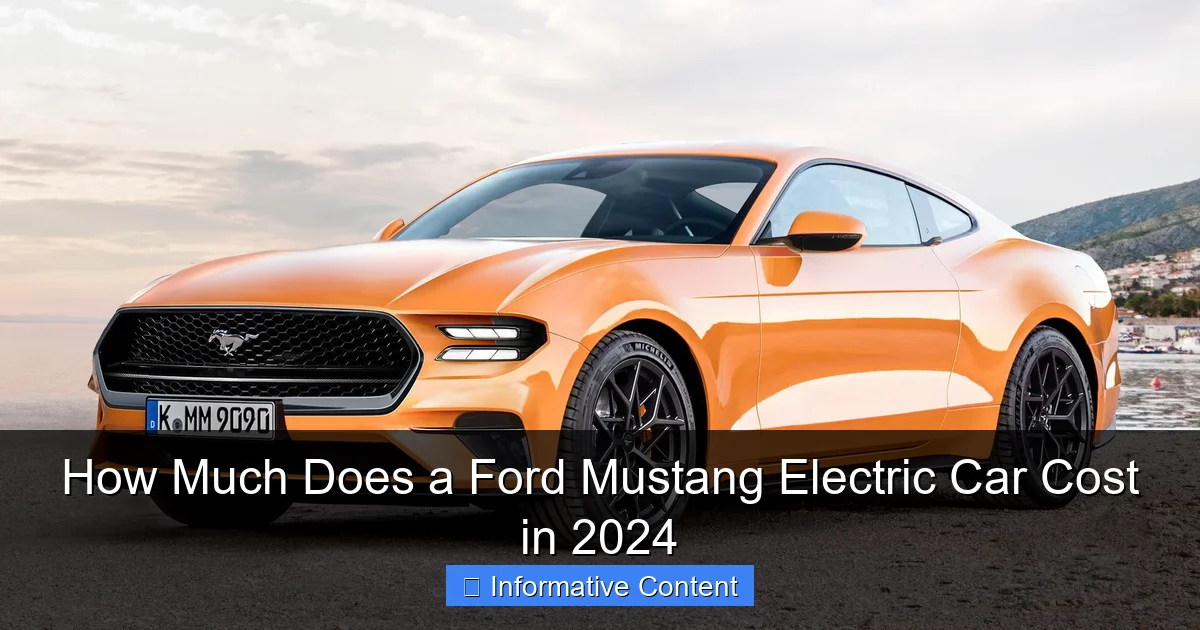
Featured image for how much does a ford mustang electric car cost
Image source: cargeeks.net
The 2024 Ford Mustang Mach-E starts at $42,995, offering an affordable entry into electric performance with trim levels scaling up to $58,000+ for premium features. With federal tax credits potentially slashing costs by $7,500, it’s a compelling blend of power, range, and value.
Key Takeaways
- Base price starts at $42,995 for the 2024 Ford Mustang Mach-E Select trim.
- Premium trims exceed $60,000 with added features like AWD and extended range.
- Federal tax credits up to $7,500 may reduce cost if eligibility criteria are met.
- Charging equipment costs extra; factor in home installation for convenience.
- Lease options start around $399/month with qualifying credit and incentives.
- Resale value remains strong due to high demand and brand loyalty.
📑 Table of Contents
- The Electric Mustang That’s Turning Heads (and Wallets)
- 2024 Ford Mustang Mach-E: Base Price and Trim Levels
- Hidden Costs: Beyond the Sticker Price
- Federal and State Incentives: How Much Can You Save?
- Long-Term Costs: Maintenance, Depreciation, and Resale Value
- Comparing the Mach-E to Other Electric SUVs
- Final Thoughts: Is the Mach-E Worth the Cost?
The Electric Mustang That’s Turning Heads (and Wallets)
Remember the first time you heard a Ford Mustang roar to life? That deep, throaty growl, the kind that sends chills down your spine. Now, imagine that same legendary performance—but without a single drop of gasoline. That’s the Ford Mustang Mach-E, the electric car that’s redefining what a Mustang can be. It’s not just about swapping an engine for a battery; it’s about reimagining the driving experience for the 21st century. And if you’re here, you’re probably asking the big question: How much does a Ford Mustang electric car cost in 2024?
Let’s be real: electric vehicles (EVs) can feel like a mystery. Prices vary, tax credits change, and trim levels multiply faster than you can say “range anxiety.” But here’s the good news: the Mach-E is more than just a cool-looking EV. It’s a practical, powerful, and (relatively) affordable way to go electric without giving up the Mustang nameplate. Whether you’re a longtime Mustang fan curious about the future or a first-time EV buyer looking for style and substance, this guide will walk you through every cost—from sticker price to long-term savings. Think of this as the honest, no-fluff breakdown you’d get from a friend who’s already made the leap to electric.
2024 Ford Mustang Mach-E: Base Price and Trim Levels
What’s the Starting Price in 2024?
Let’s cut to the chase: the 2024 Ford Mustang Mach-E starts at $39,995 before any incentives or fees. That’s for the base Select trim with rear-wheel drive (RWD) and the standard 70 kWh battery. For many, this is the entry point—a solid balance of price and performance. But here’s the thing: Mustang fans know that “base” rarely means “basic.” Even the Select trim comes with a 10.2-inch digital cluster, a 15.5-inch touchscreen with SYNC 4A, LED lighting, and Ford’s Co-Pilot360 suite of safety features. It’s not stripped down—it’s streamlined.
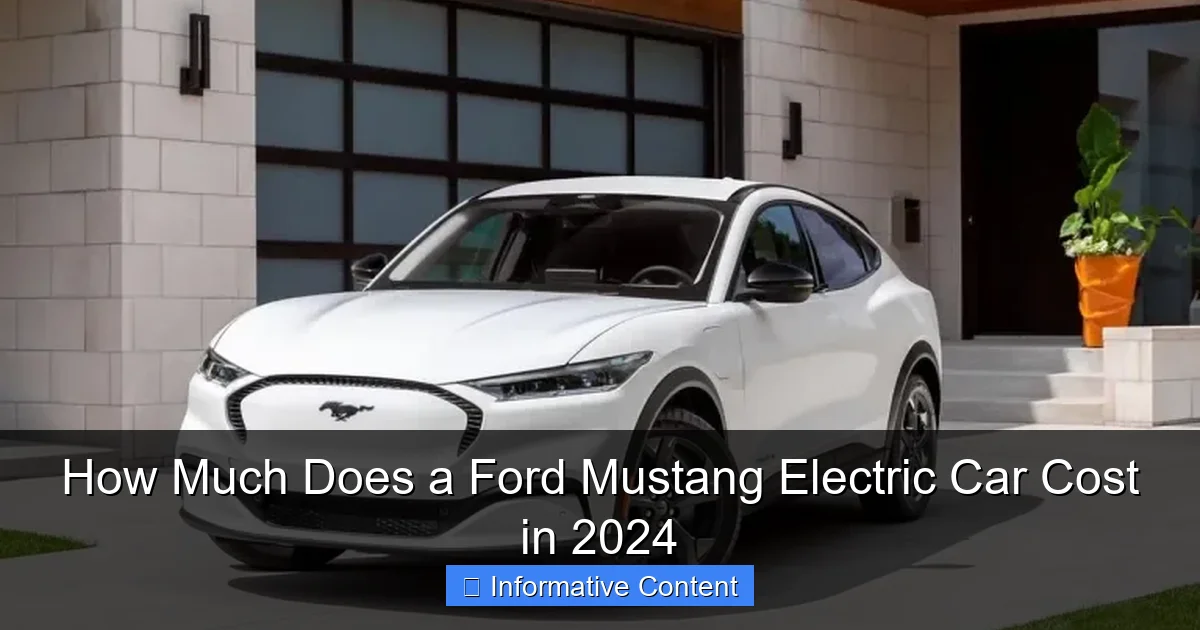
Visual guide about how much does a ford mustang electric car cost
Image source: motorbiscuit.com
Now, let’s talk about what you’re really paying for. The Mach-E isn’t just a Mustang with a battery. It’s a reimagined Mustang. The design? Sleek, coupe-like, with a fastback roofline that screams “Mustang” even without the V8 rumble. The interior? Modern, tech-heavy, and surprisingly spacious—especially in the rear seats. And the performance? With 266 horsepower and 317 lb-ft of torque, the base model can hit 60 mph in around 6 seconds. Not bad for an SUV-shaped electric car.
Breaking Down the 2024 Trim Levels
Ford offers five trim levels for the 2024 Mach-E, each with its own personality and price tag. Here’s how they stack up:
- Select ($39,995): The entry-level model. RWD, 70 kWh battery, 247 miles of EPA-estimated range. Great for city driving and short commutes.
- Premium ($44,995): Adds comfort and convenience—heated front seats, a hands-free liftgate, ambient lighting, and the option for all-wheel drive (AWD) and the larger 91 kWh battery (300+ miles range).
- California Route 1 ($48,995): Focused on range and efficiency. AWD, 91 kWh battery, 312 miles range. Named after the Pacific Coast Highway for a reason—it’s built for long road trips.
- GT ($59,995): The performance beast. AWD, 480 horsepower, 634 lb-ft torque, 0-60 mph in 3.8 seconds. Includes sport-tuned suspension, 20-inch wheels, and a unique front fascia.
- GT Performance Edition ($63,995): The top dog. Adds MagneRide damping, performance brakes, and a sport-tuned interior. For those who want track-day thrills without the gas pump.
Pro tip: If you’re on a budget, the Select is surprisingly capable. But if you live in a snowy area or want more range, the Premium with AWD and the extended battery ($52,995) is a sweet spot. It’s not the cheapest, but it’s the most balanced.
Real-World Example: Choosing the Right Trim
Take Sarah, a 32-year-old graphic designer in Chicago. She drives 40 miles a day, has a garage for charging, and wants a car that looks good and handles winter. She started at the Select but realized she needed AWD for snowy roads. She also wanted more range for weekend trips to Michigan. So she went with the Premium AWD with extended battery. The total? Around $54,000 after options. “It’s more than I planned,” she said, “but the peace of mind and extra range are worth it.”
Hidden Costs: Beyond the Sticker Price
Taxes, Fees, and Delivery Charges
Let’s get real: the sticker price isn’t the final price. When you buy a new car, you’ll pay:
- Destination and delivery fee: $1,595 (standard for all Mach-E models).
- Sales tax: Varies by state. In California, it’s 7.25%; in Texas, it’s 6.25%. For a $50,000 car, that’s $3,625 to $4,562 extra.
- Registration and title fees: Usually $100-$300, depending on your state.
So, for a $50,000 Mach-E, you could easily add $5,000-$6,000 in fees and taxes. Always ask your dealer for a full breakdown before signing. And don’t forget: some states charge extra fees for EVs (yes, really). California, for example, has a $175 EV registration fee. It’s not much, but it’s another line item.
Charging: Home Installation vs. Public Networks
One of the biggest hidden costs? Charging. You’ll need a Level 2 home charger (240-volt) to charge efficiently. The Mach-E comes with a portable 120-volt charger, but it’s painfully slow—adding only 3-5 miles of range per hour. A Level 2 charger adds 20-30 miles per hour, which is much more practical.
- Charger cost: $500-$800 for a basic unit (like the Ford Connected Charge Station).
- Installation: $500-$2,000, depending on your home’s electrical setup. If you need a new circuit or panel upgrade, it gets expensive fast.
Tip: Check with your utility company. Many offer rebates for EV charger installation. In New York, for example, you can get up to $500 back. In Texas, some providers offer free chargers.
And what about public charging? The Mach-E uses the CCS (Combined Charging System) connector, which is widely available. But prices vary. A 30-minute DC fast charge (to 80%) might cost $15-$25, depending on the network and time of day. Apps like PlugShare or ChargePoint can help you find the cheapest options.
Insurance: EVs Can Be More Expensive
Here’s a shocker: EVs often cost more to insure. Why? They’re expensive to repair (especially with advanced tech like cameras and sensors), and their high performance can lead to higher premiums. For the Mach-E, expect to pay 10-20% more than a comparable gas-powered SUV. For example:
- A 2023 Ford Escape (similar size) might cost $1,500/year to insure.
- The Mach-E? Around $1,700-$1,800/year.
But don’t panic. Shop around. Some insurers offer EV-specific discounts (like for low emissions or safety features). And if you bundle with home insurance, you might save more.
Federal and State Incentives: How Much Can You Save?
The Federal Tax Credit: What’s the Deal?
As of 2024, the federal EV tax credit is up to $7,500—but with a catch. The credit is non-refundable, meaning you can only claim it if you owe at least $7,500 in federal taxes. And the credit is phased out for higher-income earners. If your modified adjusted gross income (MAGI) is over $150,000 (single) or $300,000 (married), you’re out of luck.
But here’s the good news: the Mach-E qualifies for the full $7,500 credit in 2024. Why? Because Ford uses North American-made batteries and meets the critical mineral requirements. This is a big deal—it effectively drops the base Select model to $32,495.
Important: You can’t get the credit at the dealership (like a rebate). You claim it when you file your taxes. But some dealers offer “tax credit transfers,” where they take the credit and apply it as a discount. Ask about this option.
State and Local Incentives: The Hidden Savings
States love EVs. Many offer their own incentives, and they can add up fast. Here are a few standouts:
- California: Up to $2,000 rebate (CVRP) for low- and middle-income buyers. Plus, HOV lane access (even with just one driver).
- Colorado: $5,000 tax credit for new EV purchases. Yes, $5,000—on top of the federal credit.
- New York: $2,000 rebate through the Drive Clean Rebate program.
- Texas: No state tax on EVs (saves about $1,000 on a $50,000 car).
Pro tip: Check the Alternative Fuels Data Center for a full list of incentives by state. And don’t forget local perks—some cities offer free parking for EVs or discounted charging.
Real-World Example: The Colorado Advantage
Meet David, a teacher in Denver. He bought a Mach-E Premium for $54,000. He qualified for the full $7,500 federal credit and Colorado’s $5,000 state credit. His total savings? $12,500. His out-the-door price? $41,500. “I was shocked,” he said. “I expected to pay $50K, not $41K.”
Long-Term Costs: Maintenance, Depreciation, and Resale Value
Maintenance: EVs Are Cheaper to Own
Here’s the fun part: EVs cost less to maintain. Why? No oil changes, no spark plugs, no exhaust systems. The Mach-E has fewer moving parts, which means fewer things to break. According to Consumer Reports, EVs cost about 50% less to maintain over 10 years than gas cars.
For the Mach-E, expect:
- Annual maintenance cost: $300-$500 (mostly tire rotations, brake inspections, and cabin air filter changes).
- Battery warranty: 8 years/100,000 miles (covers defects, not degradation).
Note: Brakes last longer in EVs because regenerative braking does most of the work. But tires can wear faster due to the Mach-E’s weight (over 4,000 lbs).
Depreciation and Resale Value
Let’s be honest: EVs depreciate fast. The Mach-E is no exception. After 3 years, it might retain 50-55% of its value, compared to 60-65% for a gas-powered Mustang. Why? The market is still adapting to EVs, and battery tech is evolving rapidly.
But there’s hope. The Mach-E’s strong brand recognition and Mustang nameplate help. And as charging infrastructure improves, resale values may stabilize. For now, if you plan to keep the car long-term, depreciation matters less. If you trade in every 3-5 years, it’s a bigger factor.
Fuel Savings: The Big Win
Gas prices are unpredictable. Electricity? More stable. On average, driving a Mach-E costs 3-4 cents per mile in electricity, compared to 10-12 cents for a gas car. For 12,000 miles a year, that’s $360-$480 in savings. Over 5 years? $1,800-$2,400.
Example: In California, where gas is $5/gallon, the savings are even bigger. A 30 mpg gas car costs $2,000/year in fuel. The Mach-E? Around $500/year (with home charging).
Comparing the Mach-E to Other Electric SUVs
Price vs. Range: How Does It Stack Up?
The Mach-E isn’t the only electric SUV in town. Let’s see how it compares to key rivals:
| Model | Base Price | Range (EPA) | 0-60 mph | Top Trim Price |
|---|---|---|---|---|
| Ford Mustang Mach-E | $39,995 | 247-312 miles | 3.8-6.1 sec | $63,995 |
| Tesla Model Y | $43,990 | 260-330 miles | 3.5-4.8 sec | $52,490 |
| Hyundai Ioniq 5 | $41,650 | 220-303 miles | 5.0-6.7 sec | $56,500 |
| Kia EV6 | $42,600 | 232-310 miles | 4.6-6.2 sec | $58,400 |
The Mach-E stands out for its Mustang branding, interior space, and balanced pricing. The Model Y has slightly better range and faster charging, but the Mach-E offers more rear-seat room and a more traditional SUV layout. The Ioniq 5 and EV6 have futuristic designs and ultra-fast charging, but their ride quality isn’t as refined.
Who Should Buy the Mach-E?
- Mustang fans: You get the name, the style, and the performance—without the gas.
- Families: The Mach-E has more cargo space (29.7 cu ft) than the Model Y (26.5 cu ft).
- First-time EV buyers: The tech is intuitive, and Ford’s dealer network is widespread.
Final Thoughts: Is the Mach-E Worth the Cost?
So, how much does a Ford Mustang electric car cost in 2024? The answer is: it depends. The base Select starts at $39,995, but most buyers will end up in the $45,000-$55,000 range after options, taxes, and fees. With incentives, you could knock $7,500-$12,500 off that—making it more affordable than it seems.
But cost isn’t just about the price tag. It’s about value. The Mach-E delivers on performance, range, and practicality. It’s not perfect—the infotainment system can be glitchy, and the ride can be stiff in the GT trims—but it’s a compelling package for anyone ready to go electric.
And here’s the best part: you’re not just buying a car. You’re buying into a future where performance doesn’t mean pollution, where innovation meets tradition. The Mach-E isn’t just a Mustang. It’s a statement. And in 2024, that statement might be the best deal on four wheels.
Frequently Asked Questions
How much does a Ford Mustang electric car cost in 2024?
The 2024 Ford Mustang Mach-E starts at $42,895 for the base Select trim, while higher trims like the GT Performance Edition can exceed $60,000. Pricing varies based on battery range, AWD, and added tech features.
What is the cheapest Ford Mustang electric car model?
The most affordable option is the 2024 Mustang Mach-E Select RWD, priced at $42,895 before incentives. It offers 247 miles of EPA-estimated range and standard tech like SYNC 4A infotainment.
Does the Ford Mustang Mach-E qualify for federal tax credits?
Yes, select 2024 Mach-E trims qualify for a $3,750 federal tax credit under current rules. Check local incentives, as some states offer additional rebates for EV buyers.
How much more expensive is the Mach-E GT than the base model?
The Mach-E GT starts at $58,995, about $16,100 more than the Select trim. The price jump includes dual-motor AWD, sport-tuned suspension, and 20-inch wheels.
Are there extra costs for extended battery range in the Mach-E?
Yes, upgrading from the standard 70kWh battery to the extended 91kWh pack adds $7,500–$8,000 depending on the trim. This boosts range to 290–310 miles for RWD models.
How does the Mustang Mach-E’s price compare to other electric SUVs?
The Mach-E is competitively priced against rivals like the Tesla Model Y ($45,000) and Hyundai Ioniq 5 ($41,650). Its blend of performance, range, and tech offers strong value in the mid-size EV segment.